
Inhaltsangabe
Named the #1 Bestselling Non-Fiction Title by the Calgary Herald
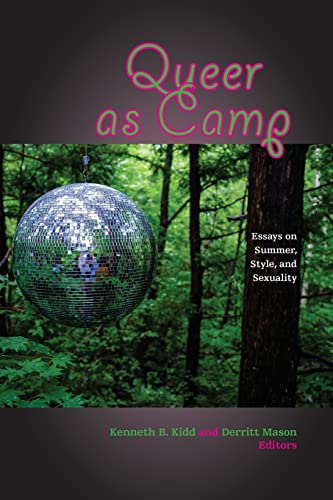
To camp means to occupy a place and/or time provisionally or under special circumstances. To camp can also mean to queer. And for many children and young adults, summer camp is a formative experience mixed with homosocial structure and homoerotic longing. In Queer as Camp, editors Kenneth B. Kidd and Derritt Mason curate a collection of essays and critical memoirs exploring the intersections of "queer" and "camp," focusing especially on camp as an alternative and potentially nonnormative place and/or time.
Exploring questions of identity, desire, and social formation, Queer as Camp delves into the diverse and queer-enabling dimensions of particular camp/sites, from traditional iterations of camp to camp-like ventures, literary and filmic texts about camp across a range of genres (fantasy, horror, realistic fiction, graphic novels), as well as the notorious appropriation of Indigenous life and the consequences of "playing Indian."
These accessible, engaging essays examine, variously, camp as a queer place and/or the experiences of queers at camp, including Vermont's Indian Brook, a single-sex girls' camp that has struggled with the inclusion of nonbinary and transgender campers and staff; the role of Jewish summer camp as a complicated site of sexuality, social bonding, and citizen-making as well as a potentially if not routinely queer-affirming place. They also attend to cinematic and literary representations of camp, such as the Eisner award-winning comic series Lumberjanes, which revitalizes and revises the century-old Girl Scout story; Disney's Paul Bunyan, a short film that plays up male homosociality and cross-species bonding while inviting queer identification in the process; Sleepaway Camp, a horror film that exposes and deconstructs anxieties about the gendered body; and Wes Anderson's critically acclaimed Moonrise Kingdom, which evokes dreams of escape, transformation, and other ways of being in the world.
Highly interdisciplinary in scope, Queer as Camp reflects on camp and Camp with candor, insight, and often humor.
Contributors: Kyle Eveleth, D. Gilson, Charlie Hailey, Ana M. Jimenez-Moreno, Kathryn R. Kent, Mark Lipton, Kerry Mallan, Chris McGee, Roderick McGillis, Tammy Mielke, Alexis Mitchell, Flavia Musinsky, Daniel Mallory Ortberg, Annebella Pollen, Andrew J. Trevarrow, Paul Venzo, Joshua Whitehead
Die Inhaltsangabe kann sich auf eine andere Ausgabe dieses Titels beziehen.
Über die Autorin bzw. den Autor
Kenneth B. Kidd (Edited By)
Kenneth B. Kidd is Professor of English at the University of Florida. He is the author of Making American Boys: Boyology and the Feral Tale and Freud in Oz: At the Intersections of Psychoanalysis and Children’s Literature. He is also co-editor (with Derritt Mason) of Queer as Camp: Essays on Summer, Style, and Sexuality (Fordham).
Derritt Mason (Edited By)
Derritt Mason is Assistant Professor of English at the University of Calgary.
Auszug. © Genehmigter Nachdruck. Alle Rechte vorbehalten.
Queer as Camp
Essays on Summer, Style, and Sexuality
By Kenneth B. Kidd, Derritt MasonFordham University Press
Copyright © 2019 Fordham University Press
All rights reserved.
ISBN: 978-0-8232-8360-6All rights reserved.
Contents
Preface CHARLIE HAILEY, vii,
Camping Out: An Introduction KENNETH B. KIDD AND DERRITT MASON, 1,
Notes Home from Camp, by Susan Sontag DANIEL MALLORY ORTBERG, 000,
Part I CAMP SITES,
"The most curious" of all "queer societies"? Sexuality and Gender in British Woodcraft Camps, 1916-2016 ANNEBELLA POLLEN, 000,
Queer Pedagogy at Indian Brook Camp FLAVIA MUSINSKY, 000,
"No Trespassing": Girl Scout Camp and the Limits of the Counterpublic Sphere KATHRYN R. KENT, 000,
Nation-Bonding: Sexuality and the State in the Jewish Summer Camp ALEXIS MITCHELL, 000,
Notes on Church Camp D. GILSON, 000,
Queer at Camp: A Selected Assemblage of Resistance and HopeMark Lipton, 000,
The Camping Ground "Down Under": Queer Interpretations of the Australian Summer Holiday PAUL VENZO, 000,
Part II Camp Stories,
Camping with Walt Disney's Paul Bunyan: An Essay Short TAMMY L. MIELKE AND ANDREW TREVARROW, 000,
Illegal Citizen: The Japanese-American Internment Camp in Soon-Teck Oh's Tondemonai-Never Happen! ANA M. JIMENEZ MORENO, 000,
Why Angela Won't Go Swimming: Sleepaway Camp, Slasher Films, and Summer Camp Horrors CHRIS MCGEE, 000,
Striking Camp: Empowerment and Re-Presentation in Lumberjanes KYLE EVELETH, 000,
Escape to Moonrise Kingdom: Let's Go Camping! KERRY MALLAN AND RODERICK MCGILLIS, 000,
"Finding We'Wha": Indigenous Idylls in Queer Young Adult Literature JOSHUA WHITEHEAD, 000,
Acknowledgments, 000,
Works Cited, 000,
List of Contributors, 000,
Index, 000,
CHAPTER 1
"The most curious" of all "queer societies"? Sexuality and Gender in British Woodcraft Camps, 1916–2016
Annebella Pollen
In the years during and after the Great War, disaffected with the apparent militarism and imperialism of Boy Scouts, British pacifists established rival outdoor youth organizations. These new organizations returned to some of the founding ideas of Scouting in the form of the "woodcraft" system of outdoor education pioneered at the turn of the twentieth century by Ernest Thompson Seton and latterly absorbed into Baden-Powell's organization. To these ideas each of the new organizations — the Order of Woodcraft Chivalry, the Kindred of the Kibbo Kift, and Woodcraft Folk — added their own distinctive philosophies, drawing on psychology, spirituality, art and politics, to provide idiosyncratic camping experiences across genders and ages. Camp in this context was more than leisure, and more than an escape from encroaching industrialization — it was a personally and socially trans- formative space, rich with utopian possibility.
The British woodcraft movement's subversions represent a distinctive and elaborate queering of the Boy Scout ideal. Through their futurist visions and revivalist performances, members acted out their radical ideals for a hybrid new/old world. Alongside these activities, each group developed detailed and sometimes unorthodox ideas about "sex instruction" and "sex equality" interlinked with complex theories of camping. As such, new ideas about social relationships ran through woodcraft organizations' vision and were played out under canvas. In the temporary worlds of primitivist camps in the heady period of change after the Great War, alternatives to so-called civilized life could be tried on for size. Gender and sexuality became prime sites where the limits of experimental practices were tested and contested, and aspects of these challenges continue in the organizations' twenty-first century manifestations.
Through an investigation of woodcraft theories and practices, this essay examines the movement as a case study of oppositional ideals in the interwar period, when camping and experiments in living intertwined. While woodcraft organizations in Britain have always been much smaller in scale than numbers of Scouts and Guides, and their founding ideas were far from mainstream, their position as aspiring cultural revolutionaries meant that they inhabited a space — literally and figuratively — as outsiders. This essay presents views from the three most prominent woodcraft organizations, each founded during or shortly after the Great War. The Order of Woodcraft Chivalry was the first pacifist coeducational breakaway from Scouts. Founded in 1916, it was at its most productive in the 1920s and 1930s with public projects including the progressive Forest School for children and Grith Fyrd craft training camp for unemployed men. The organization recently celebrated its centenary; it is now a very small cluster of descendants of early members. The flamboyant, artistic Kindred of the Kibbo Kift was established as an all-ages, mixed-gender alternative to Scouts in 1920 but only lasted just over a decade as a woodcraft organiza- tion before being radically remodeled into an economic campaign group (The Green Shirts) and latterly a short-lived political party (The Social Credit Party of Great Britain and Ireland). Finally, Woodcraft Folk was founded in 1925 following a schism in Kibbo Kift over political direction; it continues to thrive as an outdoor-focused and democratic organization with around 15,000 adult and child members in groups spread across the United Kingdom.
Camping as an Oppositional Practice
Camping may seem to be an innocuous leisure activity, merely providing a low-budget holiday; as such, it could be of little social or political consequence. Yet camping has also been described as essentially socialist in character. In G. A. Cohen's analysis, as a system based on collective property and mutual giving, camping demonstrates in miniature "that society-wide socialism is equally feasible and equally desirable" (11). Camps are clearly diverse in their organization and ideologies, but they have nevertheless been characterized as extraordinary and exceptional places; as philosopher Giorgio Agamben has put it, the camp is "a piece of land placed outside the normal juridical order" (1). For their capacity to stand outside conventional social structures, camps have become utilized for protest and as sites where the building blocks of society can be symbolically deconstructed and remade. Angela Feigenbaum, Fabian Frenzel, and Patrick McCurdy, for example, have argued that the collective nature of camps has been particularly effective in forging "communities of understanding." In their conception, camp is a "unique structural, spatial and temporal form that shapes those who live, work, play and create within it" (8). A further essential aspect of camp — its transitory nature — necessarily results in a shift in everyday practices. To use the anarchist Hakim Bey's terminology, camps encapsulate a "temporary autonomous zone" where intentional com- munities can form "pirate utopias." The temporary nature of camping allows for the suspension of norms and the trying on of new worlds for size. As camping historian Matthew de Abaitua writes, "Camping promises nothing permanent. It is a way of trafficking between what was and what could yet be" (60).
The romantic promise of camping has long held an allure for reformers at odds with the modern world. Since the writings of Henry David Thoreau in the mid-nineteenth century, a substantial body of literature has been produced in Britain and America espousing the ostensibly moral value...
„Über diesen Titel“ kann sich auf eine andere Ausgabe dieses Titels beziehen.
Weitere beliebte Ausgaben desselben Titels

Suchergebnisse für Queer as Camp: Essays on Summer, Style, and Sexuality

Foto des Verkäufers
Queer as Camp: essays on Summer, style, and sexuality
Verlag:
Fordham University Press, 2019
ISBN 10: 0823283607
ISBN 13: 9780823283606
Gebraucht
Softcover
Anbieter: Cotswold Internet Books, Cheltenham, Vereinigtes Königreich
Verkäuferbewertung 5 von 5 Sternen

Zustand: Used - Very Good. VG paperback. Proof copy. Appears unread. Artikel-Nr. BOOKS266201I
Gebraucht kaufen
EUR 15,10
EUR 16,42 Versand
Versand von Vereinigtes Königreich nach USA
Versand von Vereinigtes Königreich nach USA
Anzahl: 1 verfügbar
Beispielbild für diese ISBN
Queer as Camp: Essays on Summer, Style, and Sexuality
Verlag:
Fordham University Press, 2019
ISBN 10: 0823283607
ISBN 13: 9780823283606
Gebraucht
Paperback
Anbieter: ThriftBooks-Atlanta, AUSTELL, GA, USA
Verkäuferbewertung 5 von 5 Sternen
Paperback. Zustand: Very Good. No Jacket. May have limited writing in cover pages. Pages are unmarked. ~ ThriftBooks: Read More, Spend Less. Artikel-Nr. G0823283607I4N00
Gebraucht kaufen
EUR 32,45
Versand gratis
Versand innerhalb von USA
Versand innerhalb von USA
Anzahl: 1 verfügbar
Beispielbild für diese ISBN
Queer As Camp
Anbieter: PBShop.store UK, Fairford, GLOS, Vereinigtes Königreich
Verkäuferbewertung 5 von 5 Sternen
PAP. Zustand: New. New Book. Shipped from UK. Established seller since 2000. Artikel-Nr. FW-9780823283606
Neu kaufen
EUR 33,42
EUR 4,88 Versand
Versand von Vereinigtes Königreich nach USA
Versand von Vereinigtes Königreich nach USA
Anzahl: 15 verfügbar
Beispielbild für diese ISBN
Queer as Camp Essays on Summer, Style, and Sexuality
Anbieter: Revaluation Books, Exeter, Vereinigtes Königreich
Verkäuferbewertung 5 von 5 Sternen
Paperback. Zustand: Brand New. 278 pages. 9.00x6.00x0.75 inches. In Stock. Artikel-Nr. __0823283607
Neu kaufen
EUR 35,12
EUR 11,73 Versand
Versand von Vereinigtes Königreich nach USA
Versand von Vereinigtes Königreich nach USA
Anzahl: 2 verfügbar
Beispielbild für diese ISBN
Queer as Camp: Essays on Summer, Style, and Sexuality
Anbieter: Majestic Books, Hounslow, Vereinigtes Königreich
Verkäuferbewertung 4 von 5 Sternen

Zustand: New. pp. 256. Artikel-Nr. 370332812
Neu kaufen
EUR 40,06
EUR 7,62 Versand
Versand von Vereinigtes Königreich nach USA
Versand von Vereinigtes Königreich nach USA
Anzahl: 3 verfügbar
Beispielbild für diese ISBN
Queer as Camp: Essays on Summer, Style, and Sexuality
Anbieter: Kennys Bookstore, Olney, MD, USA
Verkäuferbewertung 5 von 5 Sternen
Zustand: New. 2019. 1st Edition. Paperback. . . . . . Books ship from the US and Ireland. Artikel-Nr. V9780823283606
Neu kaufen
EUR 44,63
EUR 9,19 Versand
Versand innerhalb von USA
Versand innerhalb von USA
Anzahl: Mehr als 20 verfügbar