
Verwandte Artikel zu The Unconstructable Earth: An Ecology of Separation...
Inhaltsangabe
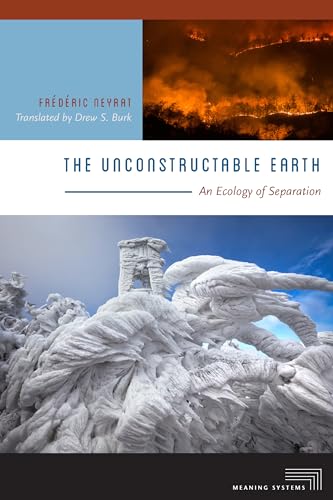
This book contributes to the environmental humanities field by offering an analysis of the Anthropocene fantasy: the idea that the Anthropocene is an opportunity to remake our terrestrial environment thanks to the power of technology. The author argues that the earth always escapes the human desire to remake and master it.
Die Inhaltsangabe kann sich auf eine andere Ausgabe dieses Titels beziehen.
Über die Autorin bzw. den Autor
Frédéric Neyrat (Author)
Frederic Neyrat is Associate Professor of Comparative Literature at University of Wisconsin-Madison. He is editor of Alienocene, an online journal that charts the environmental humanities and contemporary theory. His first book in English (following thirteen in French) is Atopias: Manifesto for a Radical Existentialism (Fordham, 2018).
Drew S. Burk (Translator)
Drew S. Burk is the translator of more than dozen books in continental philosophy and theory.
Von der hinteren Coverseite
“A vitally important book that stakes out a new position in the environmental humanities. This is not a book of policy recommendations, but rather of basic foundational concerns that any actually policy will have to address and to be answerable to.”—Steven Shaviro, Wayne State University
“This is a book of great interest that addresses a topic of considerable concern among environmentalists in North America and Western Europe today—how to find a third way between ‘eco-modernism’ and an organic and holistic nature.”—Ursula Heise, UCLA
“An unflinching critique of geoengineering, this book offers hope in a sliver of uncolonized, unmapped, unconstructed space and time, amid the super-storms of ideology, the teleology of historicism, and the bad faith of political actors with vested interests. Planet earth is not an object or a subject, but a trajectory in time and space toward anti-production, entropy, perhaps extinction—cause for a new political ecology in the time of 400+ ppm of C02.”—Karen Pinkus, Cornell University
The Anthropocene has both described and rendered a post-natural planet that can be remade at will through the prowess of geoengineering. This new imaginary is accompanied by a new kind of power—geopower—that takes the entire Earth, in its social, biological and geophysical dimensions, as an object of knowledge, intervention, and governmentality.
Not merely the fruit of geo-capitalism, this new grand narrative has also been activated by theorists of the constructivist turn—ecomodernist, postenvironmentalist, accelerationist—who have likewise called into question the divide between nature and culture. Denying all otherness to the Earth by internalizing nature, constructivist ecology thus finds itself unable to confront the geoconstructivist denial of nature and its attendant project to replace Earth with Earth 2.0.
Against both positions, Neyrat stakes out the importance of the unconstructable Earth, proposing an “ecology of separation” that acknowledges the wild, subtractive capacity of nature. Against the technocratic delusion of a constructible Earth, but equally against an organicism marked by unacknowledged traces of racism and sexism, Neyrat shows what it means to appreciate Earth as an unsubstitutable becoming: a traject that cannot be replicated in a laboratory. Underway for billions of years, withdrawing into the most distant past and the most inaccessible future, Earth escapes the hubris of all who would remake and master it.
Frederic Neyrat is Associate Professor of Comparative Literature at University of Wisconsin-Madison.
Drew S. Burk is the translator of more than dozen books in continental philosophy and theory.
Aus dem Klappentext
A vitally important book that stakes out a new position in the environmental humanities. This is not a book of policy recommendations, but rather of basic foundational concerns that any actually policy will have to address and to be answerable to. Steven Shaviro, Wayne State University
This is a book of great interest that addresses a topic of considerable concern among environmentalists in North America and Western Europe today how to find a third way between eco-modernism and an organic and holistic nature. Ursula Heise, UCLA
An unflinching critique of geoengineering, this book offers hope in a sliver of uncolonized, unmapped, unconstructed space and time, amid the super-storms of ideology, the teleology of historicism, and the bad faith of political actors with vested interests. Planet earth is not an object or a subject, but a trajectory in time and space toward anti-production, entropy, perhaps extinction cause for a new political ecology in the time of 400+ ppm of C02. Karen Pinkus, Cornell University
The Anthropocene has both described and rendered a post-natural planet that can be remade at will through the prowess of geoengineering. This new imaginary is accompanied by a new kind of power geopower that takes the entire Earth, in its social, biological and geophysical dimensions, as an object of knowledge, intervention, and governmentality.
Not merely the fruit of geo-capitalism, this new grand narrative has also been activated by theorists of the constructivist turn ecomodernist, postenvironmentalist, accelerationist who have likewise called into question the divide between nature and culture. Denying all otherness to the Earth by internalizing nature, constructivist ecology thus finds itself unable to confront the geoconstructivist denial of nature and its attendant project to replace Earth with Earth 2.0.
Against both positions, Neyrat stakes out the importance of the unconstructable Earth, proposing an ecology of separation that acknowledges the wild, subtractive capacity of nature. Against the technocratic delusion of a constructible Earth, but equally against an organicism marked by unacknowledged traces of racism and sexism, Neyrat shows what it means to appreciate Earth as an unsubstitutable becoming: a traject that cannot be replicated in a laboratory. Underway for billions of years, withdrawing into the most distant past and the most inaccessible future, Earth escapes the hubris of all who would remake and master it.
Frederic Neyrat is Associate Professor of Comparative Literature at University of Wisconsin-Madison.
Drew S. Burk is the translator of more than dozen books in continental philosophy and theory.
„Über diesen Titel“ kann sich auf eine andere Ausgabe dieses Titels beziehen.
Suchergebnisse für The Unconstructable Earth: An Ecology of Separation...

Beispielbild für diese ISBN
The Unconstructable Earth: An Ecology of Separation
Verlag:
Fordham University Press, 2018
ISBN 10: 0823282570
ISBN 13: 9780823282579
Gebraucht
Paperback
Anbieter: ThriftBooks-Atlanta, AUSTELL, GA, USA
Verkäuferbewertung 5 von 5 Sternen

Paperback. Zustand: Good. No Jacket. Pages can have notes/highlighting. Spine may show signs of wear. ~ ThriftBooks: Read More, Spend Less. Artikel-Nr. G0823282570I3N00
Gebraucht kaufen
EUR 27,64
Versand gratis
Versand innerhalb von USA
Versand innerhalb von USA
Anzahl: 1 verfügbar
Beispielbild für diese ISBN
The Unconstructable Earth
Anbieter: PBShop.store UK, Fairford, GLOS, Vereinigtes Königreich
Verkäuferbewertung 5 von 5 Sternen
PAP. Zustand: New. New Book. Shipped from UK. Established seller since 2000. Artikel-Nr. FW-9780823282579
Neu kaufen
EUR 30,15
EUR 4,92 Versand
Versand von Vereinigtes Königreich nach USA
Versand von Vereinigtes Königreich nach USA
Anzahl: 15 verfügbar
Beispielbild für diese ISBN
The Unconstructable Earth: An Ecology of Separation (Meaning Systems)
Anbieter: Majestic Books, Hounslow, Vereinigtes Königreich
Verkäuferbewertung 4 von 5 Sternen

Zustand: New. pp. 256. Artikel-Nr. 381871329
Neu kaufen
EUR 40,82
EUR 7,69 Versand
Versand von Vereinigtes Königreich nach USA
Versand von Vereinigtes Königreich nach USA
Anzahl: 3 verfügbar
Beispielbild für diese ISBN
The Unconstructable Earth: An Ecology of Separation (Meaning Systems)
Anbieter: Ria Christie Collections, Uxbridge, Vereinigtes Königreich
Verkäuferbewertung 5 von 5 Sternen
Zustand: New. In English. Artikel-Nr. ria9780823282579_new
Neu kaufen
EUR 38,74
EUR 11,09 Versand
Versand von Vereinigtes Königreich nach USA
Versand von Vereinigtes Königreich nach USA
Anzahl: Mehr als 20 verfügbar
Beispielbild für diese ISBN
The Unconstructable Earth: An Ecology of Separation
Anbieter: Kennys Bookstore, Olney, MD, USA
Verkäuferbewertung 5 von 5 Sternen
Zustand: New. 2018. 1st Edition. Paperback. . . . . . Books ship from the US and Ireland. Artikel-Nr. V9780823282579
Neu kaufen
EUR 45,63
EUR 9,36 Versand
Versand innerhalb von USA
Versand innerhalb von USA
Anzahl: Mehr als 20 verfügbar
Beispielbild für diese ISBN
The Unconstructable Earth An Ecology of Separation
Anbieter: Revaluation Books, Exeter, Vereinigtes Königreich
Verkäuferbewertung 5 von 5 Sternen
Paperback. Zustand: Brand New. translation edition. 230 pages. 9.00x6.00x0.75 inches. In Stock. Artikel-Nr. x-0823282570
Neu kaufen
EUR 57,06
EUR 11,84 Versand
Versand von Vereinigtes Königreich nach USA
Versand von Vereinigtes Königreich nach USA
Anzahl: 2 verfügbar
Foto des Verkäufers
The Unconstructable Earth | An Ecology of Separation
Anbieter: preigu, Osnabrück, Deutschland
Verkäuferbewertung 5 von 5 Sternen
Taschenbuch. Zustand: Neu. The Unconstructable Earth | An Ecology of Separation | Frédéric Neyrat | Taschenbuch | Einband - flex.(Paperback) | Englisch | 2018 | Fordham University Press | EAN 9780823282579 | Verantwortliche Person für die EU: Mare Nostrum Group B.V., Doelen 72, 4831 GR BREDA, NIEDERLANDE, gpsr[at]mare-nostrum[dot]co[dot]uk | Anbieter: preigu. Artikel-Nr. 112478652
Neu kaufen
EUR 34,70
EUR 70,00 Versand
Versand von Deutschland nach USA
Versand von Deutschland nach USA
Anzahl: 5 verfügbar