
Verwandte Artikel zu Out of the Ordinary: A Life of Gender and Spiritual...
Inhaltsangabe
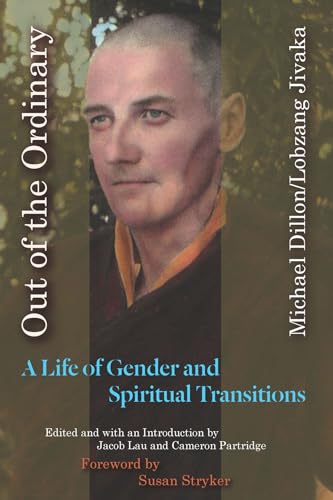
Now available for the first time—more than 50 years after it was written—is the memoir of Michael Dillon/Lobzang Jivaka (1915–62), the British doctor and Buddhist monastic novice chiefly known to scholars of sex, gender, and sexuality for his pioneering transition from female to male between 1939 and 1949, and for his groundbreaking 1946 book Self: A Study in Ethics and Endocrinology. Here at last is Dillon/Jivaka’s extraordinary life story told in his own words.
Out of the Ordinary captures Dillon/Jivaka’s various journeys—to Oxford, into medicine, across the world by ship—within the major narratives of his gender and religious journeys. Moving chronologically, Dillon/Jivaka begins with his childhood in Folkestone, England, where he was raised by his spinster aunts, and tells of his days at Oxford immersed in theology, classics, and rowing. He recounts his hormonal transition while working as an auto mechanic and fire watcher during World War II and his surgical transition under Sir Harold Gillies while Dillon himself attended medical school. He details his worldwide travel as a ship’s surgeon in the British Merchant Navy with extensive commentary on his interactions with colonial and postcolonial subjects, followed by his “outing” by the British press while he was serving aboard The City of Bath.
Out of the Ordinary is not only a salient record of an early sex transition but also a unique account of religious conversion in the mid–twentieth century. Dillon/Jivaka chronicles his gradual shift from Anglican Christianity to the esoteric spiritual systems of George Gurdjieff and Peter Ouspensky to Theravada and finally Mahayana Buddhism. He concludes his memoir with the contested circumstances of his Buddhist monastic ordination in India and Tibet. Ultimately, while Dillon/Jivaka died before becoming a monk, his novice ordination was significant: It made him the first white European man to be ordained in the Tibetan Buddhist tradition.
Out of the Ordinary is a landmark publication that sets free a distinct voice from the history of the transgender movement.
Die Inhaltsangabe kann sich auf eine andere Ausgabe dieses Titels beziehen.
Über die Autorinnen und Autoren
Michael Dillon/Lobzang Jivaka (1915-62) was an English physician, the first female-to-male post-operative transsexual, and a Buddhist monastic novice.
Jacob Lau is a University of California President's Postdoctoral Fellow in Film and Media Studies at the University of California, Irvine.
Cameron Partridge is a Lecturer at Harvard Divinity School.
Susan Stryker is Associate Professor of Gender and Women's Studies at the University of Arizona. She has written and edited several books including, most recently, Transgender History.
Michael Dillon/Lobzang Jivaka (Author)
Michael Dillon/Lobzang Jivaka (1915–62) was an English physician, the first female-to-male post-operative transsexual, and a Buddhist monastic novice.
Jacob Lau (Edited By)
Jacob Lau is a Carolina Postdoctoral Fellow through the Program for Faculty Diversity in the Women's and Gender Studies Department at The University of North Carolina at Chapel Hill.
Cameron Partridge (Edited By)
Cameron Partridge is an Episcopal priest, theologian, scholar of trans and religious studies, and an openly transgender man. He has taught at Harvard University, Harvard Divinity School and Episcopal Divinity School and is currently the rector of St. Aidan's Episcopal Church in San Francisco.
Susan Stryker (Foreword By)
Susan Stryker is Associate Professor of Gender and Women’s Studies at the University of Arizona. She has written and edited several books including, most recently, Transgender History.
Auszug. © Genehmigter Nachdruck. Alle Rechte vorbehalten.
Out of the Ordinary
A Life of Gender and Spiritual Transitions
By Michael Dillon, Lobzang Jivaka, Jacob Lau, Cameron PartridgeFordham University Press
Copyright © 2017 The Estate of Michael Dillon
All rights reserved.
ISBN: 978-0-8232-7480-2All rights reserved.
Contents
Foreword by Susan Stryker,
Editors' Note,
"In His Own Way, In His Own Time": An Introduction to Out of the Ordinary,
Out of the Ordinary,
Author's Introduction,
Part I. Conquest of the Body,
1. Birth and Origins,
2. The Nursery,
3. Schooldays,
4. Oxford,
5. War—The Darkest of Days,
Part II. Conquest of the Mind,
6. Medical Student,
7. Resident Medical Officer,
8. Surgeon M.N.,
9. On the Haj,
10. Round the World,
11. Interlude Ashore,
12. The Last Voyage,
13. Imji Getsul,
Michael Dillon / Lobzang Jivaka: A Timeline,
Acknowledgments,
CHAPTER 1
Birth and Origins
I was born on May 1, 1915, in a nursing home in Ladbroke Grove in the borough of Kensington. The nursing home is no longer in existence but one can still read "Ladbroke Grove" on the front of some of the London buses. Although never having gone with one to its destination, I have often had the urge to see the area whereon my eyes first rested, changed though undoubtedly it must be by now. I had been preceded fifteen months before by a brother who had been a seven months baby. He had caused his mother much trouble in labor and in anxiety for some time afterwards, since he was naturally delicate. Then, all too soon, I followed and after six or perhaps ten days she died, of puerperal sepsis it seems.
The vagueness of information on the whole matter is due to the fact that none of my family knew her. For some reason our father, who had not married until the age of forty-seven, never took his wife down to Folkestone where his aged parents were still alive and four of his sisters resident. Only one sister who happened to be staying at the time in London, and a niece of his, attended the wedding. The sister, our Aunt Evie to-be, said that our mother was a fine looking woman, big and handsome, and our cousin, Auntie Daphne, said that she was much addicted to playing bridge while carrying me and she had often wondered whether the baby would be a bridge player. Long before I ever knew of this I had expressed an intense dislike of bridge and would never learn to play it, thus saving myself much time and money in future days while I was at sea.
A further source of information was to come many, many years later from my mother's only surviving sister in Sydney, Australia, when I was a Merchant Navy Surgeon. But that must wait until it occurs in its chronological order. It was she who maintained that my mother lived for ten days and not six and that she died suddenly when almost on the point of leaving the nursing home.
Be that as it may, on our father's side we are Anglo-Irish and on our mother's side Australio-German. I always regretted the German, but what could one do about it? It seems that our maternal grandfather emigrated from Germany to Australia with his wife and family, but his wife, far from being German, too, was an Irish girl from Cork, so that the Irish blood runs the more thickly in our veins. He, too, had a large family, but of them all our mother alone showed signs of independence of spirit, abjuring the Catholic faith in which she had been brought up (as, indeed in time did several of her brothers and sisters), and determined to see what lay beyond the confines of Sydney Harbor.
Just under what circumstances a young lady in the first decade of this century could have managed to break away and go a-sailing off alone, has not been discovered, but it seems that she landed first in South Africa and there married a man named MacLiver who owned a ranch or a fruit farm or the like and was very happy with him. Then one day disaster overtook them. Her husband was entertaining a friend to lunch and wished to show off the fine points of a new pony he had acquired, for he was an enthusiastic horseman. The horse put its foot into a rabbit hole and threw its rider and to the horror of the wife and the guest watching from the verandah, rolled on its master, disemboweling him. At the time our mother-to-be was with child and the shock caused a miscarriage and long illness. It was after she had recovered from this that she left South Africa and came to England where she met our father in a boarding-house and it appears it was a case of love at first sight. Whether it was because she was technically a Roman Catholic whereas his family was rigidly Protestant, that prompted his not bringing her to meet his parents, I do not know. At any rate no better explanation has been offered.
Hence it was that, although other children were accustomed to having two families, in the shape of aunts and uncles, multiple grandparents and cousins, to us there was only one family and that was the Dillons. True, as children, we had an occasional letter to write to an aunt in Australia, the place which had swans on its stamps, but there was no connection in our minds between her and the other aunts who surrounded us from morning till night. And how that came about was as follows:
Our father, it appears, was somewhat of a weak character and had already ruined a promising career in the Royal Navy by drink which habit he was to keep through life, although possibly for the one year of a happy marriage, he may have abjured it. As it was he was completely demoralized by his wife's sudden and unexpected death and he blamed it on to me. He refused to so much as see me, but arranged with his favorite sister, who lived with her parents in Folkestone, to come to London and fetch the two babies and bring them up in the tall, six-storey house in Westbourne Gardens and he would contribute weekly to their upkeep. Employ a nanny and give them all they needed but keep them away from him, especially that new one! And so we came to Folkestone.
The atmosphere was Victorian, or at the best Edwardian, since two generations separated the new arrivals from the youngest of the resident aunts and at least four from our grandparents. Our grandfather was a fine character by all accounts and I lived with him for one year before he died at the age of ninety-six. I have ever since wished that I had been old enough to talk with him for his experience of the changing world must have been fascinating.
He was born in 1820 and followed the army as did many of his forebears. He lived in the days when commissions were bought and not earned and my brother still has the letters patent signed by Queen Victoria giving him his different ranks. He became a major in the Crimean War and after that decided it was time to retire and settle down to raise a family. So with the rank of Lieutenant Colonel he took to himself a young lady from Malta where he was, I believe, for a while Governor, whose name was Mills and who is the person remembered as "Granny." By her he had seven children, all but one of them girls, which accounts for the bevy of aunts that were to be ever present.
After Malta they had all gone to live in Brussels where the older girls were educated, learning it seemed little more than French, but our father was sent to school at Westward Ho! in Devon and was a schoolfellow of Rudyard Kipling. When they were in their teens they came to Folkestone and Toto became the belle of the ball held at Shorncliffe Garrison and, indeed, photographs show her as immensely attractive in her youth; but she was too "nervous" to...
„Über diesen Titel“ kann sich auf eine andere Ausgabe dieses Titels beziehen.
Suchergebnisse für Out of the Ordinary: A Life of Gender and Spiritual...

Beispielbild für diese ISBN
Out of the Ordinary: A Life of Gender and Spiritual Transitions
Verlag:
Fordham University Press, 2016
ISBN 10: 0823274802
ISBN 13: 9780823274802
Gebraucht
Hardcover
Anbieter: ThriftBooks-Dallas, Dallas, TX, USA
Verkäuferbewertung 5 von 5 Sternen

Hardcover. Zustand: Very Good. No Jacket. Former library book; May have limited writing in cover pages. Pages are unmarked. ~ ThriftBooks: Read More, Spend Less. Artikel-Nr. G0823274802I4N10
Gebraucht kaufen
EUR 19,61
Versand gratis
Versand innerhalb von USA
Versand innerhalb von USA
Anzahl: 1 verfügbar
Beispielbild für diese ISBN
Out of the Ordinary: A Life of Gender and Spiritual Transitions
Verlag:
Fordham University Press, 2016
ISBN 10: 0823274802
ISBN 13: 9780823274802
Gebraucht
Hardcover
Anbieter: Reuseabook, Gloucester, GLOS, Vereinigtes Königreich
Verkäuferbewertung 5 von 5 Sternen
hardcover. Zustand: Used; Very Good. Dispatched, from the UK, within 48 hours of ordering. Though second-hand, the book is still in very good shape. Minimal signs of usage may include very minor creasing on the cover or on the spine. Artikel-Nr. CHL10455934
Gebraucht kaufen
EUR 26,33
EUR 8,16 Versand
Versand von Vereinigtes Königreich nach USA
Versand von Vereinigtes Königreich nach USA
Anzahl: 1 verfügbar
Beispielbild für diese ISBN
Out of the Ordinary: A Life of Gender and Spiritual Transitions
Anbieter: Ria Christie Collections, Uxbridge, Vereinigtes Königreich
Verkäuferbewertung 5 von 5 Sternen
Zustand: New. In English. Artikel-Nr. ria9780823274802_new
Neu kaufen
EUR 48,89
EUR 13,16 Versand
Versand von Vereinigtes Königreich nach USA
Versand von Vereinigtes Königreich nach USA
Anzahl: Mehr als 20 verfügbar
Beispielbild für diese ISBN
Out of the Ordinary A Life of Gender and Spiritual Transitions
Anbieter: Revaluation Books, Exeter, Vereinigtes Königreich
Verkäuferbewertung 5 von 5 Sternen
Hardcover. Zustand: Brand New. 1st edition. 238 pages. 9.25x6.25x0.75 inches. In Stock. Artikel-Nr. x-0823274802
Neu kaufen
EUR 48,50
EUR 14,57 Versand
Versand von Vereinigtes Königreich nach USA
Versand von Vereinigtes Königreich nach USA
Anzahl: 2 verfügbar
Foto des Verkäufers
Out of the Ordinary: A Life of Gender and Spiritual Transitions
Verlag:
Fordham University Press, New York, 2017
ISBN 10: 0823274802
ISBN 13: 9780823274802
Gebraucht
Hardcover
Anbieter: The Book Merchant Jenkins, ANZAAB / ILAB, Brooks Bay, TAS, Australien
Verkäuferbewertung 5 von 5 Sternen
Hardcover. Zustand: New Book. Zustand des Schutzumschlags: New. Reprint. 23.5cm x 16cm. xi, 238 pages. Matte papered boards, pictorial jacket. "Now available for the first time--more than 50 years after it was written--is the memoir of Michael Dillon/Lobzang Jivaka (1915-62), the British doctor and Buddhist monastic novice chiefly known to scholars of sex, gender, and sexuality for his pioneering transition from female to male between 1939 and 1949, and for his groundbreaking 1946 book Self: A Study in Ethics and Endocrinology. Here at last is Dillon/Jivaka's extraordinary life story told in his own words. Out of the Ordinary captures Dillon/Jivaka's various journeys--to Oxford, into medicine, across the world by ship--within the major narratives of his gender and religious journeys. Moving chronologically, Dillon/Jivaka begins with his childhood in Folkestone, England, where he was raised by his spinster aunts, and tells of his days at Oxford immersed in theology, classics, and rowing. He recounts his hormonal transition while working as an auto mechanic and fire watcher during World War II and his surgical transition under Sir Harold Gillies while Dillon himself attended medical school. He details his worldwide travel as a ship's surgeon in the British Merchant Navy with extensive commentary on his interactions with colonial and postcolonial subjects, followed by his "outing" by the British press while he was serving aboard The City of Bath. Out of the Ordinary is not only a salient record of an early sex transition but also a unique account of religious conversion in the mid-twentieth century. Dillon/Jivaka chronicles his gradual shift from Anglican Christianity to the esoteric spiritual systems of George Gurdjieff and Peter Ouspensky to Theravada and finally Mahayana Buddhism. He concludes his memoir with the contested circumstances of his Buddhist monastic ordination in India and Tibet. Ultimately, while Dillon/Jivaka died before becoming a monk, his novice ordination was significant: It made him the first white European man to be ordained in the Tibetan Buddhist tradition. Out of the Ordinary is a landmark publication that sets free a distinct voice from the history of the transgender movement." (publisher's blurb) Multiple copies available this title. Category: Biography & Autobiography; Magic, Mysticism & the Occult; LGBTIQ+::Gender Diversity; LGBTIQ+. ISBN/EAN: 9780823274802. Inventory No: 0021510. Artikel-Nr. 0021510
Gebraucht kaufen
EUR 41,94
EUR 24,62 Versand
Versand von Australien nach USA
Versand von Australien nach USA
Anzahl: 2 verfügbar
Beispielbild für diese ISBN
Out of the Ordinary
Anbieter: Kennys Bookstore, Olney, MD, USA
Verkäuferbewertung 5 von 5 Sternen
Zustand: New. Out of the Ordinary is the memoir of Dr. Michael Dillon/ Lobzang Jivaka (1915-1962), a transsexual man and Buddhist monastic novice chiefly known to scholars of sex, gender and sexuality for his pioneering transition from female to male between 1939 and 1949, and for his groundbreaking 1946 book Self: A Study in Ethics and Endocrinology. Editor(s): Lau, Jacob. Num Pages: 256 pages, 12 b/w illustrations. BIC Classification: BGA; HRE; JFSJ5; MBD. Category: (G) General (US: Trade). Dimension: 231 x 150 x 23. Weight in Grams: 499. . 2016. Hardback. . . . . Books ship from the US and Ireland. Artikel-Nr. V9780823274802
Neu kaufen
EUR 61,22
EUR 9,23 Versand
Versand innerhalb von USA
Versand innerhalb von USA
Anzahl: 1 verfügbar
Foto des Verkäufers
Out of the Ordinary : A Life of Gender and Spiritual Transitions
Verlag:
Fordham University Press Nov 2016, 2016
ISBN 10: 0823274802
ISBN 13: 9780823274802
Neu
Hardcover
Anbieter: AHA-BUCH GmbH, Einbeck, Deutschland
Verkäuferbewertung 5 von 5 Sternen
Buch. Zustand: Neu. Neuware - Now available for the first time--more than 50 years after it was written--is the memoir of Michael Dillon/Lobzang Jivaka (1915-62), the British doctor and Buddhist monastic novice chiefly known to scholars of sex, gender, and sexuality for his pioneering transition from female to male between 1939 and 1949, and for his groundbreaking 1946 book Self: A Study in Ethics and Endocrinology. Here at last is Dillon/Jivaka's extraordinary life story told in his own words.Out of the Ordinary captures Dillon/Jivaka's various journeys--to Oxford, into medicine, across the world by ship--within the major narratives of his gender and religious journeys. Moving chronologically, Dillon/Jivaka begins with his childhood in Folkestone, England, where he was raised by his spinster aunts, and tells of his days at Oxford immersed in theology, classics, and rowing. He recounts his hormonal transition while working as an auto mechanic and fire watcher during World War II and his surgical transition under Sir Harold Gillies while Dillon himself attended medical school. He details his worldwide travel as a ship's surgeon in the British Merchant Navy with extensive commentary on his interactions with colonial and postcolonial subjects, followed by his 'outing' by the British press while he was serving aboard The City of Bath.Out of the Ordinary is not only a salient record of an early sex transition but also a unique account of religious conversion in the mid-twentieth century. Dillon/Jivaka chronicles his gradual shift from Anglican Christianity to the esoteric spiritual systems of George Gurdjieff and Peter Ouspensky to Theravada and finally Mahayana Buddhism. He concludes his memoir with the contested circumstances of his Buddhist monastic ordination in India and Tibet. Ultimately, while Dillon/Jivaka died before becoming a monk, his novice ordination was significant: It made him the first white European man to be ordained in the Tibetan Buddhist tradition.Out of the Ordinary is a landmark publication that sets free a distinct voice from the history of the transgender movement. Artikel-Nr. 9780823274802
Neu kaufen
EUR 50,60
EUR 35,00 Versand
Versand von Deutschland nach USA
Versand von Deutschland nach USA
Anzahl: 1 verfügbar
Foto des Verkäufers
Out of the Ordinary: A Life of Gender and Spiritual Transitions
Anbieter: moluna, Greven, Deutschland
Verkäuferbewertung 5 von 5 Sternen
Zustand: New. Out of the Ordinary is the memoir of Dr. Michael Dillon / Lobzang Jivaka (1915-1962) who transitioned from female to male between 1939 and 1949, became a ship s surgeon in the (British) Merchant Navy, and was a monastic novice in the Tibetan Buddhist tra. Artikel-Nr. 470865512
Neu kaufen
EUR 39,25
EUR 48,99 Versand
Versand von Deutschland nach USA
Versand von Deutschland nach USA
Anzahl: Mehr als 20 verfügbar