
Verwandte Artikel zu Logical Empiricism: Historical & Contemporary Perspectiv...
Inhaltsangabe
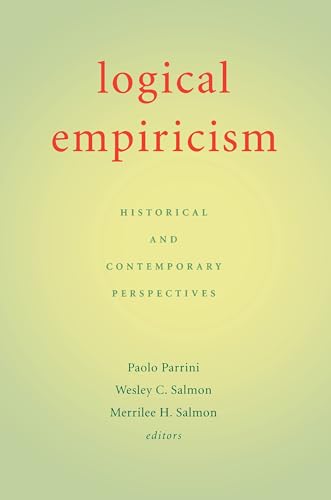
Logical empiricism, a program for the study of science that attempted to provide logical analyses of the nature of scientific concepts, the relation between evidence and theory, and the nature of scientific explanation, formed among the famed Vienna and Berlin Circles of the 1920s and '30s and dominated the philosophy of science throughout much of the twentieth century. In recent decades, a "post-positivist" philosophy, deriding empiricism and its claims in light of more recent historical and sociological discoveries, has been the ascendant mode of philosophy and other disciplines in the arts and sciences.This book features original research that challenges such broad oppositions. In eleven essays, leading scholars from many nations construct a more nuanced understanding of logical empiricism, its history, and development, offering promising implications for current philosophy of science debates.Tapping rich resources of unpublished material from archives in Haarlem, Konstanz, Pittsburgh, and Vienna, contributors conduct a deep investigation into the origins and development of the Vienna and Berlin Circles. They expose the roots of the philosophy in such varied sources as Cassirer, Poincaire, Husserl, Heidegger, and Wittgenstein. Important connections between the empiricists and other movements—neo-empiricism, British empiricism—are vigorously explored. Building on these historical studies, a critical reevaluation emerges that shrinks the distance between old and new philosophers of science, between "analytic" and "Continental" philosophy. A number of compelling recent debates, including those involving Kuhn, Feyerabend, Hesse, Glymour, and Hanson, are reopened to show the ways in which logical empiricist theory can still be validly applied.Logical Empiricism is the result of a remarkable conference, convened in the spirit of reflection and international cooperation, that took place in Florence, Italy, in 1999.
Die Inhaltsangabe kann sich auf eine andere Ausgabe dieses Titels beziehen.
Über die Autorin bzw. den Autor
Paolo Parrini, full professor of theoretical philosophy at the University of Florence and past president of the Italian Society of Analytical Philosophy, is the author of numerous works on epistemology, philosophy of science, and history of science.
Wesley C. Salmon was University Professor of Philosophy, Emeritus, at the University of Pittsburgh at the time of his death in 2001. He is best known for his work on scientific explanation and causation.
Merrilee H. Salmon, professor emerita of history and philosophy of science at the University of Pittsburgh, is the author of Introduction to Logic & Critical Thinking, Fourth Edition, and coauthor of Introduction to Philosophy of Science, among her many other publications.
„Über diesen Titel“ kann sich auf eine andere Ausgabe dieses Titels beziehen.
Suchergebnisse für Logical Empiricism: Historical & Contemporary Perspectiv...

Beispielbild für diese ISBN
Logical Empiricism
Anbieter: PBShop.store UK, Fairford, GLOS, Vereinigtes Königreich
Verkäuferbewertung 5 von 5 Sternen

PAP. Zustand: New. New Book. Shipped from UK. Established seller since 2000. Artikel-Nr. FW-9780822959496
Neu kaufen
EUR 64,13
EUR 5,92 Versand
Versand von Vereinigtes Königreich nach USA
Versand von Vereinigtes Königreich nach USA
Anzahl: 15 verfügbar
Beispielbild für diese ISBN
Logical Empiricism: Historical and Contemporary Perspectives
Verlag:
University of Pittsburgh Press, 2010
ISBN 10: 0822959496
ISBN 13: 9780822959496
Neu
Softcover
Anbieter: Ria Christie Collections, Uxbridge, Vereinigtes Königreich
Verkäuferbewertung 5 von 5 Sternen
Zustand: New. In English. Artikel-Nr. ria9780822959496_new
Neu kaufen
EUR 69,83
EUR 13,32 Versand
Versand von Vereinigtes Königreich nach USA
Versand von Vereinigtes Königreich nach USA
Anzahl: Mehr als 20 verfügbar
Beispielbild für diese ISBN
Logical Empiricism
Verlag:
University of Pittsburgh Press, 2010
ISBN 10: 0822959496
ISBN 13: 9780822959496
Neu
Softcover
Anbieter: Majestic Books, Hounslow, Vereinigtes Königreich
Verkäuferbewertung 4 von 5 Sternen

Zustand: New. pp. 408. Artikel-Nr. 7100131
Neu kaufen
EUR 77,28
EUR 7,67 Versand
Versand von Vereinigtes Königreich nach USA
Versand von Vereinigtes Königreich nach USA
Anzahl: 3 verfügbar
Beispielbild für diese ISBN
Logical Empiricism: Historical and Contemporary Perspectives
Verlag:
University of Pittsburgh Press, 2010
ISBN 10: 0822959496
ISBN 13: 9780822959496
Neu
Softcover
Anbieter: Kennys Bookstore, Olney, MD, USA
Verkäuferbewertung 5 von 5 Sternen
Zustand: New. 2010. 1st Edition. paperback. . . . . . Books ship from the US and Ireland. Artikel-Nr. V9780822959496
Neu kaufen
EUR 89,59
EUR 9,36 Versand
Versand innerhalb von USA
Versand innerhalb von USA
Anzahl: Mehr als 20 verfügbar
Beispielbild für diese ISBN
Logical Empiricism Historical and Contemporary Perspectives
Anbieter: Revaluation Books, Exeter, Vereinigtes Königreich
Verkäuferbewertung 5 von 5 Sternen
Paperback. Zustand: Brand New. 1st edition. 408 pages. 9.21x5.98x0.98 inches. In Stock. Artikel-Nr. x-0822959496
Neu kaufen
EUR 97,36
EUR 14,75 Versand
Versand von Vereinigtes Königreich nach USA
Versand von Vereinigtes Königreich nach USA
Anzahl: 2 verfügbar
Foto des Verkäufers
Logical Empiricism
Anbieter: moluna, Greven, Deutschland
Verkäuferbewertung 5 von 5 Sternen
Zustand: New. This collection of essays reexamines the origins of logical empiricism and offers fresh insights into its relationship to contemporary philosophy of science. Artikel-Nr. 898848428
Neu kaufen
EUR 73,35
EUR 48,99 Versand
Versand von Deutschland nach USA
Versand von Deutschland nach USA
Anzahl: Mehr als 20 verfügbar
Foto des Verkäufers
Logical Empiricism : Historical & Contemporary Perspectives
Verlag:
University Of Pittsburgh Press Jul 2010, 2010
ISBN 10: 0822959496
ISBN 13: 9780822959496
Neu
Taschenbuch
Anbieter: AHA-BUCH GmbH, Einbeck, Deutschland
Verkäuferbewertung 5 von 5 Sternen
Taschenbuch. Zustand: Neu. Neuware - Logical empiricism, a program for the study of science that attempted to provide logical analyses of the nature of scientific concepts, the relation between evidence and theory, and the nature of scientific explanation, formed among the famed Vienna and Berlin Circles of the 1920s and '30s and dominated the philosophy of science throughout much of the twentieth century. In recent decades, a 'post-positivist' philosophy, deriding empiricism and its claims in light of more recent historical and sociological discoveries, has been the ascendant mode of philosophy and other disciplines in the arts and sciences.This book features original research that challenges such broad oppositions. In eleven essays, leading scholars from many nations construct a more nuanced understanding of logical empiricism, its history, and development, offering promising implications for current philosophy of science debates.Tapping rich resources of unpublished material from archives in Haarlem, Konstanz, Pittsburgh, and Vienna, contributors conduct a deep investigation into the origins and development of the Vienna and Berlin Circles. They expose the roots of the philosophy in such varied sources as Cassirer, Poincaire, Husserl, Heidegger, and Wittgenstein. Important connections between the empiricists and other movements--neo-empiricism, British empiricism--are vigorously explored.Building on these historical studies, a critical reevaluation emerges that shrinks the distance between old and new philosophers of science, between 'analytic' and 'Continental' philosophy. A number of compelling recent debates, including those involving Kuhn, Feyerabend, Hesse, Glymour, and Hanson, are reopened to show the ways in which logical empiricist theory can still be validly applied.Logical Empiricism is the result of a remarkable conference, convened in the spirit of reflection and international cooperation, that took place in Florence, Italy, in 1999. Artikel-Nr. 9780822959496
Neu kaufen
EUR 99,18
EUR 35,00 Versand
Versand von Deutschland nach USA
Versand von Deutschland nach USA
Anzahl: 2 verfügbar