
Inhaltsangabe
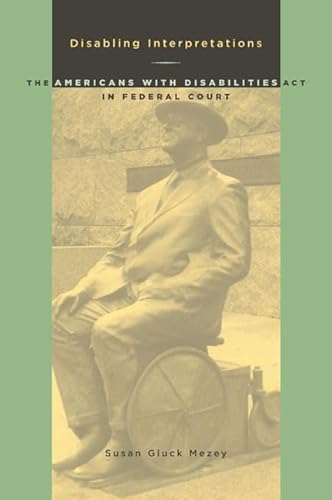
The Americans with Disabilities Act (ADA) of 1990 was intended to send a clear message to society that discrimination on the basis of disability is unacceptable. As with most civil rights laws, the courts were given primary responsibility for implementing disability rights policy.
Mezey argues that the act has not fulfilled its potential primarily because of the judiciary's "disabling interpretations" in adjudicating ADA claims. In the decade of litigation following the enactment of the ADA, judicial interpretation of the law has largely constricted the parameters of disability rights and excluded large numbers of claimants from the reach of the law. The Supreme Court has not interpreted the act broadly, as was intended by Congress, and this method of decision making was for the most part mirrored by the courts below. The high court's rulings to expand state sovereign immunity and insulate states from liability in damage suits has also caused claimants to become enmeshed in litigation and has encouraged defendants to challenge other laws affecting disability rights. Despite the law's strong civil rights rhetoric, disability rights remain an imperfectly realized goal.
Die Inhaltsangabe kann sich auf eine andere Ausgabe dieses Titels beziehen.
Über die Autorin bzw. den Autor
Susan Gluck Mezey, Ph.D., J.D., is a professor of political science at Loyola University, Chicago. She is former director of Loyola’s Women’s Studies Program and chair of the 1999 Forum on the Child. She is the author of Pitiful Plaintiffs: Child Welfare Litigation and the Federal Courts; No Longer Disabled: The Federal Courts and the Politics of Social Security Disability; In Pursuit of Equality: Women, Public Policy, and the Federal Courts; and Children in Court: Public Policymaking and Federal Court Decisions.
„Über diesen Titel“ kann sich auf eine andere Ausgabe dieses Titels beziehen.
Suchergebnisse für Disabling Interpretations: The Americans With Disabilities...

Beispielbild für diese ISBN
Disabling Interpretations: The Americans With Disabilities Act In Federal Court
Verlag:
University of Pittsburgh Press (edition 1), 2005
ISBN 10: 0822958791
ISBN 13: 9780822958796
Gebraucht
Paperback
Anbieter: BooksRun, Philadelphia, PA, USA
Verkäuferbewertung 5 von 5 Sternen

Paperback. Zustand: Very Good. 1. It's a well-cared-for item that has seen limited use. The item may show minor signs of wear. All the text is legible, with all pages included. It may have slight markings and/or highlighting. Artikel-Nr. 0822958791-11-1
Gebraucht kaufen
EUR 7,65
Versand gratis
Versand innerhalb von USA
Versand innerhalb von USA
Anzahl: 1 verfügbar