
Verwandte Artikel zu A Sentimental Education for the Working Man: The Mexico...
Inhaltsangabe
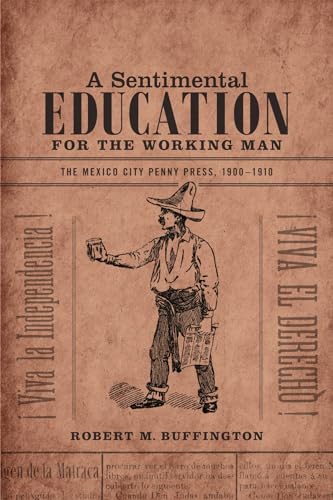
In A Sentimental Education for the Working Man Robert Buffington reconstructs the complex, shifting, and contradictory ideas about working-class masculinity in early twentieth-century Mexico City. He argues that from 1900 to 1910, the capital's satirical penny press provided working-class readers with alternative masculine scripts that were more realistic about their lives, more responsive to their concerns, and more representative of their culture than anything proposed by elite social reformers and Porfirian officials. The penny press shared elite concerns about the destructive vices of working-class men, and urged them to be devoted husbands, responsible citizens, and diligent workers; but it also used biting satire to recast negative portrayals of working-class masculinity and to overturn established social hierarchies. In this challenge to the "macho" stereotype of working-class Mexican men, Buffington shows how the penny press contributed to the formation of working-class consciousness, facilitated the imagining of a Mexican national community, and validated working-class men as modern citizens.
Die Inhaltsangabe kann sich auf eine andere Ausgabe dieses Titels beziehen.
Über die Autorin bzw. den Autor
Robert M. Buffington is Associate Professor of Women and Gender Studies at the University of Colorado, Boulder. He is the author of Criminal and Citizen in Modern Mexico.
Auszug. © Genehmigter Nachdruck. Alle Rechte vorbehalten.
A Sentimental Education for the Working Man
The Mexico City Penny Press, 1900–1910
By Robert M. BuffingtonDuke University Press
Copyright © 2015 Duke University Press
All rights reserved.
ISBN: 978-0-8223-5882-4All rights reserved.
Contents
Acknowledgments,
Introduction,
CHAPTER 1 Working-Class Heroes,
CHAPTER 2 The One True Juárez,
CHAPTER 3 The Apotheosis of the Working Man,
CHAPTER 4 Rumbo Perdido: Transgressive Journeys into Manhood,
CHAPTER 5 Don Juan and the Troubled Birth of Modern Love,
EPILOGUE Las Trampas Modernas,
Notes,
Bibliography,
Index,
CHAPTER 1
WORKING-CLASS HEROES
Forging the Ties That Bind
As we saw in the introduction, most early twentieth-century Mexico City workers subscribed to a shifting constellation of interrelated ideas, attitudes, and notions that historians have labeled "popular liberalism." Although derived from mainstream liberalism with its emphasis on citizenship — civic responsibilities, political rights, respect for the rule of law, respect for the dignity of the individual — popular liberalism grounded that citizenship, not in the newly emergent middle classes (often allied in Mexico as elsewhere with traditional elites), but in the historical resentments, patriotic sentiments, and productive toil of marginalized working-class men (and to a much lesser extent women). Mexico City's thriving satiric penny press for workers played a key role in establishing popular liberalism as an oppositional discourse committed to challenging the exploitation, corruption, cronyism, and authoritarian tactics of the Porfirian regime.
These are fundamental insights. Nevertheless, historians have only just begun to scratch the surface of what social theorist Raymond Williams calls the "structures of feeling"—"meanings and values as they are actively lived and felt" — that underlay popular liberalism and the emerging class consciousness of Mexico City workers. This chapter thus examines the concerted efforts of satiric penny press editors and contributors to link these structures of feeling to working-class political consciousness by constructing popular alternatives to the official story propagated by liberal elites and Porfirian ideologues. These alternatives embraced many of the same liberal icons featured in official histories but resignified them as working-class heroes and then deployed them to undermine the regime's claims to legitimacy. An essential component of this time-honored tactic of symbolic subversion was the forging of deep affective bonds between popular figures — especially independence martyr Miguel Hidalgo and liberal statesman Benito Juárez — and their working-class admirers in an effort to bind workers to a utopian vision of a liberal, democratic Mexico no longer in thrall to special interests and responsive to all its citizens, however humble their circumstances. The oppositional discourse that emerged from this process worked to split the liberal political spectrum into two distinct camps and transform popular liberalism into liberal populism, a move with revolutionary implications (see ch. 3).
This was hardly the first manifestation of working-class support for liberal heroes, especially Benito Juárez. In 1876, just four years after his death, the Gran Círculo de Obreros de México (Great Circle of Mexican Workers) staged the first of many Juárez commemorations sponsored by working-class organizations. But deepening fractures among Mexican liberals after Porfirio Díaz's 1884 reelection, exacerbated by government crackdowns on the independent press, provided an opening for an alternative liberal history that stressed the special bonds between liberal heroes and workingmen (rather than fractious political elites). The success of these late Porfirian efforts to link popular structures of feeling to working-class politics proved remarkably durable. But the waging of this symbolic "war of position" for the hearts and minds of Mexican workers was no simple thing.
The Art of War
In recent years, art historians have begun to explore the intimate links between the production of images and the construction of national histories. As Tomás Pérez Vejo explains, "images, in addition to reflecting reality, are also ... a sophisticated way of constructing reality, a powerful instrument in the production and control of collective imaginaries." Given this remarkable power to produce and control collective imaginaries, it should come as no surprise that ideologues of all stripes — penny press editors included — made frequent use of graphic images in the struggle to develop a national narrative that promoted their different conceptions of the nation-state as an "imagined and imaginary community" and their different constituencies as central to that community.
Two front-page illustrations from La Guacamaya provide a useful entry point into the intricacies of working-class politics in late Porfirian Mexico City. The first image, "En Honor de Juárez," from the cover of the July 18, 1907, issue, celebrates the anniversary of Benito Juárez's death (July 18, 1872). The second image, "¡VIVA la LIBERTAD!," from September 12, 1907, anticipates the upcoming Independence Day celebrations of September 15 and 16 (see figs. 1.1 and 1.2). The images are unsigned but in the graphic style of master printmaker and frequent contributor José Guadalupe Posada. Although close examination reveals some nice touches — the confrontation between a policeman and a newspaper boy in the second image, for example — neither illustration seems particularly inspired, at least in any conventional artistic sense. Despite these aesthetic shortcomings, the basic message is hard to miss: working-class Mexican men are true patriots; upper-class Mexican men are self-absorbed sycophants and slackers.
Although the main point is relatively straightforward; the complex web of symbolic and historical referents deployed in its service is not. Neither were its implications for working-class Mexican men. Before tackling these complications, however, we need first to examine the ways in which these graphic images and the short verses that accompany them work as texts, setting aside for a moment important questions about the historical circumstances and cultural context in which those texts were produced, circulated, and read. Only a close reading of image and text can properly convey the subtle art behind their creation and deployment: the deft manipulation of spatial conventions, the sly play with visual and linguistic signs, the meticulous fitting of graphic mortise to literary tenon. For all its fussing over picayune details and obsession with everyday tricks of the trade, a nuts-and-bolts analysis of this kind is in fact essential to our understanding of the penny press "war of position" with Porfirian bourgeois culture. This is so, because without a solid appreciation of the art of that war, we would find ourselves hard pressed to explain its subtle but powerful ideological effects. Although compelled by disciplinary training to select, sort, and synthesize, in their heart of hearts historians, like moralists, know that the devil — little, red, joking, or otherwise — resides in the details. This inquiry, then, begins there.
The image beneath the July 18 headline, "En Honor de Juárez," depicts six well-to-do men in formal attire — top hats, frock coats, starched...
„Über diesen Titel“ kann sich auf eine andere Ausgabe dieses Titels beziehen.
Suchergebnisse für A Sentimental Education for the Working Man: The Mexico...

Beispielbild für diese ISBN
A Sentimental Education for the Working Man
Anbieter: PBShop.store UK, Fairford, GLOS, Vereinigtes Königreich
Verkäuferbewertung 5 von 5 Sternen

PAP. Zustand: New. New Book. Shipped from UK. Established seller since 2000. Artikel-Nr. FW-9780822358824
Neu kaufen
EUR 31,95
EUR 4,93 Versand
Versand von Vereinigtes Königreich nach USA
Versand von Vereinigtes Königreich nach USA
Anzahl: 15 verfügbar
Beispielbild für diese ISBN
A Sentimental Education for the Working Man: The Mexico City Penny Press, 1900-1910
Anbieter: Majestic Books, Hounslow, Vereinigtes Königreich
Verkäuferbewertung 4 von 5 Sternen

Zustand: New. 312. Artikel-Nr. 373808369
Neu kaufen
EUR 40,73
EUR 7,71 Versand
Versand von Vereinigtes Königreich nach USA
Versand von Vereinigtes Königreich nach USA
Anzahl: 3 verfügbar
Beispielbild für diese ISBN
A Sentimental Education for the Working Man: The Mexico City Penny Press, 1900-1910
Anbieter: Kennys Bookstore, Olney, MD, USA
Verkäuferbewertung 5 von 5 Sternen
Zustand: New. 2015. Illustrated. Paperback. . . . . . Books ship from the US and Ireland. Artikel-Nr. V9780822358824
Neu kaufen
EUR 48,47
EUR 9,34 Versand
Versand innerhalb von USA
Versand innerhalb von USA
Anzahl: Mehr als 20 verfügbar
Beispielbild für diese ISBN
A Sentimental Education for the Working Man The Mexico City Penny Press, 19001910
Anbieter: Revaluation Books, Exeter, Vereinigtes Königreich
Verkäuferbewertung 5 von 5 Sternen
Paperback. Zustand: Brand New. 312 pages. 9.00x6.00x0.75 inches. In Stock. Artikel-Nr. x-0822358824
Neu kaufen
EUR 53,72
EUR 11,86 Versand
Versand von Vereinigtes Königreich nach USA
Versand von Vereinigtes Königreich nach USA
Anzahl: 2 verfügbar
Beispielbild für diese ISBN
A Sentimental Education for the Working Man: The Mexico City Penny Press, 1900-1910
Anbieter: Ria Christie Collections, Uxbridge, Vereinigtes Königreich
Verkäuferbewertung 5 von 5 Sternen
Zustand: New. In English. Artikel-Nr. ria9780822358824_new
Neu kaufen
EUR 54,51
EUR 13,39 Versand
Versand von Vereinigtes Königreich nach USA
Versand von Vereinigtes Königreich nach USA
Anzahl: Mehr als 20 verfügbar