
Verwandte Artikel zu When Rains Became Floods: A Child Soldier's Story...
When Rains Became Floods: A Child Soldier's Story (Latin America in Translation) - Softcover
Buch 25 von 33: Latin America in Translation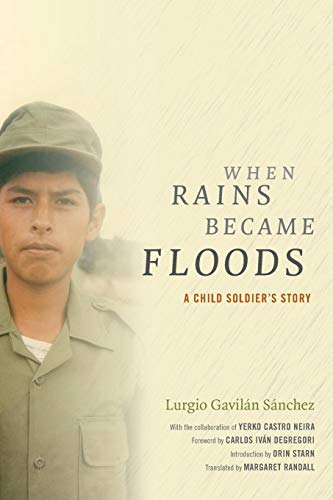
Inhaltsangabe
When Rains Became Floods is the gripping autobiography of Lurgio Gavilán Sánchez, who as a child soldier fought for both the Peruvian guerrilla insurgency Shining Path and the Peruvian military. After escaping the conflict, he became a Franciscan priest and is now an anthropologist. Gavilán Sánchez's words mark otherwise forgotten acts of brutality and kindness, moments of misery and despair as well as solidarity and love.
Die Inhaltsangabe kann sich auf eine andere Ausgabe dieses Titels beziehen.
Über die Autorin bzw. den Autor
Lurgio GavilÁn SÁnchez is a Ph.D. candidate in Anthropology at the Universidad Iberoamericana (Mexico).
Margaret Randall is the author of dozens of books, including Che On My Mind, also published by Duke University Press.
Margaret Randall is the author of dozens of books, including Che On My Mind, also published by Duke University Press.
Auszug. © Genehmigter Nachdruck. Alle Rechte vorbehalten.
When Rains Became Floods
A Child Soldier's Story
By Lurgio Gavilán Sánchez, Margaret RandallDuke University Press
Copyright © 2015 Duke University Press
All rights reserved.
ISBN: 978-0-8223-5851-0All rights reserved.
Contents
FOREWORD Carlos Iván Degregori Surviving the Flood: The Multiple Lives of Lurgio Gavilán,
1. In the Ranks of Shining Path,
2. At the Military Base,
3. Time in the Franciscan Convent,
4. I Return to the Countryside of Ayacucho,
GLOSSARY,
ACKNOWLEDGMENTS,
TRANSLATOR'S NOTE AND ACKNOWLEDGMENTS,
NOTES,
INDEX,
CHAPTER 1
IN THE RANKS OF SHINING PATH
I write this history in order to retrieve my memory; and also so nothing like it will happen again in Peru.
Verba volant, scripta manent (Words fly away, what is written remains). In the spirit of this Latin phrase, and encouraged by a professor at the School of Pontifical and Civil Theology in Lima, today I decide to tell my story from the age of twelve, when I followed my brother into the ranks of Shining Path (Sendero Luminoso). She said: "Why don't you write about your life?" I often hesitated, asking myself: Who would be interested in a story like mine? Would writing it enable Peru to know a guerrilla fighter? Would it allow Peru to understand something of human suffering? Would it keep history from repeating itself? What could it possibly be good for? Now I simply prefer — as José Carlos Mariátegui said — that the work speak for itself. This is how I got the courage to talk about what I have lived. I hope my story contributes to human understanding, and that others may share the sentiments of this writer and of those I portray here, because our lives are like soap bubbles: from the moment they exist they begin to die. As we make our way through life, in that long process of dying we shoulder and then discard our cultural baggage.
This autobiography was written between 1996 and 1998 and finished in 2000. I filled in the empty spaces in 2007 and 2010. This was how I was able to complete the book and put a few of my memories into words. This is not a history of violence, but rather a series of stories about ordinary life, devoid of theatrics and party politics.
In no way do I try to justify the atrocities committed by Shining Path or the Peruvian army; I simply tell the events as they occurred. For this writer, these are ordinary memories, as if I lived them only yesterday. An unknown soldier's life takes many twists and turns. They are not all here, perhaps because some of the memories are distant now, or some are less important.
When we children had not yet reached adolescence we were already fighting in the so-called people's war. Back then, the idea was to contribute to the needs of a new nation, one that was more developed, with greater justice and equality, where man's exploitation of man did not exist. But it all disintegrated into humans acting worse than beasts to one another and into times of suffering (waqay vida).
All this has to do with something I have always asked myself, always wanted to know: what is Peru? Is it made up of soulless Indians, as the first religious men who came to the New World believed, or simply a lot of beggars seated on golden benches, as Antonio Raymondi wrote? Peru is a multicultural and diverse nation with many bloods, an amalgam of cultures with a discriminatory idiosyncrasy. When have we ever been one Peru, a country united?
Sometimes I think we are united (huklla) only when our soccer players wear their "red and white" and get our people to joyously scream the word "goal"; or when we raise on high the red-and-white flag, or simply a red one, as if begging for help. What passions fire our blood? What notion do we have of the country in which we live? What temporal meaning do these symbols express? Will they endure? Or, as the cumbia sung by a northern musical group proclaims about love: "will they appear and disappear." Peru is a country as complicated as its idiosyncrasies, as the indignation of its people or its momentary, regional, family, or individual conflicts. So when does resentment, vengeance, and rebellion explode? When Peru becomes aware that it lives in a deceptive system? When the level of hunger is greater than the daily possibilities of subsistence? When, tired of democratic utopias and political parties, people say "enough" and rise up?
As we have seen, our leaders have invented constitutions in order to legitimize their power, hiding within the judicial apparatus a language that gets more perverse by the day. Our political constitutions have not been documents of rights but models for structuring the state. We live in constant anxiety, trying this and that, always beginning again at zero and never getting anywhere. We have too much faith in the virtues of politicians, in presumed saviors, in the pretty phrases "the government is for all Peruvians," or the government with a "human face."
I am left with the words of Saint Francis of Assisi: "Brothers, let us begin, we have done little or nothing," or with the universal poet César Vallejo's judgment: "sadly, humans ... brothers there is much to be done."
It is true that, as one remembers one experiences a kind of nostalgia, but at the same time there is a lightening of the spirit. I lived for many years in the ranks of Shining Path, in military barracks, in a Franciscan convent, in peasant communities, and in centers of academic learning.
MY FIRST EXPERIENCES IN THE RANKS OF SHINING PATH
It was the month of January 1983. My uncle and I were traveling from the rain forest to the mountains to visit my relatives in Auquiraccay. We carried some foodstuffs from the region (potatoes, geese, broad beans). It's a two-day trip by foot. And so we journeyed, through mountains, forest, and deep gorges.
"Where will you be tomorrow," my father asked — a day before my departure for Auquiraccay — as he looked toward the solitary hills that appeared blue in the distance at the hour of dusk (pantaq), when the sky stretching west was tinted with orange, a premonition of nostalgia.
I left my community weeks after the massacre at Uchuraccay. It was the rainy season, when peanuts are planted. It was the time when the first mangoes, oranges, and tangerines begin to ripen, and appear yellow as glints of light through the thick green forest of the Apurímac River.
Shining Path had also appeared at that time and in that place, imitating the dark clouds of the south. Clouds don't always come filled with good rain. They often flood the fields or destroy the crops. That's how Shining Path came to my community, disguised as good rain. The first drops gave us hope for life, for social justice. But the rains lasted longer and longer. And fear appeared, because the water began to destroy and clean away "all that was old." And so we began to live the "flood."
There was nothing to do but to climb aboard Shining Path's ark or join the village militias (rondas campesinas). Shining Path leader Chairman Gonzalo's words were coming true: "A blood bath is needed," because, according to him, there couldn't be an authentic revolution without spilling blood. And "when the flood passes," in the new state, under socialism, we will plant uncontaminated crops once more.
In 1983, that year of heavy rain, I went with my uncle to Auquiraccay, along a switchback path that runs serpentine from where the Ayacucho rain forest begins. It is the path used by...
„Über diesen Titel“ kann sich auf eine andere Ausgabe dieses Titels beziehen.
Suchergebnisse für When Rains Became Floods: A Child Soldier's Story...

Beispielbild für diese ISBN
When Rains Became Floods : A Child Soldier's Story
Anbieter: Better World Books, Mishawaka, IN, USA
Verkäuferbewertung 5 von 5 Sternen

Zustand: Fine. Used book that is in almost brand-new condition. May contain a remainder mark. Better World Books: Buy Books. Do Good. Artikel-Nr. 41788685-6
Gebraucht kaufen
EUR 6,64
Versand gratis
Versand innerhalb von USA
Versand innerhalb von USA
Anzahl: 5 verfügbar
Beispielbild für diese ISBN
When Rains Became Floods: A Child Soldier's Story
Anbieter: ThriftBooks-Atlanta, AUSTELL, GA, USA
Verkäuferbewertung 5 von 5 Sternen
Paperback. Zustand: Good. No Jacket. Pages can have notes/highlighting. Spine may show signs of wear. ~ ThriftBooks: Read More, Spend Less. Artikel-Nr. G0822358514I3N00
Gebraucht kaufen
EUR 7,19
Versand gratis
Versand innerhalb von USA
Versand innerhalb von USA
Anzahl: 1 verfügbar
Beispielbild für diese ISBN
When Rains Became Floods: A Child Soldier's Story
Anbieter: ThriftBooks-Dallas, Dallas, TX, USA
Verkäuferbewertung 5 von 5 Sternen
Paperback. Zustand: Very Good. No Jacket. May have limited writing in cover pages. Pages are unmarked. ~ ThriftBooks: Read More, Spend Less. Artikel-Nr. G0822358514I4N00
Gebraucht kaufen
EUR 7,19
Versand gratis
Versand innerhalb von USA
Versand innerhalb von USA
Anzahl: 1 verfügbar
Beispielbild für diese ISBN
When Rains Became Floods: A Child Soldier's Story
Anbieter: ThriftBooks-Atlanta, AUSTELL, GA, USA
Verkäuferbewertung 5 von 5 Sternen
Paperback. Zustand: Very Good. No Jacket. May have limited writing in cover pages. Pages are unmarked. ~ ThriftBooks: Read More, Spend Less. Artikel-Nr. G0822358514I4N00
Gebraucht kaufen
EUR 7,19
Versand gratis
Versand innerhalb von USA
Versand innerhalb von USA
Anzahl: 1 verfügbar
Beispielbild für diese ISBN
When Rains Became Floods: A Child Soldier's Story (Latin America in Translation)
Verlag:
Duke University Press Books, 2015
ISBN 10: 0822358514
ISBN 13: 9780822358510
Gebraucht
paperback
Anbieter: Books From California, Simi Valley, CA, USA
Verkäuferbewertung 4 von 5 Sternen

paperback. Zustand: Good. Back cover is torn near the spine, minor shelf wear present. Pages are clean. Artikel-Nr. mon0003609592
Gebraucht kaufen
EUR 7,35
EUR 4,39 Versand
Versand innerhalb von USA
Versand innerhalb von USA
Anzahl: 1 verfügbar
Beispielbild für diese ISBN
When Rains Became Floods: A Child Soldier's Story (Latin America in Translation)
Verlag:
Duke University Press Books, 2015
ISBN 10: 0822358514
ISBN 13: 9780822358510
Gebraucht
paperback
Anbieter: Books From California, Simi Valley, CA, USA
Verkäuferbewertung 4 von 5 Sternen
paperback. Zustand: Fine. Artikel-Nr. mon0003768957
Gebraucht kaufen
EUR 7,35
EUR 4,39 Versand
Versand innerhalb von USA
Versand innerhalb von USA
Anzahl: 3 verfügbar
Beispielbild für diese ISBN
When Rains Became Floods: A Child Soldier's Story (Latin America in Translation)
Verlag:
Duke University Press Books, 2015
ISBN 10: 0822358514
ISBN 13: 9780822358510
Gebraucht
paperback
Anbieter: Books From California, Simi Valley, CA, USA
Verkäuferbewertung 4 von 5 Sternen
paperback. Zustand: Very Good. Artikel-Nr. mon0003768869
Gebraucht kaufen
EUR 7,35
EUR 4,39 Versand
Versand innerhalb von USA
Versand innerhalb von USA
Anzahl: 3 verfügbar
Beispielbild für diese ISBN
When Rains Became Floods: A Child Soldier's Story (Latin America in Translation)
Anbieter: Majestic Books, Hounslow, Vereinigtes Königreich
Verkäuferbewertung 4 von 5 Sternen
Zustand: New. 152. Artikel-Nr. 375160279
Neu kaufen
EUR 21,96
EUR 7,56 Versand
Versand von Vereinigtes Königreich nach USA
Versand von Vereinigtes Königreich nach USA
Anzahl: 1 verfügbar
Beispielbild für diese ISBN
When Rains Became Floods A Child Soldier`s Story
Anbieter: Revaluation Books, Exeter, Vereinigtes Königreich
Verkäuferbewertung 5 von 5 Sternen
Paperback. Zustand: Brand New. 128 pages. 8.25x5.50x0.50 inches. In Stock. Artikel-Nr. x-0822358514
Neu kaufen
EUR 25,98
EUR 11,63 Versand
Versand von Vereinigtes Königreich nach USA
Versand von Vereinigtes Königreich nach USA
Anzahl: 2 verfügbar
Beispielbild für diese ISBN
When Rains Became Floods: A Child Soldier's Story (Latin America in Translation)
Anbieter: Ria Christie Collections, Uxbridge, Vereinigtes Königreich
Verkäuferbewertung 5 von 5 Sternen
Zustand: New. In English. Artikel-Nr. ria9780822358510_new
Neu kaufen
EUR 29,59
EUR 10,89 Versand
Versand von Vereinigtes Königreich nach USA
Versand von Vereinigtes Königreich nach USA
Anzahl: Mehr als 20 verfügbar