
Verwandte Artikel zu Paper Knowledge: Toward a Media History of Documents...
Paper Knowledge: Toward a Media History of Documents (Sign, Storage, Transmission) - Softcover
Buch 3 von 20: Sign, Storage, Transmission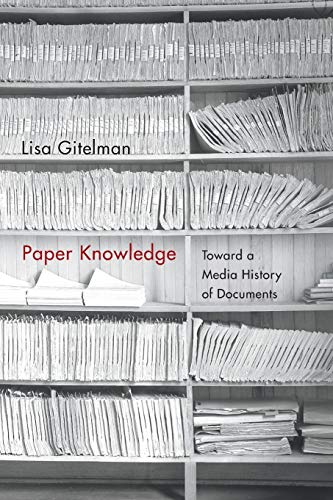
Inhaltsangabe
Paper Knowledge is a remarkable book about the mundane: the library card, the promissory note, the movie ticket, the PDF (Portable Document Format). It is a media history of the document. Drawing examples from the 1870s, the 1930s, the 1960s, and today, Lisa Gitelman thinks across the media that the document form has come to inhabit over the last 150 years, including letterpress printing, typing and carbon paper, mimeograph, microfilm, offset printing, photocopying, and scanning. Whether examining late nineteenth century commercial, or "job" printing, or the Xerox machine and the role of reproduction in our understanding of the document, Gitelman reveals a keen eye for vernacular uses of technology. She tells nuanced, anecdote-filled stories of the waning of old technologies and the emergence of new. Along the way, she discusses documentary matters such as the relation between twentieth-century technological innovation and the management of paper, and the interdependence of computer programming and documentation. Paper Knowledge is destined to set a new agenda for media studies.
Die Inhaltsangabe kann sich auf eine andere Ausgabe dieses Titels beziehen.
Über die Autorin bzw. den Autor
Lisa Gitelman is Professor of English and of Media, Culture, and Communication at New York University. She is the author of Always Already New: Media, History, and the Data of Culture and Scripts, Grooves, and Writing Machines: Representing Technology in the Edison Era and the editor of "Raw Data" Is an Oxymoron and New Media, 1740-1915.
Auszug. © Genehmigter Nachdruck. Alle Rechte vorbehalten.
Paper Knowledge
TOWARD A MEDIA HISTORY OF DOCUMENTS
By Lisa GitelmanDuke University Press
Copyright © 2014 Duke University Press
All rights reserved.
ISBN: 978-0-8223-5657-8All rights reserved.
Contents
Preface, ix,
INTRODUCTION Paper Knowledge, 1,
ONE A Short History of ________, 21,
TWO The Typescript Book, 53,
THREE Xerographers of the Mind, 83,
FOUR Near Print and Beyond Paper: Knowing by *.pdf, 111,
AFTERWORD Amateurs Rush In, 136,
Notes, 151,
Works Cited, 189,
Index, 205,
CHAPTER 1
A Short History of _________
In 1894 the American Dictionary of Printing and Bookmaking offered examples in its entry on blank books:
Address-books, bank-books, bankers' cases, bill-books, blotters, books of design, buyers' price-books, card albums, cash-books, check-books, collection-books, composition, exercise and manuscript books, cotton-weight books, day-books, diaries, drawing-books, engineers' field-books, fern and moss albums, flap memorandums, grocers' and butchers' order books, herbariums, hotel registers, indexes, invoice-books, ledgers, letter-copying books, lumber and log tally-books, manifold-books, memorandum-books, miniature blanks, milk-books, money receipts, notes, drafts and receipts, notebooks, order-books, package receipts, pass-books, pencil-books, perpetual diaries, pocket ledgers, portfolios, receiving and discharging books, rent receipts, renewable memorandums, reporters' note-books, roll-books, salesmen's order-books, scrapbooks, scratch-books, shipping receipts, shopping-lists, tally-books, travelers' ledgers, trial-balance books, tuck memorandums, two-third books, visiting-books, writing-books and workmen's time-books.
The list points variously to the workplace, marketplace, school, and home, while it belies the assumption that books are for reading. Books like these were for writing, or at least for incremental filling in, filling up. Fillability in some cases suggests a moral economy (diaries and fern and moss albums, for example), and in many others it suggests the cash economy with which nineteenth-century Americans had grown familiar. Filling up evidently helped people locate goods, map transactions, and transfer value, while it also helped them to locate themselves or others within or against the sites, practices, and institutions that helped to structure daily life. Roll-books and workmen's time-books might be the incremental instruments of power—locating as they do the schooled and the laboring—while hotel registers, rent receipts, and visiting-books point toward the varied mobility of subjects who stayed over, resided, or stopped by. Letter-copying books helped businessmen keep at hand the very letters they also sent away, while cotton-weight, milk-, lumber and log tally-books offered space to record one moment—and always again the same moment—in the life cycle of a bulk commodity. Some examples (flap memorandums? two-third books?) are obscure today. The general picture, however, is one of motion—a confusion of mobilities, really—whereby things, value, and people circulate: they move through space and across borders, from and to, out and in; they get caught and kept, or they pause and pass. Moving faster or slower, they also move in time, recorded in increments and thus amid intervals.
Yet for all of the mobilities the list suggests, it also suggests stasis or inertia. Things (cards and fern fronds, for example) and—more typically—records of things stopped forever as they filled the waiting blankness of books like these. Writing is mnemonic, the history of communication tells us; it is preservative. And so are printing and bookmaking: each of the books listed formed a class or category of blank because each catered to the repetition of certain kinds of writing. If writing is preservative, these books preserved preservation. Their design, manufacture, and adoption worked to conserve patterns of inscription and expression. A blank blotter catered to the repetition of inked inscription only—no matter what was written or drawn—but most blank books would have worked however modestly to mold, to direct and delimit expression. Order and invoice books, for instance, like ledgers and daybooks, catered to inscriptions accreted according to the vernacular habits of trade and the long-standing formulas of accountancy. Habits and formulas can change or be changed, of course, but inertia is their defining characteristic. Checkbooks and receipt books called for perfunctory expressions according to legal necessity, or at least according to shared standards of proof attending the transfer of funds ("Pay to the order of _________"). Entries made in exercise books, composition books, and reporters' notebooks would have been far less constrained, less formulaic, yet they too were loosely microgenres, repetitive expressions in some sense shaped according to the inertial norms and obligations that attended the specific settings or callings in which they and the books that contained them were habitually deployed. These blank books were meta-microgenres, one might say, documents establishing the parameters or the rules for entries to be made individually in pencil or ink. Rules, like habits, were broken, of course—as notebooks became scrapbooks, for instance, or as ledgers became the illustrated chronicles of indigenous tribes—but rules there were; that is what made one class of blank book distinguishable from another.
To write of "rules" for filling them up is likely to exaggerate the constraints hinted at or imposed by different types of blank books, but it also appeals obliquely to conditions of their design and manufacture to which it is crucial to remain attuned. Many blank books—though not all—were ruled, their pages lined in expectation of particular uses, as if in standing reserve for the document they are to become. Like blank forms generally, the pages of many blank books had ink on them. That ink—whether applied by a specialized ruling machine (figure 1.1) or printed on a printing press—was paradoxically what made most blanks blank. Each type of blank was designed and manufactured for its own purpose, like a primitive information technology, Martin Campbell-Kelly has suggested, suited to the organization and control of knowledge according to what Charles Babbage—writing in 1835—called "the division of mental labor." Though the first blanks were ancient or medieval documents rather than modern ones, and thus predate printing (think, for example, of papal indulgences5), the nineteenth century witnessed a proliferation of preprinted blank forms. The people who designed and deployed them were thinking ahead to their filling in. The labor of filling was divided from the labor of planning what filling was for and directing how filling should happen: a "managerial revolution" wrought in miniature and avant la lettre.
Take a quick look at that list again. The sheer diversity of forms—of blank forms or of forms of blank—hints first at the broad purview and intricate specialization of the printing trades in the nineteenth century, but it hints more particularly at the diversity of knowledge work to which job printers and their associates catered. So-called job printing was a porous category used to designate commercial printing on contract—often small jobs—standing in habitual distinction from the periodical press and "book work," in the nineteenth-century printers' argot. Job printers were printers who catered to...
„Über diesen Titel“ kann sich auf eine andere Ausgabe dieses Titels beziehen.
Suchergebnisse für Paper Knowledge: Toward a Media History of Documents...

Beispielbild für diese ISBN
Paper Knowledge: Toward a Media History of Documents (Sign, Storage, Transmission)
Verlag:
Duke University Press Books, 2014
ISBN 10: 0822356570
ISBN 13: 9780822356578
Gebraucht
Softcover
Anbieter: World of Books (was SecondSale), Montgomery, IL, USA
Verkäuferbewertung 5 von 5 Sternen

Zustand: Good. Item in good condition. Textbooks may not include supplemental items i.e. CDs, access codes etc. Artikel-Nr. 00108590344
Gebraucht kaufen
EUR 7,78
Versand gratis
Versand innerhalb von USA
Versand innerhalb von USA
Anzahl: 1 verfügbar
Beispielbild für diese ISBN
Paper Knowledge: Toward a Media History of Documents (Sign, Storage, Transmission)
Verlag:
Duke University Press (edition ), 2014
ISBN 10: 0822356570
ISBN 13: 9780822356578
Gebraucht
Paperback
Anbieter: BooksRun, Philadelphia, PA, USA
Verkäuferbewertung 5 von 5 Sternen
Paperback. Zustand: Very Good. It's a well-cared-for item that has seen limited use. The item may show minor signs of wear. All the text is legible, with all pages included. It may have slight markings and/or highlighting. Artikel-Nr. 0822356570-8-1
Gebraucht kaufen
EUR 9,34
Versand gratis
Versand innerhalb von USA
Versand innerhalb von USA
Anzahl: 1 verfügbar
Foto des Verkäufers
Paper Knowledge: Toward a Media History of Documents (Sign, Storage, Transmission)
Anbieter: Southampton Books, Sag Harbor, NY, USA
Verkäuferbewertung 5 von 5 Sternen
Paperback. Zustand: Very Good. FIRST THUS. First Edition Thus, First Printing. Not price-clipped. Published by Duke University Press, 2014. Octavo. Paperback. Book is very good with previous owner's annotations. 100% positive feedback. 30 day money back guarantee. NEXT DAY SHIPPING! Excellent customer service. Please email with any questions. All books packed carefully and ship with free delivery confirmation/tracking. All books come with free bookmarks. Ships from Sag Harbor, New York. Artikel-Nr. 373990
Gebraucht kaufen
EUR 17,71
EUR 4,29 Versand
Versand innerhalb von USA
Versand innerhalb von USA
Anzahl: 1 verfügbar
Beispielbild für diese ISBN
Paper Knowledge: Toward a Media History of Documents (Sign, Storage, Transmission)
Anbieter: WorldofBooks, Goring-By-Sea, WS, Vereinigtes Königreich
Verkäuferbewertung 5 von 5 Sternen
Paperback. Zustand: Very Good. The book has been read, but is in excellent condition. Pages are intact and not marred by notes or highlighting. The spine remains undamaged. Artikel-Nr. GOR010942639
Gebraucht kaufen
EUR 19,15
EUR 6,52 Versand
Versand von Vereinigtes Königreich nach USA
Versand von Vereinigtes Königreich nach USA
Anzahl: 2 verfügbar
Foto des Verkäufers
Paper Knowledge: Toward a Media History of Document
Verlag:
Duke University Press, 2014
ISBN 10: 0822356570
ISBN 13: 9780822356578
Gebraucht
Paperback
Erstausgabe
Anbieter: Southampton Books, Sag Harbor, NY, USA
Verkäuferbewertung 5 von 5 Sternen
Paperback. Zustand: Like New. First Edition. First Edition, First Printing. Not price-clipped. Published by Duke University Press, 2014. Octavo. Paperback. Book is like new. 100% positive feedback. 30 day money back guarantee. NEXT DAY SHIPPING! Excellent customer service. Please email with any questions. All books packed carefully and ship with free delivery confirmation/tracking. All books come with free bookmarks. Ships from Sag Harbor, New York. Artikel-Nr. 455549
Gebraucht kaufen
EUR 22,13
EUR 4,29 Versand
Versand innerhalb von USA
Versand innerhalb von USA
Anzahl: 1 verfügbar
Beispielbild für diese ISBN
Paper Knowledge
Anbieter: PBShop.store UK, Fairford, GLOS, Vereinigtes Königreich
Verkäuferbewertung 5 von 5 Sternen
PAP. Zustand: New. New Book. Shipped from UK. Established seller since 2000. Artikel-Nr. GB-9780822356578
Neu kaufen
EUR 24,29
EUR 4,84 Versand
Versand von Vereinigtes Königreich nach USA
Versand von Vereinigtes Königreich nach USA
Anzahl: 2 verfügbar
Beispielbild für diese ISBN
Paper Knowledge: Toward a Media History of Documents (Sign, Storage, Transmission)
Anbieter: Ria Christie Collections, Uxbridge, Vereinigtes Königreich
Verkäuferbewertung 5 von 5 Sternen
Zustand: New. In English. Artikel-Nr. ria9780822356578_new
Neu kaufen
EUR 27,16
EUR 13,15 Versand
Versand von Vereinigtes Königreich nach USA
Versand von Vereinigtes Königreich nach USA
Anzahl: 2 verfügbar
Beispielbild für diese ISBN
Paper Knowledge: Toward a Media History of Documents
Anbieter: Kennys Bookstore, Olney, MD, USA
Verkäuferbewertung 5 von 5 Sternen
Zustand: New. A book about the mundane: the library card, the promissory note, the movie ticket, the PDF (Portable Document Format). Whether examining late-nineteenth-century commercial, or "job" printing, or the Xerox machine and the role of reproduction in our understanding of the document, it reveals a keen eye for vernacular uses of technology. Series: Sign, Storage, Transmission. Num Pages: 224 pages, 11 photographs. BIC Classification: JFD. Category: (G) General (US: Trade). Dimension: 230 x 152 x 13. Weight in Grams: 372. . 2014. Paperback. . . . . Books ship from the US and Ireland. Artikel-Nr. V9780822356578
Neu kaufen
EUR 35,25
EUR 9,03 Versand
Versand innerhalb von USA
Versand innerhalb von USA
Anzahl: 2 verfügbar
Beispielbild für diese ISBN
Paper Knowledge Toward a Media History of Documents
Anbieter: Revaluation Books, Exeter, Vereinigtes Königreich
Verkäuferbewertung 5 von 5 Sternen
Paperback. Zustand: Brand New. 210 pages. 8.75x5.75x0.75 inches. In Stock. Artikel-Nr. x-0822356570
Neu kaufen
EUR 40,26
EUR 11,65 Versand
Versand von Vereinigtes Königreich nach USA
Versand von Vereinigtes Königreich nach USA
Anzahl: 2 verfügbar
Foto des Verkäufers
Paper Knowledge : Toward a Media History of Documents
Verlag:
Duke University Press Mär 2014, 2014
ISBN 10: 0822356570
ISBN 13: 9780822356578
Neu
Taschenbuch
Anbieter: AHA-BUCH GmbH, Einbeck, Deutschland
Verkäuferbewertung 5 von 5 Sternen
Taschenbuch. Zustand: Neu. Neuware - Paper Knowledge is a remarkable book about the mundane: the library card, the promissory note, the movie ticket, the PDF (Portable Document Format). It is a media history of the document. Drawing examples from the 1870s, the 1930s, the 1960s, and today, Lisa Gitelman thinks across the media that the document form has come to inhabit over the last 150 years, including letterpress printing, typing and carbon paper, mimeograph, microfilm, offset printing, photocopying, and scanning. Whether examining late nineteenth century commercial, or 'job' printing, or the Xerox machine and the role of reproduction in our understanding of the document, Gitelman reveals a keen eye for vernacular uses of technology. She tells nuanced, anecdote-filled stories of the waning of old technologies and the emergence of new. Along the way, she discusses documentary matters such as the relation between twentieth-century technological innovation and the management of paper, and the interdependence of computer programming and documentation. Paper Knowledge is destined to set a new agenda for media studies. Artikel-Nr. 9780822356578
Neu kaufen
EUR 28,02
EUR 30,50 Versand
Versand von Deutschland nach USA
Versand von Deutschland nach USA
Anzahl: 2 verfügbar