
Verwandte Artikel zu Life Interrupted: Trafficking Into Forced Labor in...
Inhaltsangabe
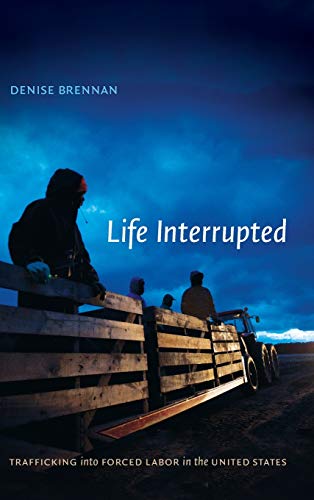
Life Interrupted introduces us to survivors of human trafficking who are struggling to get by and make homes for themselves in the United States. Having spent nearly a decade following the lives of formerly trafficked men and women, Denise Brennan recounts in close detail their flight from their abusers and their courageous efforts to rebuild their lives. At once scholarly and accessible, her book links these firsthand accounts to global economic inequities and under-regulated and unprotected workplaces that routinely exploit migrant laborers in the United States. Brennan contends that today's punitive immigration policies undermine efforts to fight trafficking. While many believe trafficking happens only in the sex trade, Brennan shows that across low-wage labor sectors—in fields, in factories, and on construction sites—widespread exploitation can lead to and conceal forced labor. Life Interrupted is a riveting account of life in and after trafficking and a forceful call for meaningful immigration and labor reform.
All royalties from this book will be donated to the nonprofit Survivor Leadership Training Fund administered through the Freedom Network.
All royalties from this book will be donated to the nonprofit Survivor Leadership Training Fund administered through the Freedom Network.
Die Inhaltsangabe kann sich auf eine andere Ausgabe dieses Titels beziehen.
Über die Autorin bzw. den Autor
Denise Brennan is Professor and Chair of the Department of Anthropology at Georgetown University. She is the author of What's Love Got to Do with It? Transnational Desires and Sex Tourism in the Dominican Republic, also published by Duke University Press.
Auszug. © Genehmigter Nachdruck. Alle Rechte vorbehalten.
Life Interrupted
TRAFFICKING into FORCED LABOR in the UNITED STATES
By Denise BrennanDuke University Press
Copyright © 2014 Duke University Press
All rights reserved.
ISBN: 978-0-8223-5624-0All rights reserved.
Contents
ACKNOWLEDGMENTS, ix,
INTRODUCTION. Starting Over, 1,
Part I. The Assault on Workers, 35,
CHAPTER 1. Dangerous Labor, 37,
CHAPTER 2. Chains of Fear, 75,
Part II. Life after Forced Labor, 113,
CHAPTER 3. Imagining the Possible, 115,
CHAPTER 4. Living the Possible, 145,
CHAPTER 5. Laboring after Forced Labor, 163,
APPENDIX. Ideas and Resources for Action, 193,
NOTES, 199,
REFERENCES, 243,
INDEX, 275,
CHAPTER 1
Dangerous Labor
MIGRANT WORKERS AND SEX WORKERS
In her office in a run-down neighborhood in Los Angeles, an organizer with a migrants' rights organization was worried. They were getting more calls every day. With the recession and recent anti-immigrant legislation in Arizona, migrant communities were rattled. Fear was palpable. Those living on a razor's edge were losing their minimum-wage jobs or having their hours scaled back, falling behind on rent, and getting evicted. Those working, the organizer explained, "tolerate all kinds of abuses to keep their jobs; they don't complain. They don't complain about terrible housing conditions either." Fearful of getting deported, they keep quiet and hold on.
* * *
At a press conference at a community center in Washington, D.C., a collaborative team of researchers reported that the D.C. police were targeting anyone who "looked" like a sex worker. Racial minorities, transgender individuals, anyone wearing certain kinds of clothes or walking in certain areas of town were being harassed (with verbal slurs, physical battering, and sexual assault) and arrested. They recounted what they heard throughout Washington: "We can't work—or even just walk—safely in our neighborhoods."
* * *
The story the organizer in Los Angeles tells—of worry, vulnerability, exploitation, and poverty—is one told by migrants' rights organizers around the United States. An organizer in the Washington, D.C., area tells of domestic workers who fear that their employers would fire them if they know the women attend domestic workers' rights meetings. A day laborer organizer in Virginia explains that he has never met a worker who has not been cheated by an employer. Farmworker activists in California tell of foremen sexually assaulting women workers, widespread wage theft, and regular exposure to pesticides.
The story the community researchers in Washington tell of danger at every turn is similar to what sex worker rights activists and researchers have heard throughout the United States. Seeking to "end demand" for prostitution as a strategy to end trafficking, antiprostitution forces have engaged in an all-out attack on anyone presumed to be in sex work. In the name of "rescuing" trafficking victims, those who choose to work in the sex sector—both U.S. citizens and foreign nationals—have been incarcerated (and deported in the case of undocumented migrants). Justified as saving women from coercion in the sex sector, the "rescues" themselves can be coercive and push already vulnerable workers further underground.
Two Communities under Attack: Migrants and Sex Workers
At first glance, these two communities—low-wage migrants (undocumented and documented) and workers in the sex sector (undocumented and documented)—may seem to have little in common. Yet both communities labor at the margins of legality, and thus both constantly face the possibility of arrest and incarceration. Those who lack legal status in the United States also face the possibility of deportation. Both communities have experienced targeted raids and arrests. Both have been trying to labor undetected. And both face great risks if they report abuses that either they or their coworkers experience.
This chapter focuses on the immigration and sexual politics shaping antitrafficking policy in the United States. I examine the fallout of antiimmigrant and antiprostitution policies on vulnerable workers and, ultimately, on the effectiveness of antitrafficking work. With local policies (such as 287(g) agreements and "secure communities" programs) and statewide legislation (such as in Arizona and Alabama) targeting undocumented migrants and coercive rescues occurring in all kinds of sex sector venues (massage parlors, dance clubs, brothels) and in public spaces, workers are unlikely to report any level of exploitation. The hyperscrutiny of the sex sector, meanwhile, often has eclipsed efforts to expose exploitation in other labor sectors. In common parlance trafficking has become synonymous with prostitution. Forced labor is simply invisible, overshadowed by the dominant discourse of sex trafficking. The reality of migrant exploitation, however, is all around us. With migrants often performing some of the most low-paying, insecure, and dangerous jobs throughout both rural and urban United States, their precarious labor is an essential element in today's economy. Low-wage migrants do work that is ubiquitous: picking crops, washing restaurant dishes, building houses, and taking care of children. But since undocumented migration is a political hot button, the link to forced labor is ignored. Instead, those who control the terms of debate, images, policies, and resource allocation focus exclusively on trafficking-as-sex trafficking. The failure to enforce labor laws and to protect the rights of all workers—including undocumented migrants and those working in the sex sector—creates the conditions that allow forced labor to flourish.
This chapter is divided into two sections: the assault on migrants in section I and the assault on sex workers in section II. While the rest of the book focuses on life in and after forced labor, section I examines the less abusive—but more widespread—exploitative practices that characterize many work sites where migrants labor. I highlight a number of factors that prevent exploited migrants from seeking help from community-based organizations or law enforcement to underscore how unlikely it is for extremely exploited workers to do so. Section II continues to explore this connection between vulnerable communities' fear of law enforcement, silence about abuse, and the paltry number of T visas issued. I argue that the conflation of trafficking with sex trafficking, particularly during the George W. Bush administration, resulted in a myopic focus on exploitation in only one labor sector: the sex sector. In the process, exploited workers in other labor sectors have gone unassisted and sex workers have become more vulnerable, with their livelihood under attack in the fight against trafficking.
I. THE ASSAULT ON MIGRANTS
Almost Trafficking
The story of living and laboring precariously in Los Angeles that opens this chapter—and the abuses that stem from this precariousness—is a recurring tale in the political economy of migrant labor. To understand cases of extreme abuse—trafficking into forced labor—we first need to understand the forms of abuse that happen every day in places where migrants work and live. Migrants stay quiet about this everyday exploitation. Employers and landlords try to get away with all they can. They are able to do so, in large part, because of workers' and tenants' undocumented status (or visa status that ties them to one employer). These...
„Über diesen Titel“ kann sich auf eine andere Ausgabe dieses Titels beziehen.
Suchergebnisse für Life Interrupted: Trafficking Into Forced Labor in...

Beispielbild für diese ISBN
Life Interrupted
Anbieter: PBShop.store UK, Fairford, GLOS, Vereinigtes Königreich
Verkäuferbewertung 5 von 5 Sternen

HRD. Zustand: New. New Book. Shipped from UK. Established seller since 2000. Artikel-Nr. FW-9780822356240
Neu kaufen
EUR 150,63
EUR 5,89 Versand
Versand von Vereinigtes Königreich nach USA
Versand von Vereinigtes Königreich nach USA
Anzahl: 1 verfügbar
Beispielbild für diese ISBN
Life Interrupted: Trafficking into Forced Labor in the United States
Anbieter: Ria Christie Collections, Uxbridge, Vereinigtes Königreich
Verkäuferbewertung 5 von 5 Sternen
Zustand: New. In English. Artikel-Nr. ria9780822356240_new
Neu kaufen
EUR 158,97
EUR 13,25 Versand
Versand von Vereinigtes Königreich nach USA
Versand von Vereinigtes Königreich nach USA
Anzahl: 1 verfügbar
Foto des Verkäufers
Life Interrupted: Trafficking into Forced Labor in the United States
Anbieter: moluna, Greven, Deutschland
Verkäuferbewertung 5 von 5 Sternen
Gebunden. Zustand: New. Having spent nearly a decade following the lives of formerly trafficked men and women, Denise Brennan recounts in close detail their flight from their abusers and their courageous efforts to rebuild their lives. Life Interrupted is a riveting account of lif. Artikel-Nr. 595070120
Neu kaufen
EUR 144,14
EUR 48,99 Versand
Versand von Deutschland nach USA
Versand von Deutschland nach USA
Anzahl: Mehr als 20 verfügbar
Beispielbild für diese ISBN
Life Interrupted Trafficking into Forced Labor in the United States
Anbieter: Revaluation Books, Exeter, Vereinigtes Königreich
Verkäuferbewertung 5 von 5 Sternen
Hardcover. Zustand: Brand New. 289 pages. 9.25x6.25x0.75 inches. In Stock. Artikel-Nr. x-0822356244
Neu kaufen
EUR 199,81
EUR 14,67 Versand
Versand von Vereinigtes Königreich nach USA
Versand von Vereinigtes Königreich nach USA
Anzahl: 2 verfügbar
Beispielbild für diese ISBN
Life Interrupted: Trafficking into Forced Labor in the United States
Anbieter: Kennys Bookstore, Olney, MD, USA
Verkäuferbewertung 5 von 5 Sternen
Zustand: New. 2014. Illustrated. Hardcover. . . . . . Books ship from the US and Ireland. Artikel-Nr. V9780822356240
Neu kaufen
EUR 211,25
EUR 9,33 Versand
Versand innerhalb von USA
Versand innerhalb von USA
Anzahl: 1 verfügbar
Foto des Verkäufers
Life Interrupted : Trafficking into Forced Labor in the United States
Verlag:
Duke University Press Mär 2014, 2014
ISBN 10: 0822356244
ISBN 13: 9780822356240
Neu
Hardcover
Anbieter: AHA-BUCH GmbH, Einbeck, Deutschland
Verkäuferbewertung 5 von 5 Sternen
Buch. Zustand: Neu. Neuware - Life Interrupted introduces us to survivors of human trafficking who are struggling to get by and make homes for themselves in the United States. Having spent nearly a decade following the lives of formerly trafficked men and women, Denise Brennan recounts in close detail their flight from their abusers and their courageous efforts to rebuild their lives. At once scholarly and accessible, her book links these firsthand accounts to global economic inequities and under-regulated and unprotected workplaces that routinely exploit migrant laborers in the United States. Brennan contends that today's punitive immigration policies undermine efforts to fight trafficking. While many believe trafficking happens only in the sex trade, Brennan shows that across low-wage labor sectors-in fields, in factories, and on construction sites-widespread exploitation can lead to and conceal forced labor. Life Interrupted is a riveting account of life in and after trafficking and a forceful call for meaningful immigration and labor reform.All royalties from this book will be donated to the nonprofit Survivor Leadership Training Fund administered through the Freedom Network. Artikel-Nr. 9780822356240
Neu kaufen
EUR 199,36
EUR 35,00 Versand
Versand von Deutschland nach USA
Versand von Deutschland nach USA
Anzahl: 1 verfügbar