
Verwandte Artikel zu Revolt of the Saints: Memory and Redemption in the...
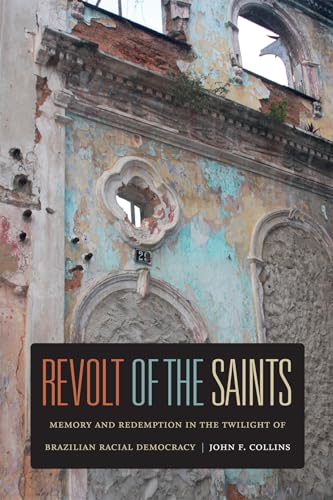
Revolt of the Saints: Memory and Redemption in the Twilight of Brazilian Racial Democracy - Softcover
Inhaltsangabe
In 1985 the Pelourinho neighborhood in Salvador, Brazil was designated as a UNESCO World Heritage Site. Over the next decades, over 4,000 residents who failed to meet the state's definition of "proper Afro-Brazilianness" were expelled to make way for hotels, boutiques, NGOs, and other attractions. In Revolt of the Saints, John F. Collins explores the contested removal of the inhabitants of Brazil's first capital and best-known site for Afro-Brazilian history, arguing that the neighborhood's most recent reconstruction, begun in 1992 and supposedly intended to celebrate the Pelourinho's working-class citizens and their culture, revolves around gendered and racialized forms of making Brazil modern. He situates this focus on national origins and the commodification of residents' most intimate practices within a longer history of government and elite attempts to "improve" the citizenry's racial stock even as these efforts take new form today. In this novel analysis of the overlaps of race, space, and history, Collins thus draws on state-citizen negotiations of everyday life to detail how residents' responses to the attempt to market Afro-Brazilian culture and reimagine the nation's foundations both illuminate and contribute to recent shifts in Brazil's racial politics.
Die Inhaltsangabe kann sich auf eine andere Ausgabe dieses Titels beziehen.
Über die Autorin bzw. den Autor
John F. Collins is Associate Professor of Anthropology at Queens College and the Graduate Center, City University of New York.
Auszug. © Genehmigter Nachdruck. Alle Rechte vorbehalten.
Revolt of the Saints
Memory and Redemption in the Twilight of Brazilian Racial Democracy
By John F. CollinsDuke University Press
Copyright © 2015 Duke University Press
All rights reserved.
ISBN: 978-0-8223-5320-1All rights reserved.
Contents
Preface and Acknowledgments,
Introduction: Being, through the Archive,
1. "The Eighteenth Battalion of Love": Failure and the Dissemination of Misinterpretation,
2. Letters to the Amazons,
3. Prostitution's Bureaucracy: Making Up People in the "City of Women",
4. A Metaphysics for Our Time: Pelourinho Properties, Bahian Social Bodies, and the Shifting Meanings of Rams and Fetuses,
5. Treasure Tales and National Bodies: Mystery and Metaphor in Bahian Life,
6. "But Madame, What If I Should Need to Defecate in Your Neighborhood?",
7. "Chatty Chatty Mouth, You Want to Know Your Culture",
Conclusion: Saints, Not Angels,
Appendix: Acronyms Used,
Notes,
References,
Index,
CHAPTER 1
"The Eighteenth Battalion of Love"
Failure and the Dissemination of Misinterpretation
The very involuntariness of love, even where it has not found itself a practical accommodation beforehand, contributes to the whole as soon as it is established as a principle.
— Theodor W. Adorno, Minima Moralia
In June 2009, during a break in the winter rains that sent chunks of masonry crashing onto homes built along the interior walls of collapsed buildings, I joined a friend at the corner of João de Deus and Gregório de Mattos Streets. This crossroads served for most of the twentieth century as the symbolic heart of the Maciel, as the western side of today's Pelourinho Historical Center was called prior to 1992, when IPAC initiated its most recent round of urban reforms. My companion, whom I will call Malaquias, had been one of the neighborhood's many infamous malandros, or old-school hard men who refused to tolerate affronts to their honor even as, like the Mago introduced in the preface above, he often "took no position at all" while making do at the edges of the so-called formal economy. By the mid-1990s Malaquias had parlayed this renown as a bender of rules, and thus as a fixture in the Maciel/Pelourinho, into a career as a reggae musician. And as we traversed streets where the smells of wet lime, garbage, and rotting hardwoods had been replaced by stale beer and fresh paint, my friend compared his life to the increasingly depopulated Historical Center.
Malaquias' autobiography, which I have heard in many iterations, usually involves escape from his overbearing cowhand father in Bahia's dry backlands (the sertão); childhood struggles to survive alone in the once lively streets of the Maciel/Pelourinho; confrontations with, and crafty confoundings of, infamous detectives; stints in the penitentiary under aliases that spared him a record and thus permitted him to travel to Europe; re-acquaintance with his mother, a domestic servant who had been forced to send him to live with his father so she could care for others' children in Salvador; conversion to Pentecostal Protestantism; and, finally, consecration as a Rastafarian leader, or a holy man celebrated due in part to widely perceived links to the Afro-Brazilian tradition packaged and disseminated in the Pelourinho's reconstruction. Malaquias, then, has become well known, and a person (gente) rather than a street child or convict, on the basis of travails and a struggle for truth that he argues has led him to an appreciation of Afro-Brazilian identity and rather Christian notions of restoration and self-examination.
As Malaquias and I left the Maciel, we stopped by the Praça das Artes, Cultura, e Memória (Plaza of Arts, Culture, and Memory), an interior courtyard restored by IPAC in 1999. There a sculpture called "Redemption" gurgled hopefully. Encrusted with semiprecious stones whose safeguarding requires that the artwork be enclosed by an iron fence, the fountain announces that:
water washes away evil as compassionate tears sacralize this contemporary ritual. In the end, then, the place's negative energies are inverted.
The Pelourinho's destructive aspects evaporate, and from this we extract its regenerative power.
Out of condemned material we extract magical power, the mana of the condemned, whose magic is that of knowing how to reinvent life in a ritualized form again and again, again and again.
But Malaquias and I did not even glance at words that suggested that we were crossing a landscape whose regeneration, we had learned through bitter experience, rested on the ritual sacrifice and careful presentation of data — the "mana of the condemned" — about its inhabitants. All too familiar with this state-directed monumentalization of the Pelourinho's populace over the last two decades, we pointed out the corner in which Bira "the Ox" and Fat Carlos used to tether their fighting cocks. And we spat, nearly in unison, below a tiled sign that announced our arrival at the Praça das Artes, Cultura, e Memória. Not by chance, then, its first vertical column was louvered at a thirty degree angle so as to guide the viewer's eye toward "A-C-M," the initials and well-known nickname of Bahia's "Governor" Antonio Carlos Magalhães.
Unnerved by the spectral power of the iron-fisted patron of "Arts, Culture and Memory" whose architects, neighborhood residents agreed, rarely missed a chance at nervous obeisance, we followed Rua João de Deus. We walked silently past the military police post established in 1992 as part of the state's initial attempts to control the Maciel and paused at the handicrafts market that had replaced a brothel formerly known as the Buraco Doce (Sweet Hole). After Malaquias collected a small sum owed to him, we crossed onto the bustling Terreiro de Jesus Square. There, bookended by Salvador's Cathedral and the gold leaf of the Baroque Igreja de São Francisco (São Francisco Church), baianas do acarajé slathered black-eyed-pea fritters (acarajé) with fish paste and okra while capoeira fighters drummed up an audience in the drizzle. At the Square's opposite edge we turned toward the still-stigmatized 28th of September Street. Descending pitted hillsides (ladeiras), we sought to recall the names of sealed buildings' former occupants. At times we stuttered and stumbled, disoriented on slippery cobblestones that had once reassured in their uneven familiarity.
Now, nearly two decades after they had shuttered the first of the Maciel's buildings, workers were transforming colonial sobrados, built for planter and merchant elites but occupied across the twentieth century by impoverished quasi-citizens, into quarters for the philanthropies and state institutions that would help cement the Pelourinho as a cultural destination. Due to hiccups in IDB funding supported by arguments that planners had neglected the population, they were also converting a number into apartments for the police and the bureaucrats reviled, and envied, by Malaquias and his former neighbors: In response to pressure to enliven a now-depopulated architectural jewel, IPAC and its institutional sibling, state-level urban planning body CONDER, had joined federal credit institutions to structure mortgages for public servants. But this meant that working-class Afro-Bahians without formal labor documents (carteira assinada) or the marks of bourgeois propriety demanded by lending officers had little hope of returning to...
„Über diesen Titel“ kann sich auf eine andere Ausgabe dieses Titels beziehen.
Suchergebnisse für Revolt of the Saints: Memory and Redemption in the...

Beispielbild für diese ISBN
Revolt of the Saints: Memory and Redemption in the Twilight of Brazilian Racial Democracy
Verlag:
Duke University Press (edition ), 2015
ISBN 10: 0822353202
ISBN 13: 9780822353201
Gebraucht
Paperback
Anbieter: BooksRun, Philadelphia, PA, USA
Verkäuferbewertung 5 von 5 Sternen

Paperback. Zustand: Very Good. It's a well-cared-for item that has seen limited use. The item may show minor signs of wear. All the text is legible, with all pages included. It may have slight markings and/or highlighting. Artikel-Nr. 0822353202-11-1
Gebraucht kaufen
EUR 17,23
Versand gratis
Versand innerhalb von USA
Versand innerhalb von USA
Anzahl: 1 verfügbar
Beispielbild für diese ISBN
Revolt of the Saints : Memory and Redemption in the Twilight of Brazilian Racial Democracy
Anbieter: Better World Books, Mishawaka, IN, USA
Verkäuferbewertung 5 von 5 Sternen
Zustand: Very Good. Pages intact with possible writing/highlighting. Binding strong with minor wear. Dust jackets/supplements may not be included. Stock photo provided. Product includes identifying sticker. Better World Books: Buy Books. Do Good. Artikel-Nr. 47889099-75
Gebraucht kaufen
EUR 19,19
Versand gratis
Versand innerhalb von USA
Versand innerhalb von USA
Anzahl: 2 verfügbar
Beispielbild für diese ISBN
Revolt of the Saints
Anbieter: PBShop.store UK, Fairford, GLOS, Vereinigtes Königreich
Verkäuferbewertung 5 von 5 Sternen
PAP. Zustand: New. New Book. Shipped from UK. Established seller since 2000. Artikel-Nr. FW-9780822353201
Neu kaufen
EUR 43,64
EUR 6,02 Versand
Versand von Vereinigtes Königreich nach USA
Versand von Vereinigtes Königreich nach USA
Anzahl: 1 verfügbar
Beispielbild für diese ISBN
Revolt of the Saints: Memory and Redemption in the Twilight of Brazilian Racial Democracy
Anbieter: Ria Christie Collections, Uxbridge, Vereinigtes Königreich
Verkäuferbewertung 5 von 5 Sternen
Zustand: New. In English. Artikel-Nr. ria9780822353201_new
Neu kaufen
EUR 41,75
EUR 13,55 Versand
Versand von Vereinigtes Königreich nach USA
Versand von Vereinigtes Königreich nach USA
Anzahl: 1 verfügbar
Foto des Verkäufers
Revolt of the Saints : Memory and Redemption in the Twilight of Brazilian Racial Democracy
Anbieter: GreatBookPricesUK, Woodford Green, Vereinigtes Königreich
Verkäuferbewertung 5 von 5 Sternen
Zustand: As New. Unread book in perfect condition. Artikel-Nr. 23098863
Gebraucht kaufen
EUR 43,35
EUR 18,00 Versand
Versand von Vereinigtes Königreich nach USA
Versand von Vereinigtes Königreich nach USA
Anzahl: 1 verfügbar
Beispielbild für diese ISBN
Revolt of the Saints: Memory and Redemption in the Twilight of Brazilian Racial Democracy
Anbieter: Kennys Bookstore, Olney, MD, USA
Verkäuferbewertung 5 von 5 Sternen
Zustand: New. 2015. Illustrated. Paperback. . . . . . Books ship from the US and Ireland. Artikel-Nr. V9780822353201
Neu kaufen
EUR 55,43
EUR 9,41 Versand
Versand innerhalb von USA
Versand innerhalb von USA
Anzahl: 1 verfügbar
Beispielbild für diese ISBN
Revolt of the Saints Memory and Redemption in the Twilight of Brazilian Racial Democracy
Anbieter: Revaluation Books, Exeter, Vereinigtes Königreich
Verkäuferbewertung 5 von 5 Sternen
Paperback. Zustand: Brand New. 440 pages. 9.00x6.00x1.50 inches. In Stock. Artikel-Nr. x-0822353202
Neu kaufen
EUR 65,23
EUR 15,00 Versand
Versand von Vereinigtes Königreich nach USA
Versand von Vereinigtes Königreich nach USA
Anzahl: 2 verfügbar