
Verwandte Artikel zu The Erotic Life of Racism
Inhaltsangabe
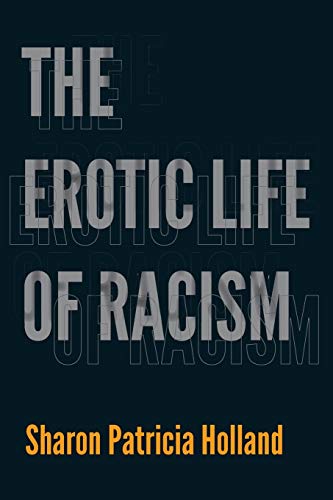
A major intervention in the fields of critical race theory, black feminism, and queer theory, The Erotic Life of Racism contends that theoretical and political analyses of race have largely failed to understand and describe the profound ordinariness of racism and the ways that it operates as a quotidian practice. If racism has an everyday life, how does it remain so powerful and yet mask its very presence? To answer this question, Sharon Patricia Holland moves into the territory of the erotic, understanding racism's practice as constitutive to the practice of racial being and erotic choice.
Reemphasizing the black/white binary, Holland reinvigorates critical engagement with race and racism. She argues that only by bringing critical race theory, queer theory, and black feminist thought into conversation with each other can we fully envision the relationship between racism and the personal and political dimensions of our desire. The Erotic Life of Racism provocatively redirects our attention to a desire no longer independent of racism but rather embedded within it.
Die Inhaltsangabe kann sich auf eine andere Ausgabe dieses Titels beziehen.
Über die Autorin bzw. den Autor
Sharon Patricia Holland is Associate Professor of English at Duke University. She is the author of Raising the Dead: Readings of Death and Black Subjectivity and the coeditor of Crossing Waters, Crossing Worlds: The African Diaspora in Indian Country, both also published by Duke University Press.
Auszug. © Genehmigter Nachdruck. Alle Rechte vorbehalten.
The Erotic Life of Racism
By Sharon Patricia HollandDUKE UNIVERSITY PRESS
Copyright © 2012 Duke University PressAll right reserved.
ISBN: 978-0-8223-5206-8
Contents
Acknowledgments......................................................................................ixintroduction The Last Word on Racism.................................................................1chapter one Race: There's No Place like "Beyond".....................................................17chapter two Desire, or "A Bit of the Other"..........................................................41chapter three S.H.E.: Reproducing Discretion as the Better Part of (Queer) Valor.....................65conclusion Racism's Last Word........................................................................95Notes................................................................................................115Bibliography.........................................................................................147Index................................................................................................161
Chapter One
It seems that race, like the presumption of innocence, the Hippocratic oath, or "till death do us part," is too useful a fiction to dispense with. —Richard Thompson Ford, "What's Queer about Race?""Race" is not what it was. —Paul Gilroy, Against Race
RACE There's No Place like "Beyond"
The rhetorical force of race talk is its ability to invoke that wonderful place called "beyond." If we can divest ourselves of our preoccupation with the past, if we can shed who we are (or have been) to one another, then we can get beyond race. Such joyful overcoming is worthy of a civil rights dirge or a Heideggerian tirade on the ends of (human?) history. But as time ticks on, moving beyond looks a lot like getting over. The particular conundrum here in this desire to move beyond, to get over, race is its reliance upon a future in which we will become, at least discursively, productive. In the wake of Johannes Fabian's classic Time and the Other: How Anthropology Makes Its Object (1983), critics such as Lindon Barrett and Michelle Maria Wright have contributed to the further dismantling of the time/space continuum—otherwise known as the West's progress narrative—and the centrality of black bodies to modernity's reimagining of the white self.
As I noted in the introduction, this peculiar overcoming might have its roots in a somewhat pedantic intelligence about the relationship between black and white. It is precisely because the black subject is mired in space and the white subject represents the full expanse of time that the meeting of the two might be thought of as never actually occurring in the same temporal plane; yet the desire to get over such a meeting is immediate and the recovery is often swift. Exactly how does one move beyond a nonevent? How can this encounter be so important to us if these two never literally meet? Or to put it another way, maybe my encounter with the woman in the Safeway parking lot attests to the problem of relation—we meet all the time, but like Faulkner's Judith and Henry at Sutpen's Hundred the words we exchange when we happen upon our nonhappening serve as "brief staccato sentences like slaps" that reverberate off the walls, corridors, alleyways, and yes, even parking lots around us. This persistent ordering of such a meeting (one that we usually show up to with script in hand) might lead us to understand the fervent desire to move beyond an encounter that has in fact already occurred in the blood, and yet in time and space remains a nonoccurrence.
The (non)happening, and our critical obsession with its potentiality, marks a strange and schizophrenic approach to the very idea of relation. In racist ordering, relation is defined as those who shape time and those who stand outside it, as those who belong to your people, and those who do not. Only grave trespass can produce another order altogether. What makes that parking lot scene so compelling to me is that although my female counterpart certainly wanted to order time for me by manipulating the space I occupied ("move your car please"), she became the one who turned back the clock, thus changing the terms of the relationship. That confrontation illuminates the way in which racist logic ensnares even the racist trying desperately to declare the order of things, verbally or physically. By refusing to move in that Bartleby the Scrivener way—politely, I preferred "not to"—I challenged her to find another way to move me. And she did; but not without giving up her own stronghold on time's order of things. To move me she had to situate me in a discourse I would recognize, and in that one moment she looked back past me. Like a rider on a difficult horse, she tried to bring me up under her so that we could move forward—a move that in equestrian parlance equals mastery. In that instance, she touched on the mysterious life force of racist endeavor: in constantly trying to align the world according to a particular ordering, it arrests time rather than attests to its futurity. For her beyond race is nothing of the sort—it is just an order of things in which black (radical) yields to white (liberal). Theoretically speaking, beyond signals a very dangerous turn for antiracist struggle as it reifies nonrelation while simultaneously reinscribing the past (one's history) in a master-slave dialectic. Such is the order of things.
If relation technically happens (two persons, black and white, face to face) but never occurs given the time/space split, then what Eduardo Bonilla-Silva observes holds great purchase on my following review of work in "race" studies. As he notes: "People cannot like or love people they don't see or interact with. This truism has been corroborated by social psychologists, who for years have maintained that friendship and love emerge when people share activities, proximity, familiarity, and status." While reorganizing "status" under capitalism in the United States might be more than a small challenge, it is not difficult to see that proximity and familiarity can create the conditions to overcome racist practice. Or do they? What if proximity and familiarity don't create a level playing field of difference, but instead replicate the terms upon which difference is articulated and therefore maintained? What if our coming together (all the time) is the thing that we continue not to see as the lie of nonrelation and difference rolls off our tongues each time we say who we are and where we come from?
In the last two decades of humanities scholarship on race and racism, proponents on either side of an increasingly widening gap have moved through the terrains of racialization as social construction, identity politics, critical race theory, and genetics and genomics in order to understand what constitutes so fraught a belonging. For example, as Antonia Darder and Rodolfo Torres, in their own formulation of racism, announce: "In our analysis 'race,' simply put, is the child of racism." By placing race in pseudo-biological relationship with racism, Darder and Torres metaphorically reify the problem of biological relationship that makes studies of race and racism so difficult to manage. Settling the problem of biological belonging is the psychic life of race, and race work is always already performed by quotidian racism. My project gives depth and shape to the work of racism, arguing first and foremost, as have other Americanists, that...
„Über diesen Titel“ kann sich auf eine andere Ausgabe dieses Titels beziehen.
Suchergebnisse für The Erotic Life of Racism

Beispielbild für diese ISBN
The Erotic Life of Racism
Anbieter: World of Books (was SecondSale), Montgomery, IL, USA
Verkäuferbewertung 5 von 5 Sternen

Paperback. Zustand: Good. In this critique of the fields of feminist theory, queer theory, and critical race theory, Sharon Holland describes how, despite decades of theoretical and political work focused on race, we are continually affected by everyday experiences of racism and attached to old patterns of racist thought. Artikel-Nr. 00104239621
Gebraucht kaufen
EUR 8,17
Versand gratis
Versand innerhalb von USA
Versand innerhalb von USA
Anzahl: 1 verfügbar
Beispielbild für diese ISBN
The Erotic Life of Racism
Anbieter: AwesomeBooks, Wallingford, Vereinigtes Königreich
Verkäuferbewertung 5 von 5 Sternen
Paperback. Zustand: Very Good. The Erotic Life of Racism This book is in very good condition and will be shipped within 24 hours of ordering. The cover may have some limited signs of wear but the pages are clean, intact and the spine remains undamaged. This book has clearly been well maintained and looked after thus far. Money back guarantee if you are not satisfied. See all our books here, order more than 1 book and get discounted shipping. Artikel-Nr. 7719-9780822352068
Gebraucht kaufen
EUR 9,95
EUR 4,89 Versand
Versand von Vereinigtes Königreich nach USA
Versand von Vereinigtes Königreich nach USA
Anzahl: 2 verfügbar
Foto des Verkäufers
The Erotic Life of Racism
Anbieter: WeBuyBooks, Rossendale, LANCS, Vereinigtes Königreich
Verkäuferbewertung 5 von 5 Sternen
paperback. Zustand: Good. Most items will be dispatched the same or the next working day. A copy that has been read but remains in clean condition. All of the pages are intact and the cover is intact and the spine may show signs of wear. The book may have minor markings which are not specifically mentioned. Annotations to some page edges/pages, may include notes, highlighting or underlining. Artikel-Nr. rev3374057838
Gebraucht kaufen
EUR 8,15
EUR 8,49 Versand
Versand von Vereinigtes Königreich nach USA
Versand von Vereinigtes Königreich nach USA
Anzahl: 1 verfügbar
Beispielbild für diese ISBN
The Erotic Life of Racism
Verlag:
Duke University Press 01/r /13 A, 2012
ISBN 10: 0822352060
ISBN 13: 9780822352068
Gebraucht
Paperback
Anbieter: Bahamut Media, Reading, Vereinigtes Königreich
Verkäuferbewertung 4 von 5 Sternen

Paperback. Zustand: Very Good. Shipped within 24 hours from our UK warehouse. Clean, undamaged book with no damage to pages and minimal wear to the cover. Spine still tight, in very good condition. Remember if you are not happy, you are covered by our 100% money back guarantee. Artikel-Nr. 6545-9780822352068
Gebraucht kaufen
EUR 13,07
EUR 8,29 Versand
Versand von Vereinigtes Königreich nach USA
Versand von Vereinigtes Königreich nach USA
Anzahl: 1 verfügbar
Beispielbild für diese ISBN
The Erotic Life of Racism
Anbieter: Better World Books, Mishawaka, IN, USA
Verkäuferbewertung 5 von 5 Sternen
Zustand: Good. Pages intact with minimal writing/highlighting. The binding may be loose and creased. Dust jackets/supplements are not included. Stock photo provided. Product includes identifying sticker. Better World Books: Buy Books. Do Good. Artikel-Nr. GRP98101899
Gebraucht kaufen
EUR 21,61
Versand gratis
Versand innerhalb von USA
Versand innerhalb von USA
Anzahl: 1 verfügbar
Beispielbild für diese ISBN
The Erotic Life of Racism
Verlag:
Duke University Press, Durham, 2012
ISBN 10: 0822352060
ISBN 13: 9780822352068
Gebraucht
Soft cover
Erstausgabe
Anbieter: Bookplate, Chestertown, MD, USA
Verkäuferbewertung 4 von 5 Sternen
Soft cover. Zustand: As New. 1st Edition. As new. BP/Race. Artikel-Nr. ABE-1631585533733
Gebraucht kaufen
EUR 18,35
EUR 7,57 Versand
Versand innerhalb von USA
Versand innerhalb von USA
Anzahl: 1 verfügbar
Beispielbild für diese ISBN
The Erotic Life of Racism
Anbieter: Kennys Bookstore, Olney, MD, USA
Verkäuferbewertung 5 von 5 Sternen
Zustand: New. A work of Black queer feminist theory that examines the intertwined histories of critical race theory, queer theory, and Black feminism, histories which could not have been formed in the same way without each other, but which are often held at a respectful distance. Num Pages: 184 pages. BIC Classification: JFFK; JFSK; JHMP. Category: (P) Professional & Vocational. Dimension: 234 x 153 x 11. Weight in Grams: 270. . 2012. Paperback. . . . . Books ship from the US and Ireland. Artikel-Nr. V9780822352068
Neu kaufen
EUR 42,49
EUR 9,35 Versand
Versand innerhalb von USA
Versand innerhalb von USA
Anzahl: Mehr als 20 verfügbar
Beispielbild für diese ISBN
The Erotic Life of Racism
Anbieter: Ria Christie Collections, Uxbridge, Vereinigtes Königreich
Verkäuferbewertung 5 von 5 Sternen
Zustand: New. In English. Artikel-Nr. ria9780822352068_new
Neu kaufen
EUR 49,07
EUR 11,13 Versand
Versand von Vereinigtes Königreich nach USA
Versand von Vereinigtes Königreich nach USA
Anzahl: Mehr als 20 verfügbar
Beispielbild für diese ISBN
The Erotic Life of Racism: The Erotic Life of Racism
Anbieter: Revaluation Books, Exeter, Vereinigtes Königreich
Verkäuferbewertung 5 von 5 Sternen
Paperback. Zustand: Brand New. 184 pages. 9.00x6.00x0.25 inches. In Stock. Artikel-Nr. x-0822352060
Neu kaufen
EUR 48,40
EUR 11,88 Versand
Versand von Vereinigtes Königreich nach USA
Versand von Vereinigtes Königreich nach USA
Anzahl: 2 verfügbar
Foto des Verkäufers
The Erotic Life of Racism
Anbieter: moluna, Greven, Deutschland
Verkäuferbewertung 5 von 5 Sternen
Kartoniert / Broschiert. Zustand: New. In this critique of the fields of feminist theory, queer theory, and critical race theory, Sharon Holland describes how, despite decades of theoretical and political work focused on race, we are continually affected by everyday experiences of racism and att. Artikel-Nr. 530191090
Neu kaufen
EUR 37,83
EUR 48,99 Versand
Versand von Deutschland nach USA
Versand von Deutschland nach USA
Anzahl: Mehr als 20 verfügbar