
Verwandte Artikel zu The Flower and the Scorpion: Sexuality and Ritual in...
The Flower and the Scorpion: Sexuality and Ritual in Early Nahua Culture (Latin America Otherwise) - Softcover
Buch 52 von 58: Latin America Otherwise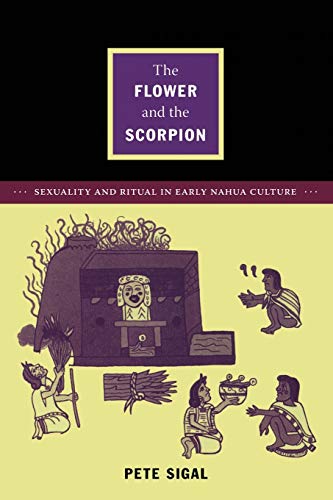
Inhaltsangabe
Prior to the Spanish conquest, the Nahua indigenous peoples of central Mexico did not have a notion of "sex" or "sexuality" equivalent to the sexual categories developed by colonial society or those promoted by modern Western peoples. In this innovative ethnohistory, Pete Sigal seeks to shed new light on Nahua concepts of the sexual without relying on the modern Western concept of sexuality. Along with clerical documents and other Spanish sources, he interprets the many texts produced by the Nahua. While colonial clerics worked to impose Catholic beliefs-particularly those equating sexuality and sin-on the indigenous people they encountered, the process of cultural assimilation was slower and less consistent than scholars have assumed. Sigal argues that modern researchers of sexuality have exaggerated the power of the Catholic sacrament of confession to change the ways that individuals understood themselves and their behaviors. At least until the mid-seventeenth century, when increased contact with the Spanish began to significantly change Nahua culture and society, indigenous peoples, particularly commoners, related their sexual lives and imaginations not just to concepts of sin and redemption but also to pleasure, seduction, and rituals of fertility and warfare.
Die Inhaltsangabe kann sich auf eine andere Ausgabe dieses Titels beziehen.
Über die Autorin bzw. den Autor
Pete Sigal
Auszug. © Genehmigter Nachdruck. Alle Rechte vorbehalten.
The FLOWER and the SCORPION
Sexuality and Ritual in Early Nahua CultureBy PETE SIGALDuke University Press
Copyright © 2011 Duke University PressAll right reserved.
ISBN: 978-0-8223-5151-1
Contents
ABOUT THE SERIES.................................................ixILLUSTRATIONS....................................................xiACKNOWLEDGMENTS..................................................xiiiPREFACE The People, the Place, and the Time.....................xv1. The Bath......................................................12. Trash.........................................................293. Sin...........................................................614. The Warrior Goddess...........................................1035. The Phallus and the Broom.....................................1396. The Homosexual 17.............................................77. Sex...........................................................2078. Mirrors.......................................................241APPENDIX The Chalca Woman's Song................................255ABBREVIATIONS....................................................263NOTES............................................................265BIBLIOGRAPHY.....................................................327INDEX............................................................353
Chapter One
THE BATH
A mid-sixteenth-century rendition of the Nahua temazcal, a steam bath (figure 1), depicts a relatively minor structure, but it signifies both the difficulties that Spaniards had understanding Nahua sexual activity and the ambiguities involved in writing about Nahua sexuality when the Nahuas did not have a category that one can translate as "sex" or "sexuality"; the image of the temazcal thus serves as an icon for the thesis of this book. Reproduced in a codex written under the auspices of Franciscan friars and copied from a prototype produced by a Nahua painter-writer, the image foregrounds the many layers of interpretation modern scholars must use to derive meaning from such a source.
Tlazolteotl, whose image appears above the small door to the steam bath, and who is the most important goddess discussed in this book, guarded the temazcal, a place intended to cure individuals but one that many Catholic priests argued fomented sexual sin by allowing for secret sexual liaisons. Tlazolteotl, the "deity of trash," guarded the steam bath because she, along with a series of related fertility goddesses, controlled the process in which individuals cleansed themselves, both metaphorically, through ritual, and literally, through washing one's body. The Nahuas did not distinguish between the metaphorical and literal cleanings, because when one cleaned oneself, one also kept at bay all of the other things signified by the term tlazolli, which I translate here as "trash." As we will see, it is precisely this tlazolli that allows me to analyze colonial Nahua sexuality. Furthermore, the difficulties of translating tlazolli and of understanding the social significance of Tlazolteotl form the core problematics of this book.
Nahuas did not have a category that a modern scholar can responsibly equate with all the things that are meant when one uses the category "sexuality." By analyzing Nahua fertility rituals as they existed at the time of the conquest and discussing the changes in the structures of these rituals through the early colonial years, I will show that neither the sexual taxonomies developed by colonial society nor those later promoted by modern Western peoples can capture the history of sexuality of the Nahuas.
The paradoxical question faced by all scholars studying sexuality who deal with non-Western or premodern societies is, how does one write a history of sexuality for a society that did not have sex? As others have shown, once a scholar exits the modern Western world, the parameters that define "sexuality" immediately change. One then faces a definitional conundrum reflected in the challenges confronted in this book; I do not wish to replicate the concept of sexuality as defined in the modern West, but neither do I wish to suggest that Nahua notions of the sexual are so esoteric that we cannot ever understand them.
Building upon this concept, this book argues that modern researchers of sexuality, following Michel Foucault, have placed far too much emphasis on the ability of the Roman Catholic sacrament of confession to change the ways in which individuals conceived of themselves and their behaviors. Reading and analyzing all of the available sources, and not only Spanish clerical documents, allow me to argue that this assumption is incorrect. The process of cultural assimilation and appropriation lasted much longer, was slow and inconsistent, and in fact is not yet complete.
The Flower and the Scorpion
Tlazolteotl was one of many fertility deities, and the flower and the scorpion are two representations of sexuality. As we will see, all of the gods and the "natural world" linked to concepts of fertility, and its corollary, waste. Nahua cosmology was a complex amalgam of different concepts in which deities had the ability to transform themselves into virtually anything, and humans and animals under certain circumstances could become gods. Underlying this structure was a particular set of beliefs about the interconnections among the earth, the heavens, and the land of the dead.
Sources vary on the events that led to the division between these three realms, but for my purposes what is most important is that the mythology alludes to a set of powerful deities that asserted a feminine earth and a masculine sky but also allowed them to change genders and identities in order to access relevant levels of the cosmos. The actual substances that made up these gods could be exchanged when the god willed it.
The deities most important to this book had particular qualities that linked them most closely with fertility (Tlazolteotl, Teteo Innan, Toci, Xochiquetzal, Chicomecoatl, Chalchiuhtlicue, Tlaltecuhtli) or warfare (Tezcatlipoca). The deities linked with fertility are most often deemed "female," but we will see that such a gendered identification is deeply flawed. Moreover, while most of the deities linked with warfare are deemed "male," Tezcatplioca's male "identity" is generally overstated. Also important for my purposes are the ambiguously gendered "supernatural" figures linked with death (cihuateteo and tzitzimime).
The gods, in addition to having qualities that linked them to a broader and shared Nahua cosmological universe, were connected with the altepetl, the local Nahua city-state. Hence, for example, Tezcatlipoca (a powerful warrior god worshiped throughout the Nahua universe) was the patron god of Texcoco. Other gods too were patrons of some of the subdivisions of the city-states. Religion, thus, much as in early modern Europe, had both local variants and universal narratives.
According to Nahua cosmology humans came upon the earth, created by the gods after several attempts. These humans needed to respect the gods by performing ritual ceremonies designed to move time forward and thus allow for the continued survival of the deities. These humans had bodies made up of a variety of substances that could be exchanged at particular (ritually important) moments. Moreover, the human body always maintained a very close connection to both the natural world and the world of the gods. Hence a Nahua could not view the human body in isolation from the existence of the...
„Über diesen Titel“ kann sich auf eine andere Ausgabe dieses Titels beziehen.
Suchergebnisse für The Flower and the Scorpion: Sexuality and Ritual in...

Beispielbild für diese ISBN
The Flower and the Scorpion : Sexuality and Ritual in Early Nahua Culture
Anbieter: Better World Books, Mishawaka, IN, USA
Verkäuferbewertung 5 von 5 Sternen

Zustand: Good. Pages intact with minimal writing/highlighting. The binding may be loose and creased. Dust jackets/supplements are not included. Stock photo provided. Product includes identifying sticker. Better World Books: Buy Books. Do Good. Artikel-Nr. 19191829-6
Gebraucht kaufen
EUR 24,77
Versand gratis
Versand innerhalb von USA
Versand innerhalb von USA
Anzahl: 2 verfügbar
Beispielbild für diese ISBN
The Flower and the Scorpion: Sexuality and Ritual in Early Nahua Culture (Latin America Otherwise)
Anbieter: Ria Christie Collections, Uxbridge, Vereinigtes Königreich
Verkäuferbewertung 5 von 5 Sternen
Zustand: New. In English. Artikel-Nr. ria9780822351511_new
Neu kaufen
EUR 43,56
EUR 13,34 Versand
Versand von Vereinigtes Königreich nach USA
Versand von Vereinigtes Königreich nach USA
Anzahl: 2 verfügbar
Beispielbild für diese ISBN
The Flower and the Scorpion. Sexuality and Ritual in Early Nahua Culture.
Anbieter: Kennys Bookstore, Olney, MD, USA
Verkäuferbewertung 5 von 5 Sternen
Zustand: New. Argues that sixteenth century Nahua sexuality cannot be fully understood only through colonial sensibilities and sources. This book examines legal documents, clerical texts, pictorial manuscripts, images and glyphs of Nahua gods and goddesses and descriptions of fertility rituals to show the complexity of Nahua sexuality. Series: Latin America Otherwise. Num Pages: 384 pages, 43 illustrations. BIC Classification: 1KLCM; JFC; JHBK5; JHMC. Category: (P) Professional & Vocational. Dimension: 234 x 155 x 23. Weight in Grams: 544. . 2011. Paperback. . . . . Books ship from the US and Ireland. Artikel-Nr. V9780822351511
Neu kaufen
EUR 54,74
EUR 9,37 Versand
Versand innerhalb von USA
Versand innerhalb von USA
Anzahl: 1 verfügbar
Beispielbild für diese ISBN
The Flower and the Scorpion Sexuality and Ritual in Early Nahua Culture
Anbieter: Revaluation Books, Exeter, Vereinigtes Königreich
Verkäuferbewertung 5 von 5 Sternen
Paperback. Zustand: Brand New. 361 pages. 9.25x6.00x0.75 inches. In Stock. Artikel-Nr. x-082235151X
Neu kaufen
EUR 62,10
EUR 14,77 Versand
Versand von Vereinigtes Königreich nach USA
Versand von Vereinigtes Königreich nach USA
Anzahl: 2 verfügbar