
The Guatemala Reader: History, Culture, Politics (Latin America Readers) - Softcover
Buch 5 von 18: The Latin America Readers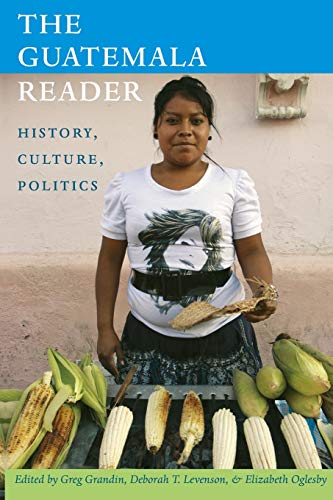
Inhaltsangabe
This reader brings together more than 200 texts and images in a broad introduction to Guatemala's history, culture, and politics. In choosing the selections, the editors sought to avoid representing the country only in terms of its long experience of conflict, racism, and violence. And so, while offering many perspectives on that violence, this anthology portrays Guatemala as a real place where people experience joys and sorrows that cannot be reduced to the contretemps of resistance and repression. It includes not only the opinions of politicians, activists, and scholars, but also poems, songs, plays, jokes, novels, short stories, recipes, art, and photographs that capture the diversity of everyday life in Guatemala. The editors introduce all of the selections, from the first piece, an excerpt from the Popol Vuh, a mid-sixteenth-century text believed to be the single most important source documenting pre-Hispanic Maya culture, through the final selections, which explore contemporary Guatemala in relation to neoliberalism, multiculturalism, and the dynamics of migration to the United States and of immigrant life. Many pieces were originally published in Spanish, and most of those appear in English for the first time.
Die Inhaltsangabe kann sich auf eine andere Ausgabe dieses Titels beziehen.
Über die Autorin bzw. den Autor
Greg Grandin is Professor of History at New York University and a member of the American Academy of Arts and Sciences. He is the author of Fordlandia: The Rise and Fall of Henry Ford's Forgotten Jungle City, a finalist for the Pulitzer Prize in History.
Deborah T. Levenson is Associate Professor of History at Boston College and the author of Trade Unionists against Terror: Guatemala City, 1954-1985 and Adiós Niño: Political Violence and the Gangs of Guatemala City, forthcoming from Duke University Press.
Elizabeth Oglesby is Associate Professor of Geography and Latin American Studies at the University of Arizona. She previously worked as the editor of Central America Report and the associate editor for NACLA Report on the Americas.
Auszug. © Genehmigter Nachdruck. Alle Rechte vorbehalten.
THE GUATEMALA READER
HISTORY, CULTURE, POLITICSBy Greg Grandin Deborah T. Levenson Elizabeth OglesbyDUKE UNIVERSITY PRESS
Copyright © 2011 Duke University PressAll right reserved.
ISBN: 978-0-8223-5107-8
Contents
List of Illustrations........................................xvAcknowledgments..............................................xxiIntroduction.................................................1I The Maya: Before the Europeans.............................11II Invasion and Colonialism..................................39III A Caffeinated Modernism..................................107IV Ten Years of Spring and Beyond............................197V Roads to Revolution........................................281VI Intent to Destroy.........................................361VII An Unsettled Peace.......................................441VIII Maya Movements..........................................501IX The Sixth Century.........................................545Suggestions for Further Reading..............................625Acknowledgment of Copyrights and Sources.....................641Index........................................................653
Chapter One
The Maya: Before the Europeans
Before the Spanish invasion in 1524 and independence from Spain in 1821, no nation called Guatemala existed. Today's Guatemala is part of what was once a far- flung Maya civilization that developed along a backbone of volcanoes in Chiapas, Mexico, extending down into what are now Honduras and El Salvador, and into the lowlands along the limestone shelf that forms the Yucatán Peninsula and the Petén. Since at least 15,000 BC, people in these areas had been planting maize, beans, squashes, and chili peppers, crops that remain central to the Guatemalan diet. Maya city-states appeared in what is now the Valley of Guatemala around 250 BC. The best-known of these ancient settlements is a large, barely excavated site called Kaminaljuyu. Most of this site of hundreds of temples has been lost to bulldozers, brickyards, and expanding neighborhoods; today, fragments of it lay buried under Guatemala City's Zone Seven (Guatemala City is administratively divided into an ever-expanding number of "zones").
The center of this Maya world moved into the lowlands of the northern Petén jungle and what is now Belize. Here, great city-states such as Tikal, Aguateca, Uaxactún, Copán, Caracol, and Naranjo arose in the ad 200s and then declined precipitously after about ad 800 for many interwoven reasons, including land overuse, drought, and endemic internecine war. Scholars still vigorously debate the causes of the Maya city-states' decline as new evidence continues to be gathered through tree-ring data, historical climate modeling, and new archaeological discoveries. Archaeologists and anthropologists once imagined the Maya to be peace-loving folk, but information supplied by newly found murals and the recently acquired ability to read Maya writing reveal that Maya society was wracked by conflict. The Maya had a complex intellectual and spiritual culture about which we know only a fraction. We know that the Maya had the concept of zero and calculated the movements of Venus, the moon, and the sun almost perfectly. The Maya used base-twenty (vigesimal) numeral systems, and Maya languages contain words for vigesimal multiples. The complexities of the Maya calendar reflect its many purposes, which ranged from agriculture to divination. It is believed that within the Maya worldview, time was not linear but rather consisted of cycles of creation and destruction, and it was conceptualized as sacred. What would have been the trajectories of Maya elites and commoners, and of their local and regional cultures, if the Spanish conquistadores, guided by conquered Mexicans, had not arrived in 1524?
In the centuries before the Conquest—which archaeologists divide into a Classic Period (AD 250 to 900) and a Postclassic Period (the tenth through the early sixteenth centuries)—the Maya world became increasingly dispersed. Groups of Mexican origin ruled the Maya Yucatán, and confederations of the K'iche', the Kaqchikel, and (to a lesser extent) the Tz'utujil and Poqomam dominated millions of commoners, farmers, artisans, and hunters in the highlands of Guatemala. The linguistic cohesion of the different groups in this widespread area consisted of closely related but often mutually unintelligible languages, such as the two oldest, Cholan and Yucatec. Their many gods embodied material forces, such as Chak, the god of rain; Aha K'in, the sun god; Itzamná, god of maize; and Chak Chel, old moon goddess and goddess of medicine.
Our knowledge about the pre-Conquest Maya is mediated by scholars interpreting scant primary sources. Only a handful of Maya texts survived the Conquest because the Spaniards destroyed thousands of scroll books full of histories, sciences, songs, and prophecies. As archaeologist Michael Coe says: "It's as if all that posterity knew about us [in the United States] were based on three prayer books and Pilgrim's Progress." Archaeologists deciphered Maya writing only recently (see "Breaking the Maya Code" in this volume) and are now able to read ancient Maya inscriptions set on vertical stone slabs called stelae. Other sources include texts written in the Roman alphabet after the 1524 conquest, such as the Popol Vuh, the Título de Totonicapán, Annals of the Kaqchikel, and the Books of Chilam Balam. Most of these sources provide information about elite politics and cultures; only glimpses of commoners' lives appear, even though strands of their culture survived the trauma of European invasion and remained in everyday spiritualism, household life, agriculture, art, and community values.
Popol Vuh Unknown K'iche' authors
In the mid-1500s, decades after the Spanish invasion, anonymous K'iche' scribes in the town of Santa Cruz (built of stones from the conquered Maya city of Utatlán) wrote down the Popol Vuh, or Council book. The Popol Vuh, often called the "K'iche' Bible," is a creation story believed to be the single most important source documenting Maya culture. The book was written in K'iche' using the Roman alphabet. It was passed down secretly from generation to generation until one of the manuscript's guardians showed it to the Spanish Dominican priest Francisco Ximénez in 1702. Ximénez copied it and translated it into Spanish. The manuscript remained with the Dominicans until the region achieved independence from Spain, and thereafter it traveled. First it was sent to the University of San Carlos, but it was stolen and taken to France by a French abbot at mid- century. It was sold in the 1890s to a US business magnate who deposited it in the Newberry Library in Chicago. It was not until 1941 that a Guatemalan scholar, Adrián Recinos, rescued it from obscurity.
The Popol Vuh tells how the many gods residing in the sky/earth (the K'iche' way of saying "world") in the "prior world"—that is, before the Christians came—went about making human beings. On their first try, the gods made creatures that could only shriek and had no arms. On their second try, the mud the gods were using wouldn't retain a shape. Before making a third attempt, they decided to consult an elderly couple: Xpiyacoc, divine matchmaker, and Xmucané, divine midwife. The couple told the gods to use wood. This worked, but the humans were emotionless, and they were soon destroyed by a hurricane....
„Über diesen Titel“ kann sich auf eine andere Ausgabe dieses Titels beziehen.
Weitere beliebte Ausgaben desselben Titels

Suchergebnisse für The Guatemala Reader: History, Culture, Politics (Latin...

Beispielbild für diese ISBN
The Guatemala Reader: History, Culture, Politics (The Latin America Readers)
Anbieter: World of Books (was SecondSale), Montgomery, IL, USA
Verkäuferbewertung 5 von 5 Sternen

Zustand: Very Good. Item in very good condition! Textbooks may not include supplemental items i.e. CDs, access codes etc. Artikel-Nr. 00106671150
Gebraucht kaufen
EUR 20,77
Versand gratis
Versand innerhalb von USA
Versand innerhalb von USA
Anzahl: 1 verfügbar
Beispielbild für diese ISBN
The Guatemala Reader: History, Culture, Politics (The Latin America Readers)
Verlag:
Duke University Press Books, 2011
ISBN 10: 0822351072
ISBN 13: 9780822351078
Gebraucht
Paperback
Anbieter: Singing Saw Books, Portland, OR, USA
Verkäuferbewertung 5 von 5 Sternen
Paperback. Zustand: As New. Paperback. Nice shape overall. Artikel-Nr. 131129129
Gebraucht kaufen
EUR 22,51
EUR 4,37 Versand
Versand innerhalb von USA
Versand innerhalb von USA
Anzahl: 1 verfügbar
Beispielbild für diese ISBN
The Guatemala Reader
Anbieter: PBShop.store UK, Fairford, GLOS, Vereinigtes Königreich
Verkäuferbewertung 5 von 5 Sternen
PAP. Zustand: New. New Book. Shipped from UK. Established seller since 2000. Artikel-Nr. FW-9780822351078
Neu kaufen
EUR 27,68
EUR 7,95 Versand
Versand von Vereinigtes Königreich nach USA
Versand von Vereinigtes Königreich nach USA
Anzahl: 2 verfügbar
Beispielbild für diese ISBN
The Guatemala Reader History, Culture, Politics
Anbieter: Revaluation Books, Exeter, Vereinigtes Königreich
Verkäuferbewertung 5 von 5 Sternen
Paperback. Zustand: Brand New. 648 pages. 9.25x6.00x2.00 inches. In Stock. Artikel-Nr. __0822351072
Neu kaufen
EUR 32,75
EUR 14,70 Versand
Versand von Vereinigtes Königreich nach USA
Versand von Vereinigtes Königreich nach USA
Anzahl: 2 verfügbar
Beispielbild für diese ISBN
The Guatemala Reader: History, Culture, Politics
Anbieter: Kennys Bookstore, Olney, MD, USA
Verkäuferbewertung 5 von 5 Sternen
Zustand: New. 2011. Paperback. History, Culture, Politics. Series: Latin America Readers. 688 pages, 105 illustrations, 10 colour plates, 1 map. Editor(s): Grandin, Greg; Levenson, Deborah; Oglesby, Elizabeth. Brings together more than 200 texts and images in a broad introduction to Guatemala's history, culture, and politics. Cateogry: (P) Professional & Vocational. BIC Classification: 1KLCG; GTB; HBJK. Dimension: 235 x 162 x 44. Weight: 990. . . . . . Books ship from the US and Ireland. Artikel-Nr. V9780822351078
Neu kaufen
EUR 42,16
EUR 9,18 Versand
Versand innerhalb von USA
Versand innerhalb von USA
Anzahl: 1 verfügbar
Beispielbild für diese ISBN
The Guatemala Reader: History, Culture, Politics (The Latin America Readers)
Anbieter: Majestic Books, Hounslow, Vereinigtes Königreich
Verkäuferbewertung 4 von 5 Sternen

Zustand: New. pp. 688 105 Illus., Map. Artikel-Nr. 3396741
Neu kaufen
EUR 45,33
EUR 7,64 Versand
Versand von Vereinigtes Königreich nach USA
Versand von Vereinigtes Königreich nach USA
Anzahl: 1 verfügbar