
Verwandte Artikel zu Competing Kingdoms: Women, Mission, Nation, and the...
Competing Kingdoms: Women, Mission, Nation, and the American Protestant Empire, 1812–1960 (American Encounters/Global Interactions) - Softcover
Buch 41 von 60: American Encounters/Global Interactions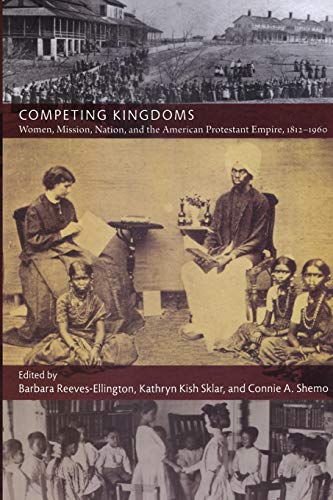
Inhaltsangabe
Competing Kingdoms rethinks the importance of women and religion within U.S. imperial culture from the early nineteenth century to the mid-twentieth. In an era when the United States was emerging as a world power to challenge the hegemony of European imperial powers, American women missionaries strove to create a new Kingdom of God. They did much to shape a Protestant empire based on American values and institutions. This book examines American women's activism in a broad transnational context. It offers a complex array of engagements with their efforts to provide rich intercultural histories about the global expansion of American culture and American Protestantism.
An international and interdisciplinary group of scholars, the contributors bring under-utilized evidence from U.S. and non-U.S. sources to bear on the study of American women missionaries abroad and at home. Focusing on women from several denominations, they build on the insights of postcolonial scholarship to incorporate the agency of the people among whom missionaries lived. They explore how people in China, the Congo Free State, Egypt, India, Japan, Ndebeleland (colonial Rhodesia), Ottoman Bulgaria, and the Philippines perceived, experienced, and negotiated American cultural expansion. They also consider missionary work among people within the United States who were constructed as foreign, including African Americans, Native Americans, and Chinese immigrants. By presenting multiple cultural perspectives, this important collection challenges simplistic notions about missionary cultural imperialism, revealing the complexity of American missionary attitudes toward race and the ways that ideas of domesticity were reworked and appropriated in various settings. It expands the field of U.S. women's history into the international arena, increases understanding of the global spread of American culture, and offers new concepts for analyzing the history of American empire.
Contributors: Beth Baron, Betty Bergland, Mary Kupiec Cayton, Derek Chang, Sue Gronewold, Jane Hunter, Sylvia Jacobs, Susan Haskell Khan, Rui Kohiyama, Laura Prieto, Barbara Reeves-Ellington, Mary Renda, Connie A. Shemo, Kathryn Kish Sklar, Ian Tyrrell, Wendy Urban-Mead
Die Inhaltsangabe kann sich auf eine andere Ausgabe dieses Titels beziehen.
Über die Autorin bzw. den Autor
Barbara Reeves-Ellington is Associate Professor of History at Siena College in Loudonville, New York.
Kathryn Kish Sklar is Distinguished Professor of History at the State University of New York, Binghamton.
Connie A. Shemo is Assistant Professor of History at the State University of New York, Plattsburgh.
Von der hinteren Coverseite
"This rich, diverse collection of essays illuminates women's pivotal role in the Protestant missions that were at the center of Americans' interactions with Asia, Africa, and the Middle East in the nineteenth century and early twentieth. Throughout the pieces, readers witness the women that made missions possible--not only as missionaries, but also as sponsors and audiences--navigating the tensions and intersections between ideals and practices of spiritual equality and those of patriarchy, empire, and race, enlisting and challenging gendered conventions in the process. This volume will prove an indispensable guide in the effort to bring gender analysis, religious culture, and women's agency into an internationalized historiography of the United States."--Paul A. Kramer, author of "The Blood of Government: Race, Empire, the United States and the Philippines"
Auszug. © Genehmigter Nachdruck. Alle Rechte vorbehalten.
COMPETING KINGDOMS
Women, Mission, Nation, and the American Protestant Empire, 1812-1960DUKE UNIVERSITY PRESS
Copyright © 2010 Duke University PressAll right reserved.
ISBN: 978-0-8223-4650-0
Contents
Acknowledgments..............................................................................................................................................................................xiIntroduction Barbara Reeves-Ellington, Kathryn Kish Sklar, and Connie A. Shemo..............................................................................................................1Women's Mission in Historical Perspective American Identity and Christian Internationalism Jane H. Hunter..................................................................................19Woman, Missions, and Empire New Approaches to American Cultural Expansion Ian Tyrrell......................................................................................................43Canonizing Harriet Newell Women, the Evangelical Press, and the Foreign Mission Movement in New England, 1800-1840 Mary Kupiec Cayton......................................................69An Unwomanly Woman and Her Sons in Christ Faith, Empire, and Gender in Colonial Rhodesia, 1899-1906 Wendy Urban-Mead.......................................................................94"So Thoroughly American" Gertrude Howe, Kang Cheng, and Cultural Imperialism in the Woman's Foreign Missionary Society, 1872-1931 Connie A. Shemo..........................................117From Redeemers to Partners American Women Missionaries and the "Woman Question" in India, 1919-1939 Susan Haskell Khan.....................................................................141Settler Colonists, "Christian Citizenship," and the Women's Missionary Federation at the Bethany Indian Mission in Wittenberg, Wisconsin, 1884-1934 Betty Ann Bergland.....................167New Life, New Faith, New Nation, New Women Competing Models at the Door of Hope Mission in Shanghai Sue Gronewold..........................................................................195"No Nation Can Rise Higher than Its Women" The Women's Ecumenical Missionary Movement and Tokyo Woman's Christian College Rui Kohiyama.....................................................218Nile Mother Lillian Trasher and the Orphans of Egypt Beth Baron............................................................................................................................240Embracing Domesticity Women, Mission, and Nation Building in Ottoman Europe, 1832-1872 Barbara Reeves-Ellington............................................................................269Imperial Encounters at Home Women, Empire, and the Home Mission Project in Late Nineteenth-Century America Derek Chang.....................................................................293Three African American Women Missionaries in the Congo, 1887-1899 The Confluence of Race, Culture, Identity, and Nationality Sylvia M. Jacobs..............................................318"Stepmother America" The Woman's Board of Missions in the Philippines, 1902-1930 Laura R. Prieto...........................................................................................342Conclusion. Doing Everything Religion, Race, and Empire in the U.S. Protestant Women's Missionary Enterprise, 1812-1960 Mary A. Renda......................................................367Selected Bibliography........................................................................................................................................................................391Contributors.................................................................................................................................................................................397Index........................................................................................................................................................................................401
Chapter One
WOMEN'S MISSION IN HISTORICAL PERSPECTIVEAmerican Identity and Christian Internationalism
Jane H. Hunter
The events of the early twenty-first century present a challenge to historians of the United States as well as to scholars in political science, international relations, and the history of the Middle East. While the world history movement has swept up our colleagues in European, Asian, and African history, Americanists have too often remained stuck within the stories of the American continent, content to take advantage of the oceans on the east and west to disregard the global context which has governed American history, just as it has the histories of other nations around the world. Though most American historians today would disavow any notion of American exceptionalism-any notion that the nation's founding political documents have somehow sanitized American national projects-the failure of American historians to engage with larger international frameworks has allowed their students and readers to retain naive notions about the unique righteousness of the American role in the world. American historians now confront an urgent responsibility to insert American power, both hard and soft, back in the national story so that all Americans can develop a fuller understanding of its global consequences.
The erasure of the history of American foreign relations from the stories historians tell is an unfortunate and paradoxical result of the new American history. During the late twentieth century, the historical study of the American people was revolutionized, illuminated by the penetrating insights of social history and, more recently, by the creativity of a new group of cultural historians. The social historical turn, then the linguistic turn and the new cultural history have been enormously fruitful, but they have often restricted their focus to Americans' national land mass, indeed the site of ample drama and conflict. This golden age of American history has come at a cost. With the exception of continued attention to the century's wars, including the Cold War, American history textbooks have cut back their attention to what has been considered old-fashioned diplomatic history to showcase the dramatic insights of social history. The events of 9/11 and thereafter have shown American historians, along with other academics, the cost of Americans' ignorance about their country's global presence.
One exception to American ignorance has been the ongoing obsession of Americans with the Vietnam legacy-a scab that American writers, filmmakers, and politicians continue to pick at, even as the Vietnamese people themselves move on. The question of what Americans should have learned from the Vietnam War remains contested terrain, especially salient for a nation confronting the agonies and errors of Iraq. Certainly it influenced historians who came of age during the years of the Vietnam War. A generation of Vietnam scholars reflected on the ways in which the framework of the Cold War distorted the vision of American policy-makers, who misinterpreted the nationalist desires of a people subjected to a series of colonial masters. David Halberstam's The Best and the Brightest (1972) summarized the puzzlement of my parents' generation upon discovering that the best minds in the United States were inadequate to the task of understanding the ongoing conflict in Southeast Asia.
This was the context in which I wrote my decades-old missionary book, Gospel of...
„Über diesen Titel“ kann sich auf eine andere Ausgabe dieses Titels beziehen.
Suchergebnisse für Competing Kingdoms: Women, Mission, Nation, and the...

Beispielbild für diese ISBN
Competing Kingdoms: Women, Mission, Nation, and the American Protestant Empire, 1812-1960 (American Encounters/Global Interactions)
Anbieter: World of Books (was SecondSale), Montgomery, IL, USA
Verkäuferbewertung 5 von 5 Sternen

Zustand: Very Good. Item in very good condition! Textbooks may not include supplemental items i.e. CDs, access codes etc. Artikel-Nr. 00098588960
Gebraucht kaufen
EUR 6,41
Versand gratis
Versand innerhalb von USA
Versand innerhalb von USA
Anzahl: 1 verfügbar
Beispielbild für diese ISBN
Competing Kingdoms: Women, Mission, Nation, and the American Protestant Empire, 1812-1960 (American Encounters/Global Interactions)
Anbieter: Wonder Book, Frederick, MD, USA
Verkäuferbewertung 5 von 5 Sternen
Zustand: As New. Like New condition. A near perfect copy that may have very minor cosmetic defects. Artikel-Nr. F13F-03470
Gebraucht kaufen
EUR 6,42
Versand gratis
Versand innerhalb von USA
Versand innerhalb von USA
Anzahl: 1 verfügbar
Beispielbild für diese ISBN
Competing Kingdoms : Women, Mission, Nation, and the American Protestant Empire, 1812-1960
Anbieter: Better World Books, Mishawaka, IN, USA
Verkäuferbewertung 5 von 5 Sternen
Zustand: Good. Pages intact with minimal writing/highlighting. The binding may be loose and creased. Dust jackets/supplements are not included. Stock photo provided. Product includes identifying sticker. Better World Books: Buy Books. Do Good. Artikel-Nr. 11948735-6
Gebraucht kaufen
EUR 8,56
Versand gratis
Versand innerhalb von USA
Versand innerhalb von USA
Anzahl: 1 verfügbar
Beispielbild für diese ISBN
Competing Kingdoms: Women, Mission, Nation, and the American Protestant Empire, 1812-1960 (American Encounters/Global Interactions)
Verlag:
Duke University Press, 2010
ISBN 10: 0822346508
ISBN 13: 9780822346500
Gebraucht
Paperback
Erstausgabe
Anbieter: Powell's Bookstores Chicago, ABAA, Chicago, IL, USA
Verkäuferbewertung 5 von 5 Sternen
Paperback. Zustand: Used-Very Good. First Edition. Pap. Minor shelf-wear. Artikel-Nr. 1796093
Gebraucht kaufen
EUR 8,27
EUR 4,46 Versand
Versand innerhalb von USA
Versand innerhalb von USA
Anzahl: 1 verfügbar
Beispielbild für diese ISBN
Competing Kingdoms: Women, Mission, Nation, and the American Protestant Empire, 1812-1960 (American Encounters/Global Interactions)
Anbieter: Phatpocket Limited, Waltham Abbey, HERTS, Vereinigtes Königreich
Verkäuferbewertung 5 von 5 Sternen
Zustand: Good. Your purchase helps support Sri Lankan Children's Charity 'The Rainbow Centre'. Ex-library, so some stamps and wear, but in good overall condition. Our donations to The Rainbow Centre have helped provide an education and a safe haven to hundreds of children who live in appalling conditions. Artikel-Nr. Z1-K-002-02324
Gebraucht kaufen
EUR 18,22
EUR 12,59 Versand
Versand von Vereinigtes Königreich nach USA
Versand von Vereinigtes Königreich nach USA
Anzahl: 1 verfügbar
Beispielbild für diese ISBN
Competing Kingdoms
Anbieter: PBShop.store UK, Fairford, GLOS, Vereinigtes Königreich
Verkäuferbewertung 5 von 5 Sternen
PAP. Zustand: New. New Book. Shipped from UK. Established seller since 2000. Artikel-Nr. FW-9780822346500
Neu kaufen
EUR 38,08
EUR 5,94 Versand
Versand von Vereinigtes Königreich nach USA
Versand von Vereinigtes Königreich nach USA
Anzahl: 1 verfügbar
Beispielbild für diese ISBN
Competing Kingdoms: Women, Mission, Nation, and the American Protestant Empire, 1812-1960 (American Encounters/Global Interactions)
Anbieter: Ria Christie Collections, Uxbridge, Vereinigtes Königreich
Verkäuferbewertung 5 von 5 Sternen
Zustand: New. In English. Artikel-Nr. ria9780822346500_new
Neu kaufen
EUR 43,64
EUR 13,36 Versand
Versand von Vereinigtes Königreich nach USA
Versand von Vereinigtes Königreich nach USA
Anzahl: 1 verfügbar
Beispielbild für diese ISBN
Competing Kingdoms: Women, Mission, Nation, and the American Protestant Empire, 1812?1960
Anbieter: Kennys Bookstore, Olney, MD, USA
Verkäuferbewertung 5 von 5 Sternen
Zustand: New. A collection exploring how American women missionaries spread U.S. cultural imperialism along with Protestant Christianity from the early nineteenth century to the mid-twentieth, and how their work was received. Editor(s): Reeves-Ellington, Barbara; Sklar, Kathryn Kish; Shemo, Connie Anne. Series: American Encounters/Global Interactions. Num Pages: 432 pages, 32 illustrations. BIC Classification: 1KBB; HBTQ; HRCX7; JFSJ1; JPS. Category: (P) Professional & Vocational; (U) Tertiary Education (US: College). Dimension: 233 x 157 x 28. Weight in Grams: 630. . 2010. Paperback. . . . . Books ship from the US and Ireland. Artikel-Nr. V9780822346500
Neu kaufen
EUR 54,79
EUR 9,36 Versand
Versand innerhalb von USA
Versand innerhalb von USA
Anzahl: 1 verfügbar
Beispielbild für diese ISBN
Competing Kingdoms
Anbieter: Majestic Books, Hounslow, Vereinigtes Königreich
Verkäuferbewertung 4 von 5 Sternen

Zustand: New. pp. 432 32 Illus. Artikel-Nr. 7952986
Neu kaufen
EUR 64,44
EUR 7,69 Versand
Versand von Vereinigtes Königreich nach USA
Versand von Vereinigtes Königreich nach USA
Anzahl: 1 verfügbar
Beispielbild für diese ISBN
Competing Kingdoms Women, Mission, Nation, and the American Protestant Empire, 18121960
Anbieter: Revaluation Books, Exeter, Vereinigtes Königreich
Verkäuferbewertung 5 von 5 Sternen
Paperback. Zustand: Brand New. 432 pages. 9.00x5.75x1.00 inches. In Stock. Artikel-Nr. x-0822346508
Neu kaufen
EUR 62,88
EUR 14,79 Versand
Versand von Vereinigtes Königreich nach USA
Versand von Vereinigtes Königreich nach USA
Anzahl: 2 verfügbar