
Verwandte Artikel zu Emergence and Embodiment: New Essays on Second-Order...
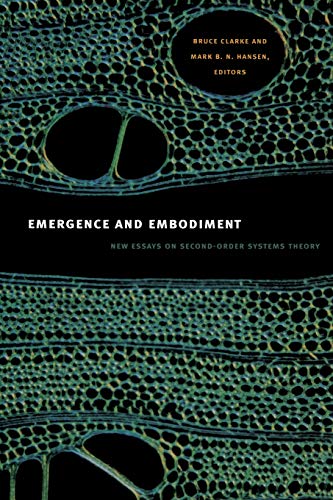
Emergence and Embodiment: New Essays on Second-Order Systems Theory (Science and Cultural Theory) - Softcover
Inhaltsangabe
Emerging in the 1940s, the first cybernetics-the study of communication and control systems-was mainstreamed under the names artificial intelligence and computer science and taken up by the social sciences, the humanities, and the creative arts. In Emergence and Embodiment, Bruce Clarke and Mark B. N. Hansen focus on cybernetic developments that stem from the second-order turn in the 1970s, when the cyberneticist Heinz von Foerster catalyzed new thinking about the cognitive implications of self-referential systems. The crucial shift he inspired was from first-order cybernetics' attention to homeostasis as a mode of autonomous self-regulation in mechanical and informatic systems, to second-order concepts of self-organization and autopoiesis in embodied and metabiotic systems. The collection opens with an interview with von Foerster and then traces the lines of neocybernetic thought that have followed from his work.
In response to the apparent dissolution of boundaries at work in the contemporary technosciences of emergence, neocybernetics observes that cognitive systems are operationally bounded, semi-autonomous entities coupled with their environments and other systems. Second-order systems theory stresses the recursive complexities of observation, mediation, and communication. Focused on the neocybernetic contributions of von Foerster, Francisco Varela, and Niklas Luhmann, this collection advances theoretical debates about the cultural, philosophical, and literary uses of their ideas. In addition to the interview with von Foerster, Emergence and Embodiment includes essays by Varela and Luhmann. It engages with Humberto Maturana's and Varela's creation of the concept of autopoiesis, Varela's later work on neurophenomenology, and Luhmann's adaptations of autopoiesis to social systems theory. Taken together, these essays illuminate the shared commitments uniting the broader discourse of neocybernetics.
Contributors. Linda Brigham, Bruce Clarke, Mark B. N. Hansen, Edgar Landgraf, Ira Livingston, Niklas Luhmann, Hans-Georg Moeller, John Protevi, Michael Schiltz, Evan Thompson, Francisco J. Varela, Cary Wolfe
Die Inhaltsangabe kann sich auf eine andere Ausgabe dieses Titels beziehen.
Über die Autorin bzw. den Autor
Bruce Clarke is Professor of English at Texas Tech University and a past president of the Society for Literature, Science, and the Arts. His books include Posthuman Metamorphosis: Narrative and Systems and Energy Forms: Allegory and Science in the Era of Classical Thermodynamics.
Mark B. N. Hansen is Professor of Literature at Duke University. He is the author of New Philosophy for New Media and Bodies in Code: Interfaces with Digital Media.
Von der hinteren Coverseite
""Emergence and Embodiment" provides a useful overview and detailed analyses of the complex field of neocybernetics and its major thinkers. It indicates the significance and breadth of interdisciplinary work being done in the wake of Humberto Maturana, Francisco Varela, Heinz von Foerster, and George Spencer-Brown, even as it makes demands on its readers to rethink some of their assumptions about he last forty years of 'theory' in the humanities and the interdisciplinary social sciences."--Robert Markley, author of "Dying Planet: Mars in Science and the Imagination"
Auszug. © Genehmigter Nachdruck. Alle Rechte vorbehalten.
Emergence and Embodiment
New Essays on Second-Order Systems TheoryDuke University Press
Copyright © 2009 Duke University PressAll right reserved.
ISBN: 978-0-8223-4600-5
Contents
Acknowledgments.............................................................................................................................viiIntroduction: Neocybernetic Emergence BRUCE CLARKE AND MARK B. N. HANSEN...................................................................1Interview with Heinz von Foerster INTERVIEWER: BRUCE CLARKE................................................................................26Heinz von Foerster's Demons: The Emergence of Second-Order Systems Theory BRUCE CLARKE.....................................................34The Early Days of Autopoiesis FRANCISCO J VARELA...........................................................................................62Life and Mind: From Autopoiesis to Neurophenomenology EVAN THOMPSON........................................................................77Beyond Autopoiesis: Inflections of Emergence and Politics in Francisco Varela JOHN PROTEVI.................................................94System-Environment Hybrids MARK B. N. HANSEN...............................................................................................113Self-Organization and Autopoiesis NIKLAS LUHMANN...........................................................................................143Space Is the Place: The Laws of Form and Social Systems MICHAEL SCHILTZ....................................................................157Improvisation: Form and Event-A Spencer-Brownian Calculation EDGAR LANDGRAF................................................................179Communication versus Communion in Modern Psychic Systems: Maturana, Luhmann, and Cognitive Neurology LINDA BRIGHAM.........................205Meaning as Event-Machine, or Systems Theory and "The Reconstruction of Deconstruction": Derrida and Luhmann CARY WOLFE.....................220Complex Visuality: The Radical Middleground IRA LIVINGSTON.................................................................................246Bibliography................................................................................................................................263Contributors................................................................................................................................279Index.......................................................................................................................................281
Chapter One
Interview with Heinz von FoersterJuly 20, 2001, Pescadero, California
INTERVIEWER: BRUCE CLARKE
Family in Vienna
Bruce Clarke: I wanted to ask you about your very unique style, your playful way of putting professional papers together. Did you always write that way?
Heinz von Foerster: I think my answer is that I'm from Vienna. At the time I was born, at the turn of the century, Vienna was so multicultural-fabulous in medicine, in architecture, in art and painting and drawing. Ernst Mach and people like that came from Vienna. My family belonged to this whirlwind of people. My father was an architect with the electric industry but had lots of friends in mathematics and physics. My mother came from an artistic family. Her people were dancers, painters, sculptors, poets, and I was a little kid tossed into this bunch of different people who met at the home of my parents. My grandmother kept a kind of salon where people from different universes met. The actress Eleanor Duse came to the house.
What was your grandmother's name?
Marie Lang. She published the first European journal on women's liberation, and she was therefore known all over Europe.
Did they have the suffrage issue-the women's suffrage movement that began in the nineteenth century?
They were not directly members of it. My grandmother founded something which came from the British suffrage movement ... the settlements, for poor people. And my mother and some of her friends founded one of those settlements in Vienna. So when I was a little boy, staying with my grandmother, sitting under her gigantic desk with big legs, I had my little chair there, and then all the ladies argued about philosophy, women's labor, and the rights of women. So as a kid I was familiar with the political and the cultural problems which arise in a society.
Uncle Ludwig
In many cases people are victims of semantics. They are not aware of what they are saying. My role is to be a semantic cleaning boy, who comes out with a big broom.
That was Wittgenstein's point.
Exactly.
To sweep the pointless arguments off the stage.
Exactly. You see, I was a Wittgenstein victim when I was nineteen or twenty. I think I knew the Tractatus by heart....
Now are you related to Wittgenstein?
Yes, I am related distantly.
You have a cousin named Wittgenstein....
Yes, my grandmother married twice. And from her first marriage there are children that are related directly to Wittgenstein. I knew Uncle Ludwig when I was about eleven or twelve. I think I can even localize the time when I met him. My mother was a very good friend of his sister, Margarethe. They were very, very close. I was with her visiting Aunt Margarethe, and a young man came in. He asked me, "Heinz, what would you like to become when you are grown up?" Now I had just passed a very crucial examination. I wanted to get out of grade school and go into the gymnasium. Wittgenstein asked me what I would like to become, and I said I would like to be a Naturforscher [scientist]. To me that was a combination of Fridtjov Nansen and Madame Curie. He said, but then you have to know a lot. I said, but I know a lot; I just passed the examination. And then he said, you know a lot, but you don't know-how right you are. I said, what? I don't know how right I am? This was my first encounter with Uncle Ludwig.
Later on I became deeply involved in the Tractatus. And there was a nephew, a real nephew of Ludwig's by the name of Karl, who also knew the Tractatus by heart: "Heinz, can you tell me proposition 6.24?" I said, "Of course, that's an easy proposition." "Yes, but Heinz what about 7.1?" ... I was really a pest: "Apologies, ladies and gentlemen; what you are saying is all wrong. According to proposition 2.7 in the Tractatus ... that is the case." They said, "Poor Heinz, what can we do with you?"
Luhmann and Maturana
Were some of your papers driven by the invitations you received?
In most cases it was the consequence of an invitation, either to write a paper or to give a lecture. I tried to strike a balance, to give a paper people should enjoy. I don't want to talk gibberish that nobody understands. Who are these people and what are they interested in and why did they invite me? This is what I ask myself first, and then I sit down and say, what can I tell them?
As it was with the Luhmann thing, you see. They were all academics. I wanted to do two things. Number one, even if you are not a sociologist, you can say very tough things about sociology which are not easy to digest and which are not being observed, even by the sociologists themselves. The other thing is that you can make them laugh. So I had the flower bouquet-the mathematics for afterward.
Is it easy to get a magical bouquet?
Of course, if you are a professional magician, you can produce them. It is no problem. I was in fact looking forward...
„Über diesen Titel“ kann sich auf eine andere Ausgabe dieses Titels beziehen.
Suchergebnisse für Emergence and Embodiment: New Essays on Second-Order...

Beispielbild für diese ISBN
Emergence and Embodiment: New Essays on Second-Order Systems Theory (Science and Cultural Theory)
Anbieter: medimops, Berlin, Deutschland
Verkäuferbewertung 5 von 5 Sternen

Zustand: good. Befriedigend/Good: Durchschnittlich erhaltenes Buch bzw. Schutzumschlag mit Gebrauchsspuren, aber vollständigen Seiten. / Describes the average WORN book or dust jacket that has all the pages present. Artikel-Nr. M00822346001-G
Gebraucht kaufen
EUR 12,12
EUR 10,00 Versand
Versand von Deutschland nach USA
Versand von Deutschland nach USA
Anzahl: 1 verfügbar
Beispielbild für diese ISBN
Emergence and Embodiment: New Essays on Second-Order Systems Theory (Science and Cultural Theory)
Anbieter: Phatpocket Limited, Waltham Abbey, HERTS, Vereinigtes Königreich
Verkäuferbewertung 5 von 5 Sternen
Zustand: Good. Your purchase helps support Sri Lankan Children's Charity 'The Rainbow Centre'. Ex-library, so some stamps and wear, but in good overall condition. Our donations to The Rainbow Centre have helped provide an education and a safe haven to hundreds of children who live in appalling conditions. Artikel-Nr. Z1-C-030-03078
Gebraucht kaufen
EUR 13,65
EUR 12,36 Versand
Versand von Vereinigtes Königreich nach USA
Versand von Vereinigtes Königreich nach USA
Anzahl: 1 verfügbar
Beispielbild für diese ISBN
Emergence and Embodiment - New Essays on Second-Order Systems Theory
Anbieter: PBShop.store UK, Fairford, GLOS, Vereinigtes Königreich
Verkäuferbewertung 5 von 5 Sternen
PAP. Zustand: New. New Book. Shipped from UK. Established seller since 2000. Artikel-Nr. FW-9780822346005
Neu kaufen
EUR 35,26
EUR 4,83 Versand
Versand von Vereinigtes Königreich nach USA
Versand von Vereinigtes Königreich nach USA
Anzahl: 1 verfügbar
Beispielbild für diese ISBN
Emergence and Embodiment: New Essays on Second-Order Systems Theory (Science and Cultural Theory)
Anbieter: Ria Christie Collections, Uxbridge, Vereinigtes Königreich
Verkäuferbewertung 5 von 5 Sternen
Zustand: New. In English. Artikel-Nr. ria9780822346005_new
Neu kaufen
EUR 38,07
EUR 13,11 Versand
Versand von Vereinigtes Königreich nach USA
Versand von Vereinigtes Königreich nach USA
Anzahl: 1 verfügbar
Beispielbild für diese ISBN
Emergence and Embodiment: New Essays on Second-Order Systems Theory
Anbieter: Kennys Bookstore, Olney, MD, USA
Verkäuferbewertung 5 von 5 Sternen
Zustand: New. Explores the cultural legacy of cybernetics and neocybernetics that offers new insight on the role of the human in an era of the posthuman. Editor(s): Clarke, Bruce; Hansen, Mark B. N. Series: Science & Cultural Theory. Num Pages: 296 pages, 12 figures. BIC Classification: GPFC; UYQ. Category: (P) Professional & Vocational. Dimension: 157 x 232 x 18. Weight in Grams: 440. . 2009. Paperback. . . . . Books ship from the US and Ireland. Artikel-Nr. V9780822346005
Neu kaufen
EUR 47,95
EUR 9,23 Versand
Versand innerhalb von USA
Versand innerhalb von USA
Anzahl: 1 verfügbar
Beispielbild für diese ISBN
Emergence and Embodiment New Essays on SecondOrder Systems Theory
Anbieter: Revaluation Books, Exeter, Vereinigtes Königreich
Verkäuferbewertung 5 von 5 Sternen
Paperback. Zustand: Brand New. 285 pages. 9.50x6.25x0.75 inches. In Stock. Artikel-Nr. x-0822346001
Neu kaufen
EUR 52,90
EUR 11,61 Versand
Versand von Vereinigtes Königreich nach USA
Versand von Vereinigtes Königreich nach USA
Anzahl: 2 verfügbar
Foto des Verkäufers
Emergence and Embodiment : New Essays on Second-Order Systems Theory
Verlag:
Duke University Press Okt 2009, 2009
ISBN 10: 0822346001
ISBN 13: 9780822346005
Neu
Taschenbuch
Anbieter: AHA-BUCH GmbH, Einbeck, Deutschland
Verkäuferbewertung 5 von 5 Sternen
Taschenbuch. Zustand: Neu. Neuware - Emerging in the 1940s, the first cybernetics-the study of communication and control systems-was mainstreamed under the names artificial intelligence and computer science and taken up by the social sciences, the humanities, and the creative arts. In Emergence and Embodiment, Bruce Clarke and Mark B. N. Hansen focus on cybernetic developments that stem from the second-order turn in the 1970s, when the cyberneticist Heinz von Foerster catalyzed new thinking about the cognitive implications of self-referential systems. The crucial shift he inspired was from first-order cybernetics' attention to homeostasis as a mode of autonomous self-regulation in mechanical and informatic systems, to second-order concepts of self-organization and autopoiesis in embodied and metabiotic systems. The collection opens with an interview with von Foerster and then traces the lines of neocybernetic thought that have followed from his work.In response to the apparent dissolution of boundaries at work in the contemporary technosciences of emergence, neocybernetics observes that cognitive systems are operationally bounded, semi-autonomous entities coupled with their environments and other systems. Second-order systems theory stresses the recursive complexities of observation, mediation, and communication. Focused on the neocybernetic contributions of von Foerster, Francisco Varela, and Niklas Luhmann, this collection advances theoretical debates about the cultural, philosophical, and literary uses of their ideas. In addition to the interview with von Foerster, Emergence and Embodiment includes essays by Varela and Luhmann. It engages with Humberto Maturana's and Varela's creation of the concept of autopoiesis, Varela's later work on neurophenomenology, and Luhmann's adaptations of autopoiesis to social systems theory. Taken together, these essays illuminate the shared commitments uniting the broader discourse of neocybernetics.Contributors. Linda Brigham, Bruce Clarke, Mark B. N. Hansen, Edgar Landgraf, Ira Livingston, Niklas Luhmann, Hans-Georg Moeller, John Protevi, Michael Schiltz, Evan Thompson, Francisco J. Varela, Cary Wolfe. Artikel-Nr. 9780822346005
Neu kaufen
EUR 53,64
EUR 35,00 Versand
Versand von Deutschland nach USA
Versand von Deutschland nach USA
Anzahl: 1 verfügbar
Foto des Verkäufers
Emergence and Embodiment: New Essays on Second-Order Systems Theory
Anbieter: moluna, Greven, Deutschland
Verkäuferbewertung 5 von 5 Sternen
Zustand: New. Explores the cultural legacy of cybernetics and neocybernetics that offers new insight on the role of the human in an era of the posthuman.Über den AutorBruce Clarke and Mark B. N. Hansen, eds.Inhaltsverzeichnis. Artikel-Nr. 595069569
Neu kaufen
EUR 41,88
EUR 48,99 Versand
Versand von Deutschland nach USA
Versand von Deutschland nach USA
Anzahl: Mehr als 20 verfügbar