
Verwandte Artikel zu Translating Time: Cinema, the Fantastic, and Temporal...
Translating Time: Cinema, the Fantastic, and Temporal Critique (John Hope Franklin Center Book) - Softcover
Buch 23 von 39: a John Hope Franklin Center Book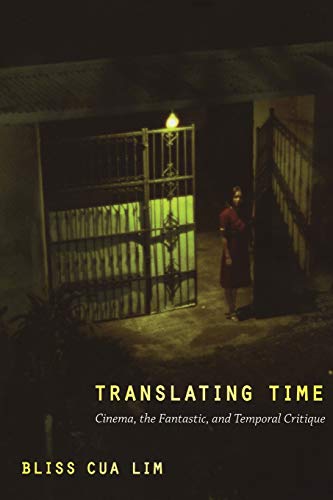
Inhaltsangabe
Under modernity, time is regarded as linear and measurable by clocks and calendars. Despite the historicity of clock-time itself, the modern concept of time is considered universal and culturally neutral. What Walter Benjamin called "homogeneous, empty time" founds the modern notions of progress and a uniform global present in which the past and other forms of time consciousness are seen as superseded. In Translating Time, Bliss Cua Lim argues that fantastic cinema depicts the coexistence of other modes of being alongside and within the modern present, disclosing multiple "immiscible temporalities" that strain against the modern concept of homogeneous time. In this wide-ranging study-encompassing Asian American video (On Cannibalism), ghost films from the New Cinema movements of Hong Kong and the Philippines (Rouge, Itim, Haplos), Hollywood remakes of Asian horror films (Ju-on, The Grudge, A Tale of Two Sisters) and a Filipino horror film cycle on monstrous viscera suckers (Aswang)-Lim conceptualizes the fantastic as a form of temporal translation. The fantastic translates supernatural agency in secular terms while also exposing an untranslatable remainder, thereby undermining the fantasy of a singular national time and emphasizing shifting temporalities of transnational reception. Lim interweaves scholarship on visuality with postcolonial historiography. She draws on Henri Bergson's understanding of cinema as both implicated in homogeneous time and central to its critique, as well as on postcolonial thought linking the ideology of progress to imperialist expansion. At stake in this project are more ethical forms of understanding time that refuse to domesticate difference as anachronism. While supernaturalism is often disparaged as a vestige of primitive or superstitious thought, Lim suggests an alternative interpretation of the fantastic as a mode of resistance to the ascendancy of homogeneous time and a starting-point for more ethical temporal imaginings.
Die Inhaltsangabe kann sich auf eine andere Ausgabe dieses Titels beziehen.
Über die Autorin bzw. den Autor
Bliss Cua Lim is Associate Professor of Film & Media Studies and Visual Studies at the University of California, Irvine.
Von der hinteren Coverseite
"Bliss Cua Lim's extends ideas about the uncanny, the fantastic and the genre we usually call the horror film beyond its usual references to Hollywood and European cinema, which is fully welcome in this new era of global cinema. But it does much more than that. Her consideration of the uncanny and fantastic open up the profoundly untimely nature of fantasy films--and new possibilities for conceiving of the history of cinema."--Tom Gunning, author of "The Films of Fritz Lang: Allegories of Vision and Modernity"
Auszug. © Genehmigter Nachdruck. Alle Rechte vorbehalten.
Translating Time
Cinema, the Fantastic, and Temporal CritiqueBy BLISS CUA LIMDuke University Press
Copyright © 2009 Duke University PressAll right reserved.
ISBN: 978-0-8223-4510-7
Contents
List of Illustrations...........................................................................................iAcknowledgments.................................................................................................iINTRODUCTION Clocks for Seeing Cinema, the Fantastic, and the Critique of Homogeneous Time.....................1CHAPTER 1 Two Modes of Temporal Critique Bergsonism and Postcolonial Thought..................................43CHAPTER 2 The Fantastic as Temporal Translation Aswang and Occult National Times..............................96CHAPTER 3 Spectral Time, Heterogeneous Space The Ghost Film as Historical Allegory............................149CHAPTER 4 The Ghostliness of Genre Global Hollywood Remakes the "Asian Horror Film"...........................190EPILOGUE Writing within Time's Compass From Epistemologies to Ontologies......................................245Notes...........................................................................................................253Bibliography....................................................................................................305Index...........................................................................................................323
Chapter One
Two Modes of Temporal Critique Bergsonism and Postcolonial Thought
The cinema is a legatee of modern homogeneous time. This argument finds its fullest elaboration in the work of Henri Bergson; nevertheless, cinema's entanglement in modern time consciousness is latent in historical accounts of cinema's emergence amid a host of technologies that ushered in profound changes in our apprehension of time and space. The cinema belongs to the shared genealogy of mechanical clock, wireless telegraph, and railroad, that is, to the tendency toward the technical denaturalization, homogenization, and standardization of time.
This chapter is composed of two main sections, the first of which explores the ontological critique of homogeneous time elaborated by Bergson. Beginning with Time and Free Will, written in the years from 1883 to 1887 and published in 1889, Bergson offers a critique of spatialized time contemporaneous with the railroad industry's successful promulgation of standardized public time in the closing decades of the nineteenth century, a rationalized temporality that is still part of our global inheritance today. Bergson offers a corrective theory of time, one that disrupts our habit of thinking time in spatial, numerical terms. Bergson's corrective philosophy of time is emphatically visualist, a visualism that can be grasped in two ways: first, as a suspicion of seeing and of optical technologies. Bergson argues that in order to regard time as homogeneous, one must first visualize an empty space in which increments of time can be laid out for measurement. Similarly, Bergson repeatedly equates spectatorship-watching the clock or the moving images of a cinematograph-with our failure to apprehend the heterogeneity of true duration. We misrecognize our own duration as coinciding with the trajectory of the clock hand, or the movement-in-general of the cinematographic apparatus. Yet Bergsonian visualism, I argue in this chapter, also has a second valence, one that holds out the possibility of forging an alternate route through Bergson's suspicion of vision and the cinema.
Drawing on David N. Rodowick's discussion of Deleuze's Cinema books, I suggest that the visual analogues that suffuse Bergson's writing-photograph, cinematograph, spectatorship-should be construed as historical "images of thought." Such figures are not merely conceptual objects of denunciation; rather, visual analogies enable Bergson's temporal critique and ground the modernity of his approach. Deleuze asks a crucial question of Bergson: has the cinema always been with us? Is it, as Bergson maintained in Creative Evolution, a cipher for the age-old flaws of human perception? Or, to ask Deleuze's question in a different way, could Bergson's temporal critique have been possible prior to the advent of the cinema? An alternative path through Bergson begins with a consideration of the cinema's historicity, its own unforeseeable "creative evolution." Bergson's searing treatment of the cinematograph appeared in print in 1907; a hundred years later, we feel the enduring force and relevance of that critique but are well aware that Bergson's cinema-as reducible to the cinematographic apparatus-is no longer our own. Our global cinema-predominantly narrative, industrialized, and media-convergent, a social institution circulating among diverse publics-is not the mechanical novelty Bergson encountered in the medium's earliest years.
The second part of this chapter traces the emergence of modern time consciousness, a reified time that for Karl Mar levels the qualitative heterogeneity of human labor into abstract labor time; homogeneous labor time lies concealed at the heart of the commodity form. Though the concept of progress, according to Reinhart Koselleck, is minted in the eighteenth century, the decisive ascendancy of a world-historical homogeneous time can be traced to late nineteenth-century and early twentieth-century transformations in the experience of time and space. In the United States, national standard time was operationalized by railway managers in 1883; the following year, the International Meridian Conference inaugurated the worldwide adoption of twenty-four standard time zones calculated from the Greenwich Prime Meridian.
Like Benjamin, Koselleck sees progress as the defining attribute of modern historical consciousness. Both concepts-modern historical time and its central feature, progress-were fired in the furnace of global imperialism from the late fifteenth century onward. In the crucible of empire, the emerging ideology of progress was twinned with its obverse: anachronism. Again and again, colonial expansion and the European encounter with radically heterogeneous worlds were temporalized. Though intractable differences divulged by culture contact always threatened to expose the fiction of a single homogeneous present, such differences were temporally managed by distancing the indigene from the colonizer's present. Koselleck's "contemporaneity of the noncontemporaneous," Fabian's "denial of coevalness," and Chakrabarty's "anachronism" are names for allochronic gestures, tactics of temporal distancing that translate heterogeneity into the terms of homogeneous time.
The cinema is implicated in this modern temporal elitism. As filmmaker-theorist Fatimah Tobing Rony demonstrates, early ethnographic cinema is a kind of time machine that transports the primitive to a "faraway present." This chapter closes with a discussion of Rony's experimental video On Cannibalism, a work that dislodges the rhetoric of anachronism by upholding the force of lived experience. Rony's video exposes the ruse of temporal exclusion and brings both the nineteenth-century ethnographic imagination and the contemporary spectator into the ambit of temporal copresence and accountability toward those encountered as savages.
By orchestrating a conversation between two ways of mounting a critique of homogeneous time-Bergson's ontological method and a...
„Über diesen Titel“ kann sich auf eine andere Ausgabe dieses Titels beziehen.
Suchergebnisse für Translating Time: Cinema, the Fantastic, and Temporal...

Beispielbild für diese ISBN
Translating Time: Cinema, the Fantastic, and Temporal Critique
Anbieter: World of Books (was SecondSale), Montgomery, IL, USA
Verkäuferbewertung 5 von 5 Sternen

Paperback. Zustand: Good. Argues that fantastic cinema depicts the coexistence of other modes of being alongside and within the modern present, disclosing multiple 'immiscible' temporalities that strain against homogeneous time. Artikel-Nr. 00093204562
Gebraucht kaufen
EUR 28,89
Versand gratis
Versand innerhalb von USA
Versand innerhalb von USA
Anzahl: 1 verfügbar
Beispielbild für diese ISBN
Translating Time: Cinema, the Fantastic, and Temporal Critique
Anbieter: Anybook.com, Lincoln, Vereinigtes Königreich
Verkäuferbewertung 5 von 5 Sternen
Zustand: Good. This is an ex-library book and may have the usual library/used-book markings inside.This book has soft covers. In good all round condition. Please note the Image in this listing is a stock photo and may not match the covers of the actual item,700grams, ISBN:9780822345107. Artikel-Nr. 9993552
Gebraucht kaufen
EUR 14,10
EUR 15,84 Versand
Versand von Vereinigtes Königreich nach USA
Versand von Vereinigtes Königreich nach USA
Anzahl: 1 verfügbar
Beispielbild für diese ISBN
Translating Time: Cinema, the Fantastic, and Temporal Critique
Anbieter: Anybook.com, Lincoln, Vereinigtes Königreich
Verkäuferbewertung 5 von 5 Sternen
Zustand: Good. This is an ex-library book and may have the usual library/used-book markings inside.This book has soft covers. In good all round condition. Please note the Image in this listing is a stock photo and may not match the covers of the actual item,650grams, ISBN:9780822345107. Artikel-Nr. 4941379
Gebraucht kaufen
EUR 22,26
EUR 15,84 Versand
Versand von Vereinigtes Königreich nach USA
Versand von Vereinigtes Königreich nach USA
Anzahl: 1 verfügbar
Beispielbild für diese ISBN
Translating Time: Cinema, the Fantastic, and Temporal Critique (A John Hope Franklin Center Book)
Anbieter: AproposBooks&Comics, London, Vereinigtes Königreich
Verkäuferbewertung 4 von 5 Sternen

Soft cover. Zustand: Near Fine. BOOK IS FINE BUT HAS 3 INCH INDENTATION ALONG TOP OF PAGES. Artikel-Nr. 040325/dalwhite/+65+65
Gebraucht kaufen
EUR 23,02
EUR 17,91 Versand
Versand von Vereinigtes Königreich nach USA
Versand von Vereinigtes Königreich nach USA
Anzahl: 1 verfügbar
Foto des Verkäufers
Translating Time : Cinema, the Fantastic, and Temporal Critique
Anbieter: GreatBookPricesUK, Woodford Green, Vereinigtes Königreich
Verkäuferbewertung 5 von 5 Sternen
Zustand: As New. Unread book in perfect condition. Artikel-Nr. 6365748
Gebraucht kaufen
EUR 56,00
EUR 17,97 Versand
Versand von Vereinigtes Königreich nach USA
Versand von Vereinigtes Königreich nach USA
Anzahl: Mehr als 20 verfügbar
Beispielbild für diese ISBN
Translating Time Cinema, the Fantastic, and Temporal Critique
Anbieter: Revaluation Books, Exeter, Vereinigtes Königreich
Verkäuferbewertung 5 von 5 Sternen
Paperback. Zustand: Brand New. 345 pages. 9.00x6.00x0.75 inches. In Stock. Artikel-Nr. x-0822345102
Neu kaufen
EUR 62,49
EUR 14,98 Versand
Versand von Vereinigtes Königreich nach USA
Versand von Vereinigtes Königreich nach USA
Anzahl: 2 verfügbar