
Verwandte Artikel zu Jacques Rancière: History, Politics, Aesthetics
Inhaltsangabe
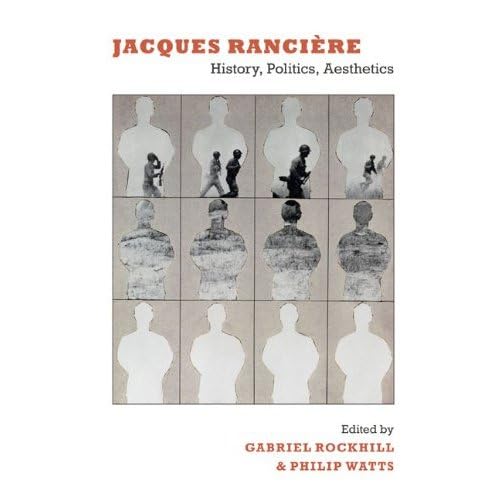
The French philosopher Jacques Rancière has influenced disciplines from history and philosophy to political theory, literature, art history, and film studies. His research into nineteenth-century workers' archives, reflections on political equality, critique of the traditional division between intellectual and manual labor, and analysis of the place of literature, film, and art in modern society have all constituted major contributions to contemporary thought. In this collection, leading scholars in the fields of philosophy, literary theory, and cultural criticism engage Rancière's work, illuminating its originality, breadth, and rigor, as well as its place in current debates. They also explore the relationships between Rancière and the various authors and artists he has analyzed, ranging from Plato and Aristotle to Flaubert, Rossellini, Auerbach, Bourdieu, and Deleuze.
The contributors to this collection do not simply elucidate Rancière's project; they also critically respond to it from their own perspectives. They consider the theorist's engagement with the writing of history, with institutional and narrative constructions of time, and with the ways that individuals and communities can disturb or reconfigure what he has called the "distribution of the sensible." They examine his unique conception of politics as the disruption of the established distribution of bodies and roles in the social order, and they elucidate his novel account of the relationship between aesthetics and politics by exploring his astute analyses of literature and the visual arts. In the collection's final essay, Rancière addresses some of the questions raised by the other contributors and returns to his early work to provide a retrospective account of the fundamental stakes of his project.
Contributors. Alain Badiou, Étienne Balibar, Bruno Bosteels, Yves Citton, Tom Conley, Solange Guénoun, Peter Hallward, Todd May, Eric Méchoulan, Giuseppina Mecchia, Jean-Luc Nancy, Andrew Parker, Jacques Rancière, Gabriel Rockhill, Kristin Ross, James Swenson, Rajeshwari Vallury, Philip Watts
Die Inhaltsangabe kann sich auf eine andere Ausgabe dieses Titels beziehen.
Über die Autorin bzw. den Autor
Garbiel Rockhill is an assistant professor of philosophy at Villanova University. He is edited and translated Jacques Rancière's The Politics of Aesthetics. Philip Watts is an associate professor of French at Columbia University. He is the author of Allegories of the Purge: How Literature Responded to the Postwar Trials of Writers and Intellectuals in France.
Philip Watts is Associate Professor and Chair of the Department of French and Romance Philology at Columbia University. He is the author of Allegories of the Purge.
Von der hinteren Coverseite
"This timely collection of essays should finally jump-start the English-speaking conversation about the work of Jacques Ranciere, one of the most innovative political philosophers now writing. His method of equality, his contrast of a stable 'police' order with 'the political' as an interruption of that order by those invisible within it, and his idea that both politics and art involve modes of distributing/partitioning the sensible together form a unique constellation of radical political thinking."--J. M. Bernstein, New School for Social Research
Auszug. © Genehmigter Nachdruck. Alle Rechte vorbehalten.
JACQUES RANCIRE
HISTORY, POLITICS, AESTHETICSDUKE UNIVERSITY PRESS
Copyright © 2009 Duke University PressAll right reserved.
ISBN: 978-0-8223-4493-3
Contents
Introduction / Jacques Rancire: Thinker of Dissensus GABRIEL ROCKHILL and PHILIP WATTS........................................11. Historicizing Untimeliness KRISTIN ROSS....................................................................................152. The Lessons of Jacques Rancire: Knowledge and Power after the Storm ALAIN BADIOU..........................................303. Sophisticated Continuities and Historical Discontinuities, Or, Why Not Protagoras? ERIC MCHOULAN..........................554. The Classics and Critical Theory in Postmodern France: The Case of Jacques Rancire GIUSEPPINA MECCHIA.....................675. Rancire and Metaphysics JEAN-LUC NANCY....................................................................................836. What Is Political Philosophy? Contextual Notes TIENNE BALIBAR.............................................................957. Rancire in South Carolina TODD MAY........................................................................................1058. Political Agency and the Ambivalence of the Sensible YVES CITTON...........................................................1209. Staging Equality: Rancire's Theatrocracy and the Limits of Anarchic Equality PETER HALLWARD...............................14010. Rancire's Leftism, Or, Politics and Its Discontents BRUNO BOSTEELS........................................................15811. Jacques Rancire's Ethical Turn and the Thinking of Discontents SOLANGE GUNOUN............................................17612. The Politics of Aesthetics: Political History and the Hermeneutics of Art GABRIEL ROCKHILL.................................19513. Cinema and Its Discontents TOM CONLEY......................................................................................21614. Politicizing Art in Rancire and Deleuze: The Case of Postcolonial Literature RAJI VALLURY.................................22915. Impossible Speech Acts: Jacques Rancire's Erich Auerbach ANDREW PARKER....................................................24916. Style indirect libre JAMES SWENSON.........................................................................................258Afterword / The Method of Equality: An Answer to Some Questions JACQUES RANCIRE...............................................273Notes...........................................................................................................................289Bibliography....................................................................................................................327Index...........................................................................................................................341Contributors and Translators....................................................................................................355
Chapter One
Historicizing Untimeliness KRISTIN ROSS
In an essay written shortly after the American war in Iraq began, Jacques Rancire wrote about the seamless integration of capital, state, military, and media power achieved in the United States during the months preceding the invasion. He called the fusion "a perfecting of the plutocratic system." Certainly, those of us who lived through those months in the United States (or-again-the months preceding the 2004 presidential election) can testify to the background noise we heard. It wasn't bombs-these we saw and heard very little of-but rather the media's relentless litany of repeated phrases: "weapons of mass destruction," "Afghani women voting," "evil dictator," and one or two others. But I want to begin by evoking an earlier moment in the history of that seamless integration: the moment in 1983 when Ronald Reagan set up a covert CIA operation bearing a name I think Rancire might appreciate: "Perception Management." Perception Management, unlike other CIA operations, was directed domestically and was, for all intents and purposes, the now-forgotten origin of the media techniques later to be perfected by the George W. Bush administration. Reagan wanted to swing public opinion to support his Central American policies in Nicaragua and El Salvador, and to that end polling was conducted to determine which precise buzzwords and concepts would best turn U.S. citizens against the Sandanistas and get them to support the Contras and the Salvadoran government. In the face of the latest great "third-worldist" cause, the solidarity movements with the peoples of Nicaragua and El Salvador, the idea was to saturate the media with phrases repeated over and over like mantras: the Sandanistas are anti-Semitic, they're drug runners, they discriminate against indigenous peoples, they're terrorists, and so forth-to enormous effect. It is during these years, I think-the early 1980s-that consensus first comes to be taken for granted as the optimum political gesture or goal, with "Perception Management" its more than adequate figure. And it was around this time that I first began to read Rancire's work. Against this ideological backdrop, the untimeliness of his project was strongly perceptible. This is why I'll not focus on Dis-agreement and the recent intellectual developments which, as conferences held in the United Kingdom, Berlin, Cisy, and elsewhere suggest, are now placing Rancire's work at the center of contemporary discussions. I want to go back, rather, to the earlier stages of the project: to Jacotot and The Names of History. For it was in the late 1970s and early 1980s that a generalized offensive against equality, under the cover of a critique of egalitarianism, began to make of equality a synonym for uniformity, for the constraint or alienation of liberty, or for an assault on the free functioning of the market. It is in this context that Rancire's preoccupation with, or recurrent staging of, equality and its verification could be called untimely, or that my own experience reading a book like The Ignorant Schoolmaster could be one of delighted shock-only initially really graspable for me, teaching in central California, as a kind of echo of certain Latin American utopian pedagogical experiments of the 1960s. So although the introduction I wrote to my translation of The Ignorant Schoolmaster created a kind of context for the book out of the French educational policies and debates of the first period of Mitterrand, my own enthusiasm, what made me want to do the translation, was the way Rancire's book seemed to me to resonate, however slightly, with earlier interventions like Ivan Illich's Deschooling Society or Paolo Friere's Pedagogy of the Oppressed.
Now France, of course, like Germany, had no Reagan or Thatcher, which is to say no full-scale ultraconservative restructuring of its economy in the 1980s. Then, as now, a difference can be detected between governments where systems of social protection and solidarity have not been completely dismantled and those, like the United States, where they have. But the 1980s in France were nevertheless what Serge Halimi might call an intensely philo-American time, as France began to accommodate itself to the ascendancy of an American liberal orthodoxy, an orthodoxy in which equality came to be seen as a body of principles which, at best, can be interpreted by a court rather than what Rancire's work insisted on showing it to be: a profoundly political...
„Über diesen Titel“ kann sich auf eine andere Ausgabe dieses Titels beziehen.
Weitere beliebte Ausgaben desselben Titels

Suchergebnisse für Jacques Rancière: History, Politics, Aesthetics

Beispielbild für diese ISBN
Jacques Rancière: History, Politics, Aesthetics
Anbieter: Kennys Bookstore, Olney, MD, USA
Verkäuferbewertung 5 von 5 Sternen

Zustand: New. A collection that examines the work of cultural and political theorist Jacques Ranciere. Editor(s): Rockhill, Gabriel; Watts, Philip. Num Pages: 368 pages. BIC Classification: HPS. Category: (P) Professional & Vocational; (U) Tertiary Education (US: College). Dimension: 5817 x 3887 x 28. Weight in Grams: 645. Lacking dust wrapper. 2009. hardcover. Not a first edition copy. . . . Books ship from the US and Ireland. Artikel-Nr. 9780822344933
Beispielbild für diese ISBN
Jacques Rancià re : History, Politics, Aesthetics
Anbieter: Better World Books, Mishawaka, IN, USA
Verkäuferbewertung 5 von 5 Sternen
Zustand: Good. Pages intact with minimal writing/highlighting. The binding may be loose and creased. Dust jackets/supplements are not included. Stock photo provided. Product includes identifying sticker. Better World Books: Buy Books. Do Good. Artikel-Nr. 57651045-6
Gebraucht kaufen
EUR 15,23
Versand gratis
Versand innerhalb von USA
Versand innerhalb von USA
Anzahl: 1 verfügbar
Beispielbild für diese ISBN
Jacques Ranci?re
Anbieter: PBShop.store UK, Fairford, GLOS, Vereinigtes Königreich
Verkäuferbewertung 5 von 5 Sternen
HRD. Zustand: New. New Book. Shipped from UK. Established seller since 2000. Artikel-Nr. FW-9780822344933
Neu kaufen
EUR 111,20
EUR 5,88 Versand
Versand von Vereinigtes Königreich nach USA
Versand von Vereinigtes Königreich nach USA
Anzahl: 1 verfügbar
Beispielbild für diese ISBN
Jacques Rancière History, Politics, Aesthetics
Anbieter: Revaluation Books, Exeter, Vereinigtes Königreich
Verkäuferbewertung 5 von 5 Sternen
Hardcover. Zustand: Brand New. 392 pages. 9.00x6.25x1.00 inches. In Stock. Artikel-Nr. __0822344939
Neu kaufen
EUR 130,22
EUR 14,63 Versand
Versand von Vereinigtes Königreich nach USA
Versand von Vereinigtes Königreich nach USA
Anzahl: 1 verfügbar