
Verwandte Artikel zu Punishing the Poor: The Neoliberal Government of Social...
Punishing the Poor: The Neoliberal Government of Social Insecurity (Politics, History, and Culture) - Softcover
Buch 33 von 49: Asia-Pacific: Culture, Politics, and Society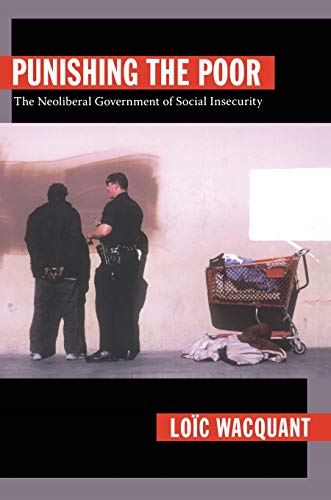
Inhaltsangabe
The punitive turn of penal policy in the United States after the acme of the Civil Rights movement responds not to rising criminal insecurity but to the social insecurity spawned by the fragmentation of wage labor and the shakeup of the ethnoracial hierarchy. It partakes of a broader reconstruction of the state wedding restrictive "workfare" and expansive "prisonfare" under a philosophy of moral behaviorism. This paternalist program of penalization of poverty aims to curb the urban disorders wrought by economic deregulation and to impose precarious employment on the postindustrial proletariat. It also erects a garish theater of civic morality on whose stage political elites can orchestrate the public vituperation of deviant figures-the teenage "welfare mother," the ghetto "street thug," and the roaming "sex predator"-and close the legitimacy deficit they suffer when they discard the established government mission of social and economic protection. By bringing developments in welfare and criminal justice into a single analytic framework attentive to both the instrumental and communicative moments of public policy, Punishing the Poor shows that the prison is not a mere technical implement for law enforcement but a core political institution. And it reveals that the capitalist revolution from above called neoliberalism entails not the advent of "small government" but the building of an overgrown and intrusive penal state deeply injurious to the ideals of democratic citizenship.
Visit the author's website.
Die Inhaltsangabe kann sich auf eine andere Ausgabe dieses Titels beziehen.
Über die Autorin bzw. den Autor
Loïc Wacquant is Professor of Sociology at the University of California, Berkeley, and Researcher at the Centre de sociologie européenne, Paris. He is a MacArthur Foundation Fellow and recipient of the 2008 Lewis Coser Award of the American Sociological Association. His recent books include Urban Outcasts: A Comparative Sociology of Advanced Marginality, Body & Soul: Notebooks of an Apprentice Boxer, and Pierre Bourdieu and Democratic Politics. He is a co-founder and editor of the interdisciplinary journal Ethnography.
Von der hinteren Coverseite
"This masterful treatment of contemporary punishment policies relocates the entire field within the political sweep of the twentieth-century ascendance of economic neoliberalism and the evisceration of the welfare state. Loic Wacquant skillfully weds materialist and symbolic approaches in the best tradition of Marx and radical criminology, on the one hand, and Durkheim and Bourdieu, on the other. This provocative book is the counter-manifesto to neoliberal penality, a must-read for all students of criminal justice and citizenship."--Bernard E. Harcourt, author of "Against Prediction: Profiling, Policing, and Punishing in an Actuarial Age"
Auszug. © Genehmigter Nachdruck. Alle Rechte vorbehalten.
Punishing the Poor
THE NEOLIBERAL GOVERNMENT OF SOCIAL INSECURITYBy Loc WacquantDuke University Press
Copyright © 2009 DUKE UNIVERSITY PRESSAll right reserved.
ISBN: 978-0-8223-4422-3
Contents
Tables and Figures....................................................................ixPrologue: America as Living Laboratory of the Neoliberal Future.......................xi1. Social Insecurity and the Punitive Upsurge.........................................12. The Criminalization of Poverty in the Post-Civil Rights Era........................413. Welfare "Reform" as Poor Discipline and Statecraft.................................764. The Great Confinement of the Fin de Sicle.........................................1135. The Coming of Carceral "Big Government"............................................1516. The Prison as Surrogate Ghetto: Encaging Black Subproletarians.....................1957. Moralism and Punitive Panopticism: Hunting Down Sex Offenders......................2098. The Scholarly Myths of the New Law-and-Order Reason................................2439. Carceral Aberration Comes to France................................................270Theoretical Coda: A Sketch of the Neoliberal State....................................287Acknowledgments.......................................................................315Notes.................................................................................319Index.................................................................................367
Chapter One
Social Insecurity and the Punitive Upsurge
Comparative analysis of the evolution of penality in the advanced countries over the past decade reveals a close link between the ascendancy of neoliberalism, as ideological project and governmental practice mandating submission to the "free market" and the celebration of "individual responsibility" in all realms,* on the one hand, and the deployment of punitive and proactive law-enforcement policies targeting street delinquency and the categories trapped in the margins and cracks of the new economic and moral order coming into being under the conjoint empire of financialized capital and flexible wage labor, on the other hand.
Beyond their national inflections and institutional variations, these policies sport six common features. First, they purport to put an end to the "era of leniency" and to attack head-on the problem of crime, as well as urban disorders and the public nuisances that border the confines of penal law, baptized "incivilities," while openly disregarding their causes. To do so, they claim to rely on the recovered or renewed capacity of the state to bend so-called problem populations and territories to the common norm. Whence, second, a proliferation of laws and an insatiable craving for bureaucratic innovations and technological gadgets: crime-watch groups and "guarantors of place"; partnerships between the police and other public services (schools, hospitals, social workers, the national tax office, etc.); video surveillance cameras and computerized mapping of offenses; compulsory drug testing, "Tazers" and "flash-ball" guns; fast-track judicial processing and the extension of the prerogatives of probation and parole officers; criminal profiling, satellite-aided electronic monitoring, and generalized genetic finger-printing; enlargement and technological modernization of carceral facilities; multiplication of specialized detention centers (for foreigners waiting to be expelled, recidivist minors, women and the sick, convicts serving community sentences, etc.).
Next, the need for these punitive policies is conveyed everywhere by an alarmist, even catastrophist discourse on "insecurity," animated with martial images and broadcast to saturation by the commercial media, the major political parties, and professionals in the enforcement of order-police officials, magistrates, legal scholars, experts and merchants in "urban safety" counseling and services-who vie to propose remedies as drastic as they are simplistic. Woven of amalgamation, approximation, and exaggeration, this discourse is amplified and ratified by the prefabricated productions of a certain magazine sociology that shamelessly lumps together schoolyard brawls, stairwell graffiti, and riots in derelict housing projects, in accordance with the demands of the new political common sense.
Fourthly, out of a proclaimed concern for efficiency in the "war on crime" as much as for proof of solicitude toward this new figure of the deserving citizen that is the crime victim, this discourse overtly revalorizes repression and stigmatizes youths from declining working-class neighborhoods, the jobless, homeless, beggars, drug addicts and street prostitutes, and immigrants from the former colonies of the West and from the ruins of the Soviet empire, designated as the natural vectors of a pandemic of minor offenses that poison daily life and the progenitors of "urban violence" bordering on collective chaos. Following which, on the carceral front, the therapeutic philosophy of "rehabilitation" has been more or less supplanted by a managerialist approach centered on the cost-driven administration of carceral stocks and flows, paving the way for the privatization of correctional services. Lastly, the implementation of these new punitive policies has invariably resulted in an extension and tightening of the police dragnet, a hardening and speeding-up of judicial procedures, and, at the end of the penal chain, an incongruous increase in the population under lock, even though their impact on the incidence of offenses has never been established other than by pure proclamation, and without anyone raising the question of their financial burden, social costs, and civic implications.
These punitive policies are the object of an unprecedented political consensus and enjoy broad public support cutting across class lines, boosted by the tenacious blurring of crime, poverty, and immigration in the media as well as by the constant confusion between insecurity and the "feeling of insecurity." This confusion is tailor-made to channel toward the (dark-skinned) figure of the street delinquent the diffuse anxiety caused by a string of interrelated social changes: the dislocations of wage work, the crisis of the patriarchal family and the erosion of traditional relations of authority among sex and age categories, the decomposition of established working-class territories and the intensification of school competition as requirement for access to employment. And how would the rolling out of the penal arm of the state not be popular when the parties of the governmental Left in all of the postindustrial countries have converted to a narrowly behaviorist and moralistic Rightist vision that counterposes "individual responsibility" and "sociological excuses" in the name of the (electoral) "reality principle"? It follows that penal severity is now presented virtually everywhere and by everyone as a healthy necessity, a vital reflex of self-defense by a social body threatened by the gangrene of criminality, no matter how petty. Caught in the vise of the biased alternative between catastrophic and angelic visions, anyone who dares to question the self-evident commonplaces of the pense unique (one-way thinking) about "insecurity" that now rules uncontested is irrevocably (dis)qualified as a vain dreamer or an ideologue guilty of ignoring the harsh realities of contemporary...
„Über diesen Titel“ kann sich auf eine andere Ausgabe dieses Titels beziehen.
Suchergebnisse für Punishing the Poor: The Neoliberal Government of Social...

Beispielbild für diese ISBN
Punishing the Poor : The Neoliberal Government of Social Insecurity
Anbieter: Better World Books, Mishawaka, IN, USA
Verkäuferbewertung 5 von 5 Sternen

Zustand: Good. Former library copy. Pages intact with minimal writing/highlighting. The binding may be loose and creased. Dust jackets/supplements are not included. Includes library markings. Stock photo provided. Product includes identifying sticker. Better World Books: Buy Books. Do Good. Artikel-Nr. 40756269-20
Gebraucht kaufen
EUR 21,39
Versand gratis
Versand innerhalb von USA
Versand innerhalb von USA
Anzahl: 2 verfügbar
Beispielbild für diese ISBN
Punishing the Poor
Anbieter: PBShop.store UK, Fairford, GLOS, Vereinigtes Königreich
Verkäuferbewertung 5 von 5 Sternen
PAP. Zustand: New. New Book. Shipped from UK. Established seller since 2000. Artikel-Nr. FW-9780822344223
Neu kaufen
EUR 27,58
EUR 6,00 Versand
Versand von Vereinigtes Königreich nach USA
Versand von Vereinigtes Königreich nach USA
Anzahl: 6 verfügbar
Beispielbild für diese ISBN
Punishing the Poor
Anbieter: Majestic Books, Hounslow, Vereinigtes Königreich
Verkäuferbewertung 4 von 5 Sternen

Zustand: New. pp. 408 Figures, 21 Illus. Artikel-Nr. 7952819
Neu kaufen
EUR 34,06
EUR 7,76 Versand
Versand von Vereinigtes Königreich nach USA
Versand von Vereinigtes Königreich nach USA
Anzahl: 3 verfügbar
Beispielbild für diese ISBN
Punishing the Poor: The Neoliberal Government of Social Insecurity
Anbieter: Ria Christie Collections, Uxbridge, Vereinigtes Königreich
Verkäuferbewertung 5 von 5 Sternen
Zustand: New. In English. Artikel-Nr. ria9780822344223_new
Neu kaufen
EUR 35,45
EUR 13,48 Versand
Versand von Vereinigtes Königreich nach USA
Versand von Vereinigtes Königreich nach USA
Anzahl: 9 verfügbar
Beispielbild für diese ISBN
Punishing the Poor: The Neoliberal Government of Social Insecurity
Anbieter: Kennys Bookstore, Olney, MD, USA
Verkäuferbewertung 5 von 5 Sternen
Zustand: New. 2009. First edition, paperback issue. Paperback. A sociologist explains how over the past two decades neoliberal societies have sought to control the poor through a combination of penal sanction and welfare supervision. Series: Politics, History, & Culture. Num Pages: 408 pages, 21 illustrations. BIC Classification: 1KBB; JFF; JKVP; JPQB. Category: (UP) Postgraduate, Research & Scholarly. Dimension: 235 x 155 x 52. Weight in Grams: 594. . . . . . Books ship from the US and Ireland. Artikel-Nr. V9780822344223
Neu kaufen
EUR 41,20
EUR 9,40 Versand
Versand innerhalb von USA
Versand innerhalb von USA
Anzahl: 1 verfügbar
Beispielbild für diese ISBN
Punishing the Poor The Neoliberal Government of Social Insecurity
Anbieter: Revaluation Books, Exeter, Vereinigtes Königreich
Verkäuferbewertung 5 von 5 Sternen
Paperback. Zustand: Brand New. 384 pages. 9.25x6.25x1.00 inches. In Stock. Artikel-Nr. x-082234422X
Neu kaufen
EUR 49,60
EUR 14,93 Versand
Versand von Vereinigtes Königreich nach USA
Versand von Vereinigtes Königreich nach USA
Anzahl: 2 verfügbar
Foto des Verkäufers
Punishing the Poor : The Neoliberal Government of Social Insecurity
Verlag:
Duke University Press Mai 2009, 2009
ISBN 10: 082234422X
ISBN 13: 9780822344223
Neu
Taschenbuch
Anbieter: AHA-BUCH GmbH, Einbeck, Deutschland
Verkäuferbewertung 5 von 5 Sternen
Taschenbuch. Zustand: Neu. Neuware - The punitive turn of penal policy in the United States after the acme of the Civil Rights movement responds not to rising criminal insecurity but to the social insecurity spawned by the fragmentation of wage labor and the shakeup of the ethnoracial hierarchy. It partakes of a broader reconstruction of the state wedding restrictive "workfare" and expansive "prisonfare" under a philosophy of moral behaviorism. This paternalist program of penalization of poverty aims to curb the urban disorders wrought by economic deregulation and to impose precarious employment on the postindustrial proletariat. It also erects a garish theater of civic morality on whose stage political elites can orchestrate the public vituperation of deviant figures-the teenage "welfare mother," the ghetto "street thug," and the roaming "sex predator"-and close the legitimacy deficit they suffer when they discard the established government mission of social and economic protection. By bringing developments in welfare and criminal justice into a single analytic framework attentive to both the instrumental and communicative moments of public policy, Punishing the Poor shows that the prison is not a mere technical implement for law enforcement but a core political institution. And it reveals that the capitalist revolution from above called neoliberalism entails not the advent of "small government" but the building of an overgrown and intrusive penal state deeply injurious to the ideals of democratic citizenship.Visit the author's website. Artikel-Nr. 9780822344223
Neu kaufen
EUR 35,54
EUR 35,00 Versand
Versand von Deutschland nach USA
Versand von Deutschland nach USA
Anzahl: 1 verfügbar
Beispielbild für diese ISBN
PUNISHING THE POOR
Anbieter: Speedyhen, Hertfordshire, Vereinigtes Königreich
Verkäuferbewertung 5 von 5 Sternen
Zustand: NEW. Artikel-Nr. NW9780822344223
Neu kaufen
EUR 26,15
EUR 48,97 Versand
Versand von Vereinigtes Königreich nach USA
Versand von Vereinigtes Königreich nach USA
Anzahl: 3 verfügbar
Foto des Verkäufers
Punishing the Poor
Anbieter: moluna, Greven, Deutschland
Verkäuferbewertung 5 von 5 Sternen
Zustand: New. A sociologist explains how over the past two decades neoliberal societies have sought to control the poor through a combination of penal sanction and welfare supervision.Über den AutorLoïc Wacquant is Professor of S. Artikel-Nr. 5976418
Neu kaufen
EUR 33,18
EUR 48,99 Versand
Versand von Deutschland nach USA
Versand von Deutschland nach USA
Anzahl: 3 verfügbar
Foto des Verkäufers
Punishing the Poor | The Neoliberal Government of Social Insecurity
Anbieter: preigu, Osnabrück, Deutschland
Verkäuferbewertung 5 von 5 Sternen
Taschenbuch. Zustand: Neu. Punishing the Poor | The Neoliberal Government of Social Insecurity | Loïc Wacquant | Taschenbuch | Einband - flex.(Paperback) | Englisch | 2009 | Duke University Press | EAN 9780822344223 | Verantwortliche Person für die EU: Libri GmbH, Europaallee 1, 36244 Bad Hersfeld, gpsr[at]libri[dot]de | Anbieter: preigu. Artikel-Nr. 101661226
Neu kaufen
EUR 37,90
EUR 70,00 Versand
Versand von Deutschland nach USA
Versand von Deutschland nach USA
Anzahl: 1 verfügbar