
Verwandte Artikel zu The Yale Indian: The Education of Henry Roe Cloud (New...
Inhaltsangabe
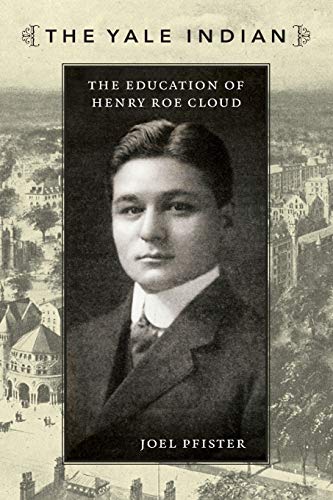
Honored in his own time as one of the most prominent Indian public intellectuals, Henry Roe Cloud (c. 1884-1950) fought to open higher education to Indians. Joel Pfister's extensive archival research establishes the historical significance of key chapters in the Winnebago's remarkable life. Roe Cloud was the first Indian to receive undergraduate and graduate degrees from Yale University, where he was elected to the prestigious and intellectual Elihu Club. Pfister compares Roe Cloud's experience to that of other "college Indians" and also to African Americans such as W. E. B. Du Bois. Roe Cloud helped launch the Society of American Indians, graduated from Auburn seminary, founded a preparatory school for Indians, and served as the first Indian superintendent of the Haskell Institute (forerunner of Haskell Indian Nations University). He also worked under John Collier at the Bureau of Indian Affairs, where he was a catalyst for the Indian New Deal.
Roe Cloud's white-collar activism was entwined with the Progressive Era formation of an Indian professional and managerial class, a Native "talented tenth," whose members strategically used their contingent entry into arenas of white social, intellectual, and political power on behalf of Indians without such access. His Yale training provided a cross-cultural education in class-structured emotions and individuality. While at Yale, Roe Cloud was informally adopted by a white missionary couple. Through them he was schooled in upper-middle-class sentimentality and incentives. He also learned how interracial romance could jeopardize Indian acceptance into their class. Roe Cloud expanded the range of what modern Indians could aspire to and achieve.
Die Inhaltsangabe kann sich auf eine andere Ausgabe dieses Titels beziehen.
Über die Autorin bzw. den Autor
Joel Pfister is Professor of American Studies and English at Wesleyan University. He is the author of four books, including Individuality Incorporated: Indians and the Multicultural Modern, also published by Duke University Press, and Critique for What? Cultural Studies, American Studies, Left Studies. He is a co-editor of Inventing the Psychological: Toward a Cultural History of Emotional Life in America.
Von der hinteren Coverseite
""The Yale Indian" advances a project begun in Joel Pfister's "Individuality Incorporated" and also breaks new ground. This book, based on archival research, is about the Winnebago (Ho-Chunk) Henry Roe Cloud (1884-1950), the first full-blood Indian to graduate from Yale (BA 1910, MA 1914). Mostly overlooked by historians, in his era he was recognized as one of the greatest Native leaders. Roe Cloud expanded the meaning of 'Indian, ' in part by striving to develop a university-trained professional and managerial class of Native people at a time when the Carlisle Institute was educating Indians to work on Ford's assembly lines. This is a rich and important book."--Arnold Krupat, author of "Red Matters: Native American Studies"
Auszug. © Genehmigter Nachdruck. Alle Rechte vorbehalten.
THE YALE INDIAN
The Education of Henry Roe CloudBy JOEL PFISTERDUKE UNIVERSITY PRESS
Copyright © 2009 Duke University PressAll right reserved.
ISBN: 978-0-8223-4421-6
Contents
Preface.........................................................................xiAcknowledgments.................................................................xviiIntroduction. Chapters in the Education of Henry Roe Cloud.....................1One. Yale Education............................................................23Two. Sentimentalized Education.................................................83Three. Cultural Incentive-and-Activism Education...............................127Coda. The Indian Ethos of Service..............................................161Appendix. Sometimes History Needs Reminding....................................175Notes...........................................................................177Index...........................................................................243
Chapter One
YALE EDUCATION
HENRY ROE CLOUD was not culturally slated to wind up at Yale or any institution remotely like it. He was not supposed to acquire the knowledge, and the social uses of the knowledge, that Yale taught. Neither was he expected to meet, no less befriend, most of the men of social standing that Yale welcomed or the refined women who moved in Yale circles. Equally, he was not intended to receive anything resembling a Yale schooling in incentive, aspiration, taste, and feeling. At early twentieth-century Yale he also encountered the changing ways in which markers of American middle- and upper-class individuality were coming to assume conspicuously psychological forms. For the Yale he attended was beginning to assign class value to new cultural and literary forms of an elite psychological individuality. The Winnebago realized well before he matriculated that colleges like Yale (he had also visited Princeton and Wesleyan on his college tour) offered not just academic courses of study but a cultural authorization, an intellectual status, a social identity, a gilded stage for improvisations, an access to class power that he could use for himself and the Indians he served.
At the same time, I do not think that he saw his education at institutions such as Mount Hermon, Yale, Oberlin, and Auburn purely as socially instrumental. The letters I have read convey Roe Cloud's love of learning and rhetorical play. Unafraid of intellectual challenges, he took social pleasure in oratory and debate. He was curious about exploring multiple ways of thinking, multiple ways of feeling, multiple ways of seeing and of seeing himself. Roe Cloud did not think that an Indian should be interested only in particular subjects or ideas. Charles Eastman rhapsodized that his education led him to dive "deep into a strange life from which I could not retreat.... I absorbed knowledge through every pore.... The more I got, the larger my capacity grew, and my appetite increased in proportion." This also expresses the intellectual spirit of Henry Roe Cloud.
Below I situate Roe Cloud's letters in a phase of Yale's history and address key questions about this case study in the development of white-collar Indian activism. Did Roe Cloud enjoy Yale? Was his presence there significant? Did some campus groups, activities, publications, and faculty sponsor Indian stereotypes? If Roe Cloud performed the role of student, did he also enact the role of teacher? How did he use what he learned? Who did he try to influence?
COLLEGE INDIANS AND CLASS LITERACY
The writings of Indian Affairs Commissioner Thomas Jefferson Morgan help clarify some aspects of the systemic production of inequality Roe Cloud battled. In 1890, possibly thinking himself beneficently progressive, this well-educated commissioner advocated the formation of three five-year industrial high schools for Indians (Carlisle, Haskell, Chemawa) to form "character," adapt students to "modern civilization," accustom them to repetitive toil, and inculcate what was openly termed "treason to the tribe." He armed that "the Indian [has] the same diversity of endowment and the same high order of talent that the other races possess" and voiced parsimonious encouragement for those "very few" Indian students with "special aptitudes and lofty ambition" who wish to attend college. Although he acknowledged the "urgent need" among Indians "for a class of leaders of thought, lawyers, physicians, preachers, teachers, editors, statesmen, and men of letters," his interest in addressing this "need" was by no means "urgent."
Any Indians who aspired to attend college fared no better with Indian Affairs Commissioner William A. Jones. In 1900 he admitted that the state education of its "wards" in no way constituted "an elaborate preparation for a collegiate course." He used the gospel of self-help as his cover for the systemic under-education of an entire people: "Their future career should always be dependent upon their own exertions and not at the expense of the General Government." Then in 1905 Commissioner Francis E. Leupp, a graduate of Williams College and Columbia Law School, enthusiastically supported teaching Indians "handy tinkering" (such as mending harnesses and wagon wheels), elementary letter writing, and basic literacy skills (for reading bills and newspapers), while he confidently assured whites that only a tiny proportion of Indians possess the talent and "individuality" (his term) to attend college. He believed that Indians' evolutionary racial characteristics as well as their cultural environments handicapped them. A year later Roe Cloud commenced "tinkering" at Yale. Only in the late 1920s did the Bureau of Indian Affairs, in response to lobbying on the parts of Indians and reform groups, which included Roe Cloud, offer some Indian youth a high school education that, in Morgan's words, was readily available-and available not in a five-year half-academic and half-vocational training industrial program-to "the great mass of youth of every race and condition except the Indian."
In the early 1910s, Robert Yellowtail (Crow), who later became superintendent of his reservation, and Thomas Sloan (Omaha), a Hampton Institute valedictorian who had been accepted at Yale Law School and chose instead to apprentice to become an attorney, published articles in Carlisle's Red Man, in which they argued that young Indians now needed college educations to fight new sorts of battles in American courts, legislatures, and bureaucracies. Similarly, in 1913 the Society of American Indians decried systemic efforts to reproduce Indians as a "grammar school race" ill-equipped to "compete with a [white] college bred race." Some Indians who had not been able, or permitted, to take this educational route identified its importance. Thus in the 1930s Luther Standing Bear, the great Sioux autobiographer and cultural critic who had attended Carlisle, but not high school or college, told the ridiculous tale of his brother Henry's request to the Indian Affairs commissioner for funds to study in a Chicago college. His brother had just returned from Carlisle, where he had only a few years of half-academic and half-vocational education. The commissioner turned him down because other Indians "who crave[d] a higher education" would expect the same backing if he granted it to his brother. "That is the most exalted opinion I ever heard an Indian Commissioner express on the educational aspirations of the Indian youth of the land, and I think his compliment was...
„Über diesen Titel“ kann sich auf eine andere Ausgabe dieses Titels beziehen.
Suchergebnisse für The Yale Indian: The Education of Henry Roe Cloud (New...

Beispielbild für diese ISBN
The Yale Indian: The Education of Henry Roe Cloud
Anbieter: ThriftBooks-Dallas, Dallas, TX, USA
Verkäuferbewertung 5 von 5 Sternen

Paperback. Zustand: Very Good. No Jacket. May have limited writing in cover pages. Pages are unmarked. ~ ThriftBooks: Read More, Spend Less. Artikel-Nr. G0822344211I4N00
Gebraucht kaufen
EUR 14,84
Versand gratis
Versand innerhalb von USA
Versand innerhalb von USA
Anzahl: 1 verfügbar
Beispielbild für diese ISBN
The Yale Indian : The Education of Henry Roe Cloud
Anbieter: Better World Books, Mishawaka, IN, USA
Verkäuferbewertung 5 von 5 Sternen
Zustand: Very Good. Former library copy. Pages intact with possible writing/highlighting. Binding strong with minor wear. Dust jackets/supplements may not be included. Includes library markings. Stock photo provided. Product includes identifying sticker. Better World Books: Buy Books. Do Good. Artikel-Nr. 38847800-6
Gebraucht kaufen
EUR 15,81
Versand gratis
Versand innerhalb von USA
Versand innerhalb von USA
Anzahl: 3 verfügbar
Beispielbild für diese ISBN
The Yale Indian
Anbieter: PBShop.store UK, Fairford, GLOS, Vereinigtes Königreich
Verkäuferbewertung 5 von 5 Sternen
PAP. Zustand: New. New Book. Shipped from UK. Established seller since 2000. Artikel-Nr. FW-9780822344216
Neu kaufen
EUR 30,43
EUR 4,97 Versand
Versand von Vereinigtes Königreich nach USA
Versand von Vereinigtes Königreich nach USA
Anzahl: 1 verfügbar
Beispielbild für diese ISBN
The Yale Indian: The Education of Henry Roe Cloud (New Americanists)
Anbieter: Pearlydewdrops, Streat, Vereinigtes Königreich
Verkäuferbewertung 5 von 5 Sternen
Paperback. Zustand: Fine. New & unread, however may have light shelf wear to cover face, edges or corners. Shipped from the UK within 2 business days of order being placed. Artikel-Nr. mon0000345455
Gebraucht kaufen
EUR 13,67
EUR 26,28 Versand
Versand von Vereinigtes Königreich nach USA
Versand von Vereinigtes Königreich nach USA
Anzahl: 1 verfügbar
Beispielbild für diese ISBN
The Yale Indian: The Education of Henry Roe Cloud (New Americanists)
Anbieter: Pearlydewdrops, Streat, Vereinigtes Königreich
Verkäuferbewertung 5 von 5 Sternen
Paperback. Zustand: New. Shipped from the UK within 2 business days of order being placed. Artikel-Nr. mon0000345330
Neu kaufen
EUR 15,58
EUR 26,28 Versand
Versand von Vereinigtes Königreich nach USA
Versand von Vereinigtes Königreich nach USA
Anzahl: 2 verfügbar
Beispielbild für diese ISBN
The Yale Indian: The Education of Henry Roe Cloud (New Americanists)
Anbieter: Ria Christie Collections, Uxbridge, Vereinigtes Königreich
Verkäuferbewertung 5 von 5 Sternen
Zustand: New. In English. Artikel-Nr. ria9780822344216_new
Neu kaufen
EUR 39,16
EUR 13,49 Versand
Versand von Vereinigtes Königreich nach USA
Versand von Vereinigtes Königreich nach USA
Anzahl: 1 verfügbar
Foto des Verkäufers
Yale Indian : The Education of Henry Roe Cloud
Anbieter: GreatBookPricesUK, Woodford Green, Vereinigtes Königreich
Verkäuferbewertung 5 von 5 Sternen
Zustand: As New. Unread book in perfect condition. Artikel-Nr. 6043204
Gebraucht kaufen
EUR 38,37
EUR 17,92 Versand
Versand von Vereinigtes Königreich nach USA
Versand von Vereinigtes Königreich nach USA
Anzahl: 1 verfügbar
Beispielbild für diese ISBN
The Yale Indian: The Education of Henry Roe Cloud
Anbieter: Kennys Bookstore, Olney, MD, USA
Verkäuferbewertung 5 von 5 Sternen
Zustand: New. A biography of Henry Roe Cloud (c. 1884-1950), a Winnebago educator, scholar, and minister who was one of the most renowned Native Americans of his time. Series: New Americanists. Num Pages: 280 pages, 9 illustrations. BIC Classification: 1KBB; JFFJ; JFSL1; JNM. Category: (U) Tertiary Education (US: College). Dimension: 5969 x 3963 x 18. Weight in Grams: 408. . 2009. Illustrated. Paperback. . . . . Books ship from the US and Ireland. Artikel-Nr. V9780822344216
Neu kaufen
EUR 48,83
EUR 9,41 Versand
Versand innerhalb von USA
Versand innerhalb von USA
Anzahl: 1 verfügbar
Beispielbild für diese ISBN
The Yale Indian The Education of Henry Roe Cloud
Anbieter: Revaluation Books, Exeter, Vereinigtes Königreich
Verkäuferbewertung 5 von 5 Sternen
Paperback. Zustand: Brand New. 259 pages. 9.25x6.25x0.75 inches. In Stock. Artikel-Nr. x-0822344211
Neu kaufen
EUR 53,57
EUR 11,95 Versand
Versand von Vereinigtes Königreich nach USA
Versand von Vereinigtes Königreich nach USA
Anzahl: 2 verfügbar
Foto des Verkäufers
The Yale Indian : The Education of Henry Roe Cloud
Verlag:
Duke University Press Jun 2009, 2009
ISBN 10: 0822344211
ISBN 13: 9780822344216
Neu
Taschenbuch
Anbieter: AHA-BUCH GmbH, Einbeck, Deutschland
Verkäuferbewertung 5 von 5 Sternen
Taschenbuch. Zustand: Neu. Neuware - Honored in his own time as one of the most prominent Indian public intellectuals, Henry Roe Cloud (c. 18841950) fought to open higher education to Indians. Joel Pfister's extensive archival research establishes the historical significance of key chapters in the Winnebago's remarkable life. Roe Cloud was the first Indian to receive undergraduate and graduate degrees from Yale University, where he was elected to the prestigious and intellectual Elihu Club. Pfister compares Roe Cloud's experience to that of other "college Indians" and also to African Americans such as W. E. B. Du Bois. Roe Cloud helped launch the Society of American Indians, graduated from Auburn seminary, founded a preparatory school for Indians, and served as the first Indian superintendent of the Haskell Institute (forerunner of Haskell Indian Nations University). He also worked under John Collier at the Bureau of Indian Affairs, where he was a catalyst for the Indian New Deal. Roe Cloud's white-collar activism was entwined with the Progressive Era formation of an Indian professional and managerial class, a Native "talented tenth," whose members strategically used their contingent entry into arenas of white social, intellectual, and political power on behalf of Indians without such access. His Yale training provided a cross-cultural education in class-structured emotions and individuality. While at Yale, Roe Cloud was informally adopted by a white missionary couple. Through them he was schooled in upper-middle-class sentimentality and incentives. He also learned how interracial romance could jeopardize Indian acceptance into their class. Roe Cloud expanded the range of what modern Indians could aspire to and achieve. Artikel-Nr. 9780822344216
Neu kaufen
EUR 47,99
EUR 35,00 Versand
Versand von Deutschland nach USA
Versand von Deutschland nach USA
Anzahl: 1 verfügbar