
Verwandte Artikel zu Genocide: Truth, Memory, and Representation (Cultures...
Genocide: Truth, Memory, and Representation (Cultures and Practice of Violence) - Softcover
Buch 3 von 10: The Cultures and Practice of Violence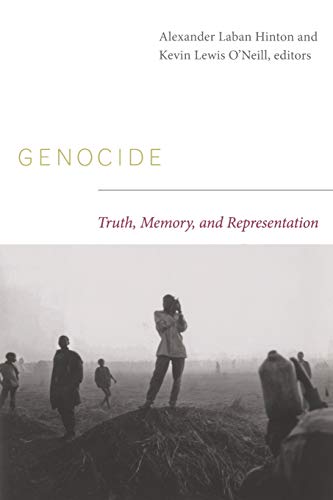
Inhaltsangabe
What happens to people and the societies in which they live after genocide? How are the devastating events remembered on the individual and collective levels, and how do these memories intersect and diverge as the rulers of postgenocidal states attempt to produce a monolithic "truth" about the past? In this important volume, leading anthropologists consider such questions about the relationship of genocide, truth, memory, and representation in the Balkans, East Timor, Germany, Guatemala, Indonesia, Nigeria, Rwanda, Sudan, and other locales.
Specialists on the societies about which they write, these anthropologists draw on ethnographic research to provide on-the-ground analyses of communities in the wake of mass brutality. They investigate how mass violence is described or remembered, and how those representations are altered by the attempts of others, from NGOs to governments, to assert "the truth" about outbreaks of violence. One contributor questions the neutrality of an international group monitoring violence in Sudan and the assumption that such groups are, at worst, benign. Another examines the consequences of how events, victims, and perpetrators are portrayed by the Rwandan government during the annual commemoration of that country's genocide in 1994. Still another explores the silence around the deaths of between eighty and one hundred thousand people on Bali during Indonesia's state-sponsored anticommunist violence of 1965-1966, a genocidal period that until recently was rarely referenced in tourist guidebooks, anthropological studies on Bali, or even among the Balinese themselves. Other contributors consider issues of political identity and legitimacy, coping, the media, and "ethnic cleansing." Genocide: Truth, Memory, and Representation reveals the major contribution that cultural anthropologists can make to the study of genocide.
Contributors. Pamela Ballinger, Jennie E. Burnet, Conerly Casey, Elizabeth Drexler, Leslie Dwyer, Alexander Laban Hinton, Sharon E. Hutchinson, Uli Linke, Kevin Lewis O'Neill, Antonius C. G. M. Robben, Debra Rodman, Victoria Sanford
Die Inhaltsangabe kann sich auf eine andere Ausgabe dieses Titels beziehen.
Über die Autorin bzw. den Autor
Alexander Laban Hinton is Director of the Center for the Study of Genocide and Human Rights and Associate Professor of Anthropology and Global Affairs at Rutgers University, Newark. He is the author of Why Did They Kill? Cambodia in the Shadow of Genocide and editor of Annihilating Difference: The Anthropology of Genocide.
Kevin Lewis O'Neill is Assistant Professor of Religious Studies and American Studies at Indiana University, Bloomington.
Von der hinteren Coverseite
"This volume brings rich historical and contemporary ethnographic material to bear on the urgent task of writing against violence and terror. The volume benefits greatly from the long-term professional commitments of anthropologists working in settings embroiled in violence and engaging with peoples suffering the ongoing sequelae and cycles of genocidal terror."--Philippe Bourgois, author of "In Search of Respect: Selling Crack in El Barrio" and co-editor of "Violence in War and Peace"
Auszug. © Genehmigter Nachdruck. Alle Rechte vorbehalten.
GENOCIDE
TRUTH, MEMORY, and REPRESENTATIONDuke University Press
Copyright © 2009 Duke University PressAll right reserved.
ISBN: 978-0-8223-4405-6
Contents
Acknowledgments..................................................................................................................................1PART 1 TRUTH/MEMORY/REPRESENTATION.............................................................................................................291. What Is an Anthropology of Genocide? Reflections on Field Research with Maya Survivors in Guatemala Victoria Sanford.........................542. Perilous Outcomes: International Monitoring and the Perpetuation of Violence in Sudan Sharon E. Hutchinson...................................80PART 2 TRUTH/MEMORY/REPRESENTATION.............................................................................................................1134. A Politics of Silences: Violence, Memory, and Treacherous Speech in Post-1965 Bali Leslie Dwyer..............................................1475. The Limits of Empathy: Emotional Anesthesia and the Museum of Corpses in Post-Holocaust Germany Uli Linke....................................192PART 3 TRUTH/MEMORY/REPRESENTATION.............................................................................................................2197. Addressing the Legacies of Mass Violence and Genocide in Indonesia and East Timor Elizabeth F. Drexler.......................................2478. Mediated Hostility: Media, Affective Citizenship, and Genocide in Northern Nigeria Conerly Casey.............................................2739. Cleansed of Experience? Genocide, Ethnic Cleansing, and the Challenges of Anthropological Representation Pamela Ballinger.....................317Epilogue: The Imagination of Genocide Antonius C. G. M. Robben..................................................................................333Contributors.....................................................................................................................................339
Chapter One
WHAT IS AN ANTHROPOLOGY OF GENOCIDE?Reflections on Field Research with Maya Survivors in Guatemala
Genocide is a problem not only of war but also of peace. -Raphal Lemkin, Axis Rule in Occupied Europe: Laws of Occupation, Analysis of Government, Proposals for Redress
This essay draws on the work of Dominick LaCapra (2001) and Primo Levi (1989) to consider the limits of memory and the challenges of anthropological research on genocide. In particular, I borrow Levi's concept of the "grey zone" to consider the lived experiences of Maya youth who were both victims and victimizers in the Guatemalan genocide. Based on more than a decade of field research on the exhumations of clandestine cemeteries of Maya massacre victims,1 I consider the excavation of individual and collective memory as a cultural and political act of community reconstruction. I suggest that both the accretion of truth and political space in the exhumation of clandestine cemeteries are central to the processes of reclaiming cultural memory and of contesting dominant metanarratives that negate subaltern subjectivity and buttress official histories of denial. I trace political agency and the development of new subjectivities in Maya communities over time. I ask, "What is an anthropology of genocide?" to provide a framework for my reflections on field research with Maya survivors of genocide. It is my hope that this framework is useful for reflecting on field research on genocide and violence in other contexts (see also Strathern, Stewart, and Whitehead 2006; Riches 1991). This essay is my modest attempt to share both the survivor memories and the challenge they present to the researcher in the field who, while overwhelmed by the sensation of their immediacy and sorrow, seeks to understand the lived experiences of survivors in such a way that they might make sense to survivors, researchers, and readers.
THE LIMITS OF MEMORY AND RESEARCH
The Auschwitz survivor Levi wrote: "It is natural and obvious that the most substantial material for the reconstruction of truth about the camps is the memories of the survivors" (1989:16). Holding this same belief in the value of testimony a half century later and on a different continent, the Guatemalan anthropologist Ricardo Falla lived with survivors of Guatemalan army massacres who were still in flight from army attacks in the northern Ixcn region of the country. While he accompanied Maya survivors in their hardship, he took their testimonies of survival. In 1992 Falla published Masacres de la selva based on some 700 testimonies. That same year I completed a yearlong project of taping the life history of Mateo, a Mam Maya child survivor of the Ixcn massacres, who had been recruited by the guerrillas, the civil patrols, and the army before reaching the age of 15. At the time of our project, Mateo was a 19-year-old refugee attending high school in San Francisco. Falla documented two survival stories that are of interest for our consideration of the limits of memory and of the challenge of research on genocide. Mateo had never met Falla, nor had he read his work, yet he gave similar testimony regarding these two survivor stories.
Falla's witness remembers:
An 8-year-old girl survived because they tied a rope around her neck and tightened it, "they saw the tongue coming out of the girl and thought she was dead." An old man of 75 was cut in the neck by the soldiers, and he also lived because "the knife got stuck on a button in his shirt, and the soldiers thought they had hit the bone and there was blood, so they kicked him and left him for dead." A couple and their baby girl also survived. They threw themselves into the river from a bridge. She was carrying the baby of 1 1/2 years and the woman was hit by a bullet from the bridge, but she did not die, neither did her baby. "God is great," says the witness, because these five survived. (1992:57)
Mateo remembers what was recounted to his family by the survivors:
The army arrived to another center very close to our village. The people were at church praying. The soldiers surrounded the church, doused it with gas, and burned it with the people inside. Other families were burned too because the church was built with carton and palms and close to some other little, palm houses. So they caught fire and burned as well. There were about 10 families and the army captured them and put them into a line. My father's compadre and comadre were in this line. One-by-one, the army would grab each person in line, beat them and ask them questions. The soldiers beat the campesinos and they killed them. But my father's compadre was old. They tied him up and they stabbed him three times in the neck and they cut him in other places, too. But because he was so old, his skin didn't break enough. First the soldiers were mad because he didn't die. Then when he looked bad off, they said, "Now, he is dead." Then, they threw him in a hole. He stayed there. Next, the soldiers took his daughter and they tortured her with a rope. They put a rope around her neck and pulled the ends of the rope until they thought she was dead, too. Then, they threw her in the same hole. They told us later that the army left them there for dead. Behind them, were some other friends waiting their turn. He was very religious and was with his wife and baby girl, maybe she was one year old. The baby was crying. The father said, "Why don't we...
„Über diesen Titel“ kann sich auf eine andere Ausgabe dieses Titels beziehen.
Suchergebnisse für Genocide: Truth, Memory, and Representation (Cultures...

Beispielbild für diese ISBN
Genocide: Truth, Memory, and Representation
Anbieter: ThriftBooks-Dallas, Dallas, TX, USA
Verkäuferbewertung 5 von 5 Sternen

Paperback. Zustand: Good. No Jacket. Former library book; Pages can have notes/highlighting. Spine may show signs of wear. ~ ThriftBooks: Read More, Spend Less. Artikel-Nr. G082234405XI3N10
Gebraucht kaufen
EUR 12,48
Versand gratis
Versand innerhalb von USA
Versand innerhalb von USA
Anzahl: 1 verfügbar
Beispielbild für diese ISBN
Genocide : Truth, Memory, and Representation
Anbieter: Better World Books, Mishawaka, IN, USA
Verkäuferbewertung 5 von 5 Sternen
Zustand: Good. Pages intact with minimal writing/highlighting. The binding may be loose and creased. Dust jackets/supplements are not included. Stock photo provided. Product includes identifying sticker. Better World Books: Buy Books. Do Good. Artikel-Nr. 67768706-6
Gebraucht kaufen
EUR 14,79
Versand gratis
Versand innerhalb von USA
Versand innerhalb von USA
Anzahl: 1 verfügbar
Beispielbild für diese ISBN
Genocide
Anbieter: PBShop.store UK, Fairford, GLOS, Vereinigtes Königreich
Verkäuferbewertung 5 von 5 Sternen
PAP. Zustand: New. New Book. Shipped from UK. Established seller since 2000. Artikel-Nr. FW-9780822344056
Neu kaufen
EUR 33,97
EUR 5,86 Versand
Versand von Vereinigtes Königreich nach USA
Versand von Vereinigtes Königreich nach USA
Anzahl: 15 verfügbar
Beispielbild für diese ISBN
Genocide: Truth, Memory, and Representation (The Cultures and Practice of Violence)
Anbieter: Ria Christie Collections, Uxbridge, Vereinigtes Königreich
Verkäuferbewertung 5 von 5 Sternen
Zustand: New. In English. Artikel-Nr. ria9780822344056_new
Neu kaufen
EUR 39,08
EUR 13,17 Versand
Versand von Vereinigtes Königreich nach USA
Versand von Vereinigtes Königreich nach USA
Anzahl: Mehr als 20 verfügbar
Beispielbild für diese ISBN
Genocide
Anbieter: Majestic Books, Hounslow, Vereinigtes Königreich
Verkäuferbewertung 4 von 5 Sternen

Zustand: New. pp. 352. Artikel-Nr. 7952707
Neu kaufen
EUR 45,43
EUR 7,58 Versand
Versand von Vereinigtes Königreich nach USA
Versand von Vereinigtes Königreich nach USA
Anzahl: 3 verfügbar
Beispielbild für diese ISBN
Genocide: Truth, Memory, and Representation
Anbieter: Kennys Bookstore, Olney, MD, USA
Verkäuferbewertung 5 von 5 Sternen
Zustand: New. Leading anthropologists consider issues of truth, memory, and representation in the aftermath of genocides in the Balkans, Guatemala, Indonesia, East Timor, Germany, Nigeria, Rwanda, and Sudan. Editor(s): Hinton, Alexander Laban; O'Neill, Kevin Lewis. Series: The Cultures and Practice of Violence. Num Pages: 352 pages, 19 b&w photographs, 1 table. BIC Classification: HBTB; JHBZ; JHMP. Category: (P) Professional & Vocational. Dimension: 5969 x 3963 x 23. Weight in Grams: 504. . 2009. Illustrated. Paperback. . . . . Books ship from the US and Ireland. Artikel-Nr. V9780822344056
Neu kaufen
EUR 53,56
EUR 9,16 Versand
Versand innerhalb von USA
Versand innerhalb von USA
Anzahl: Mehr als 20 verfügbar
Beispielbild für diese ISBN
Genocide Truth, Memory, and Representation
Anbieter: Revaluation Books, Exeter, Vereinigtes Königreich
Verkäuferbewertung 5 von 5 Sternen
Paperback. Zustand: Brand New. 340 pages. 9.25x6.25x0.75 inches. In Stock. Artikel-Nr. x-082234405X
Neu kaufen
EUR 60,03
EUR 11,67 Versand
Versand von Vereinigtes Königreich nach USA
Versand von Vereinigtes Königreich nach USA
Anzahl: 2 verfügbar
Foto des Verkäufers
Genocide: Truth, Memory, and Representation
Anbieter: moluna, Greven, Deutschland
Verkäuferbewertung 5 von 5 Sternen
Zustand: New. Leading anthropologists consider issues of truth, memory, and representation in the aftermath of genocides in the Balkans, Guatemala, Indonesia, East Timor, Germany, Nigeria, Rwanda, and Sudan.Über den AutorAlexander Laban Hinto. Artikel-Nr. 600735188
Neu kaufen
EUR 40,85
EUR 48,99 Versand
Versand von Deutschland nach USA
Versand von Deutschland nach USA
Anzahl: Mehr als 20 verfügbar
Foto des Verkäufers
Genocide | Truth, Memory, and Representation
Anbieter: preigu, Osnabrück, Deutschland
Verkäuferbewertung 5 von 5 Sternen
Taschenbuch. Zustand: Neu. Genocide | Truth, Memory, and Representation | Alexander Laban Hinton (u. a.) | Taschenbuch | Einband - flex.(Paperback) | Englisch | 2009 | Duke University Press | EAN 9780822344056 | Verantwortliche Person für die EU: Mare Nostrum Group B.V., Doelen 72, 4831 GR BREDA, NIEDERLANDE, gpsr[at]mare-nostrum[dot]co[dot]uk | Anbieter: preigu. Artikel-Nr. 108483985
Neu kaufen
EUR 37,45
EUR 70,00 Versand
Versand von Deutschland nach USA
Versand von Deutschland nach USA
Anzahl: 5 verfügbar