
Verwandte Artikel zu The Will to Improve: Governmentality, Development,...
Inhaltsangabe
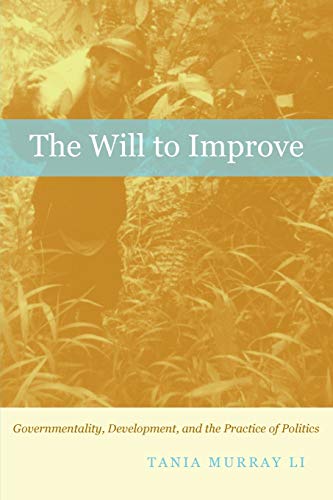
The Will to Improve is a remarkable account of development in action. Focusing on attempts to improve landscapes and livelihoods in Indonesia, Tania Murray Li carefully exposes the practices that enable experts to diagnose problems and devise interventions, and the agency of people whose conduct is targeted for reform. Deftly integrating theory, ethnography, and history, she illuminates the work of colonial officials and missionaries; specialists in agriculture, hygiene, and credit; and political activists with their own schemes for guiding villagers toward better ways of life. She examines donor-funded initiatives that seek to integrate conservation with development through the participation of communities, and a one-billion-dollar program designed by the World Bank to optimize the social capital of villagers, inculcate new habits of competition and choice, and remake society from the bottom up.
Demonstrating that the "will to improve" has a long and troubled history, Li identifies enduring continuities from the colonial period to the present. She explores the tools experts have used to set the conditions for reform-tools that combine the reshaping of desires with applications of force. Attending in detail to the highlands of Sulawesi, she shows how a series of interventions entangled with one another and tracks their results, ranging from wealth to famine, from compliance to political mobilization, and from new solidarities to oppositional identities and violent attack. The Will to Improve is an engaging read-conceptually innovative, empirically rich, and alive with the actions and reflections of the targets of improvement, people with their own critical analyses of the problems that beset them.
Die Inhaltsangabe kann sich auf eine andere Ausgabe dieses Titels beziehen.
Über die Autorin bzw. den Autor
Tania Murray Li is Professor of Anthropology and Senior Canada Research Chair in Political Economy and Culture in Asia-Pacific at the University of Toronto. She is the author of Malays in Singapore: Culture, Economy, and Ideology and the editor of Transforming the Indonesian Uplands: Marginality, Power, and Production.
Von der hinteren Coverseite
"Tania Murray Li brilliantly combines the analytic rubrics of Foucault, Marx, and Gramsci to explain 'the will to improve' as an essential though poorly understood component of rule in Indonesia. This is not your grandmother's ethnography: the well-written chapters are packed with the conflicts, contestations, and uncertainties that characterize power relations. Deeply engaged with the processes and practices that shape peoples' lives, Li's book should be required reading for scholars interested in how power works and for development practitioners everywhere."--Nancy Lee Peluso, author of "Rich Forests, Poor People: Resource Control and Resistance in Java"
Auszug. © Genehmigter Nachdruck. Alle Rechte vorbehalten.
THE WILL TO IMPROVE
Governmentality, Development, and the Practice of PoliticsBy TANIA MURRAY LIDuke University Press
Copyright © 2007 Duke University PressAll right reserved.
ISBN: 978-0-8223-4027-0
Contents
List of Acronyms............................................viiGlossary of Indonesian Terms................................ixAcknowledgments.............................................xiIntroduction: The Will to Improve...........................1Contradictory Positions.....................................31Projects, Practices, and Effects............................61Formations of Capital and Identity..........................96Rendering Technical?........................................123Politics in Contention......................................156Provocation and Reversal....................................192Development in the Age of Neoliberalism.....................230Conclusion..................................................270Notes.......................................................285Bibliography................................................337Index.......................................................367
Chapter One
CONTRADICTORY POSITIONS
This chapter explores two of the contradictions I outlined in the introduction, contradictions deeply embedded in the will to improve. The first is the contradiction between the promotion of capitalist processes and concern to improve the condition of the dispossessed. I examine how this contradiction played out through a series of governmental assemblages, each with its characteristic diagnoses and prescriptions, its preferred way of balancing profits, native welfare, and other "specific finalities." The second is the way that programs of improvement designed to reduce the distance between trustees and deficient subjects actually reinscribe the boundary that positions them on opposite sides of an unbridgeable divide. This boundary is the contradictory foundation that makes colonial and contemporary improvement programs thinkable, anxious and doggedly persistent. Yet it is not self-evident. It is produced through situated practices that can be critically explored.
My examination in this chapter takes the form of a history of government, teasing out the problems that various authorities sought to address, the techniques they deployed, their contradictions, and their effects. It is an overview, covering in schematic form a period of two centuries (1800-2000), with particular emphasis on the island of Java, the focus of colonial attention before the Netherlands East Indies Empire was "rounded out" in the period 1900-1910. Subsequent chapters, focused on the highlands of Sulawesi, examine governmental programs of the colonial and contemporary periods at much closer range.
Although I have arranged the parts of the chapter in chronological order, this is not a narrative of governmentality rising. It is not the case that late colonial rule overcame the racism and despotism of earlier regimes, nor did independence bring all citizens into the nation on an equal basis. The governmental assemblage that took shape on Java early in the nineteenth century was far more optimistic about the capacity of Indonesians to develop their own capacities through a "normal" process of self-improvement than the assemblage that emerged under Suharto in the New Order, in which the boundary separating trustees from those they would know and improve was sharp indeed. Arguments about the racial superiority of Europeans, relatively inchoate for more than two centuries while the Netherlands East Indies Company (Vereenigde Oost-Indische Compagnie, or VOC) competed with other parties for a share and eventual monopoly of trade in the archipelago, became much more pronounced after 1800 when the Dutch crown assumed sovereignty. They were entrenched in separate legal systems and reached their peak under the ethical policy (1905-30), precisely the moment when the white man's burden of improving Native lives was most clearly enunciated. As I will show, this was also the period when the "otherness" of the Natives, their ineffable difference, was conceptually elaborated, empirically investigated, and made the basis for policies aimed to restore "tradition" and harmonious, Asiatic village life.
THE RIGHT TO RULE
As far as possible, the voc ruled indirectly. It reinforced the powers of local rulers so that they could extract more profits for themselves, and for the company, by intensifying existing systems of appanages, tax farms, forced labor, usury, and trading monopolies. In Java, it used Chinese as agents in its collection system. Its objectives were not governmental-it did not intervene in native lives in order to improve them or make them more secure. It reserved discipline for the population of the territory it ruled directly-a minute proportion of the territory that later became the Netherlands East Indies. Even then, it asserted detailed control only when this was necessary to maximize profits. The predominance of the VOC's extractive orientation is evident from its accounts. It paid stockholders an average of 18 percent per year for two hundred years (1602-1800), a return so high the company was eventually bankrupt.
The bankruptcy of the voc obliged the Dutch crown to assume direct responsibility for the Indies in 1800. Thereafter, Dutch authorities became more deeply involved in the lives of subject populations in some parts of the archipelago-namely Java, parts of Sumatra, and the northern tip of Sulawesi. Over much of the rest of the archipelago, Dutch rule remained nominal, taking the form of treaties and contracts with local rulers to protect Dutch commercial interests. Only in 1900-1910 did the Dutch establish territorial control over the entire archipelago by the extension of existing contracts in some areas, and direct military action in others.
The reasons for the territorial extension and intensification of Dutch rule around 1900 are the subject of debate. Although some historians have argued that the Dutch were obliged to consolidate their hold over territory to ward o competing colonial powers, others argue that the spheres of influence of Britain, France and the United States were stable by 1900, and Dutch interests were sufficiently protected by the British as arbiter mundi. The argument that commercial motives prompted intensification is persuasive for some parts of the archipelago but not others. Many expansionary ventures "made little sense in terms of economic profitability" and some were "financially disastrous." Costs could easily outrun returns. State-owned mines and plantations plus port duties added important sources of revenue, but European corporations paid little tax. Military ventures could be ruinously expensive, the prolonged Aceh War (1873-1903) a case in point.
Decisions about territorial expansion, argues Benedict Anderson, "were made in Batavia rather than The Hague, and for local raison d'etat." What were these reasons? By the end of the nineteenth century, Robert Elson observes, the "right to rule was no longer a function of divine anointing, or possession of the palace or regalia, but rather of secular efficiency, formalized order, and getting things done." Local rulers had always been awkward partners for the Dutch, routinely despised, critiqued, and sometimes unseated for their despotic ways and personal failings. What changed around 1900 was not the conduct of local rulers, but the practices and assumptions of the...
„Über diesen Titel“ kann sich auf eine andere Ausgabe dieses Titels beziehen.
Suchergebnisse für The Will to Improve: Governmentality, Development,...

Beispielbild für diese ISBN
The Will to Improve: Governmentality, Development, and the Practice of Politics
Anbieter: World of Books (was SecondSale), Montgomery, IL, USA
Verkäuferbewertung 5 von 5 Sternen

Paperback. Zustand: Fair. Offers an account of development in action. Focusing on experts' attempts to improve landscapes and livelihoods in Indonesia, this title exposes the practices that enable experts to diagnose problems and devise interventions, and the agency of people whose conduct is targeted for reform. Artikel-Nr. 00110047299
Gebraucht kaufen
EUR 18,65
Versand gratis
Versand innerhalb von USA
Versand innerhalb von USA
Anzahl: 1 verfügbar
Beispielbild für diese ISBN
The Will to Improve
Anbieter: PBShop.store UK, Fairford, GLOS, Vereinigtes Königreich
Verkäuferbewertung 5 von 5 Sternen
PAP. Zustand: New. New Book. Shipped from UK. Established seller since 2000. Artikel-Nr. FW-9780822340270
Neu kaufen
EUR 28,46
EUR 5,92 Versand
Versand von Vereinigtes Königreich nach USA
Versand von Vereinigtes Königreich nach USA
Anzahl: 8 verfügbar
Beispielbild für diese ISBN
The Will to Improve
Anbieter: Majestic Books, Hounslow, Vereinigtes Königreich
Verkäuferbewertung 4 von 5 Sternen

Zustand: New. pp. 392 3 Figures, 13 Illus. Artikel-Nr. 7952511
Neu kaufen
EUR 38,68
EUR 7,67 Versand
Versand von Vereinigtes Königreich nach USA
Versand von Vereinigtes Königreich nach USA
Anzahl: 3 verfügbar
Beispielbild für diese ISBN
The Will to Improve: Governmentality, Development, and the Practice of Politics
Anbieter: Ria Christie Collections, Uxbridge, Vereinigtes Königreich
Verkäuferbewertung 5 von 5 Sternen
Zustand: New. In English. Artikel-Nr. ria9780822340270_new
Neu kaufen
EUR 35,02
EUR 13,32 Versand
Versand von Vereinigtes Königreich nach USA
Versand von Vereinigtes Königreich nach USA
Anzahl: 10 verfügbar
Beispielbild für diese ISBN
The Will to Improve: Governmentality, Development, and the Practice of Politics
Anbieter: Kennys Bookstore, Olney, MD, USA
Verkäuferbewertung 5 von 5 Sternen
Zustand: New. 2007. Paperback. Offers an account of development in action. Focusing on experts' attempts to improve landscapes and livelihoods in Indonesia, this title exposes the practices that enable experts to diagnose problems and devise interventions, and the agency of people whose conduct is targeted for reform. Num Pages: 392 pages, 13 illustrations, 3 figures. BIC Classification: JP. Category: (P) Professional & Vocational. Dimension: 149 x 228 x 23. Weight in Grams: 538. . . . . . Books ship from the US and Ireland. Artikel-Nr. V9780822340270
Neu kaufen
EUR 42,06
EUR 9,37 Versand
Versand innerhalb von USA
Versand innerhalb von USA
Anzahl: 1 verfügbar
Beispielbild für diese ISBN
The Will to Improve Governmentality, Development, and the Practice of Politics
Anbieter: Revaluation Books, Exeter, Vereinigtes Königreich
Verkäuferbewertung 5 von 5 Sternen
Paperback. Zustand: Brand New. new title edition. 392 pages. 8.75x6.00x1.00 inches. In Stock. Artikel-Nr. x-0822340275
Neu kaufen
EUR 49,14
EUR 14,75 Versand
Versand von Vereinigtes Königreich nach USA
Versand von Vereinigtes Königreich nach USA
Anzahl: 2 verfügbar
Foto des Verkäufers
The Will to Improve : Governmentality, Development, and the Practice of Politics
Verlag:
Duke University Press Mai 2007, 2007
ISBN 10: 0822340275
ISBN 13: 9780822340270
Neu
Taschenbuch
Anbieter: AHA-BUCH GmbH, Einbeck, Deutschland
Verkäuferbewertung 5 von 5 Sternen
Taschenbuch. Zustand: Neu. Neuware - The Will to Improve is a remarkable account of development in action. Focusing on attempts to improve landscapes and livelihoods in Indonesia, Tania Murray Li carefully exposes the practices that enable experts to diagnose problems and devise interventions, and the agency of people whose conduct is targeted for reform. Deftly integrating theory, ethnography, and history, she illuminates the work of colonial officials and missionaries; specialists in agriculture, hygiene, and credit; and political activists with their own schemes for guiding villagers toward better ways of life. She examines donor-funded initiatives that seek to integrate conservation with development through the participation of communities, and a one-billion-dollar program designed by the World Bank to optimize the social capital of villagers, inculcate new habits of competition and choice, and remake society from the bottom up.Demonstrating that the "will to improve" has a long and troubled history, Li identifies enduring continuities from the colonial period to the present. She explores the tools experts have used to set the conditions for reform-tools that combine the reshaping of desires with applications of force. Attending in detail to the highlands of Sulawesi, she shows how a series of interventions entangled with one another and tracks their results, ranging from wealth to famine, from compliance to political mobilization, and from new solidarities to oppositional identities and violent attack. The Will to Improve is an engaging read-conceptually innovative, empirically rich, and alive with the actions and reflections of the targets of improvement, people with their own critical analyses of the problems that beset them. Artikel-Nr. 9780822340270
Neu kaufen
EUR 30,35
EUR 35,00 Versand
Versand von Deutschland nach USA
Versand von Deutschland nach USA
Anzahl: 1 verfügbar
Beispielbild für diese ISBN
WILL IMPROVE
Anbieter: Speedyhen, Hertfordshire, Vereinigtes Königreich
Verkäuferbewertung 5 von 5 Sternen
Zustand: NEW. Artikel-Nr. NW9780822340270
Neu kaufen
EUR 25,84
EUR 48,37 Versand
Versand von Vereinigtes Königreich nach USA
Versand von Vereinigtes Königreich nach USA
Anzahl: 2 verfügbar
Foto des Verkäufers
The Will to Improve
Anbieter: moluna, Greven, Deutschland
Verkäuferbewertung 5 von 5 Sternen
Zustand: New. Offers an account of development in action. Focusing on experts attempts to improve landscapes and livelihoods in Indonesia, this title exposes the practices that enable experts to diagnose problems and devise interventions, and the agency of people whose . Artikel-Nr. 329972554
Neu kaufen
EUR 33,18
EUR 48,99 Versand
Versand von Deutschland nach USA
Versand von Deutschland nach USA
Anzahl: 2 verfügbar
Foto des Verkäufers
The Will to Improve | Governmentality, Development, and the Practice of Politics
Anbieter: preigu, Osnabrück, Deutschland
Verkäuferbewertung 5 von 5 Sternen
Taschenbuch. Zustand: Neu. The Will to Improve | Governmentality, Development, and the Practice of Politics | Tania Murray Li | Taschenbuch | Einband - flex.(Paperback) | Englisch | 2007 | Duke University Press | EAN 9780822340270 | Verantwortliche Person für die EU: Libri GmbH, Europaallee 1, 36244 Bad Hersfeld, gpsr[at]libri[dot]de | Anbieter: preigu. Artikel-Nr. 102094511
Neu kaufen
EUR 37,90
EUR 70,00 Versand
Versand von Deutschland nach USA
Versand von Deutschland nach USA
Anzahl: 1 verfügbar