
Verwandte Artikel zu The Affective Turn: Theorizing The Social
Inhaltsangabe
"The innovative essays in this volume . . . demonstrat[e] the potential of the perspective of the affects in a wide range of fields and with a variety of methodological approaches. Some of the essays . . . use fieldwork to investigate the functions of affects-among organized sex workers, health care workers, and in the modeling industry. Others employ the discourses of microbiology, thermodynamics, information sciences, and cinema studies to rethink the body and the affects in terms of technology. Still others explore the affects of trauma in the context of immigration and war. And throughout all the essays run serious theoretical reflections on the powers of the affects and the political possibilities they pose for research and practice."-Michael Hardt, from the foreword
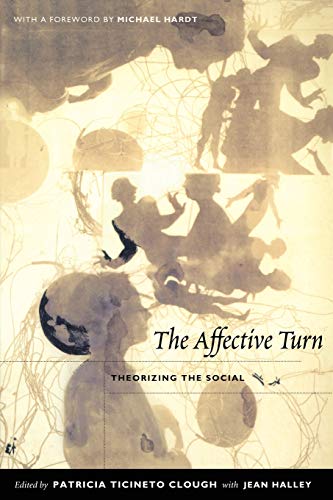
In the mid-1990s, scholars turned their attention toward the ways that ongoing political, economic, and cultural transformations were changing the realm of the social, specifically that aspect of it described by the notion of affect: pre-individual bodily forces, linked to autonomic responses, which augment or diminish a body's capacity to act or engage with others. This "affective turn" and the new configurations of bodies, technology, and matter that it reveals, is the subject of this collection of essays. Scholars based in sociology, cultural studies, science studies, and women's studies illuminate the movement in thought from a psychoanalytically informed criticism of subject identity, representation, and trauma to an engagement with information and affect; from a privileging of the organic body to an exploration of nonorganic life; and from the presumption of equilibrium-seeking closed systems to an engagement with the complexity of open systems under far-from-equilibrium conditions. Taken together, these essays suggest that attending to the affective turn is necessary to theorizing the social.
Contributors. Jamie "Skye" Bianco, Grace M. Cho, Patricia Ticineto Clough, Melissa Ditmore, Ariel Ducey, Deborah Gambs, Karen Wendy Gilbert, Greg Goldberg, Jean Halley, Hosu Kim, David Staples, Craig Willse, Elizabeth Wissinger, Jonathan R. Wynn
Die Inhaltsangabe kann sich auf eine andere Ausgabe dieses Titels beziehen.
Über die Autorin bzw. den Autor
Patricia Ticineto Clough is Professor of Sociology and Women's Studies at the Graduate Center and Queens College of the City University of New York. She is the author of Autoaffection: Unconscious Thought in the Age of Teletechnology; The End(s) of Ethnography: From Realism to Social Criticism; and Feminist Thought: Desire, Power and Academic Discourse.
Jean Halley is Assistant Professor of Sociology at Wagner College in New York City. She is the author of The Boundaries of Touch: Social Power, Parenting, and Adult-Child Intimacy (forthcoming).
Von der hinteren Coverseite
"From the trauma of cultural displacement to the political economy of affective labor, the essays brought together here examine the many facets of affect, focusing on its consequences for theories of the social and well-informed by recent rethinkings of power. Expertly framed by Patricia Clough's introduction, the volume presents a diversity of voices engaged in a shared exploration of the conceptual landscape stretching beyond the bend of 'the affective turn.'"--Brian Massumi, author of "Parables for the Virtual: Movement, Affect, Sensation"
Auszug. © Genehmigter Nachdruck. Alle Rechte vorbehalten.
The Affective Turn
THEORIZING THE SOCIALDuke University Press
Copyright © 2007 DUKE UNIVERSITY PRESSAll right reserved.
ISBN: 978-0-8223-3925-0
Contents
Acknowledgments..................................................................................................................ixForeword: What Affects Are Good For MICHAEL HARDT...............................................................................1Introduction PATRICIA TICINETO CLOUGH...........................................................................................34The Parched Tongue HOSU KIM.....................................................................................................47Techno-Cinema: Image Matters in the Affective Unfoldings of Analog Cinema and New Media JAMIE "SKYE" BIANCO.....................77Slowness: Notes toward an Economy of Diffrancial Rates of Being KAREN WENDY GILBERT............................................106Myocellular Transduction: When My Cells Trained My Body-Mind DEBORAH GAMBS......................................................119Women's Work and the Ambivalent Gift of Entropy DAVID STAPLES...................................................................151Voices from the Teum: Synesthetic Trauma and the Ghosts of the Korean Diaspora GRACE M. CHO.....................................170In Calcutta, Sex Workers Organize MELISSA DITMORE...............................................................................187More Than a Job: Meaning, Affect, and Training Health Care Workers ARIEL DUCEY..................................................209Haunting Orpheus: Problems of Space and Time in the Desert JONATHAN R. WYNN.....................................................231Always on Display: Affective Production in the Modeling Industry ELIZABETH WISSINGER............................................261The Wire JEAN HALLEY............................................................................................................264Losses and Returns: The Soldier in Trauma GREG GOLDBERG AND CRAIG WILLSE........................................................287Bibliography.....................................................................................................................303Contributors.....................................................................................................................305
Introduction
PATRICIA TICINETO CLOUGHEach self-reproducing system in this generalized production of order out of chaos combines modulations of what could be called, broadly, the "political" dimension ... the "economic" dimension ..., and contributes in a way that could be called "cultural".... For lack of a better word, the chaotic cofunctioning of the political, economic and cultural dimensions could be dubbed the "social"-although all of these designations are fairly arbitrary at this point. -Brian Massumi, "Requiem for Our Prospective Dead (Toward a Participatory Critique of Capitalist Power)"
The increasing significance of affect as a focus of analysis across a number of disciplinary and interdisciplinary discourses is occurring at a time when critical theory is facing the analytic challenges of ongoing war, trauma, torture, massacre, and counter/terrorism. If these world events can be said to be symptomatic of ongoing political, economic, and cultural transformations, the turn to affect may be registering a change in the cofunctioning of the political, economic, and cultural, or what Brian Massumi in the epigraph to this introduction dubs the "social." The essays collected in The Affective Turn: Theorizing the Social explore these political, economic, and cultural tendencies and investigate how they are being rendered as a shift in thought-captured in critical theory's turn to affect.
The essays collected in The Affective Turn-written when their authors were completing doctoral work in sociology, women's studies, and cultural studies-explore the recent turn in critical theory to affect, especially the conceptualization of affect that draws on the line of thought from Gilles Deleuze and Flix Guattari back through Baruch Spinoza and Henri Bergson. The essays engage the insights of scholars presently working in this line of thought and who treat affectivity as a substrate of potential bodily responses, often autonomic responses, in excess of consciousness. For these scholars, affect refers generally to bodily capacities to affect and be affected or the augmentation or diminution of a body's capacity to act, to engage, and to connect, such that autoaffection is linked to the self-feeling of being alive-that is, aliveness or vitality. Yet affect is not "presocial," as Massumi argues. There is a reflux back from conscious experience to affect, which is registered, however, as affect, such that "past action and contexts are conserved and repeated, autonomically reactivated but not accomplished; begun but not completed." Affect constitutes a nonlinear complexity out of which the narration of conscious states such as emotion are subtracted, but always with "a never-to-be-conscious autonomic remainder."
In this conceptualization, affect is not only theorized in terms of the human body. Affect is also theorized in relation to the technologies that are allowing us both to "see" affect and to produce affective bodily capacities beyond the body's organic-physiological constraints. The technoscientific experimentation with affect not only traverses the opposition of the organic and the non-organic; it also inserts the technical into felt vitality, the felt aliveness given in the preindividual bodily capacities to act, engage, and connect-to affect and be affected. The affective turn, therefore, expresses a new configuration of bodies, technology, and matter instigating a shift in thought in critical theory. It is this shift in thought that the following essays engage. Taken together, the essays explore the movement in critical theory from a psychoanalytically informed criticism of subject identity, representation, and trauma to an engagement with information and affect; from privileging the organic body to exploring nonorganic life; from the presumption of equilibrium-seeking closed systems to engaging the complexity of open systems under far-from-equilibrium conditions of metastability; from focusing on an economy of production and consumption to focusing on the economic circulation of pre-individual bodily capacities or affects in the domain of biopolitical control. Taken together, the essays suggest that attending to the affective turn is necessary to theorizing the social.
This not only means thinking about affect in terms of the historical changes in Western capitalist industrial societies but also recognizing that politics, economy, and culture always have been and are presently being reconfigured differently across various regions of the world. This recognition comes not so much from a comparative but rather from a geopolitical analysis of the ongoing transformation of relations of power across international organizations, regions, nations, states, economies, and private and public spheres. The Affective Turn especially marks the way these historical changes are indicative of the changing global processes of accumulating capital and employing labor power through the deployment of technoscience to reach beyond the limitations of the human in experimentation with the structure and organization of the human body, or what is called "life itself." The...
„Über diesen Titel“ kann sich auf eine andere Ausgabe dieses Titels beziehen.
Suchergebnisse für The Affective Turn: Theorizing The Social

Beispielbild für diese ISBN
The Affective Turn: Theorizing the Social
Anbieter: ThriftBooks-Dallas, Dallas, TX, USA
Verkäuferbewertung 5 von 5 Sternen

Paperback. Zustand: Very Good. No Jacket. May have limited writing in cover pages. Pages are unmarked. ~ ThriftBooks: Read More, Spend Less. Artikel-Nr. G0822339250I4N00
Gebraucht kaufen
EUR 10,64
Versand gratis
Versand innerhalb von USA
Versand innerhalb von USA
Anzahl: 1 verfügbar
Beispielbild für diese ISBN
The Affective Turn: Theorizing the Social
Anbieter: ThriftBooks-Atlanta, AUSTELL, GA, USA
Verkäuferbewertung 5 von 5 Sternen
Paperback. Zustand: Good. No Jacket. Pages can have notes/highlighting. Spine may show signs of wear. ~ ThriftBooks: Read More, Spend Less. Artikel-Nr. G0822339250I3N00
Gebraucht kaufen
EUR 10,64
Versand gratis
Versand innerhalb von USA
Versand innerhalb von USA
Anzahl: 1 verfügbar
Beispielbild für diese ISBN
The Affective Turn: Theorizing the Social
Anbieter: ThriftBooks-Phoenix, Phoenix, AZ, USA
Verkäuferbewertung 5 von 5 Sternen
Paperback. Zustand: Very Good. No Jacket. May have limited writing in cover pages. Pages are unmarked. ~ ThriftBooks: Read More, Spend Less. Artikel-Nr. G0822339250I4N00
Gebraucht kaufen
EUR 10,64
Versand gratis
Versand innerhalb von USA
Versand innerhalb von USA
Anzahl: 1 verfügbar
Beispielbild für diese ISBN
The Affective Turn: Theorizing the Social
Anbieter: Books From California, Simi Valley, CA, USA
Verkäuferbewertung 4 von 5 Sternen

paperback. Zustand: Good. Minimal markings from previous owner threwout pages.General shelf wear. Artikel-Nr. mon0004034599
Gebraucht kaufen
EUR 6,77
EUR 4,45 Versand
Versand innerhalb von USA
Versand innerhalb von USA
Anzahl: 1 verfügbar
Beispielbild für diese ISBN
The Affective Turn : Theorizing the Social
Anbieter: Better World Books, Mishawaka, IN, USA
Verkäuferbewertung 5 von 5 Sternen
Zustand: Good. Pages intact with minimal writing/highlighting. The binding may be loose and creased. Dust jackets/supplements are not included. Stock photo provided. Product includes identifying sticker. Better World Books: Buy Books. Do Good. Artikel-Nr. 11069339-6
Gebraucht kaufen
EUR 11,40
Versand gratis
Versand innerhalb von USA
Versand innerhalb von USA
Anzahl: 2 verfügbar
Foto des Verkäufers
The Affective Turn; Theorizing the Social
Verlag:
Duke University Press, Durham, NC, 2007
ISBN 10: 0822339250
ISBN 13: 9780822339250
Gebraucht
Paperback
Erstausgabe
Anbieter: True Oak Books, Highland, NY, USA
Verkäuferbewertung 5 von 5 Sternen
Paperback. Zustand: Very Good+. 6.13 X 0.82 X 9.25 inches; 313 pages; A couple of very minor, faint finger rubbing smudges on the exterior edges of textblock. Very Good condition otherwise. No other noteworthy defects. No markings.; - Your satisfaction is our priority. We offer free returns and respond promptly to all inquiries. Your item will be packaged with care and ship on the same or next business day. Buy with confidence. 1st Edition (Unstated); No Printing Stated. Artikel-Nr. HVD-65853-A-0
Gebraucht kaufen
EUR 24,78
Versand gratis
Versand innerhalb von USA
Versand innerhalb von USA
Anzahl: 1 verfügbar
Beispielbild für diese ISBN
The Affective Turn: Theorizing the Social
Anbieter: Anybook.com, Lincoln, Vereinigtes Königreich
Verkäuferbewertung 5 von 5 Sternen
Zustand: Poor. This is an ex-library book and may have the usual library/used-book markings inside.This book has soft covers. Book contains pencil markings. In poor condition, suitable as a reading copy. Library sticker on front cover.Water damaged. Please note the Image in this listing is a stock photo and may not match the covers of the actual item,550grams, ISBN:9780822339250. Artikel-Nr. 4941240
Gebraucht kaufen
EUR 14,28
EUR 15,57 Versand
Versand von Vereinigtes Königreich nach USA
Versand von Vereinigtes Königreich nach USA
Anzahl: 1 verfügbar
Beispielbild für diese ISBN
The Affective Turn: Theorizing the Social
Anbieter: Anybook.com, Lincoln, Vereinigtes Königreich
Verkäuferbewertung 5 von 5 Sternen
Zustand: Good. This is an ex-library book and may have the usual library/used-book markings inside.This book has soft covers. In good all round condition. Please note the Image in this listing is a stock photo and may not match the covers of the actual item,550grams, ISBN:9780822339250. Artikel-Nr. 8690094
Gebraucht kaufen
EUR 14,76
EUR 15,57 Versand
Versand von Vereinigtes Königreich nach USA
Versand von Vereinigtes Königreich nach USA
Anzahl: 1 verfügbar
Beispielbild für diese ISBN
The Affective Turn
Anbieter: PBShop.store UK, Fairford, GLOS, Vereinigtes Königreich
Verkäuferbewertung 5 von 5 Sternen
PAP. Zustand: New. New Book. Shipped from UK. Established seller since 2000. Artikel-Nr. FW-9780822339250
Neu kaufen
EUR 35,80
EUR 5,99 Versand
Versand von Vereinigtes Königreich nach USA
Versand von Vereinigtes Königreich nach USA
Anzahl: 1 verfügbar
Beispielbild für diese ISBN
The Affective Turn: Theorizing the Social
Anbieter: Majestic Books, Hounslow, Vereinigtes Königreich
Verkäuferbewertung 4 von 5 Sternen
Zustand: New. Artikel-Nr. 7952435
Neu kaufen
EUR 43,28
EUR 7,76 Versand
Versand von Vereinigtes Königreich nach USA
Versand von Vereinigtes Königreich nach USA
Anzahl: 3 verfügbar