
Verwandte Artikel zu Dietrich Icon
Inhaltsangabe
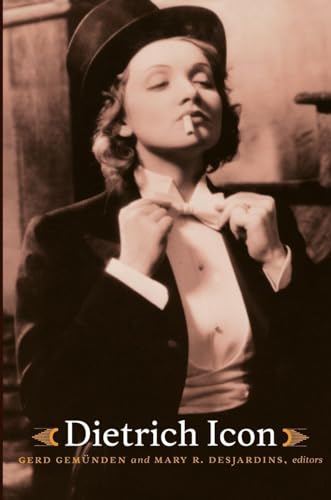
Few movie stars have meant as many things to as many different audiences as the iconic Marlene Dietrich. The actress-chanteuse had a career of some seventy years: one that included not only classical Hollywood cinema and the concert hall but also silent film in Weimar Germany, theater, musical comedy, vaudeville, army camp shows, radio, recordings, television, and even the circus. Having renounced and left Nazi Germany, assumed American citizenship, and entertained American troops, Dietrich has long been a flashpoint in Germany's struggles over its cultural heritage. She has also figured prominently in European and American film scholarship, in studies ranging from analyses of the directors with whom she worked to theories about the ideological and psychic functions of film. Dietrich Icon, which includes essays by established and emerging film scholars, is a unique examination of the many meanings of Dietrich. Some of the essays in this collection revisit such familiar topics as Germany's complex relationship with Dietrich, her ambiguous sexuality, her place in the lesbian archive, her star status, and her legendary legs, but with fresh critical perspective and an emphasis on historical background. Other essays establish new avenues for understanding Dietrich's persona. Among these are a reading of Marlene Dietrich's ABC-an eclectic autobiographical compendium containing Dietrich's thoughts on such diverse subjects as "steak," "Sternberg (Joseph von)," "Stravinsky," and "stupidity"-and an argument that Dietrich manipulated her voice-through her accent, sexual innuendo, and singing-as much as her visual image in order to convey a cosmopolitan world-weariness. Still other essays consider the specter of aging that loomed over Dietrich's career, as well as the many imitations of the Dietrich persona that have emerged since the star's death in 1992. Contributors. Nora M. Alter, Steven Bach, Elisabeth Bronfen, Erica Carter, Mary R. Desjardins, Joseph Garncarz, Gerd Gemünden, Mary Beth Haralovich, Amelie Hastie, Lutz Koepnick, Alice A. Kuzniar, Amy Lawrence, Judith Mayne, Patrice Petro, Eric Rentschler, Gaylyn Studlar, Werner Sudendorf, Mark Williams
Die Inhaltsangabe kann sich auf eine andere Ausgabe dieses Titels beziehen.
Über die Autorin bzw. den Autor
Gerd Gemünden is the Ted and Helen Geisel Third Century Professor in the Humanities at Dartmouth College. He is the author of Framed Visions: Popular Culture, Americanization, and the Contemporary German and Austrian Imagination and coeditor of The Cinema of Wim Wenders: Image, Narrative, and the Postmodern Condition.
Mary R. Desjardins is Associate Professor of Film and Television Studies at Dartmouth College.
Von der hinteren Coverseite
"Most works on actresses are largely biographical in nature, with some critical evaluation of particular films and stage appearances thrown into the mix. This anthology by Gerd Gemunden and Mary R. Desjardins, however, presents serious historical and theoretical work on Dietrich's star image and career--all expressed in clear and readable language, devoid of 'jargon.'"--Lucy Fischer, author of "Designing Women: Cinema, Art Deco, and the Female Form"
Auszug. © Genehmigter Nachdruck. Alle Rechte vorbehalten.
Dietrich Icon
Duke University Press
Copyright © 2007 DUKE UNIVERSITY PRESSAll right reserved.
ISBN: 978-0-8223-3819-2
Contents
Acknowledgments......................................................................................................viiMary R. Desjardins and Gerd Gemnden, Introduction: Marlene Dietrich's Appropriations................................3Steven Bach, Falling in Love Again...................................................................................25Lutz Koepnick, Dietrich's Face.......................................................................................43Nora M. Alter, The Legs of Marlene Dietrich..........................................................................60Amy Lawrence, Marlene Dietrich: The Voice as Mask....................................................................79Joseph Garncarz, Playing Garbo: How Marlene Dietrich Conquered Hollywood.............................................103Elisabeth Bronfen, Seductive Departures of Marlene Dietrich: Exile and Stardom in The Blue Angel.....................119Patrice Petro, The Blue Angel in Multiple-Language Versions: The Inner Thighs of Miss Dietrich.......................141Mary Beth Haralovich, Marlene Dietrich in Blonde Venus: Advertising Dietrich in Seven Markets........................162Erica Carter, Marlene Dietrich: The Prodigal Daughter................................................................186Gaylyn Studlar, Marlene Dietrich and the Erotics of Code-Bound Hollywood.............................................211Alice A. Kuzniar, "It's Not Often That I Want a Man": Reading for a Queer Marlene....................................239Mark Williams, Get/Away: Structure and Desire in Rancho Notorious....................................................259Amelie Hastie, The Order of Knowledge and Experience: Marlene Dietrich's ABC.........................................289Mary R. Desjardins, Dietrich Dearest: Family Memoir and the Fantasy of Origins.......................................310Eric Rentschler, An Icon between the Fronts: Vilsmaier's Recast Marlene..............................................328Judith Mayne, "Life Goes On without Me": Marlene Dietrich, Old Age, and the Archive..................................347Judith Mayne, Homage, Impersonation, and Magic: An Interview with James Beaman.......................................364Werner Sudendorf, "Is That Me?": The Marlene Dietrich Collection Berlin..............................................376Bibliography.........................................................................................................385Contributors.........................................................................................................401Index................................................................................................................405
Chapter One
Dietrich's Face
In 1934, a Film Pictorial article entitled "Composite Beauty-Hollywood Standard" surveyed the bodies and physiognomies of several leading female film stars in order to compile an image of physical perfection. Norma Shearer ranked first in the category of hair, Loretta Young was seen as having the most desirable eyes, and Irene Dunne and Claudette Colbert surpassed the looks of all other film stars when it came to the shape of noses and mouths. No other star, however, had as many perfect body parts to offer than Marlene Dietrich, the highest grossing screen actress of the time. After Paramount had marketed Dietrich two years earlier as "the women all women want to see" (John Baxter 75), the Film Pictorial essay now instructed the fans exactly what to look at when admiring their star on screen. Dietrich featured with no less than four body parts in the essay's normative vision of female beauty, three of them located in her body's lower regions and all of them, in Dietrich's early Hollywood films, often involved in a calculated aesthetic of display and concealment: her hands, legs, ankles, and feet.
Sarah Berry (Screen Style) has recently examined the extent to which Hollywood star images of the early 1930s encouraged fantasies of personal self-transformation and social mobility that, to some degree, challenged received notions of individual sovereignty, identity, and authority. Accordingly, star images were designed to empower individual spectators to flirt with temporary losses and mimetic transgressions of their ordinary selves; they promoted an ethos of individual self-formation that invited the viewer to adopt the star's features and translate them into a multiplicity of vernacular uses and meanings. In some sense, the 1934 article in Film Pictorial was the culmination of this trend. It not only presented the stars' bodies as prototypes for acts of personal self-redress, but literally dismembered the stars' corporeal appearances in order to fuel desire and capture the imagination. The notion of perfect beauty here bordered the monstrous. Far from recalling classical ideals of physical integrity, balance, and symmetry, the article's vision of composite beauty in fact reached Frankensteinian proportions. In its efforts to exploit the Hollywood cult of stardom at its fullest, Film Pictorial surreptitiously spoke the truth about the reifying logic of Fordist consumer culture. Instead of circulating star images as signs of authenticity and wholeness, Film Pictorial endorsed visions of the human body as marked by atomization and aggregation, by syncretism and montage. Instead of defining beauty as humanity's most captivating attraction, the article invited the fan to enter and exalt in nothing other than the realm of the posthuman, of prosthetic identities.
Given Dietrich's star status in Hollywood in the early 1930s, as well as the continual realignment of her persona with the tastes of Depression-ridden America, Dietrich's prominent position in the Film Pictorial ranking should hardly come as a surprise. What may astonish, however, is the fact that in its search for ideal body parts the article completely bypassed any mention of Dietrich's facial features: her sharp, elongated eyebrows, her dramatically elevated cheekbones, the enigmatic smile of her mouth, the canvas-like composition of her forehead and skin. In the perspective of the judges of Film Pictorial, Dietrich's body and its beauty seemed to begin somewhere below the star's neck. They had no eyes for how Dietrich tended to exhibit her face to her director's camera, nor did they encourage fans to mimic what has marked the circulation of the Dietrich image ever since, namely to emulate how Dietrich staged her countenance as a fetish, one that involved the viewer in a dazzling game of hide and seek, of lure and endless deferral, of multivalent attraction and theatrical artifice.
Film Pictorial's silence about Dietrich's face is particularly surprising if we consider the extent to which Dietrich, in her initial efforts to secure and increase her market value in 1930s Hollywood, subjected her face to a scrupulous process of remodeling and transformation. A good number of production stills and publicity materials, rejected by Dietrich for publication, and gathered at the Marlene Dietrich Collection in Berlin, document in a highly instructive manner Dietrich's quest for facial makeover during the 1930s. Time and again, we can see the trace of Dietrich's pen in these images, pointing out or even correcting certain unwanted aspects of her facial appearance: unwelcome shadows under her eyes; tiny wrinkles around her mouth; stray hairs, which by stubbornly...
„Über diesen Titel“ kann sich auf eine andere Ausgabe dieses Titels beziehen.
Suchergebnisse für Dietrich Icon

Beispielbild für diese ISBN
Dietrich Icon
Anbieter: Better World Books, Mishawaka, IN, USA
Verkäuferbewertung 5 von 5 Sternen

Zustand: Very Good. Pages intact with possible writing/highlighting. Binding strong with minor wear. Dust jackets/supplements may not be included. Stock photo provided. Product includes identifying sticker. Better World Books: Buy Books. Do Good. Artikel-Nr. 46495433-75
Gebraucht kaufen
EUR 6,93
Versand gratis
Versand innerhalb von USA
Versand innerhalb von USA
Anzahl: 1 verfügbar
Beispielbild für diese ISBN
Dietrich Icon
Anbieter: Better World Books, Mishawaka, IN, USA
Verkäuferbewertung 5 von 5 Sternen
Zustand: Good. Former library copy. Pages intact with minimal writing/highlighting. The binding may be loose and creased. Dust jackets/supplements are not included. Includes library markings. Stock photo provided. Product includes identifying sticker. Better World Books: Buy Books. Do Good. Artikel-Nr. 46497899-6
Gebraucht kaufen
EUR 6,93
Versand gratis
Versand innerhalb von USA
Versand innerhalb von USA
Anzahl: 1 verfügbar
Beispielbild für diese ISBN
Dietrich Icon
Anbieter: ThriftBooks-Atlanta, AUSTELL, GA, USA
Verkäuferbewertung 5 von 5 Sternen
Paperback. Zustand: Good. No Jacket. Pages can have notes/highlighting. Spine may show signs of wear. ~ ThriftBooks: Read More, Spend Less. Artikel-Nr. G082233819XI3N00
Gebraucht kaufen
EUR 8,21
Versand gratis
Versand innerhalb von USA
Versand innerhalb von USA
Anzahl: 1 verfügbar
Beispielbild für diese ISBN
Dietrich Icon
Anbieter: medimops, Berlin, Deutschland
Verkäuferbewertung 5 von 5 Sternen
Zustand: good. Befriedigend/Good: Durchschnittlich erhaltenes Buch bzw. Schutzumschlag mit Gebrauchsspuren, aber vollständigen Seiten. / Describes the average WORN book or dust jacket that has all the pages present. Artikel-Nr. M0082233819X-G
Gebraucht kaufen
EUR 14,10
EUR 10,00 Versand
Versand von Deutschland nach USA
Versand von Deutschland nach USA
Anzahl: 1 verfügbar
Beispielbild für diese ISBN
Dietrich Icon
Anbieter: Phatpocket Limited, Waltham Abbey, HERTS, Vereinigtes Königreich
Verkäuferbewertung 5 von 5 Sternen
Zustand: Good. Your purchase helps support Sri Lankan Children's Charity 'The Rainbow Centre'. Ex-library, so some stamps and wear, but in good overall condition. Our donations to The Rainbow Centre have helped provide an education and a safe haven to hundreds of children who live in appalling conditions. Artikel-Nr. Z1-M-009-02374
Gebraucht kaufen
EUR 16,69
EUR 12,70 Versand
Versand von Vereinigtes Königreich nach USA
Versand von Vereinigtes Königreich nach USA
Anzahl: 1 verfügbar
Beispielbild für diese ISBN
Dietrich Icon
Anbieter: Ria Christie Collections, Uxbridge, Vereinigtes Königreich
Verkäuferbewertung 5 von 5 Sternen
Zustand: New. In English. Artikel-Nr. ria9780822338192_new
Neu kaufen
EUR 35,51
EUR 13,48 Versand
Versand von Vereinigtes Königreich nach USA
Versand von Vereinigtes Königreich nach USA
Anzahl: 2 verfügbar
Beispielbild für diese ISBN
Dietrich Icon
Anbieter: Kennys Bookstore, Olney, MD, USA
Verkäuferbewertung 5 von 5 Sternen
Zustand: New. 2007. n. Paperback. . . . . . Books ship from the US and Ireland. Artikel-Nr. V9780822338192
Neu kaufen
EUR 43,97
EUR 9,37 Versand
Versand innerhalb von USA
Versand innerhalb von USA
Anzahl: 1 verfügbar
Beispielbild für diese ISBN
Dietrich Icon
Anbieter: Revaluation Books, Exeter, Vereinigtes Königreich
Verkäuferbewertung 5 von 5 Sternen
Paperback. Zustand: Brand New. n edition. 432 pages. 9.25x6.25x1.00 inches. In Stock. Artikel-Nr. x-082233819X
Neu kaufen
EUR 54,41
EUR 14,93 Versand
Versand von Vereinigtes Königreich nach USA
Versand von Vereinigtes Königreich nach USA
Anzahl: 2 verfügbar