
Verwandte Artikel zu Neoliberalism as Exception: Mutations in Citizenship...
Inhaltsangabe
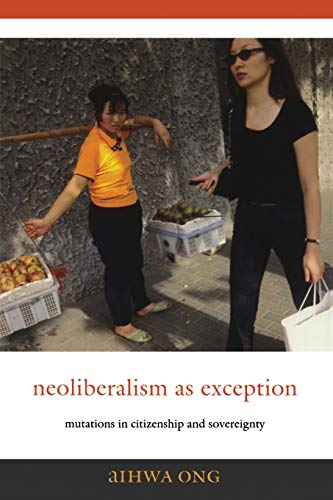
Neoliberalism is commonly viewed as an economic doctrine that seeks to limit the scope of government. Some consider it a form of predatory capitalism with adverse effects on the Global South. In this groundbreaking work, Aihwa Ong offers an alternative view of neoliberalism as an extraordinarily malleable technology of governing that is taken up in different ways by different regimes, be they authoritarian, democratic, or communist. Ong shows how East and Southeast Asian states are making exceptions to their usual practices of governing in order to position themselves to compete in the global economy. As she demonstrates, a variety of neoliberal strategies of governing are re-engineering political spaces and populations. Ong's ethnographic case studies illuminate experiments and developments such as China's creation of special market zones within its socialist economy; pro-capitalist Islam and women's rights in Malaysia; Singapore's repositioning as a hub of scientific expertise; and flexible labor and knowledge regimes that span the Pacific.
Ong traces how these and other neoliberal exceptions to business as usual are reconfiguring relationships between governing and the governed, power and knowledge, and sovereignty and territoriality. She argues that an interactive mode of citizenship is emerging, one that organizes people-and distributes rights and benefits to them-according to their marketable skills rather than according to their membership within nation-states. Those whose knowledge and skills are not assigned significant market value-such as migrant women working as domestic maids in many Asian cities-are denied citizenship. Nevertheless, Ong suggests that as the seam between sovereignty and citizenship is pried apart, a new space is emerging for NGOs to advocate for the human rights of those excluded by neoliberal measures of human worthiness.
Die Inhaltsangabe kann sich auf eine andere Ausgabe dieses Titels beziehen.
Über die Autorin bzw. den Autor
Aihwa Ong is Professor of Anthropology at the University of California, Berkeley. Her books include Global Assemblages: Technology, Politics, and Ethics as Anthropological Problems (coedited with Stephen J. Collier); Buddha Is Hiding: Refugees, Citizenship, the New America; and Flexible Citizenship: The Cultural Logics of Transnationality, winner of the Association for Asian American Studies' Cultural Studies Book Award and also published by Duke University Press.
Von der hinteren Coverseite
"This book by a leading scholar in development studies clearly documents the fact that governments and institutions have a more decisive role than markets in the successful experiences of development in the new global economy. It will become mandatory reading for students and policy makers around the world."--Manuel Castells, Wallis Annenberg Chair of Communication Technology and Society, University of Southern California
Auszug. © Genehmigter Nachdruck. Alle Rechte vorbehalten.
NEOLIBERALISM as EXCEPTION
MUTATIONS IN CITIZENSHIP AND SOVEREIGNTYBy Aihwa OngDUKE UNIVERSITY PRESS
Copyright © 2006 Duke University PressAll right reserved.
ISBN: 978-0-8223-3748-5
Contents
Acknowledgement..........................................................................ixIntroduction: Neoliberalism as Exception, Exception to Neoliberalism.....................11. Sisterly Solidarity: Feminist Virtue under "Moderate Islam"...........................312. Cyberpublics and the Pitfalls of Diasporic Chinese Politics...........................533. Graduated Sovereignty.................................................................754. Zoning Technologies in East Asia......................................................975. Latitudes, or How Markets Stretch the Bounds of Governmentality.......................1216. Higher Learning in Global Space.......................................................1397. Labor Arbitrage: Displacements and Betrayals in Silicon Valley........................1578. Baroque Ecology, Evervescent Citizenship..............................................1779. A Biocartography: Maids, Neoslavery, and NGOs.........................................19510. Reengineering the "Chinese Soul" in Shanghai?........................................219Notes....................................................................................241Bibliography.............................................................................261Index....................................................................................279
Chapter One
Sisterly Solidarity: Feminist Virtue under "Moderate Islam"
In the aftermath of the 1995 Fourth World Conference on Women in Beijing, many internationalist feminists felt triumphant as they headed for home. Bina Agarwal, an Indian economist, declared, "Many Northern women today are finding common ground with Southern women.... This is not to argue that the North-South gap has disappeared. But among women's groups there is growing recognition of the importance of forging strategic links. One could say 'romantic sisterhood' is giving way to 'strategic sisterhood' for confronting the global crisis of economy and polity."
Strategic Sisterhood
Strategic sisterhood is a new mechanism to confront the entangled issues of globalization and women's rights. The term implies a contingent North-South feminist partnership for intervention in countries where the gender gap is huge. Because of their participation in a transnational feminist public, feminists can draw on their international alliances to hold their own government to account.
Yet a lacuna remains in this strategic sisterhood intervention. Cosmopolitan feminism focuses on the unequal distribution of gender rights across the world, but its focus on feminist individualism comes into direct conflict with alternative ethics that are rooted in collectivist norms and goals. Strategic sisterhood is a concept that seeks to disseminate democratic principles of gender equality throughout the world. Drawing on Kantian democratic liberalism, the strategic sisters' notion of gender citizenship is conceptualized in absolute, universalistic terms of individual freedom and equality, regardless of the geopolitical inequalities and diverse ethical systems. Mantras from the North like "women's rights are human rights" propose global human standards without regard to other moral systems and visions of ethical living. While feminists may think their challenge is to find a universal solution to the plight of women across the world, we need to ask how these messages will be received in places that have emerged from Western colonial domination and are just now forging their own postcolonial identities and ethico-political future. Northern feminists and many of their elite Southern counterparts often skirt the issue of how to improve women's conditions without being seen as the new imperialists. Besides being more sensitive to an imperialist logic in promoting their transnational system of civic virtue, internationalist feminists may also recognize that their own self-image as autonomous individuals depends on their "liberation" of oppressed sisters in the Third World.
In internationalist feminist discourses, women in postcolonial situations are framed as the dual victims of age-old cultural traditions and postcolonial nationalism. This formulation is supported by the view that the women's question is inseparable from national emancipation in emerging countries. In countries like India, women and the home represent "the original site on which the hegemonic project of nationalism was launched." Because colonial and postcolonial struggles have been based on national ideologies of community, any discussion of the women's issue is always framed in terms of the national project and collective interests. Postcolonial scholars maintain that outsiders talking about women's rights are tampering with "the inner spaces of community" and thus "the life of the nation." We need to understand, therefore, how a national discourse of community is able to negotiate with subaltern ones on its "own terms for the purposes of producing consent." Narratives of nation and community position women within special conditions for expressing their moral agency. For instance, a patriarchal dimension in the rise of Asian tiger countries mobilized young women as a cheap labor force for multinational corporations. For postcolonial leaders and their citizens, women's emancipation, far from just being a question of individual rights, is fundamentally about the national project and the nationalist prestige of cultural difference. These issues are especially potent at the historical juncture when many postcolonial countries are finally emerging as economic competitors to the West, and they are especially sensitive to having women's rights ideology imposed from the West.
But postcolonial situations are dynamic sites of change, and over time the local and transnational variables have shifted in relation to each other. Because postcolonial milieus are constantly unfolding, the question of women's emancipation is becoming less of a stark choice between universal feminist values or domestic political agendas. Instead of a dichotomy between feminist internationalism and female-dominated nationalism, the postcolonial milieu in Southeast Asia is shaped by the intersection of nationalism, capitalist development, and religious institutions. The women-state patriarchal link is itself undergoing change, thus creating an opening for feminist claims against religious patriarchy. In the Malaysian case to which we will now turn, the state exception of "moderate Islam" promotes public conditions of possibility for women's status to be problematized in relation to Islamic patriarchy. This triangulated nexus between nationalism, women, and religion shapes the ground for feminist articulation of claims and their transformation into rights.
Women Wrestling with Ethics
Across the Islamic world, Muslim feminists are struggling against both Islamic patriarchy and authoritarian governments that have been unwilling or unable to support women's quest for gender equality. Malaysia, a developing country dominated by a Malay-Muslim majority, seems to be an exception. Malaysia is considered the most affluent and progressive Islamic (but resolutely multicultural) nation, one that has positioned itself as a bastion of...
„Über diesen Titel“ kann sich auf eine andere Ausgabe dieses Titels beziehen.
Suchergebnisse für Neoliberalism as Exception: Mutations in Citizenship...

Beispielbild für diese ISBN
Neoliberalism as Exception: Mutations in Citizenship and Sovereignty
Anbieter: ThriftBooks-Phoenix, Phoenix, AZ, USA
Verkäuferbewertung 5 von 5 Sternen

Paperback. Zustand: Very Good. No Jacket. May have limited writing in cover pages. Pages are unmarked. ~ ThriftBooks: Read More, Spend Less. Artikel-Nr. G0822337487I4N00
Gebraucht kaufen
EUR 6,20
Versand gratis
Versand innerhalb von USA
Versand innerhalb von USA
Anzahl: 1 verfügbar
Beispielbild für diese ISBN
Neoliberalism as Exception: Mutations in Citizenship and Sovereignty
Anbieter: ThriftBooks-Dallas, Dallas, TX, USA
Verkäuferbewertung 5 von 5 Sternen
Paperback. Zustand: Very Good. No Jacket. May have limited writing in cover pages. Pages are unmarked. ~ ThriftBooks: Read More, Spend Less. Artikel-Nr. G0822337487I4N00
Gebraucht kaufen
EUR 6,23
Versand gratis
Versand innerhalb von USA
Versand innerhalb von USA
Anzahl: 1 verfügbar
Beispielbild für diese ISBN
Neoliberalism as Exception: Mutations in Citizenship and Sovereignty
Anbieter: ThriftBooks-Dallas, Dallas, TX, USA
Verkäuferbewertung 5 von 5 Sternen
Paperback. Zustand: Good. No Jacket. Pages can have notes/highlighting. Spine may show signs of wear. ~ ThriftBooks: Read More, Spend Less. Artikel-Nr. G0822337487I3N00
Gebraucht kaufen
EUR 6,23
Versand gratis
Versand innerhalb von USA
Versand innerhalb von USA
Anzahl: 1 verfügbar
Beispielbild für diese ISBN
Neoliberalism as Exception: Mutations in Citizenship and Sovereignty
Anbieter: ThriftBooks-Atlanta, AUSTELL, GA, USA
Verkäuferbewertung 5 von 5 Sternen
Paperback. Zustand: Good. No Jacket. Pages can have notes/highlighting. Spine may show signs of wear. ~ ThriftBooks: Read More, Spend Less. Artikel-Nr. G0822337487I3N00
Gebraucht kaufen
EUR 6,23
Versand gratis
Versand innerhalb von USA
Versand innerhalb von USA
Anzahl: 1 verfügbar
Beispielbild für diese ISBN
Neoliberalism as Exception: Mutations in Citizenship and Sovereignty
Anbieter: ThriftBooks-Atlanta, AUSTELL, GA, USA
Verkäuferbewertung 5 von 5 Sternen
Paperback. Zustand: Very Good. No Jacket. May have limited writing in cover pages. Pages are unmarked. ~ ThriftBooks: Read More, Spend Less. Artikel-Nr. G0822337487I4N00
Gebraucht kaufen
EUR 6,23
Versand gratis
Versand innerhalb von USA
Versand innerhalb von USA
Anzahl: 1 verfügbar
Beispielbild für diese ISBN
Neoliberalism As Exception: Mutations in Citizenship and Sovereignty
Anbieter: World of Books (was SecondSale), Montgomery, IL, USA
Verkäuferbewertung 5 von 5 Sternen
Paperback. Zustand: Good. Through a series of ethnographic case studies, Aihwa Ong reconceptualizes neoliberalism as an extraordinarily malleable technology of governing that is taken up in different ways by different regimes, be they authoritarian, democratic, or communist. Artikel-Nr. 00101596064
Gebraucht kaufen
EUR 6,25
Versand gratis
Versand innerhalb von USA
Versand innerhalb von USA
Anzahl: 1 verfügbar
Beispielbild für diese ISBN
Neoliberalism As Exception: Mutations in Citizenship and Sovereignty
Anbieter: World of Books (was SecondSale), Montgomery, IL, USA
Verkäuferbewertung 5 von 5 Sternen
Paperback. Zustand: Very Good. Through a series of ethnographic case studies, Aihwa Ong reconceptualizes neoliberalism as an extraordinarily malleable technology of governing that is taken up in different ways by different regimes, be they authoritarian, democratic, or communist. Artikel-Nr. 00106422885
Gebraucht kaufen
EUR 6,25
Versand gratis
Versand innerhalb von USA
Versand innerhalb von USA
Anzahl: 1 verfügbar
Beispielbild für diese ISBN
Neoliberalism as Exception : Mutations in Citizenship and Sovereignty
Anbieter: Better World Books, Mishawaka, IN, USA
Verkäuferbewertung 5 von 5 Sternen
Zustand: Good. Pages intact with minimal writing/highlighting. The binding may be loose and creased. Dust jackets/supplements are not included. Stock photo provided. Product includes identifying sticker. Better World Books: Buy Books. Do Good. Artikel-Nr. 5456319-6
Gebraucht kaufen
EUR 6,60
Versand gratis
Versand innerhalb von USA
Versand innerhalb von USA
Anzahl: 3 verfügbar
Beispielbild für diese ISBN
Neoliberalism as Exception : Mutations in Citizenship and Sovereignty
Anbieter: Better World Books, Mishawaka, IN, USA
Verkäuferbewertung 5 von 5 Sternen
Zustand: Very Good. Pages intact with possible writing/highlighting. Binding strong with minor wear. Dust jackets/supplements may not be included. Stock photo provided. Product includes identifying sticker. Better World Books: Buy Books. Do Good. Artikel-Nr. 4643278-6
Gebraucht kaufen
EUR 6,60
Versand gratis
Versand innerhalb von USA
Versand innerhalb von USA
Anzahl: 1 verfügbar
Beispielbild für diese ISBN
Neoliberalism as Exception : Mutations in Citizenship and Sovereignty
Anbieter: Better World Books, Mishawaka, IN, USA
Verkäuferbewertung 5 von 5 Sternen
Zustand: Fine. Used book that is in almost brand-new condition. May contain a remainder mark. Better World Books: Buy Books. Do Good. Artikel-Nr. GRP95016054
Gebraucht kaufen
EUR 6,60
Versand gratis
Versand innerhalb von USA
Versand innerhalb von USA
Anzahl: 1 verfügbar