
Verwandte Artikel zu The Age of the World Target: Self-Referentiality in...
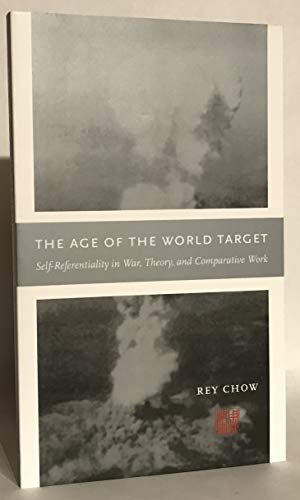
The Age of the World Target: Self-Referentiality in War, Theory, and Comparative Work (Next Wave Provocations) - Softcover
Inhaltsangabe
Martin Heidegger once wrote that the world had, in the age of modern science, become a world picture. For Rey Chow, the world has, in the age of atomic bombs, become a world target, to be attacked once it is identified, or so global geopolitics, dominated by the United States since the end of the Second World War, seems repeatedly to confirm. How to articulate the problematics of knowledge production with this aggressive targeting of the world? Chow attempts such an articulation by probing the significance of the chronological proximity of area studies, poststructuralist theory, and comparative literature--fields of inquiry that have each exerted considerable influence but whose mutual implicatedness as postwar U.S. academic phenomena has seldom been theorized. Central to Chow's discussions is a critique of the predicament of self-referentiality--the compulsive move to interiorize that, in her view, constitutes the collective frenzy of our age--in different contemporary epistemic registers, including the self-consciously avant-garde as well as the militaristic and culturally supremacist. Urging her readers to think beyond the inward-turning focus on EuroAmerica that tends to characterize even the most radical gestures of Western self-deconstruction, Chow envisions much broader intellectual premises for future transcultural work, with reading practices aimed at restoring words and things to their constitutive exteriority.
Die Inhaltsangabe kann sich auf eine andere Ausgabe dieses Titels beziehen.
Über die Autorin bzw. den Autor
Rey Chow is Andrew W. Mellon Professor of the Humanities and Professor of Comparative Literature and Modern Culture and Media at Brown University. She is the author of several books, including The Protestant Ethnic and the Spirit of Capitalism; Ethics after Idealism: Theory-Culture-Ethnicity-Reading; and Primitive Passions: Visuality, Sexuality, Ethnography, and Contemporary Chinese Cinema, which won the Modern Language Association's James Russell Lowell Prize. She is the editor of Modern Chinese Literary and Cultural Studies in the Age of Theory: Reimagining a Field, also published by Duke University Press. She is a coeditor of the Duke University Press book series Asia-Pacific.
Von der hinteren Coverseite
""The Age of the World Target" is a catalyzing tour-de-force. Rey Chow provides a poignant, persuasive staging of a topic that will shape the future of literary and cultural studies: the role of particular poststructuralist claims within the fields of area studies, identity politics, and comparative literature."--Bill Brown, author of "A Sense of Things: The Object Matter of American Literature"
Auszug. © Genehmigter Nachdruck. Alle Rechte vorbehalten.
THE AGE OF THE WORLD TARGET
Self-Referentiality in War, Theory, and Comparative WorkBy REY CHOWDuke University Press
Copyright © 2006 Duke University PressAll right reserved.
ISBN: 978-0-8223-3744-7
Contents
Preface.....................................................................................................ixIntroduction. European Theory in America....................................................................1I The Age of the World Target: Atomic Bombs, Alterity, Area Studies.........................................25II The Interruption of Referentiality; or, Poststructuralism's Outside......................................45III The Old/New Question of Comparison in Literary Studies: A Post-European Perspective.....................71Notes.......................................................................................................93Index.......................................................................................................117
Chapter One
THE AGE OF THE WORLD TARGET Atomic Bombs, Alterity, Area Studies
They did not want to risk wasting the precious weapon, and decided that it must be dropped visually and not by radar ... -Barton J. Bernstein, "The Atomic Bombings Reconsidered," Foreign Affairs (January/February 1995): 140
There has not yet developed a discourse in the American public space that does anything more than identify with power, despite the dangers of that power in a world which has shrunk so small and has become so impressively interconnected. -Edward W. Said, Culture and Imperialism (New York, 1994), 300
For most people who know something about the United States' intervention in the Second World War, one image seems to predominate and preempt the rest: the dropping of the atomic bombs on Hiroshima and Nagasaki, pictorialized in the now familiar image of the mushroom cloud, with effects of radiation and devastation of human life on a scale never before imaginable. Alternatively, we can also say that our knowledge about what happened to Hiroshima and Nagasaki is inseparable from the image of the mushroom cloud. As knowledge, "Hiroshima" and "Nagasaki" come to us inevitably as representation and, specifically, as a picture. Moreover, it is not a picture in the older sense of a mimetic replication of reality; rather, it has become in itself a sign of terror, a kind of gigantic demonstration with us, the spectators, as the potential target.
For someone such as myself, who grew up among survivors of Japan's invasion of China in the period 1937-45-banian kangzhan or the "Eight-Year War of Resistance" as it is still called among the Chinese-the image of the atomic bomb has always stood as a signifier of another kind of violence, another type of erasure. As a child, I was far more accustomed to hearing about Japanese atrocities against Chinese men and women during the war than I was to hearing about U.S. atrocities against Japan. Among the stories of the war was how the arrival of the Americans brought relief, peace, and victory for China; however hard the times were, it was said to be a moment of "liberation." As I grow older, this kind of knowledge gathered from oral narratives persists in my mind not as proof of historical accuracy but rather as a kind of emotional dissonance, a sense of something out-of-joint that becomes noticeable because it falls outside the articulations generated by the overpowering image of the mushroom cloud. It is as if the sheer magnitude of destruction unleashed by the bombs demolished not only entire populations but also the memories and histories of tragedies that had led up to that apocalyptic moment, the memories and histories of those who had been brutalized, kidnapped, raped, and slaughtered in the same war by other forces. As John W. Dower writes:
Hiroshima and Nagasaki became icons of Japanese suffering-perverse national treasures, of a sort, capable of fixating Japanese memory of the war on what had happened to Japan and simultaneously blotting out recollection of the Japanese victimization of others. Remembering Hiroshima and Nagasaki, that is, easily became a way of forgetting Nanjing, Bataan, the Burma-Siam railway, Manila, and the countless Japanese atrocities these and other place names signified to non-Japanese.
Lisa Yoneyama sums up this situation succinctly: "Hiroshima memories have been predicated on the grave obfuscation of the prewar Japanese Empire, its colonial practices, and their consequences." To this day many people in Japan still passionately deny the war crimes committed by the Japanese military in East and Southeast Asia, and the label "Japanese" is hardly ever as culturally stigmatized as, say, the label "German," which for many is still a straightforward synonym for "Nazi" and "fascist."
But my aim in this chapter is not exactly that of reinstating historical, literary, or personal accounts of the innumerable instances of victimization during and after the war. Rather, I'd like to explore the significance of the atomic bomb as an epistemic event in a global culture in which everything has become (or is mediated by) visual representation and virtual reality. What are some of the consequences in knowledge production that were unleashed with the blasts in the summer of 1945? To respond to this question, I turn briefly to the civil, pedagogical apparatus known as area studies: whereas it is common knowledge that area studies programs in the United States are a postwar, cold war, government-funded phenomenon, I want to ask how rethinking the most notorious U.S. action in the Second World War-the dropping of two atomic bombs-can complicate and change our conventional understanding of such programs.
Seeing Is Destroying
As an anonymous journalist commented in 1995, the fiftieth anniversary of the catastrophes, the bombs that fell on the two Japanese cities in August 1945 ended any pretense of equality between the United States and Japan. It was, he writes, "as if a steel battleship had appeared at Trafalgar, effortlessly and ruthlessly destroying the wooden enemy fleet. There was absolutely no contest." Passages such as this rightly point to the fundamental shift of the technological scale and definition of the war, but what remains to be articulated is the political and ideological significance of this shift.
From a purely scientific perspective, the atomic bomb was, of course, the most advanced invention of the time. Like all scientific inventions, it had to be tested in order to have its effectiveness verified. It was probably no accident that the United States chose as its laboratory, its site of experimentation, a civilian rather than military space, since the former, with a much higher population density, was far more susceptible to demonstrating the upper ranges of the bomb's spectacular potential. The mundane civilian space in the early hours of the morning, with ordinary people beginning their daily routines, offered the promise of numerical satisfaction, of a destruction whose portent defied the imagination. Such civilian spaces had to have been previously untouched by U.S. weaponry so as to offer the highest possible accuracy for the postwar evaluations of the bombing experiments. And, destroying one city was not enough: since the United States had two bombs, one uranium (which was simple and gunlike, and nicknamed Little Boy) and the other plutonium (which worked with the complex and uncertain means...
„Über diesen Titel“ kann sich auf eine andere Ausgabe dieses Titels beziehen.
Suchergebnisse für The Age of the World Target: Self-Referentiality in...

Beispielbild für diese ISBN
The Age of the World Target: Self-Referentiality in War, Theory, and Comparative Work
Anbieter: ThriftBooks-Atlanta, AUSTELL, GA, USA
Verkäuferbewertung 5 von 5 Sternen

Paperback. Zustand: Very Good. No Jacket. Former library book; May have limited writing in cover pages. Pages are unmarked. ~ ThriftBooks: Read More, Spend Less. Artikel-Nr. G0822337444I4N10
Gebraucht kaufen
EUR 13,99
Versand gratis
Versand innerhalb von USA
Versand innerhalb von USA
Anzahl: 1 verfügbar
Beispielbild für diese ISBN
The Age of the World Target: Self-Referentiality in War, Theory, and Comparative Work
Anbieter: ThriftBooks-Dallas, Dallas, TX, USA
Verkäuferbewertung 5 von 5 Sternen
Paperback. Zustand: Good. No Jacket. Pages can have notes/highlighting. Spine may show signs of wear. ~ ThriftBooks: Read More, Spend Less. Artikel-Nr. G0822337444I3N00
Gebraucht kaufen
EUR 13,99
Versand gratis
Versand innerhalb von USA
Versand innerhalb von USA
Anzahl: 1 verfügbar
Beispielbild für diese ISBN
The Age of the World Target : Self-Referentiality in War, Theory, and Comparative Work
Anbieter: Better World Books: West, Reno, NV, USA
Verkäuferbewertung 5 von 5 Sternen
Zustand: Very Good. Former library copy. Pages intact with possible writing/highlighting. Binding strong with minor wear. Dust jackets/supplements may not be included. Includes library markings. Stock photo provided. Product includes identifying sticker. Better World Books: Buy Books. Do Good. Artikel-Nr. 17626385-20
Gebraucht kaufen
EUR 16,62
Versand gratis
Versand innerhalb von USA
Versand innerhalb von USA
Anzahl: 1 verfügbar
Beispielbild für diese ISBN
The Age of the World Target: Self-Referentiality in War, Theory, and Comparative Work (Next Wave Provocations)
Anbieter: medimops, Berlin, Deutschland
Verkäuferbewertung 5 von 5 Sternen
Zustand: good. Befriedigend/Good: Durchschnittlich erhaltenes Buch bzw. Schutzumschlag mit Gebrauchsspuren, aber vollständigen Seiten. / Describes the average WORN book or dust jacket that has all the pages present. Artikel-Nr. M00822337444-G
Gebraucht kaufen
EUR 16,41
EUR 10,00 Versand
Versand von Deutschland nach USA
Versand von Deutschland nach USA
Anzahl: 1 verfügbar
Beispielbild für diese ISBN
The Age of the World Target: Self-Referentiality in War, Theory, and Comparative Work
Anbieter: Anybook.com, Lincoln, Vereinigtes Königreich
Verkäuferbewertung 5 von 5 Sternen
Zustand: Good. This is an ex-library book and may have the usual library/used-book markings inside.This book has soft covers. In good all round condition. Please note the Image in this listing is a stock photo and may not match the covers of the actual item,300grams, ISBN:9780822337447. Artikel-Nr. 8611879
Gebraucht kaufen
EUR 12,94
EUR 15,37 Versand
Versand von Vereinigtes Königreich nach USA
Versand von Vereinigtes Königreich nach USA
Anzahl: 1 verfügbar
Beispielbild für diese ISBN
The Age of the World Target: Self-Referentiality in War, Theory, and Comparative Work
Anbieter: Anybook.com, Lincoln, Vereinigtes Königreich
Verkäuferbewertung 5 von 5 Sternen
Zustand: Good. This is an ex-library book and may have the usual library/used-book markings inside.This book has soft covers. In good all round condition. Library sticker on front cover. Please note the Image in this listing is a stock photo and may not match the covers of the actual item,300grams, ISBN:9780822337447. Artikel-Nr. 9991084
Gebraucht kaufen
EUR 12,94
EUR 15,37 Versand
Versand von Vereinigtes Königreich nach USA
Versand von Vereinigtes Königreich nach USA
Anzahl: 1 verfügbar
Beispielbild für diese ISBN
The Age of the World Target
Anbieter: PBShop.store UK, Fairford, GLOS, Vereinigtes Königreich
Verkäuferbewertung 5 von 5 Sternen
PAP. Zustand: New. New Book. Shipped from UK. Established seller since 2000. Artikel-Nr. L2-9780822337447
Neu kaufen
EUR 42,78
EUR 3,88 Versand
Versand von Vereinigtes Königreich nach USA
Versand von Vereinigtes Königreich nach USA
Anzahl: Mehr als 20 verfügbar
Beispielbild für diese ISBN
The Age of the World Target: Self-Referentiality in War, Theory, and Comparative Work
Anbieter: Kennys Bookstore, Olney, MD, USA
Verkäuferbewertung 5 von 5 Sternen
Zustand: New. A theoretical exploration of the connected roles of area studies, poststructuralist theory, and comparative literature in constructing the world as a target for U.S. imperialism Series: Next Wave: Provocations. Num Pages: 144 pages. BIC Classification: DSA; JFC; JFFK. Category: (P) Professional & Vocational. Dimension: 5969 x 3734 x 10. Weight in Grams: 209. . 2006. Annotated. Paperback. . . . . Books ship from the US and Ireland. Artikel-Nr. V9780822337447
Neu kaufen
EUR 41,16
EUR 9,36 Versand
Versand innerhalb von USA
Versand innerhalb von USA
Anzahl: 1 verfügbar
Beispielbild für diese ISBN
The Age of the World Target SelfReferentiality in War, Theory, and Comparative Work
Anbieter: Revaluation Books, Exeter, Vereinigtes Königreich
Verkäuferbewertung 5 von 5 Sternen
Paperback. Zustand: Brand New. new title edition. 144 pages. 9.50x6.00x0.50 inches. In Stock. Artikel-Nr. x-0822337444
Neu kaufen
EUR 44,31
EUR 11,78 Versand
Versand von Vereinigtes Königreich nach USA
Versand von Vereinigtes Königreich nach USA
Anzahl: 2 verfügbar
Beispielbild für diese ISBN
The Age of the World Target: Self-Referentiality in War, Theory, and Comparative Work (Next Wave Provocations)
Anbieter: Ria Christie Collections, Uxbridge, Vereinigtes Königreich
Verkäuferbewertung 5 von 5 Sternen
Zustand: New. In English. Artikel-Nr. ria9780822337447_new
Neu kaufen
EUR 45,37
EUR 11,04 Versand
Versand von Vereinigtes Königreich nach USA
Versand von Vereinigtes Königreich nach USA
Anzahl: Mehr als 20 verfügbar