
Verwandte Artikel zu Strange Future: Pessimism and the 1992 Los Angeles...
Inhaltsangabe
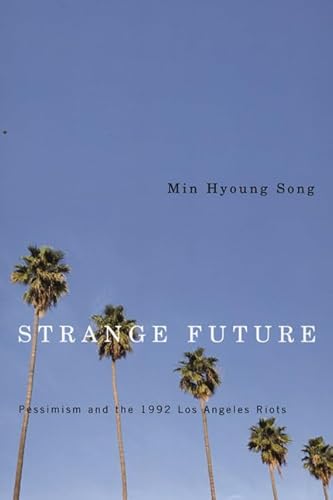
Sometime near the start of the 1990s, the future became a place of national decline. The United States had entered a period of great anxiety fueled by the shrinking of the white middle class, the increasingly visible misery of poor urban blacks, and the mass immigration of nonwhites. Perhaps more than any other event marking the passage through these dark years, the 1992 Los Angeles riots have sparked imaginative and critical works reacting to this profound pessimism. Focusing on a wide range of these creative works, Min Hyoung Song shows how the L.A. riots have become a cultural-literary event--an important reference and resource for imagining the social problems plaguing the United States and its possible futures.
Song considers works that address the riots and often the traumatic place of the Korean American community within them: the independent documentary Sa-I-Gu (Korean for April 29, the date the riots began), Chang-rae Lee's novel Native Speaker, the commercial film Strange Days, and the experimental drama of Anna Deavere Smith, among many others. He describes how cultural producers have used the riots to examine the narrative of national decline, manipulating language and visual elements, borrowing and refashioning familiar tropes, and, perhaps most significantly, repeatedly turning to metaphors of bodily suffering to convey a sense of an unraveling social fabric. Song argues that these aesthetic experiments offer ways of revisiting the traumas of the past in order to imagine more survivable futures.
Die Inhaltsangabe kann sich auf eine andere Ausgabe dieses Titels beziehen.
Über die Autorin bzw. den Autor
Min Hyoung Song is Associate Professor of English at Boston College. He is a coeditor of Asian American Studies: A Reader.
Von der hinteren Coverseite
"This is one of the most enjoyable, well-written Asian American studies books I have read in the last few years. Min Hyoung Song's work is a testament to writing well when saying something important."-- Kent Ono, coauthor of "Shifting Borders: Rhetoric, Immigration, and California's Proposition 187"
Auszug. © Genehmigter Nachdruck. Alle Rechte vorbehalten.
Strange Future
PESSIMISM AND THE 1992 LOS ANGELES RIOTSBy MIN HYOUNG SONGDUKE UNIVERSITY PRESS
Copyright © 2005 DUKE UNIVERSITY PRESSAll right reserved.
ISBN: 978-0-8223-3592-4
Contents
Preface........................................................................viiIntroduction: When the Strange Erupts in Culture...............................11 Racial Geography of Southern California......................................272 The Black Body in Pain: Rodney King and Strange Days.........................683 Culture of Wounding: The Riots and Twilight..................................1004 Mourning Los Angeles.........................................................1345 A Diasporic Future? Historical Trauma and Native Speaker.....................165Epilogue: Bearers of Bad News..................................................199Notes..........................................................................215Works Cited....................................................................257Filmography....................................................................271Index..........................................................................273
Chapter One
Racial Geography of Southern California
On 30 April 1992, a satellite operated by the National Oceanic and Atmospheric Administration (NOAA) began transmitting an image of an unusual heat source emanating from Southern California. This heat source spanned nearly thirty-three square miles and was as hot as the Mount Pinatubo eruption of 1991 in the Philippines. When researchers processed the image, they realized that what they were looking at was a picture from outer space of the second day of the Los Angeles riots. The heat source was attributed to the fact that "an average of three new fires were started each minute during the three hours preceding the image" (Dousset, Flamen, and Bernstein 1993, 33; quoted in Davis 1998, 421). At the start of the last decade of the twentieth century, technology and urban destruction melded together into an unexpected form of social epistemology. Rather than projecting us outward as it did in the mid-twentieth-century science fiction of writers such as Isaac Asimov, Arthur C. Clarke, Robert Heinlein, and Ray Bradbury, technology turned its lenses back upon the Earth. Rather than presenting us with an image of the Earth as a unified globe in a vast emptiness as successive missions to the moon made famous from 1969 to 1972, technology recorded with digital accuracy the continuous failures of post-civil-rights government policies to promote social acceptance, equal protection under the law, and common economic prosperity irrespective of race.
What this image suggests is that this failure could well have been planned. The whole of Southern California is not a bright uniform orange; nor do orange spots dot the region in sporadic and random places. Rather, the technological representation of burning buildings records a clearly defined area of containment and spatial segregation across a vast multinucleated metropolitan area. Whatever grief or frustration or justifiable political need sparked these fires, these fires were carefully managed to cluster about a subregional, mostly unincorporated grid-what I will call a negative space-defined by economic poverty, ethnic and racial diversity, and a noticeable separation from the other equally managed, incorporated, wealthier, and more racially homogeneous grids of Southern California. The concentration of these fires, made so vivid by the NOAA satellite image, calls into question the orthodoxy that often dominates awareness of our built-up surroundings. Orthodoxy refers to the sense that what appears to us as random and haphazard, so succinctly captured in the dismissive term suburban sprawl, is actually something that has been carefully organized, that serves specific functions, and that shapes our experiences in a powerful but difficult-to-acknowledge way. It is, to put it simply, common sense that this region should be the way it is. The region's gridlike spatialization seems a natural extension of its geographical peculiarities, almost as if the tract housing, the strip malls, the congested freeways and boulevards, even the economic and racial in-equities, are themselves organic growths on the floor of a Mediterranean-climate basin.
What kind of cultural logic was at work in the making of such common sense? How, in other words, has the accumulation of choices made and opportunities squandered come to appear to us, in retrospect, as somehow inevitable? By logic, I refer to the assumptions we might begin with in attempting to interpret cultural phenomena, how our thoughts and actions are guided by these assumptions, and the ways in which such assumptions are subjected to testing and reworking. With this definition in mind, we might say that the orthodoxy of planned communities, incorporated and unincorporated spaces, racial exclusions, and capital flows are built on assumptions of cultural superiority, human progress, and consumer desire. This orthodoxy of assumptions overlapped and at times were at odds with a second kind of cultural logic guiding the interpretation of spatial change by the region's residents. The latter was primarily concerned with the promises of a future that could dissolve current inequities, the looking back when looking forward became impossible, and the desire to start over either by wiping out what was already there or by moving someplace else. This subjective approach to interpreting cultural phenomena found beautiful expression in three creative works of the postwar era. Ray Bradbury's The Martian Chronicles (1997 [1946]), Luis Rodriguez's Always Running, La Vida Loca: Gang Days in L.A. (1993), and Cynthia Kadohata's In the Heart of the Valley of Love (1992) are arguably some of the most significant literary works to interest themselves in the depiction of this region's cultural contours since the Second World War. Side by side, they provide us with a rich cross section of historical changes as they are lived, brooded over, and reshaped into narrative. Together, they tell a startling story of how looking forward, looking backward, and looking to start over can occupy the same gaze through which to regard the incredible changes that Southern California has experienced in the years between the end of the Second World War and the start of the 1992 Los Angeles riots.
... NOSTALGIA FOR AN ANTIQUE FUTURE
For the generation who grew up during the heady days of early space exploration and who have largely moved to the homogeneous community developments that have sprung up throughout the United States since the Second World War, the irony of the reversals captured so vividly by the NOAA satellite must seem unusually acute. During the height of the Eisenhower and Kennedy years, advance technology was represented by rocket ships and not the miniaturization of technology, and the future involved manned missions to outer space and not a remote-controlled pixilated abstraction of American residents yet again setting fire to their own cities. In Ecology of Fear: Los Angeles and the Imagination of Disaster (1998), Mike Davis comments on the meaning of the pixilated image transmitted by the NOAA satellite for a person of his generation: "Once upon a time-in the rocket summer of my childhood-it was widely believed that Los Angeles's ultimate suburb would be the planet Mars, not a maximum-security prison in the desert.... If this now seems preposterous, it is only because our...
„Über diesen Titel“ kann sich auf eine andere Ausgabe dieses Titels beziehen.
Suchergebnisse für Strange Future: Pessimism and the 1992 Los Angeles...

Beispielbild für diese ISBN
Strange Future: Pessimism and the 1992 Los Angeles Riots
Anbieter: World of Books (was SecondSale), Montgomery, IL, USA
Verkäuferbewertung 5 von 5 Sternen

Zustand: Good. Item in good condition. Textbooks may not include supplemental items i.e. CDs, access codes etc. Artikel-Nr. 00097998781
Gebraucht kaufen
EUR 5,64
Versand gratis
Versand innerhalb von USA
Versand innerhalb von USA
Anzahl: 1 verfügbar
Beispielbild für diese ISBN
Strange Future : Pessimism and the 1992 Los Angeles Riots
Anbieter: Better World Books: West, Reno, NV, USA
Verkäuferbewertung 5 von 5 Sternen
Zustand: Good. Pages intact with minimal writing/highlighting. The binding may be loose and creased. Dust jackets/supplements are not included. Stock photo provided. Product includes identifying sticker. Better World Books: Buy Books. Do Good. Artikel-Nr. 42572018-6
Gebraucht kaufen
EUR 6,59
Versand gratis
Versand innerhalb von USA
Versand innerhalb von USA
Anzahl: 1 verfügbar
Beispielbild für diese ISBN
Strange Future
Anbieter: PBShop.store UK, Fairford, GLOS, Vereinigtes Königreich
Verkäuferbewertung 5 von 5 Sternen
PAP. Zustand: New. New Book. Shipped from UK. Established seller since 2000. Artikel-Nr. L2-9780822335924
Neu kaufen
EUR 48,59
EUR 4,85 Versand
Versand von Vereinigtes Königreich nach USA
Versand von Vereinigtes Königreich nach USA
Anzahl: Mehr als 20 verfügbar
Beispielbild für diese ISBN
Strange Future Pessimism and the 1992 Los Angeles Riots
Anbieter: Revaluation Books, Exeter, Vereinigtes Königreich
Verkäuferbewertung 5 von 5 Sternen
Paperback. Zustand: Brand New. new title edition. 285 pages. 9.00x6.00x0.75 inches. In Stock. Artikel-Nr. x-0822335921
Neu kaufen
EUR 52,50
EUR 11,66 Versand
Versand von Vereinigtes Königreich nach USA
Versand von Vereinigtes Königreich nach USA
Anzahl: 2 verfügbar
Beispielbild für diese ISBN
Strange Future: Pessimism and the 1992 Los Angeles Riots
Anbieter: Ria Christie Collections, Uxbridge, Vereinigtes Königreich
Verkäuferbewertung 5 von 5 Sternen
Zustand: New. In English. Artikel-Nr. ria9780822335924_new
Neu kaufen
EUR 53,60
EUR 13,17 Versand
Versand von Vereinigtes Königreich nach USA
Versand von Vereinigtes Königreich nach USA
Anzahl: Mehr als 20 verfügbar
Foto des Verkäufers
Strange Future : Pessimism and the 1992 Los Angeles Riots
Verlag:
Duke University Press Nov 2005, 2005
ISBN 10: 0822335921
ISBN 13: 9780822335924
Neu
Taschenbuch
Anbieter: AHA-BUCH GmbH, Einbeck, Deutschland
Verkäuferbewertung 5 von 5 Sternen
Taschenbuch. Zustand: Neu. Neuware - Sometime near the start of the 1990s, the future became a place of national decline. The United States had entered a period of great anxiety fueled by the shrinking of the white middle class, the increasingly visible misery of poor urban blacks, and the mass immigration of nonwhites. Perhaps more than any other event marking the passage through these dark years, the 1992 Los Angeles riots have sparked imaginative and critical works reacting to this profound pessimism. Focusing on a wide range of these creative works, Min Hyoung Song shows how the L.A. riots have become a cultural-literary event-an important reference and resource for imagining the social problems plaguing the United States and its possible futures.Song considers works that address the riots and often the traumatic place of the Korean American community within them: the independent documentary Sa-I-Gu (Korean for April 29, the date the riots began), Chang-rae Lee's novel Native Speaker, the commercial film Strange Days, and the experimental drama of Anna Deavere Smith, among many others. He describes how cultural producers have used the riots to examine the narrative of national decline, manipulating language and visual elements, borrowing and refashioning familiar tropes, and, perhaps most significantly, repeatedly turning to metaphors of bodily suffering to convey a sense of an unraveling social fabric. Song argues that these aesthetic experiments offer ways of revisiting the traumas of the past in order to imagine more survivable futures. Artikel-Nr. 9780822335924
Neu kaufen
EUR 76,45
EUR 30,50 Versand
Versand von Deutschland nach USA
Versand von Deutschland nach USA
Anzahl: 2 verfügbar