
Verwandte Artikel zu Social Choreography: Ideology as Performance in Dance...
Social Choreography: Ideology as Performance in Dance and Everyday Movement (Post-Contemporary Interventions) - Softcover
Buch 74 von 94: Post-contemporary interventions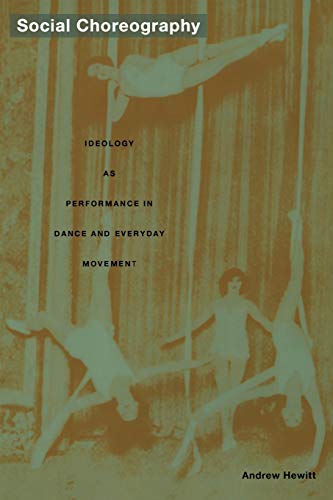
Inhaltsangabe
Through the concept of "social choreography" Andrew Hewitt demonstrates how choreography has served not only as metaphor for modernity but also as a structuring blueprint for thinking about and shaping modern social organization. Bringing dance history and critical theory together, he shows that ideology needs to be understood as something embodied and practiced, not just as an abstract form of consciousness. Linking dance and the aesthetics of everyday movement-such as walking, stumbling, and laughter-to historical ideals of social order, he provides a powerful exposition of Marxist debates about the relation of ideology and aesthetics.
Hewitt focuses on the period between the mid-nineteenth century and the early twentieth and considers dancers and social theorists in Germany, Britain, France, and the United States. Analyzing the arguments of writers including Friedrich Schiller, Theodor Adorno, Hans Brandenburg, Ernst Bloch, and Siegfried Kracauer, he reveals in their thinking about the movement of bodies a shift from an understanding of play as the condition of human freedom to one prioritizing labor as either the realization or alienation of embodied human potential. Whether considering understandings of the Charleston, Isadora Duncan, Nijinsky, or the famous British chorus line the Tiller Girls, Hewitt foregrounds gender as he uses dance and everyday movement to rethink the relationship of aesthetics and social order.
Die Inhaltsangabe kann sich auf eine andere Ausgabe dieses Titels beziehen.
Über die Autorin bzw. den Autor
Andrew Hewitt is Professor of Germanic Languages and Comparative Literature at the University of California, Los Angeles. He is the author of Political Inversions: Homosexuality, Fascism, and the Modernist Imaginary and Fascist Modernism: Aesthetics, Politics, and the Avant-Garde.
Von der hinteren Coverseite
""Social Choreography" is an intelligent, precisely argued new take on longstanding issues regarding the relationship of ideologies and aesthetics, one which invigorates those debates through its encounter with the visual and kinesthetic materiality of dance forms."--Jane Desmond, editor of "Meaning in Motion: New Cultural Studies of Dance"
Auszug. © Genehmigter Nachdruck. Alle Rechte vorbehalten.
Social Choreography
IDEOLOGY AS PERFORMANCE IN DANCE AND EVERYDAY MOVEMENTBy Andrew HewittDuke University Press
Copyright © 2005 Duke University PressAll right reserved.
ISBN: 978-0-8223-3514-6
Contents
Introduction: Social Choreography and the Aesthetic Continuum......................................11 The Body of Marsyas: Aesthetic Socialism and the Physiology of the Sublime......................372 Stumbling and Legibility: Gesture and the Dialectic of Tact.....................................783 "America Makes Me Sick!": Nationalism, Race, Gender, and Hysteria...............................1174 The Scandalous Male Icon: Nijinsky and the Queering of Symbolist Aesthetics.....................1565 From Woman to Girl: Mass Culture and Gender Panic...............................................177Notes..............................................................................................213Index..............................................................................................249
Chapter One
The Body of MarsyasAESTHETIC SOCIALISM AND THE PHYSIOLOGY OF THE SUBLIME
Dance historians have generally regarded the nineteenth century as a low point in the development of dance as a serious aesthetic form in Western Europe. It is assumed that the balletic tradition, originally developed in Italy and then transported to the French court, effectively disappeared into Russian exile where it was nurtured under the anachronistic absolutism of courtly and state protection. Meanwhile, in Western Europe-after the period of high romanticism when the ballerinas Taglioni and Elssler were feted by the literary and artistic world-dance was reduced to the status of divertissement, or popularized and vulgarized in the music hall. However one might tinker with this broad historical account, it nevertheless seems undeniable that the post-romantic period did, indeed, see a decline in dance's prestige and in the quality of aesthetic reflection accorded it-that is, until Mallarm took up the critical tradition kept alive in the mid-century by Gautier and made dance a central trope for the poetic endeavor. In this chapter I will begin by outlining what I take to be the stakes of a broad shift from tropes of play to tropes of harmonious social labor in figurations of dance, before arguing that this shift mirrors a broader social rationalization for which dance provided a perfect aesthetic and ideological vehicle. The figures I cover here are essentially literary intellectuals, and thus this chapter will offer little of immediate import to the historian of dance. In order to recontextualize the institutional and aesthetic decay of dance in Western Europe, I demonstrate that the idea of dance nevertheless carried a particular charge for social and aesthetic theorists of the period.
Instead of questioning the accepted dance historical narrative of nineteenth-century decline on empirical grounds, I wish to recast the question in the broader terms of social choreography. What structures of social experience were being theorized or projected in an almost subterranean discourse on choreography, even as dance itself seemed to languish as a high cultural form? I would argue that there was a migration of cultural interest in dance away from the "high" cultural forms toward the newly emerging forms of public amusement and mass entertainment, on the one hand, and toward an emerging discourse of anthropology on the other. The idea of choreography retained its importance, I will argue, by virtue of a fundamental shift in its significance. In brief, my thesis here is that the nineteenth century saw a shift in writings on dance from a Schillerian concern with "play" as the (pre)condition of human freedom to reflections on "work" or "labor" as (respectively) the realization or the alienation of embodied human potential. By the end of the century, the ideal of choreographed labor had become an important component both in social modernization and in the aestheticization of social and political thought. I argue that by the late nineteenth century, reflections on dance centered around the question of work in two important ways.
First, dance was invoked as a way of thinking about the kinds of work, both material production and ideological reproduction, necessary to the production of a cohesive social order. Meanwhile, in the social sciences of the time, increasingly complex Western societies began to confront "primitive" and supposedly "integrated" social orders through the prism of anthropology. Whereas moral judgments of "primitive" societies led to condemnations of uncivilized savagery, a focus on dance allowed for viewing such societies in terms of their ritual enactment of a social cohesion that was singularly missing from the rationalized, and increasingly mediatized, West. As industrial society fractured across class lines and the growing political hegemony of the nation-state made any internal fissure seem dangerous to the welfare of the commonwealth, it seemed that the production of social cohesion had become increasingly hard work. Dance would serve to figure a kind of work-again, both material and ideological-that might actually be pleasurable. In a second sense, however-as an aesthetic phenomenon-dance also served to foreground the problematic nature of the idea of work when applied to the arts. What work does dance produce? Is dance useless-or, more charitably, "disinterested"-because it produces no object, or is the absence of an excess or residue that might be characterized as the "object" of the dance rather the realization of an aesthetic ideal of self-immanence, as the symbolists hoped? In short, is dance more, or less, legitimate as a form of art because it produces no object? I wish to argue that these questions presaged debates within the twentieth-century avant-garde concerning the problematic nature of the (fetishized) art object. I wish to argue also, however, that these two parallel debates in fact intersected in interesting ways in a tradition of what I call "aesthetic socialism." The figures making up this tradition-as presented in this chapter, primarily the literary sages of nineteenth-century Britain-envisaged a social choreography that cannot simply be conflated with the forms of aestheticized politics produced in Europe in the first half of the twentieth century.
Although by the end of the nineteenth century dance had been eclipsed both as a respectable aesthetic form and as a figure for democratic social order, it nevertheless reemerged in various compromised, "eurhythmic"-and, indeed, eugenic-forms. By the end of the nineteenth century, strikingly contemporaneous with the emergence of anthropology as a defined and respected discourse, there emerged a new, conservative strain of thinking about social choreography across Europe. Inspired by a Schillerian vision, this stream of thought nevertheless took quite antiliberal forms. Thus, for example, Herbert Spencer in an article from 1895 would cite dance in support of a hierarchical and vertical social order quite different from the horizontal interlacings of Schiller's "English dance." Referring to "those savages who have no permanent chiefs or rudimentary kings," Spencer notes that such societies generally lack any professionalized or theatrical conception of performance-"among them these incipient professional actions are scarcely to be traced." Spencer's linkage of dance to the process of social distinction and differentiation, or to what we might, in technical terms, refer to...
„Über diesen Titel“ kann sich auf eine andere Ausgabe dieses Titels beziehen.
Suchergebnisse für Social Choreography: Ideology as Performance in Dance...

Beispielbild für diese ISBN
Social Choreography: Ideology as Performance in Dance and Everyday Movement (Post-Contemporary Interventions)
Anbieter: WorldofBooks, Goring-By-Sea, WS, Vereinigtes Königreich
Verkäuferbewertung 5 von 5 Sternen

Paperback. Zustand: Very Good. The book has been read, but is in excellent condition. Pages are intact and not marred by notes or highlighting. The spine remains undamaged. Artikel-Nr. GOR002413630
Gebraucht kaufen
EUR 20,42
EUR 6,54 Versand
Versand von Vereinigtes Königreich nach USA
Versand von Vereinigtes Königreich nach USA
Anzahl: 1 verfügbar
Beispielbild für diese ISBN
Social Choreography
Anbieter: PBShop.store UK, Fairford, GLOS, Vereinigtes Königreich
Verkäuferbewertung 5 von 5 Sternen
PAP. Zustand: New. New Book. Shipped from UK. Established seller since 2000. Artikel-Nr. FW-9780822335146
Neu kaufen
EUR 30,28
EUR 4,86 Versand
Versand von Vereinigtes Königreich nach USA
Versand von Vereinigtes Königreich nach USA
Anzahl: 2 verfügbar
Beispielbild für diese ISBN
Social Choreography
Anbieter: Majestic Books, Hounslow, Vereinigtes Königreich
Verkäuferbewertung 4 von 5 Sternen

Zustand: New. pp. 264. Artikel-Nr. 7956317
Neu kaufen
EUR 40,97
EUR 7,60 Versand
Versand von Vereinigtes Königreich nach USA
Versand von Vereinigtes Königreich nach USA
Anzahl: 3 verfügbar
Beispielbild für diese ISBN
Social Choreography: Ideology as Performance in Dance and Everyday Movement (Post-Contemporary Interventions)
Anbieter: Ria Christie Collections, Uxbridge, Vereinigtes Königreich
Verkäuferbewertung 5 von 5 Sternen
Zustand: New. In English. Artikel-Nr. ria9780822335146_new
Neu kaufen
EUR 35,88
EUR 14,00 Versand
Versand von Vereinigtes Königreich nach USA
Versand von Vereinigtes Königreich nach USA
Anzahl: 5 verfügbar
Beispielbild für diese ISBN
Social Choreography: Ideology as Performance in Dance and Everyday Movement
Anbieter: Kennys Bookstore, Olney, MD, USA
Verkäuferbewertung 5 von 5 Sternen
Zustand: New. Work links dance and the aesthetics of everyday movement to ideas about social order. Series: Post-Contemporary Interventions. Num Pages: 264 pages. BIC Classification: HPJ; HPN; JHBA. Category: (P) Professional & Vocational. Dimension: 230 x 153 x 16. Weight in Grams: 362. . 2005. Paperback. . . . . Books ship from the US and Ireland. Artikel-Nr. V9780822335146
Neu kaufen
EUR 46,42
EUR 9,07 Versand
Versand innerhalb von USA
Versand innerhalb von USA
Anzahl: 1 verfügbar
Beispielbild für diese ISBN
Social Choreography Ideology as Performance in Dance and Everyday Movement
Anbieter: Revaluation Books, Exeter, Vereinigtes Königreich
Verkäuferbewertung 5 von 5 Sternen
Paperback. Zustand: Brand New. new title edition. 264 pages. 8.75x5.75x0.75 inches. In Stock. Artikel-Nr. x-082233514X
Neu kaufen
EUR 51,24
EUR 11,69 Versand
Versand von Vereinigtes Königreich nach USA
Versand von Vereinigtes Königreich nach USA
Anzahl: 2 verfügbar
Beispielbild für diese ISBN
SOCIAL CHOREOGRAPHY
Anbieter: Speedyhen, Hertfordshire, Vereinigtes Königreich
Verkäuferbewertung 5 von 5 Sternen
Zustand: NEW. Artikel-Nr. NW9780822335146
Neu kaufen
EUR 29,00
EUR 47,91 Versand
Versand von Vereinigtes Königreich nach USA
Versand von Vereinigtes Königreich nach USA
Anzahl: 2 verfügbar
Foto des Verkäufers
Social Choreography
Anbieter: moluna, Greven, Deutschland
Verkäuferbewertung 5 von 5 Sternen
Zustand: New. Work links dance and the aesthetics of everyday movement to ideas about social order.Über den AutorAndrew Hewitt is Professor of Germanic Languages and Comparative Literature at the University of California, Los Angeles. Artikel-Nr. 595069095
Neu kaufen
EUR 37,61
EUR 48,99 Versand
Versand von Deutschland nach USA
Versand von Deutschland nach USA
Anzahl: 2 verfügbar
Foto des Verkäufers
Social Choreography : Ideology As Performance in Dance and Everyday Movement
Verlag:
Duke University Press Apr 2005, 2005
ISBN 10: 082233514X
ISBN 13: 9780822335146
Neu
Taschenbuch
Anbieter: AHA-BUCH GmbH, Einbeck, Deutschland
Verkäuferbewertung 5 von 5 Sternen
Taschenbuch. Zustand: Neu. Neuware - Through the concept of "social choreography" Andrew Hewitt demonstrates how choreography has served not only as metaphor for modernity but also as a structuring blueprint for thinking about and shaping modern social organization. Bringing dance history and critical theory together, he shows that ideology needs to be understood as something embodied and practiced, not just as an abstract form of consciousness. Linking dance and the aesthetics of everyday movement-such as walking, stumbling, and laughter-to historical ideals of social order, he provides a powerful exposition of Marxist debates about the relation of ideology and aesthetics.Hewitt focuses on the period between the mid-nineteenth century and the early twentieth and considers dancers and social theorists in Germany, Britain, France, and the United States. Analyzing the arguments of writers including Friedrich Schiller, Theodor Adorno, Hans Brandenburg, Ernst Bloch, and Siegfried Kracauer, he reveals in their thinking about the movement of bodies a shift from an understanding of play as the condition of human freedom to one prioritizing labor as either the realization or alienation of embodied human potential. Whether considering understandings of the Charleston, Isadora Duncan, Nijinsky, or the famous British chorus line the Tiller Girls, Hewitt foregrounds gender as he uses dance and everyday movement to rethink the relationship of aesthetics and social order. Artikel-Nr. 9780822335146
Neu kaufen
EUR 34,99
EUR 61,91 Versand
Versand von Deutschland nach USA
Versand von Deutschland nach USA
Anzahl: 1 verfügbar
Foto des Verkäufers
Social Choreography | Ideology As Performance in Dance and Everyday Movement
Anbieter: preigu, Osnabrück, Deutschland
Verkäuferbewertung 5 von 5 Sternen
Taschenbuch. Zustand: Neu. Social Choreography | Ideology As Performance in Dance and Everyday Movement | Andrew Hewitt | Taschenbuch | Post-Contemporary Interventions | Einband - flex.(Paperback) | Englisch | 2005 | Duke University Press | EAN 9780822335146 | Verantwortliche Person für die EU: Libri GmbH, Europaallee 1, 36244 Bad Hersfeld, gpsr[at]libri[dot]de | Anbieter: preigu. Artikel-Nr. 102360755
Neu kaufen
EUR 42,70
EUR 70,00 Versand
Versand von Deutschland nach USA
Versand von Deutschland nach USA
Anzahl: 1 verfügbar