
Inhaltsangabe
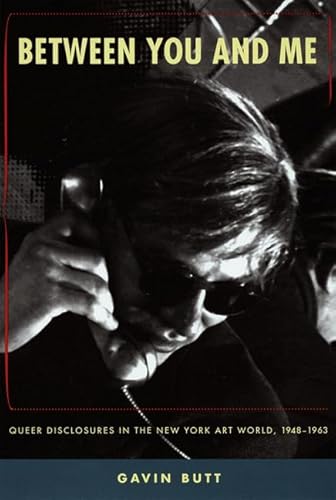
In the decades preceding the Stonewall riots-in the wake of the 1948 publication of Alfred Kinsey's controversial report on male sexuality and in the midst of a cold war culture of suspicion and paranoia-discussions of homosexuality within the New York art world necessarily circulated via gossip and rumor. Between You and Me explores this informal, everyday talk and how it shaped artists' lives, their work, and its reception. Revealing the "trivial" and "unserious" aspects of the postwar art scene as key to understanding queer subjectivity, Gavin Butt argues for a richer, more expansive concept of historical evidence, one that supplements the verifiable facts of traditional historical narrative with the gossipy fictions of sexual curiosity.
Focusing on the period from 1948 to 1963, Butt draws on the accusations and denials of homosexuality that appeared in the popular press, on early homophile publications such as One and the Mattachine Review, and on biographies, autobiographies, and interviews. In a stunning exposition of Larry Rivers's work, he shows how Rivers incorporated gossip into his paintings, just as his friend and lover Frank O'Hara worked it into his poetry. He describes how the stories about Andy Warhol being too "swish" to be taken seriously as an artist changed following his breakthrough success, reconstructing him as an asexual dandy. Butt also speculates on the meanings surrounding a MoMA curator's refusal in 1958 to buy Jasper Johns's Target with Plaster Casts on the grounds that it was too scandalous for the museum to acquire. Between You and Me sheds new light on a pivotal moment in American cultural production as it signals new directions for art history.
Die Inhaltsangabe kann sich auf eine andere Ausgabe dieses Titels beziehen.
Über die Autorin bzw. den Autor
Gavin Butt is Senior Lecturer in the Department of Visual Cultures at Goldsmiths College, University of London. He is the editor of After Criticism: New Responses to Art and Performance.
Von der hinteren Coverseite
""Between You and Me" is a brilliant read that flirtatiously winks and kisses its way through the New York art world of the postwar period, turning our favorite icons inside out and back in again. It's all in the gossip. Larry Rivers painted a 'visual gossip column' and was described by Frank O'Hara as a 'demented telephone, ' but it takes a smart flirt (the best kind) like Gavin Butt to see gossip's methodological promise. Taking gossip into his own mouthy hands, Butt slurs the studios of Rivers, Jasper Johns, and Andy Warhol with their own reckless talk: kisses turn into smacks, and winks into home runs. (Between you and me, that's how I like it.)"--Carol Mavor, author of "Becoming: The Photographs of Clementina, Viscountess Hawarden"
Auszug. © Genehmigter Nachdruck. Alle Rechte vorbehalten.
BETWEEN YOU AND ME
QUEER DISCLOSURES IN THE NEW YORK ART WORLD, 1948-1963By Gavin ButtDUKE UNIVERSITY PRESS
Copyright © 2005 DUKE UNIVERSITY PRESSAll right reserved.
ISBN: 978-0-8223-3498-9
Contents
LIST OF ILLUSTRATIONS....................................................................ixACKNOWLEDGMENTS..........................................................................xiiiINTRODUCTION Gossip: The Hardcore of Art History?.......................................11 The American Artist in a World of Suspicion............................................232 Idol Gossip: Myths of Genius and the Making of Queer Worlds............................513 The Gift of the Gab: Camp Talk and the Art of Larry Rivers.............................744 Dishing on the Swish, or, the "Inning" of Andy Warhol..................................1065 Bodies of Evidence: Queering Disclosure in the Art of Jasper Johns.....................136AFTERWORD Flirting with an Ending.......................................................163NOTES....................................................................................167BIBLIOGRAPHY.............................................................................189INDEX....................................................................................201
Chapter One
THE AMERICAN ARTIST IN A WORLD OF SUSPICION
In an article published in The Saturday Review of Literature in 1951, entitled "What's Holding Back American Art?" the artist Thomas Hart Benton provides a downbeat assessment of the condition of postwar U.S. art. In part a lament for the waning influence of the Regionalist school of painting, of which he was the most public proponent in the 1930s, it tells the story of an art world tragically diverted from the task of producing an "American" art for the American people. Tragic because, for Benton, not only had his two chief compatriots in the Regionalist project, Grant Wood and John Steuart Curry, recently died, but, by 1951, support for the idea of a popular nationalistic art was dying out with them. Younger artists were no longer interested in making heroic images of laboring men toiling with a mythologized American land, nor were they concerned with making an art that would have mass appeal. Instead, Benton writes, they were increasingly drawn away from the "living world of active men and women into an academic world of empty pattern" (9). This "world," pejoratively invoked by Benton here, was that of modernist art-one in which the narrow Americanisms of the prewar years had no place, and in which the values of a certain kind of internationalism had come to hold sway.
But in setting out his views in the Saturday Review, Benton does more than simply lament the passing of artistic fashion. He also elaborates a dramatic tale of art-world intrigue that purports to explain this shift in artistic priorities. Vividly evoking a profession held in the yoke of powerful and malignant forces, he ventures that modernism's rise, and Regionalism's concomitant fall, had been brought about by the concerted efforts of a few "cultist groups" and their "disciples" working to control the direction of American art. Led by the Museum of Modern Art in New York, Benton contends that various art professionals-including museum directors, curators, critics, and teachers-were working in concert to actively discredit the values of Regionalism and promote modernist art in its place. "Coteries of highbrows, of critics, college art professors, and museum boys," he writes, "the tastes of which had been thoroughly conditioned by the new esthetics of twentieth century Paris," were involved in a conspiracy to undermine American art in favor of securing the widespread acceptance of elitist, imported alternatives. Modernism-invoked here as a distinctly foreign, European phenomenon-was simply being imposed upon the American art-world by means of the stealth and duplicity of its chief defenders. By readily accepting modernist values and priorities, young artists were doing little more, Benton suggests, than colluding unwittingly in a sustained campaign to erode American art from within.
As we shall see during the course of this chapter, similar kinds of conspiracy theories were common currency in American culture during the early fifties. In many ways Benton's assessment of the postwar art world here can be seen to typify McCarthyite concerns with rooting out an anti-Americanism presumed to be rampant within the nation's governmental and cultural agencies. But what concerns me here at the outset is how, in referring to the architects of this supposed conspiracy, Benton's fondness for vituperative innuendoes, such as "museum boys" and elsewhere "ivory tower boys," leaves us in little doubt about the more profoundly sexual basis of this institutional conniving. The use of the word boys here refers elliptically to homosexuality by suggesting "nancy-boys" and "sissy-boys," the most widely used terms to denote gay men at the time. It is clearly intended to suggest the prevalence of gay men among the communities of America's museum curators and other art professionals. In addition, the word conjures up the objects of desire supposedly favored by these men, and it suggests a pederastic core at the heart of their attempts to influence young artists. Benton worries that gay men will turn young artists away from the world of "active men and women" toward the supposedly empty patterning of avant-garde art and in the process create a generation of effeminate and ineffectual, if not homosexual, artists. Drawing on the rich and allusive power of suggestion, Benton works to make his readers share this worry by imagining an art-world conspiracy profoundly motivated by a deviant, predatory dynamic; viewing modernist art as a kind of European homosexual sensibility being schooled into young artists by their pseudo-Wildean elders.
The stark outline of a gay conspiracy here will likely strike present-day readers as absurd, and, for those familiar with Benton's near legendary chauvinism and homophobia, as simply the paranoid imaginings of an arch reactionary. This was also the view of many of Benton's own contemporaries who, by the early 1950s, had come to be largely incredulous of his prejudicial and abusive agenda. Cut off by the turn in the artistic tide, his regressive and provincial tendencies were paid scant serious attention by a generation of artists engaged in debates about "advanced" modernist art. Speaking perhaps for many in the art world at this time, the art critic James Thrall Soby dismisses much of Benton's diagnosis of American art as absurd invective. Writing in the same edition of the Saturday Review, Soby belittles the artist's argument on numerous counts, parrying it point by point with the "facts" to the contrary, including those to counter the accusations of homosexuality in high places: "That there have been a few homosexuals on the staffs of American museums no one can fairly deny. But they have been and are vastly outnumbered by normal men. Indeed, I can't think of a single major art museum in this country whose director's sex life is open to Mr. Benton's innuendo." Soby hereby attempts to put an end to the idea of a gay conspiracy by denying any actual basis for it in reality. Benton's assertions of an art world overrun with gay men simply do not square, Soby contends, with the reality of a situation in which "normal" men outnumber them. And, of the most influential positions...
„Über diesen Titel“ kann sich auf eine andere Ausgabe dieses Titels beziehen.
Weitere beliebte Ausgaben desselben Titels

Suchergebnisse für Between You and Me: Queer Disclosures in the New York...

Beispielbild für diese ISBN
Between You and Me: Queer Disclosures in the New York Art World, 1948â"1963
Anbieter: WorldofBooks, Goring-By-Sea, WS, Vereinigtes Königreich
Verkäuferbewertung 5 von 5 Sternen

Paperback. Zustand: Very Good. The book has been read, but is in excellent condition. Pages are intact and not marred by notes or highlighting. The spine remains undamaged. Artikel-Nr. GOR008857876
Gebraucht kaufen
EUR 10,60
EUR 6,46 Versand
Versand von Vereinigtes Königreich nach USA
Versand von Vereinigtes Königreich nach USA
Anzahl: 1 verfügbar
Beispielbild für diese ISBN
Between You and Me : Queer Disclosures in the New York Art World, 1948-1963
Anbieter: Books From California, Simi Valley, CA, USA
Verkäuferbewertung 4 von 5 Sternen

Paperback. Zustand: Very Good. Artikel-Nr. mon0003648980
Gebraucht kaufen
EUR 19,39
EUR 4,35 Versand
Versand innerhalb von USA
Versand innerhalb von USA
Anzahl: 1 verfügbar
Beispielbild für diese ISBN
Between You and Me
Anbieter: PBShop.store UK, Fairford, GLOS, Vereinigtes Königreich
Verkäuferbewertung 5 von 5 Sternen
PAP. Zustand: New. New Book. Shipped from UK. Established seller since 2000. Artikel-Nr. FW-9780822334989
Neu kaufen
EUR 36,11
EUR 4,80 Versand
Versand von Vereinigtes Königreich nach USA
Versand von Vereinigtes Königreich nach USA
Anzahl: 1 verfügbar
Beispielbild für diese ISBN
Between You and Me: Queer Disclosures in the New York Art World, 1948-1963
Anbieter: Kennys Bookstore, Olney, MD, USA
Verkäuferbewertung 5 von 5 Sternen
Zustand: New. A reconsideration of queer American art culture of the mid-twentieth century Num Pages: 232 pages, 48 photos (incl. 4 in color). BIC Classification: 1KBB; AC; JFC; JFSK. Category: (P) Professional & Vocational. Dimension: 5983 x 3971 x 14. Weight in Grams: 349. . 2005. Paperback. . . . . Books ship from the US and Ireland. Artikel-Nr. V9780822334989
Neu kaufen
EUR 48,89
EUR 9,15 Versand
Versand innerhalb von USA
Versand innerhalb von USA
Anzahl: 1 verfügbar
Beispielbild für diese ISBN
Between You And Me: Queer Disclosures in the New York Art World, 1948-1963
Anbieter: Revaluation Books, Exeter, Vereinigtes Königreich
Verkäuferbewertung 5 von 5 Sternen
Paperback. Zustand: Brand New. 210 pages. 9.50x6.25x0.75 inches. In Stock. Artikel-Nr. x-0822334984
Neu kaufen
EUR 54,22
EUR 11,53 Versand
Versand von Vereinigtes Königreich nach USA
Versand von Vereinigtes Königreich nach USA
Anzahl: 2 verfügbar