
Verwandte Artikel zu Environmentality: Technologies of Government and the...
Environmentality: Technologies of Government and the Making of Subjects (New Ecologies for the Twenty-First Century) - Hardcover
Buch 2 von 18: New Ecologies for the Twenty-First Century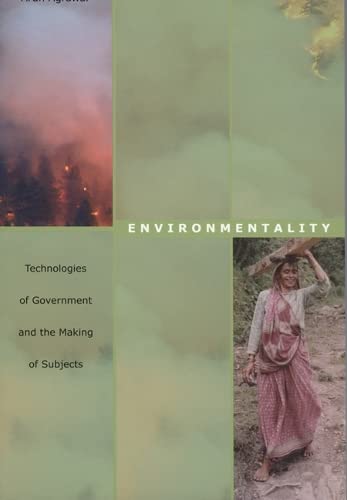
Inhaltsangabe
In Kumaon in northern India, villagers set hundreds of forest fires in the early 1920s, protesting the colonial British state's regulations to protect the environment. Yet by the 1990s, they had begun to conserve their forests carefully. In his innovative historical and political study, Arun Agrawal analyzes this striking transformation. He describes and explains the emergence of environmental identities and changes in state-locality relations and shows how the two are related. In so doing, he demonstrates that scholarship on common property, political ecology, and feminist environmentalism can be combined--in an approach he calls environmentality--to better understand changes in conservation efforts. Such an understanding is relevant far beyond Kumaon: local populations in more than fifty countries are engaged in similar efforts to protect their environmental resources.
Agrawal brings environment and development studies, new institutional economics, and Foucauldian theories of power and subjectivity to bear on his ethnographical and historical research. He visited nearly forty villages in Kumaon, where he assessed the state of village forests, interviewed hundreds of Kumaonis, and examined local records. Drawing on his extensive fieldwork and archival research, he shows how decentralization strategies change relations between states and localities, community decision makers and common residents, and individuals and the environment. In exploring these changes and their significance, Agrawal establishes that theories of environmental politics are enriched by attention to the interconnections between power, knowledge, institutions, and subjectivities.
Die Inhaltsangabe kann sich auf eine andere Ausgabe dieses Titels beziehen.
Über die Autorin bzw. den Autor
Arun Agrawal is Associate Professor in the School of Natural Resources and Environment at the University of Michigan. He is the author of Greener Pastures: Politics, Markets, and Community among a Migrant Pastoral People and a coeditor of Agrarian Environments: Resources, Representations, and Rule in India, both also published by Duke University Press.
Von der hinteren Coverseite
"Arun Agrawal has written an amazing book that draws on a very-long-term case study to make general lessons. He analyzes the development of the mentality of citizens and officials related to the environment in a particular setting undergoing major shifts from centralization to a form of decentralization. All of us can take some important lessons from this book about how people's mentalities change when they have power and knowledge to cope with a problem. That shift in knowledge and power took time and effort, but is one of the rare success stories of recent history."--Elinor Ostrom, coeditor of "Seeing the Forest and the Trees: Human-Environment Interactions in Forest Ecosystems"
Auszug. © Genehmigter Nachdruck. Alle Rechte vorbehalten.
Environmentality
Technologies of Government and the Making of Subjects
By Arun AgrawalDuke University Press
Copyright © 2005 Duke University Press
All rights reserved.
ISBN: 978-0-8223-3480-4All rights reserved.
Contents
Cover Page,
Title Page,
Copyright Page,
About the Series,
Preface and Acknowledgments,
1 Introduction: The Politics of Nature and the Making of Environmental Subjects,
Part I,
I Power/Knowledge and the Creation of Forests,
2 Forests of Statistics: Colonial Environmental Knowledges,
3 Struggles over Kumaon's Forests, 1815-1916,
Part II,
II A New Technology of Environmental Government: Politics, Institutions, and Subjectivities,
4 Governmentalized Localities: The Dispersal of Regulation,
5 Inside the Regulatory Community,
6 Making Environmental Subjects: Intimate Government,
7 Conclusion: The Analytics of Environmentality,
Notes,
Bibliography,
Index,
CHAPTER 1
Introduction: The Politics of Nature and the Making of Environmental Subjects
To reflect upon history is also, inextricably, to reflect upon power. —Guy Debord, The Society of the Spectacle
I
I first traveled to Kumaon in 1985 to learn more about how and under what conditions local residents protect their forests and the environment. At that time, I met a number of leaders of the Chipko movement—well known in India as a grassroots, collective effort to protect trees by means of direct social action. But the meeting that left the most lasting impression was to occur in a small village by the name of Kotuli. Hukam Singh, a young resident of the village, told me that it was futile to try to save forests. Too many villagers cut too many trees. Too many others did not care. He himself was no exception. "What does it matter if all these trees are cut? There is always more forest," he said. He judged that only a few villagers were interested in what I was calling the environment. "Women are the worst. With a small hatchet, they can chop so many branches, you will not believe." He qualified himself somewhat: "Not because they want to, but they have to feed animals, get firewood to cook."
Hukam Singh's judgment is probably less important for what it says about processes of environmental conservation in Kotuli than for what it reflects of his own position. Talking with other people, I realized that the long periods of time Hukam Singh spent in the town of Almora prevented him from appreciating fully the efforts afoot to protect trees and forested environments. He was trying to get a job in the Almora district court and had stopped cultivating his agricultural holdings. But the village's forest council held meetings every other month and enforced rules to regulate forest use. The 85 acres of village forest wasmore densely populated with trees and vegetation than several neighboring forests. The village forest guard often apprehended those cutting tree branches or grazing animals in the forest illegally. Most villagers did not think of the forest as a freely available public good.
The reasons my conversations with Hukam Singh had a more lasting effect than those with well-known Chipko leaders were to become apparent during my return visits to Kotuli in fall 1990 and summer 1993. In the intervening years, Hukam Singh had left Almora, settled in Kotuli, and married Sailadevi from Gunth (a nearby village). He had started growing two crops on his plots of irrigated land and had bought several cattle. He had also become a member of Kotuli's forest council after one of his uncles, a council member, retired.
More surprisingly, Hukam Singh had become a convert to environmental conservation. Sitting on a woven cot, one sturdy leg tapping the ground impatiently, he explained one afternoon: "We protect our forests better than government can. We have to. Government employees don't really have any interest in forests. It is a job for them. For us, it is life." He went on: "Just think of all the things we get from forests—fodder, wood, furniture, food, manure, soil, water, clean air. If we don't safeguard the forest, who else will? Some of the people in the village are ignorant and so they don't look after the forest. But sooner or later, they will realize this is very important work. It is important for the country, and for our village."
These different justifications of his transformation into someone who cares about protecting trees are too resonant with prevailing rhetorics around environmental conservation to sound original. But to dismiss them because they are being repeated by many others would be to miss completely the enormously interesting, complex, and crucial, but understudied, relationship between changes in government and related shifts in environmental practices and beliefs. This book seeks to track such changes by examining emerging technologies of environmental government and their relationship with changes in human subjectivities.
Hukam's story mirrors the experiences of many in Kumaon. But equally there are others whose senses of the environment, relationships with environmental government, and actions in forested environments have changed relatively little, or may even have become more extractive. Explaining why, when, how, and in what measure people come to develop an environmentally oriented subject position is the ultimate target of this book's arguments. These questions, provocative for both their practical import for conservation and their theoretical relevance to discussions of identity, require a historical examination of different technologies of government. New environmental subject positions emerge as a result of involvement in struggles over resources and in relation to new institutions and changing calculations of self-interest and notions of the self. These three conceptual elements—politics, institutions, and identities—are intimately linked. In exploring them together as constituent parts of a given technology of government, this book suggests that an exclusive focus on politics, institutions, or subjectivities likely leads to lopsided analyses of environmental politics and change.
The political, institutional, and identity-related struggles that I describe unfolded in the rich environmental history of Kumaon after the 1860s. Hukam's transformation in a sense constitutes a microcosmic window on changes in Kumaon. To explore and explain these changes, it will be useful to begin with two stories. One involves widespread protests against environmental policies in the early part of the twentieth century; the other, paradoxically, is about equally widespread involvement in environmental government that began around the 1930s and continues today. The shift that these stories represent can be understood by examining the emergence of new technologies of government that incorporated rural localities into a wider net of political relations, produced new forms of regulation in communities, and helped create new environmental subjectivities.
Massive forest fires, only some of them the usual summer fires, raged in Kumaon in the early part of the twentieth century. Between 1911 and 1916, the colonial state reclassified nearly 80 percent of Kumaon's forests into reserves. Villagers found that they had limited or no rights left in the reserves. In response, they set fires in the reserved forests in a vivid spectacle of challenge to new forms of government over nature. Fires were especially widespread in 1916. Nearly 200,000 acres were burned in hundreds of separate incidents....
„Über diesen Titel“ kann sich auf eine andere Ausgabe dieses Titels beziehen.
Suchergebnisse für Environmentality: Technologies of Government and the...

Beispielbild für diese ISBN
Environmentality : Technologies of Government and the Making of Subjects
Anbieter: Better World Books: West, Reno, NV, USA
Verkäuferbewertung 5 von 5 Sternen

Zustand: Very Good. Former library copy. Pages intact with possible writing/highlighting. Binding strong with minor wear. Dust jackets/supplements may not be included. Includes library markings. Stock photo provided. Product includes identifying sticker. Better World Books: Buy Books. Do Good. Artikel-Nr. 58177233-75
Gebraucht kaufen
EUR 29,19
Versand gratis
Versand innerhalb von USA
Versand innerhalb von USA
Anzahl: 1 verfügbar
Beispielbild für diese ISBN
Environmentality - Technologies of Government and the Making of Subjects
Anbieter: PBShop.store UK, Fairford, GLOS, Vereinigtes Königreich
Verkäuferbewertung 5 von 5 Sternen
HRD. Zustand: New. New Book. Shipped from UK. Established seller since 2000. Artikel-Nr. FW-9780822334804
Neu kaufen
EUR 149,62
EUR 6,00 Versand
Versand von Vereinigtes Königreich nach USA
Versand von Vereinigtes Königreich nach USA
Anzahl: 1 verfügbar
Foto des Verkäufers
Environmentality: Technologies of Government and the Making of Subjects
Anbieter: moluna, Greven, Deutschland
Verkäuferbewertung 5 von 5 Sternen
Zustand: New. An investigation of environmental politics in light of Foucault s work, drawing on and extending work done in feminist environmentalism, political ecology, and common property scholarship, explains why villagers in the Kumaon Himalaya have begun to conserve. Artikel-Nr. 595069082
Neu kaufen
EUR 120,67
EUR 48,99 Versand
Versand von Deutschland nach USA
Versand von Deutschland nach USA
Anzahl: 1 verfügbar
Beispielbild für diese ISBN
Environmentality: Technologies of Government and the Making of Subjects (New Ecologies for the Twenty-First Century)
Anbieter: Ria Christie Collections, Uxbridge, Vereinigtes Königreich
Verkäuferbewertung 5 von 5 Sternen
Zustand: New. In English. Artikel-Nr. ria9780822334804_new
Neu kaufen
EUR 161,84
EUR 13,49 Versand
Versand von Vereinigtes Königreich nach USA
Versand von Vereinigtes Königreich nach USA
Anzahl: 1 verfügbar
Beispielbild für diese ISBN
Environmentality Technologies of Government and the Making of Subjects
Anbieter: Revaluation Books, Exeter, Vereinigtes Königreich
Verkäuferbewertung 5 von 5 Sternen
Paperback. Zustand: Brand New. new title edition. 344 pages. 9.00x6.00x0.75 inches. In Stock. Artikel-Nr. __0822334801
Neu kaufen
EUR 173,04
EUR 14,93 Versand
Versand von Vereinigtes Königreich nach USA
Versand von Vereinigtes Königreich nach USA
Anzahl: 1 verfügbar
Foto des Verkäufers
Environmentality : Technologies of Government and the Making of Subjects
Verlag:
Duke University Press Apr 2005, 2005
ISBN 10: 0822334801
ISBN 13: 9780822334804
Neu
Hardcover
Anbieter: AHA-BUCH GmbH, Einbeck, Deutschland
Verkäuferbewertung 5 von 5 Sternen
Buch. Zustand: Neu. Neuware - In Kumaon in northern India, villagers set hundreds of forest fires in the early 1920s, protesting the colonial British state's regulations to protect the environment. Yet by the 1990s, they had begun to conserve their forests carefully. In his innovative historical and political study, Arun Agrawal analyzes this striking transformation. He describes and explains the emergence of environmental identities and changes in state-locality relations and shows how the two are related. In so doing, he demonstrates that scholarship on common property, political ecology, and feminist environmentalism can be combined-in an approach he calls environmentality-to better understand changes in conservation efforts. Such an understanding is relevant far beyond Kumaon: local populations in more than fifty countries are engaged in similar efforts to protect their environmental resources.Agrawal brings environment and development studies, new institutional economics, and Foucauldian theories of power and subjectivity to bear on his ethnographical and historical research. He visited nearly forty villages in Kumaon, where he assessed the state of village forests, interviewed hundreds of Kumaonis, and examined local records. Drawing on his extensive fieldwork and archival research, he shows how decentralization strategies change relations between states and localities, community decision makers and common residents, and individuals and the environment. In exploring these changes and their significance, Agrawal establishes that theories of environmental politics are enriched by attention to the interconnections between power, knowledge, institutions, and subjectivities. Artikel-Nr. 9780822334804
Neu kaufen
EUR 162,12
EUR 35,00 Versand
Versand von Deutschland nach USA
Versand von Deutschland nach USA
Anzahl: 1 verfügbar
Beispielbild für diese ISBN
Environmentality
Anbieter: Kennys Bookstore, Olney, MD, USA
Verkäuferbewertung 5 von 5 Sternen
Zustand: New. 2005. hardcover. . . . . . Books ship from the US and Ireland. Artikel-Nr. V9780822334804
Neu kaufen
EUR 209,97
EUR 9,36 Versand
Versand innerhalb von USA
Versand innerhalb von USA
Anzahl: 1 verfügbar