
Verwandte Artikel zu Body of Writing: Figuring Desire in Spanish American...
Inhaltsangabe
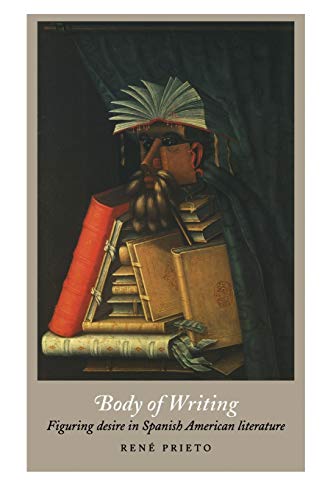
Body of Writing focuses on the traces that an author's "body" leaves on a work of fiction. Drawing on the work of six important Spanish American writers of the twentieth century, René Prieto examines narratives that reflect-in differing yet ultimately complementary ways-the imprint of the author's body, thereby disclosing insights about power, aggression, transgression, and eroticism.
Healthy, invalid, lustful, and confined bodies-as portrayed by Julio Cortázar, Guillermo Cabrera Infante, Gabriel García Márquez, Severo Sarduy, Rosario Castellanos, and Tununa Mercado-become evidence for Roland Barthes's contention that works of fiction are "anagrams of the body." Claiming that an author's intentions can be uncovered by analyzing "the topography of a text," Prieto pays particular attention not to the actions or plots of these writers' fiction but rather to their settings and characterizations. In the belief that bodily traces left on the page reveal the motivating force behind a writer's creative act, he explores such fictional themes as camouflage, deterioration, defilement, entrapment, and subordination. Along the way, Prieto reaches unexpected conclusions regarding topics that include the relationship of the female body to power, male and female transgressive impulses, and the connection between aggression, the idealization of women, and anal eroticism in men.
This study of how authors' longings and fears become embodied in literature will interest students and scholars of literary and psychoanalytic criticism, gender studies, and twentieth-century and Latin American literature.
Die Inhaltsangabe kann sich auf eine andere Ausgabe dieses Titels beziehen.
Über die Autorin bzw. den Autor
René Prieto is Professor of Foreign Languages and Literature at Southern Methodist University. He is the author of Miguel Angel Asturias's Archaeology of Return.
Von der hinteren Coverseite
""Body of Writing" is the most advanced piece of criticism on Latin American literature available. Prieto's unique mixture of theoretical sophistication with elegance of mind and style makes him soar above today's cacophonous cackle. I know of no better critic of Latin American literature than him."--Roberto Gonzalez-Echevarria, author of "Myth and Archive: A Theory of Latin American Narrative"
Auszug. © Genehmigter Nachdruck. Alle Rechte vorbehalten.
Body of writing
Figuring desire in Spanish American literatureBy Ren PrietoDuke University Press
Copyright © 2000 Duke University PressAll right reserved.
ISBN: 978-0-8223-2488-1
Contents
Acknowledgments.............................................................................................ixIntroduction................................................................................................11 Julio Cortzar's perpetual exile.........................................................................172 More than meets the I: Guillermo Cabrera Infante's La Habana para un Infante difunto.....................753 The excremental vision of Gabriel Garca Mrquez.........................................................1014 The degraded body in the work of Severo Sarduy...........................................................1355 Rewriting the body: renewal through language in the work of Rosario Castellanos..........................1736 The body of pleasure in Tununa Mercado's Canon de alcoba.................................................213Conclusion..................................................................................................240Notes.......................................................................................................255Bibliography................................................................................................275Index.......................................................................................................285
Chapter One
Julio Cortzar's perpetual exile* * *
Como los elatas, como San Agustn, Novalis presinti que el mundo de adentro es la ruta inevitable para llegar de verdad al mundo exterior y descubrir que los dos sern uno solo cuando la alquimia de ese viaje de un hombre nuevo. -Julio Cortzar, quoted by Fernando Ainsa
What makes Julio Cortzar's short stories perplexing and disturbing at the same time? Why is it we grasp the gist of his plots but feel befuddled by the outcome of his stories, as if taking the train but letting slip its destination? Bewildered by characters who vomit rabbits, and tigers that prowl around country estates, are we conscious, when reading "Letter to a Young Lady in Paris" or "Bestiario," of not getting to the heart of the dramas this resourceful author portrayed throughout his life?
Intuitive to the core, Cortzar seldom knew what would show up in his notepad; "Bestiary" and Hopscotch were composed in one fell swoop, for instance, as if internally dictated (Vargas Llosa, A Writer's Reality, 46). Cortzar wasn't just intuitive; he was downright possessed. From the time he started publishing, he felt the personal obsessions that haunted him stemmed "neither from a conscious nor a rational plane" but rather, "from down under ... from within" (Prego, La Fascinacin de las Palabras, 40, 38). The demands made by these obsessions were so peremptory that he felt he needed writing as much as writing needed him as a vehicle to express itself. It was a form of cleansing or, as he once told Omar Prego, a kind of "self-therapy" (182). However, since according to Cortzar poets are " 'possessed' by the magnetic forces of the collective unconscious and ... manifest in [their] writings 'archetypal themes and figures,'" he could connect with readers directly while engaging in self-therapy (Ana Hernndez del Castillo, Keats, Poe, and the Shaping of Cortzar's Mythopoesis, 4). This is why we can find his cryptic scenarios disturbing even when we are not fully conscious of their portent.
Their portent was, from the start, a private matter. By that I mean that if, by his own avowal, his writing was made up of obsessions stemming from within, the essence of Cortzar's art was, plain and simple, personal experience transformed into fiction. This is far from apparent because the biographical elements that inform his work are not at all transcriptions of daily events (as they are for, let us say, the Mario Vargas Llosa who writes Aunt Julia and the Scriptwriter), but are drawn from a part of himself that was well cloistered. The concealed elements were then recast into cunning scenarios that screened the sources that inspired them. The anecdotal level of his stories is so captivating, in fact, that few readers become aware of that other, highly private level without which, as we shall see, it is impossible to understand his work.
Fortunately, like Theseus entering the labyrinth, Cortzar left a thread that can be followed to the wellspring from which his stories flow, although, because he wrote to exorcise the monsters that haunted him, the "wellspring" was more akin to a festering pool of anxiety than to a clear fountain. Cortzar manifested this anxiety through a small number of obsessive images or motifs that he labeled figuras. It is through these figuras-hands, tunnels, dark holes, breathing disorders, and a handful of animals-that we can penetrate to the primary level from which Cortzar's stories issued.
The network of figuras in any given story is so complex and mesmerizing, however, that we frequently fail to reach the embedded content that Cortzar has so artfully masked. We know he pictured dark tunnels and breathing disorders, for instance, but we don't know why. In fact, so far we don't even understand how the figuras dovetail into one another to create a symphony of perfectly orchestrated parts. Cortzar's master plan remains enigmatic because, to borrow his own words, the "point of contact in which every discordant element can finally become visible as a spoke in a wheel" is still unfathomed (Libro de Manuel, 8).
Into the labyrinth
Cortzar gave us the thread leading into his personal labyrinth in a groundbreaking interview with Evelyn Picn Garfield. "Hands have always been an obsession of mine," he told Picn in 1973, "already in the first pages I ever wrote hands play an extremely important part. I was very young when I wrote that piece I later included in Ultimo Round, I think it's called 'Estacin de la mano'" (it is actually in La vuelta al da en ochenta mundos) (Picn, Cortzar por Cortzar, 110). "Estacin de la mano" ("Station of the Hand") is the story of a man who sees a hand fly through his window one day. After befriending the hand he begins to fear it until, sensing it is no longer trusted, the hand flies away, never to return.
"Station of the Hand" was the first of many stories in which Cortzar's morbid obsession with hands and gloves was showcased. This obsession was no laughing matter. Cortzar confessed to Picn that whenever he was alone in a house and there was a pair of gloves sitting on a table, he could never go to sleep until he had planted a heavy object on top of them because he had the impression that "something was going to come and fill them" (Cortzar por Cortzar, 110-11). Startled by such bewildering disclosures, Picn urged Cortzar to elaborate. "Are you referring to hands"? She prodded, until he finally admitted: "Yes, hands; it must be linked to a trauma from my childhood, some macabre story of strangulation" (111).
Mention of strangulation in connection with disembodied hands reminded Cortzar of a film that deeply impressed him, The Hands of Orlac. As he explained to Picn, the hero of this film is a concert pianist who has to have his hands amputated after a train accident. Fortunately, he has a good friend who is a surgeon and can transplant the hands of a man who has just been sent to the...
„Über diesen Titel“ kann sich auf eine andere Ausgabe dieses Titels beziehen.
Suchergebnisse für Body of Writing: Figuring Desire in Spanish American...

Beispielbild für diese ISBN
Body of Writing : Figuring Desire in Spanish American Literature
Anbieter: Better World Books: West, Reno, NV, USA
Verkäuferbewertung 5 von 5 Sternen

Zustand: Very Good. Former library copy. Pages intact with possible writing/highlighting. Binding strong with minor wear. Dust jackets/supplements may not be included. Includes library markings. Stock photo provided. Product includes identifying sticker. Better World Books: Buy Books. Do Good. Artikel-Nr. 8042011-75
Gebraucht kaufen
EUR 19,18
Versand gratis
Versand innerhalb von USA
Versand innerhalb von USA
Anzahl: 1 verfügbar
Beispielbild für diese ISBN
Body of Writing: Figuring Desire in Spanish American Literature
Anbieter: Anybook.com, Lincoln, Vereinigtes Königreich
Verkäuferbewertung 5 von 5 Sternen
Zustand: Good. This is an ex-library book and may have the usual library/used-book markings inside.This book has soft covers. Clean from markings. In good all round condition. Library sticker on front cover. Please note the Image in this listing is a stock photo and may not match the covers of the actual item,650grams, ISBN:9780822324881. Artikel-Nr. 7075325
Gebraucht kaufen
EUR 9,32
EUR 15,44 Versand
Versand von Vereinigtes Königreich nach USA
Versand von Vereinigtes Königreich nach USA
Anzahl: 1 verfügbar
Beispielbild für diese ISBN
Body of Writing: Figuring Desire in Spanish American Literature
Anbieter: Anybook.com, Lincoln, Vereinigtes Königreich
Verkäuferbewertung 5 von 5 Sternen
Zustand: Good. This is an ex-library book and may have the usual library/used-book markings inside.This book has soft covers. In good all round condition. Please note the Image in this listing is a stock photo and may not match the covers of the actual item,600grams, ISBN:9780822324881. Artikel-Nr. 5566625
Gebraucht kaufen
EUR 13,75
EUR 15,44 Versand
Versand von Vereinigtes Königreich nach USA
Versand von Vereinigtes Königreich nach USA
Anzahl: 1 verfügbar
Beispielbild für diese ISBN
Body of Writing: Figuring Desire in Spanish American Literature
Anbieter: JuddSt.Pancras, London, Vereinigtes Königreich
Verkäuferbewertung 5 von 5 Sternen
Soft cover. Zustand: As New. Artikel-Nr. c353108
Gebraucht kaufen
EUR 17,07
EUR 26,04 Versand
Versand von Vereinigtes Königreich nach USA
Versand von Vereinigtes Königreich nach USA
Anzahl: 1 verfügbar
Beispielbild für diese ISBN
Body of Writing Figuring Desire in Spanish American Literature
Anbieter: Revaluation Books, Exeter, Vereinigtes Königreich
Verkäuferbewertung 5 von 5 Sternen
Paperback. Zustand: Brand New. 295 pages. 9.00x5.75x1.25 inches. In Stock. Artikel-Nr. x-0822324881
Neu kaufen
EUR 54,88
EUR 14,80 Versand
Versand von Vereinigtes Königreich nach USA
Versand von Vereinigtes Königreich nach USA
Anzahl: 2 verfügbar
Beispielbild für diese ISBN
Body of Writing
Anbieter: Majestic Books, Hounslow, Vereinigtes Königreich
Verkäuferbewertung 4 von 5 Sternen

Zustand: New. pp. 312. Artikel-Nr. 58093418
Neu kaufen
EUR 77,03
EUR 7,69 Versand
Versand von Vereinigtes Königreich nach USA
Versand von Vereinigtes Königreich nach USA
Anzahl: 1 verfügbar
Foto des Verkäufers
Body of Writing : Figuring Desire in Spanish American Literature
Verlag:
Duke University Press Apr 2000, 2000
ISBN 10: 0822324881
ISBN 13: 9780822324881
Neu
Taschenbuch
Anbieter: AHA-BUCH GmbH, Einbeck, Deutschland
Verkäuferbewertung 5 von 5 Sternen
Taschenbuch. Zustand: Neu. Neuware - Body of Writing focuses on the traces that an author's "body" leaves on a work of fiction. Drawing on the work of six important Spanish American writers of the twentieth century, RenÉ Prieto examines narratives that reflect-in differing yet ultimately complementary ways-the imprint of the author's body, thereby disclosing insights about power, aggression, transgression, and eroticism.Healthy, invalid, lustful, and confined bodies-as portrayed by Julio CortÁzar, Guillermo Cabrera Infante, Gabriel GarcÍa MÁrquez, Severo Sarduy, Rosario Castellanos, and Tununa Mercado-become evidence for Roland Barthes's contention that works of fiction are "anagrams of the body." Claiming that an author's intentions can be uncovered by analyzing "the topography of a text," Prieto pays particular attention not to the actions or plots of these writers' fiction but rather to their settings and characterizations. In the belief that bodily traces left on the page reveal the motivating force behind a writer's creative act, he explores such fictional themes as camouflage, deterioration, defilement, entrapment, and subordination. Along the way, Prieto reaches unexpected conclusions regarding topics that include the relationship of the female body to power, male and female transgressive impulses, and the connection between aggression, the idealization of women, and anal eroticism in men. This study of how authors' longings and fears become embodied in literature will interest students and scholars of literary and psychoanalytic criticism, gender studies, and twentieth-century and Latin American literature. Artikel-Nr. 9780822324881
Neu kaufen
EUR 54,00
EUR 35,00 Versand
Versand von Deutschland nach USA
Versand von Deutschland nach USA
Anzahl: 2 verfügbar
Foto des Verkäufers
Body of Writing: Figuring Desire in Spanish American Literature
Anbieter: moluna, Greven, Deutschland
Verkäuferbewertung 5 von 5 Sternen
Zustand: New. Focuses on the traces that an author s body leaves on a work of fiction. Drawing on the work of six important Spanish American writers of the twentieth century, this book examines narratives that reflect the imprint of the author s body, thereby disclosing. Artikel-Nr. 867677076
Neu kaufen
EUR 42,58
EUR 48,99 Versand
Versand von Deutschland nach USA
Versand von Deutschland nach USA
Anzahl: Mehr als 20 verfügbar