
Verwandte Artikel zu A Deleuzian Century?
Inhaltsangabe
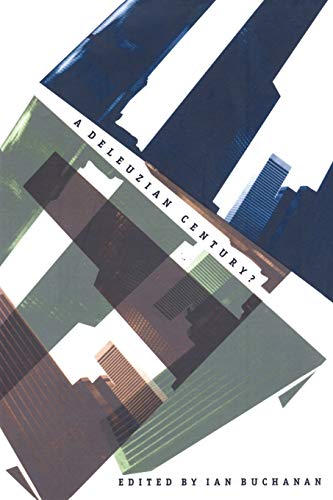
Michel Foucault's suggestion that this century would become known as "Deleuzian" was considered by Gilles Deleuze himself to be a joke "meant to make people who like us laugh, and make everyone else livid." Whether serious or not, Foucault's prediction has had enough of an impact to raise concern about the potential "deification" of this enormously influential French philosopher. Seeking to counter such tendencies toward hagiography-not unknown, particularly since Deleuze's death-Ian Buchanan has assembled a collection of essays that constitute a critical and focused engagement with Deleuze and his work.
Originally published as a special issue of South Atlantic Quarterly (Summer 1997), this volume includes essays from some of the most prominent American, Australian, British, and French scholars and translators of Deleuze's writing. These essays, ranging from film, television, art, and literature to philosophy, psychoanalysis, geology, and cultural studies, reflect the broad interests of Deleuze himself. Providing both an introduction and critique of Deleuze, this volume will engage those readers interested in literary and cultural theory, philosophy, and the future of those areas of study in which Deleuze worked.
Contributors. Ronald Bogue, Ian Buchanan, André Pierre Colombat, Tom Conley, Manuel DeLanda, Tessa Dwyer, Jerry Aline Flieger, Eugene Holland, Fredric Jameson, Jean-Clet Martin, John Mullarkey, D. N. Rodowick, Horst Ruthrof, Charles J. Stivale
Die Inhaltsangabe kann sich auf eine andere Ausgabe dieses Titels beziehen.
Über die Autorin bzw. den Autor
Ian Buchanan is Assistant Professor of English at the University of Tasmania.
Von der hinteren Coverseite
"Here's a remedy for resisting the anti-philosophy brigade. . . . [The contributors] energetically claim Deleuze's importance for issues that have pressed us both politically and philosophically."--Nina Zimnik, "Film-Philosophy"
Auszug. © Genehmigter Nachdruck. Alle Rechte vorbehalten.
A Deleuzian Century?
By Ian BuchananDuke University Press
Copyright © 1999 Duke University Press
All rights reserved.
ISBN: 978-0-8223-2392-1All rights reserved.
Contents
Introduction,
Marxism and Dualism in Deleuze,
The Memory of Resistance,
Deleuze and Materialism: One or Several Matters?,
Art and Territory,
Deleuze and Cultural Studies,
Immanence and Transcendence in the Genesis of Form,
Comment peut-on être deleuzien? Pursuing a Two-Fold Thought,
Marx and Poststructuralist Philosophies of Difference,
Straining to Hear (Deleuze),
Deleuze and the Body: Eluding Kafka's "Little Death Sentence",
Deleuze and the Three Powers of Literature and Philosophy: To Demystify, to Experiment, to Create,
Overdetermined Oedipus: Mommy, Daddy, and Me as Desiring-Machine,
Deleuze's Philosophy of the Concrete,
From Multiplicities to Folds: On Style and Form in Deleuze,
Notes on Contributors,
Index,
CHAPTER 1
Marxism and Dualism in Deleuze
Fredric Jameson
We begin, as one so often does, without necessarily wanting to, with Hegel (heaven only knows if we will also end up in the same place). The motto will be Hegel's prescient analysis of the situation of thought in modern times, which he contrasts to the situation of nascent philosophy in ancient Greece:
The manner of study in ancient times differed from that of the modern age in that the former was the proper and complete formation of the natural consciousness. Putting itself to the test at every point of its existence, and philosophizing about everything it came across, it made itself into a universality that was active through and through. In modern times, however, the individual finds the abstract form ready-made; the effort to grasp and appropriate it is more the direct driving forth of what is within and the truncated generation of the universal than it is the emergence of the latter from the concrete variety of existence. Hence the task nowadays consists not so much in purging the individual of an immediate, sensuous mode of apprehension, and making him into a substance that is an object of thought and that thinks, but rather in just the opposite, in freeing determinate thoughts from their fixity so as to give actuality to the universal, and impart to it spiritual life. But it is far harder to bring fixed thoughts into a fluid state than to do so with sensuous existence.
So here, astonishingly, at the opening of the Phenomenology of Spirit, we find a mature and subtle reflection on reification: reification not only in the world of everyday life, but in thinking as well, and in our intercourse with already existing concepts, with free-floating thoughts named and signed like so many books or paintings. The ancient Greeks had the task, Hegel suggests, of wresting abstract ideas ("universals") from the flux of the sensory: of transforming pensee' sauvage into systems of abstractions, of reclaiming Reason (or the ego, Freud might say) from the morass of the immediate. This is henceforth achieved, and thinkers in the modern period are then suffocated by the proliferation of just such abstractions, in which we swim as in an autonomous element, which suffuse our individual consciousnesses with abstract categories, concepts, and information of all kinds. What to reclaim or reconquer from this new morass, which is rather different from what confronted the Greeks in their "blooming, buzzing confusion"? And who does not see that this holds a thousand times more true for ourselves in postmodernity and late capitalism, in the society of the spectacle and the realm of the cybernetic, than in Hegel's still relatively information-poor life-world? If the Greeks transformed their sensory immediacy into universals, into what can universals themselves be transformed? Hegel's answer is generally interpreted to be reflexivity, self-consciousness, the dialectic and its distance from the concepts it wields and inhabits: that's probably not wrong, but also not very usable under present circumstances (but his own word was "actuality"). Marx had a better formula: bourgeois thought, he said (which we may also read as Greek philosophy), sought to rise from the particular to the universal; our task is now to rise (note the persistence of the verb)—to rise from the universal to the concrete.
The greatness of Gilles Deleuze—or at least one of his many claims on greatness—was to have confronted omnivorously the immense field of everything that was thought and published. No one can read the two volumes of Capitalisme et schizophrénie (or, in a different way, those of Cinéma) without being stunned by the ceaseless flood of references that tirelessly nourish these texts, and which are processed into content and organized into dualisms. This is the sense in which one can speak of Deleuze as a thinker of synthesis, one who masters the immense proliferation of thoughts and concepts by way of assimilation and appropriation. (If you like dualisms, indeed, and great cosmic or metaphysical oppositions, then you can say that Derrida is his opposite in this respect, tirelessly dissolving all the reified thoughts he encounters in the tradition back into the first impossibilities and antinomies from which they sprang.) This is why it seems to me misguided to search for a system or a central idea in Deleuze: in fact, there are many of those. It seems preferable to observe the extraordinary process whereby his intelligence rewrites and transcodes its overpopulated conceptual environment, and organizes it into force fields. But that organization, often so luminously schematic, does not aim to give us the truth, but rather a series of extraordinary representations: it is a Active mapping which utilizes as its representational language great mythic dualisms such as the Schizophrenic and the molar or Paranoid, the Nomad and the State, space and time.
I want to look further into that organizational process, but I want to come at it from a specific question. The attacks on Freud that run through Capitalisme et schizophrénie (particularly the first volume) have been more notorious than the defense and deployment of Marx, which is an equally persistent feature. But we know that Deleuze planned a work on Marx in his final years, and we may also suspect that Marx is a good deal more pervasive than the lengthy chapter on that part of the Grundrisse sometimes entitled "Precapitalist Economic Formations," which occupies so central a space in L'Anti-Oedipe. I think that Deleuze is alone among the great thinkers of so-called poststructuralism in having accorded Marx an absolutely fundamental role in his philosophy—in having found in the encounter with Marx the most energizing event for his later work.
Let's first examine, as it were, the sequence of events in that vast Marx chapter of L'Anti-Oedipe, which nonetheless and despite its energy and coherence may be taken as a set of notes on Marxism rather than some new philosophy of the latter, or some ideologically innovative reading. The chapter is itself a subdivision of a larger one, something like the philosophy of history of the Deleuze/Guattari operation, strangely entitled "Sauvages, barbares, civilise's," a classification that has more ancient roots (in Adam Ferguson, for example), but which springs in recent times (with the enthusiastic approval of Marx himself) from Lewis Henry Morgan's Ancient Society of 1877. I must say something more about this fascinating figure, whom Levi-Strauss called the inventor...
„Über diesen Titel“ kann sich auf eine andere Ausgabe dieses Titels beziehen.
Suchergebnisse für A Deleuzian Century?

Beispielbild für diese ISBN
A Deleuzian Century?
Anbieter: Better World Books Ltd, Dunfermline, Vereinigtes Königreich
Verkäuferbewertung 5 von 5 Sternen

Zustand: Good. Pages intact with minimal writing/highlighting. The binding may be loose and creased. Dust jackets/supplements are not included. Stock photo provided. Product includes identifying sticker. Better World Books: Buy Books. Do Good. Artikel-Nr. 55294796-6
Gebraucht kaufen
EUR 6,64
EUR 5,92 Versand
Versand von Vereinigtes Königreich nach USA
Versand von Vereinigtes Königreich nach USA
Anzahl: 1 verfügbar
Beispielbild für diese ISBN
A Deleuzian Century?
Anbieter: World of Books (was SecondSale), Montgomery, IL, USA
Verkäuferbewertung 5 von 5 Sternen
Paperback. Zustand: Good. Offers a collection of essays that constitute a critical and focused engagement with Deleuze and his work. This volume includes essays from some of the most prominent American, Australian, British, and French scholars and translators of Deleuze's writing. Artikel-Nr. 00094733219
Gebraucht kaufen
EUR 13,75
Versand gratis
Versand innerhalb von USA
Versand innerhalb von USA
Anzahl: 1 verfügbar
Beispielbild für diese ISBN
A Deleuzian Century?
Anbieter: Phatpocket Limited, Waltham Abbey, HERTS, Vereinigtes Königreich
Verkäuferbewertung 5 von 5 Sternen
Zustand: Good. Your purchase helps support Sri Lankan Children's Charity 'The Rainbow Centre'. Ex-library, so some stamps and wear, but in good overall condition. Our donations to The Rainbow Centre have helped provide an education and a safe haven to hundreds of children who live in appalling conditions. Artikel-Nr. Z1-W-029-02453
Gebraucht kaufen
EUR 3,96
EUR 12,59 Versand
Versand von Vereinigtes Königreich nach USA
Versand von Vereinigtes Königreich nach USA
Anzahl: 1 verfügbar
Beispielbild für diese ISBN
A Deleuzian Century?
Anbieter: A Squared Books (Don Dewhirst), South Lyon, MI, USA
Verkäuferbewertung 5 von 5 Sternen
paperback. Zustand: As New. 1999. Matte paper covers; light shelf wear; 8vo, 7 3/4" to 9 3/4" tall; interior is clean and unmarked; 274 pages. Artikel-Nr. SKU1181448
Gebraucht kaufen
EUR 11,02
EUR 5,79 Versand
Versand innerhalb von USA
Versand innerhalb von USA
Anzahl: 1 verfügbar
Beispielbild für diese ISBN
A Deleuzian Century?
Anbieter: Better World Books, Mishawaka, IN, USA
Verkäuferbewertung 5 von 5 Sternen
Zustand: Good. Pages intact with minimal writing/highlighting. The binding may be loose and creased. Dust jackets/supplements are not included. Stock photo provided. Product includes identifying sticker. Better World Books: Buy Books. Do Good. Artikel-Nr. 55294796-6
Gebraucht kaufen
EUR 18,30
Versand gratis
Versand innerhalb von USA
Versand innerhalb von USA
Anzahl: 1 verfügbar
Beispielbild für diese ISBN
A Deleuzian Century?
Anbieter: WorldofBooks, Goring-By-Sea, WS, Vereinigtes Königreich
Verkäuferbewertung 5 von 5 Sternen
Paperback. Zustand: Very Good. The book has been read, but is in excellent condition. Pages are intact and not marred by notes or highlighting. The spine remains undamaged. Artikel-Nr. GOR007460931
Gebraucht kaufen
EUR 15,94
EUR 6,63 Versand
Versand von Vereinigtes Königreich nach USA
Versand von Vereinigtes Königreich nach USA
Anzahl: 1 verfügbar
Beispielbild für diese ISBN
A Deleuzian Century?
Verlag:
Duke University Press Books, 1999
ISBN 10: 0822323923
ISBN 13: 9780822323921
Gebraucht
paperback
Anbieter: Black Gull Books (P.B.F.A.), St Leonard's on Sea, Vereinigtes Königreich
Verkäuferbewertung 4 von 5 Sternen

paperback. Zustand: Very Good. Artikel-Nr. 3-F08812
Gebraucht kaufen
EUR 10,97
EUR 15,39 Versand
Versand von Vereinigtes Königreich nach USA
Versand von Vereinigtes Königreich nach USA
Anzahl: 1 verfügbar
Beispielbild für diese ISBN
A Deleuzian Century?
Anbieter: PBShop.store UK, Fairford, GLOS, Vereinigtes Königreich
Verkäuferbewertung 5 von 5 Sternen
PAP. Zustand: New. New Book. Shipped from UK. Established seller since 2000. Artikel-Nr. FW-9780822323921
Neu kaufen
EUR 33,78
EUR 5,94 Versand
Versand von Vereinigtes Königreich nach USA
Versand von Vereinigtes Königreich nach USA
Anzahl: 1 verfügbar
Beispielbild für diese ISBN
A Deleuzian Century?
Anbieter: Ria Christie Collections, Uxbridge, Vereinigtes Königreich
Verkäuferbewertung 5 von 5 Sternen
Zustand: New. In English. Artikel-Nr. ria9780822323921_new
Neu kaufen
EUR 38,80
EUR 13,36 Versand
Versand von Vereinigtes Königreich nach USA
Versand von Vereinigtes Königreich nach USA
Anzahl: 1 verfügbar
Beispielbild für diese ISBN
A Deleuzian Century?
Anbieter: Kennys Bookstore, Olney, MD, USA
Verkäuferbewertung 5 von 5 Sternen
Zustand: New. Offers a collection of essays that constitute a critical and focused engagement with Deleuze and his work. This volume includes essays from some of the most prominent American, Australian, British, and French scholars and translators of Deleuze's writing. Editor(s): Buchanan, Ian. Num Pages: 280 pages, 5 illustrations. BIC Classification: JFC. Category: (P) Professional & Vocational. Dimension: 156 x 231 x 19. Weight in Grams: 452. . 1999. Illustrated. paperback. . . . . Books ship from the US and Ireland. Artikel-Nr. V9780822323921
Neu kaufen
EUR 48,58
EUR 9,36 Versand
Versand innerhalb von USA
Versand innerhalb von USA
Anzahl: 1 verfügbar