
Verwandte Artikel zu Managing the Environmental Crisis: Incorporating Competing...
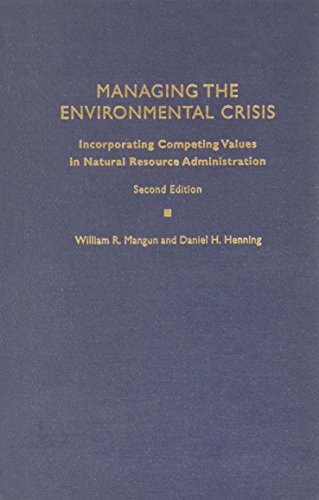
Managing the Environmental Crisis: Incorporating Competing Values in Natural Resource Administration - Hardcover
Inhaltsangabe
Second edition
With a new foreword by Lynton Keith Caldwell
In Managing the Environmental Crisis William R. Mangun and Daniel H. Henning provide a balanced and comprehensive guide to the management of complex environmental and natural resource policy issues. Taking into account new developments, trends, and issues that have arisen in recent years, the authors begin with the recognition, often overlooked, that it is not the environment that needs to be managed but human action relating to the environment.
The authors review issues associated with a range of environmental policy concerns, including energy considerations, renewable and non renewable resource management, pollution control, wilderness management, and urban and regional policy. The history of these issues, recent actions pertaining to their management, difficulties associated with their continued presence, and the consequences of a failure to address these concerns are explored. Though focused on specific political issues, Mangun and Henning direct their attention to two large-scale trends--globalization and the political polarization of the environmental movement. At the level of the decision-making process, the incorporation of values--specifically addressed from multicultural and cross-disciplinary perspectives--is also discussed. International in scope, the book provides descriptions of the roles of both governmental and nongovernmental organizations in the formulations and implementation of national and global environmental policy.
This thoroughly revised second edition discusses various successes in the arenas of environmental cooperation and management strategy while pointing to the new challenges that have emerged in the last decade.
Die Inhaltsangabe kann sich auf eine andere Ausgabe dieses Titels beziehen.
Über die Autorin bzw. den Autor
William R. Mangun is Professor of Political Science at East Carolina University. His books include American Fish and Wildlife Policy, Public Policy Issues in Wildlife Management, and The Public Administration of Environmental Policy.
Daniel H. Henning is Professor Emeritus of Political Science and Environmental Affairs at Montana State University and author of Environmental Policy and Administration and A Dove in the Forest.
Von der hinteren Coverseite
"from reviews of the first edition":
"This is a comprehensive, informed, and thoughtful volume that will serve as an excellent text . . . while providing a more enlightened perspective for graduate management training."--Norman J. Vig, "American Political Science Review
""The authors have fashioned a valuable global resource on policy and related issues."--S. Frost, "International Journal of Environmental Studies"
Auszug. © Genehmigter Nachdruck. Alle Rechte vorbehalten.
Managing the Environmental Crisis
Incorporating Competing Values in Natural Resource Administration
By William R. Mangun, Daniel H. HenningDuke University Press
Copyright © 1999 Duke University Press
All rights reserved.
ISBN: 978-0-8223-2379-2All rights reserved.
Contents
Foreword,
Preface to the Second Edition,
Preface to the First Edition,
Acknowledgments,
Abbreviations,
1 Forces Shaping Environmental and Natural Resource Administration,
2 Environmental and Natural Resource Policy,
3 Environmental Administration in a Decisionmaking Context,
4 Energy Considerations in Environmental Policy,
5 Renewable Resource Management,
6 Nonrenewable Resource Management,
7 Outdoor Recreation and Wilderness Management,
8 Environmental Pollution Control,
9 Urban and Regional Environmental Policy,
10 International Environmental Administration,
Notes,
Glossary,
Index,
About the Authors,
CHAPTER 1
Forces Shaping Environmental and Natural Resource Administration
Since the first edition of this book, several major changes have occurred in environmental administration. First, there is now a greater emphasis on the interconnectedness of elements within ecosystems. Management of environmental problems is taking on an ecosystem perspective in the United States. The leading land management agencies now use an Ecosystem management approach that incorporates ecological considerations while acknowledging human needs. Since ecosystems do not recognize political boundaries, management strategies must be employed that involve cooperation across jurisdictional lines, as well as between the private and public sector. For example, a watershed management approach has been adopted by federal agencies for water quality management that emphasizes cooperation across jurisdictions.
A second change is a greater emphasis on economic incentives and flexibility in pollution control. The high cost and inflexibility of the traditional "command and control" regulatory approach have yielded to a growth in regulatory incentives and innovative management approaches that increase flexibility in implementation. For example, trading programs have been established in air pollution control for sulfur dioxide emissions and in water pollution control for nutrient loads. The U.S. Environmental Protection Agency has reinvented environmental management with a greater emphasis on flexibility and cooperation with state and local governments through its Common Sense Initiative, Project XL, Brownfields, and Community-Based Environmental Protection (CBEP) initiatives.
A third major change appears to be a devolution of responsibility from the federal government to the states. In some areas of environmental protection, the states have been more innovative than the federal government. In other areas, the states claim that the inflexibility of federal regulations impedes their creativity. Collectively, the states have assumed greater responsibility for environmental protection and clearly dominate in the areas of waste management, groundwater protection, and coastal zone management. The states acknowledge the federal government's role in establishment of national standards for pollution control but demand greater flexibility in their implementation.
Environmental and Natural Resource Administration
Environmental administration constitutes all activities taken by government (local, national, or international) to protect or enhance the quality of the environment in the public interest. It involves numerous governmental departments, agencies, and independent units with environmental and natural resource programs and concerns at virtually every level of government. In the United States, numerous federal departments and agencies are involved in the implementation of environmental policies. Some are charged with the administration of more than 650 million acres of public land, which is about one-third of the nation's total geographical area. A totally comprehensive public policy for environmental administration does not exist in the United States nor any other country.
The administration of environmental programs, just like any other public program, is a human process where individuals and groups interact and work toward achieving certain collective and organizational objectives or values. Politics and public administration are intertwined in the struggle for power to affect governmental policies. Every policy decision in the public sector is a product of individual or group judgment through the political process. Regardless of their areas of responsibility or clientele, public organizations and personnel must operate in a highly political environment influenced by regionally or nationally dominant cultures.
The public administrator must pay particular attention to those pressures that he or she can best control while minimizing the negative effects of those that cannot be controlled or moderated significantly. The purpose of this book is not to prescribe any specific environmental administration theory. The position taken by Peter Savage–specifically with regard to comparative administration and public administration–in general remains true today: "[P]aradigmatic orthodoxy of any kind is unlikely to take root short of force." Nevertheless, this book provides a guide for natural resource decisionmakers. The theme of the book is that environmental and natural resource managers should act continually on behalf of the environmental public interest. They, more than any other public administrators, must guard against public decisions that support short-term economic gain at the cost of substantial and potentially irreversible environmental losses in the long run. Throughout the book, the role of values in decisionmaking is emphasized. Values enter into all decisions, and the quality of the environment will be determined extensively by the degree to which environmental values are taken into consideration in decisions made throughout the public sector. Among the most important influences affecting environmental and natural resource administrators are (1) Ecological complexities, (2) a Crisis Orientation, (3) the environmental public interest, (4) concern for future generations, (5) the intangible nature of many environmental values, and (6) the values and value judgments of agency personnel.
These considerations influence the feasible decision space of the public administrator. The world of the public official is not the neat, clearly defined world that many people perceive; rather, it lacks any specific shape and tends to be amorphous. The ill-defined world of the public administrator can be modified by particular forces, some of which he or she may be able to influence. Therefore, some influences may have greater or lesser impact than others, depending on the time and place of interaction with the administrator as well as his or her own administrative capabilities.
Ecological complexities
Ecology is the study of the relationships among all living things and the physical environment. The ecological concept of interrelations provides a central theme for environmental administration. Management of a specific natural resource at a given time and place involves a complex of interrelations that has the capacity to influence the environment in the present or the future. For example, the management of water resources cannot occur without affecting other natural resources. Since the environment includes all living and nonliving features,...
„Über diesen Titel“ kann sich auf eine andere Ausgabe dieses Titels beziehen.
Suchergebnisse für Managing the Environmental Crisis: Incorporating Competing...

Beispielbild für diese ISBN
Managing the Environmental Crisis : Incorporating Competing Values in Natural Resource Administration
Anbieter: Better World Books, Mishawaka, IN, USA
Verkäuferbewertung 5 von 5 Sternen

Zustand: Good. Second. Former library copy. Pages intact with minimal writing/highlighting. The binding may be loose and creased. Dust jackets/supplements are not included. Includes library markings. Stock photo provided. Product includes identifying sticker. Better World Books: Buy Books. Do Good. Artikel-Nr. 15400288-20
Gebraucht kaufen
EUR 96,79
Versand gratis
Versand innerhalb von USA
Versand innerhalb von USA
Anzahl: 1 verfügbar