
Verwandte Artikel zu Nations, Identities, Cultures
Inhaltsangabe
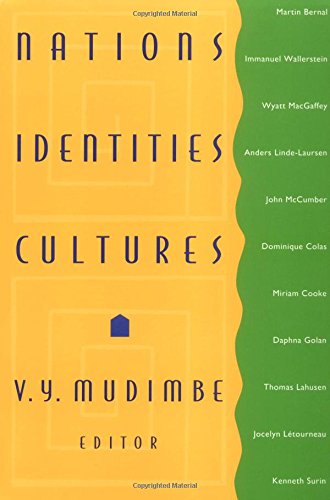
This volume investigates the concepts of nation, identity, and culture as they have evolved within the contexts of exile and as a result of the consolidation of the ethnic and the political. The contributors explore various theoretical issues involved in reconfiguring these concepts since the nineteenth century, as well as the manifestations of these issues in specific regions of the world.
Examining the degree to which twentieth-century representations of colonization, revolution, and modernity are nineteenth-century constructs, Nations, Identities, Cultures locates contemporary political thought in an ethos of exile, nostalgic for bygone places and cultures of the nineteenth century. The contributors interrogate the significance of changes in the way the political is conceptualized and the impact of shifting representations of political society on our understanding of nation, identity, and culture. Approaches to these issues range from broad perspectives on global culture, civil society, liberalism, and dialectical identity to specific case studies on the politics of Quebec, the Russian muzhik, Israel's borders, the ancient Greek origins of European culture, Kongo nationalism, the women of Lebanon, and the Danish/Swedish border.
Contributors. Martin Bernal, Dominique Colas, Miriam Cooke, Daphna Golan, Thomas Lahusen, Jocelyn Létourneau, Anders Linde-Laursen, Wyatt MacGaffey, John McCumber, V. Y. Mudimbe, Kenneth Surin, Immanuel Wallerstein
Die Inhaltsangabe kann sich auf eine andere Ausgabe dieses Titels beziehen.
Über die Autorin bzw. den Autor
V. Y. Mudimbe is William Rand Kenan, Jr. Professor of French, Comparative Literature, and Classics at Stanford University. He is also Distinguished Research Professor in the Graduate Program in Literature at Duke University.
Von der hinteren Coverseite
This volume investigates the concepts of nation, identity, and culture as they have evolved within the contexts of exile and as a result of the consolidation of the ethnic and the political. The contributors explore various theoretical issues involved in reconfiguring these concepts since the nineteenth century as well as the manifestations of these issues in specific regions of the world.
Auszug. © Genehmigter Nachdruck. Alle Rechte vorbehalten.
Nations, Identities, Cultures
By V. Y. MudimbeDuke University Press
Copyright © 1997 Duke University Press
All rights reserved.
ISBN: 978-0-8223-2065-4All rights reserved.
Contents
Introduction,
Race, Class, and Gender in the Formation of the Aryan Model of Greek Origins,
Notes,
Civil Society: From Utopia to Management, from Marxism to Anti-Marxism,
Notes,
Kongo Identity, 1483–1993,
Notes,
The Current Great Narrative of Québecois Identity,
Notes,
Between Universalism and Particularism: The "Border" in Israeli Discourse,
Notes,
Reimagining Lebanon,
Notes,
The Ethnicization of Nations: Russia, the Soviet Union, and the People,
Notes,
Small Differences—Large Issues: The Making and Remaking of a National Border,
Notes,
Dialectical Identity in a "Post-Critical" Era: A Hegelian Reading,
Notes,
The Insurmountable Contradictions of Liberalism: Human Rights and the Rights of Peoples in the Geoculture of the Modern World-System,
Notes,
On Producing the Concept of a Global Culture,
Notes,
Notes on Contributors,
Index,
CHAPTER 1
Race, Class, and Gender in the Formation of the Aryan Model of Greek Origins
Martin Bernal
My work Black Athena: The Afroasiatic Roots of Classical Civilization is concerned with the formation of ancient Greece, which I believe is quite rightly seen as the largest single source of European culture. In this project I have found it useful to classify the many different stories of Greek origins according to what I call the Ancient and Aryan models. By "model" I mean a reduced and simplified representation, and I am acutely aware that creating models inevitably distorts the complex contours of the past. As the Italian proverb states, traduttore traditore (translator, traitor). Even the translated text has problems; as David Lodge puts it in his novel Small World, "Decoding is merely re-encoding." Having said all this, I believe that models, like words, are essential for organized thought and that some codes are better than others—in terms of the accuracy of their representation of "reality" and/or their comprehensibility. Thus it has been helpful to set up these two models of Greek origins.
According to the Aryan model with which I and my contemporaries were brought up, Greek civilization was the result of the conquest of the Aegean basin from the north by the Hellenes, speakers of an Indo-European language, or as slippage between language and "race" was very easy—"Aryans." Among many other things, the original inhabitants of the region are supposed to have lost their name, so for convenience modern scholars have simply called them "pre-Hellenes." Greek language and society are believed to have emerged from this mixture, and all of the considerable portion of it that could not be related to other Indo-European-speaking cultures was designated "pre-Hellene." By definition, the pre-Hellenes must not have been Indo-European speakers, yet they are seen as Caucasian and definitely unrelated to Africans or Semitic speakers from Southwest Asia. The nineteenth-century creators of the Aryan model saw Greece as fundamentally different from India, where the Aryans had conquered a "dark" people but had eventually been corrupted by them; Greece, by contrast, was seen as racially pure and essentially European, an appropriate cradle for "Western Civilization."
This picture was essentially created in the 1830s and 1840s. Before that, the predominant view of Greek origins was informed by what I call the Ancient model, which was fully articulated in the fifth century B.C., but there is strong evidence to suggest that it had existed much earlier. According to this model, the ancestors of the Greeks had lived around the Aegean in idyllic simplicity until the Phoenicians and rulers from Egypt arrived and acquired territories, built cities, and founded dynasties. The strangers also introduced many of the arts of civilization, notably, irrigation, various types of armaments, writing, and religion. These had later been refined by Greeks studying in Egypt and, to a lesser extent, in Mesopotamia. This image of cultural dependence was not one that made fifth-century Greeks happy, so the Athenians developed a myth whereby the Thebans and Peloponnesians had foreign ancestry, but they themselves were autochthonous sons of the soil. However, the credibility of the Ancient model is increased precisely because it went against the Panhellenic, anti-"barbarian" passions of the time. This point was taken up by the eighteenth- and nineteenth-century scholars who felt obliged to defend the Ancient model against skeptics. Before that, there had been no need for any defense, as it was accepted by all scholars who considered the subject.
My project has two aspects, one historical and the other historiographical. In the historical one I set up a compromise model, the "revised Ancient model." This accepts the arguments behind the Aryan model that it is plausible to postulate a single, ancestral proto-Indo-European language originally spoken somewhere to the north of the Balkans and that Greek is therefore fundamentally an Indo-European language. Thus at some stage the Aegean basin must have been substantially influenced by the north, and this influence could have been the result of migration or conquest. On the other hand, there is no reason to see this northern influence as precluding the possibility of substantial cultural influence from the south and east as well. The fundamental structure of Greek is Indo-European, and the Greek tradition remembered the overseas settlements rather than conquests from the Balkans. It is plausible to suppose that, rather than being the result of a pre-Hellenic substrate, the non-Indo-European elements in the Greek language and culture were largely later Semitic and Egyptian superimpositions on an Indo-European base. Possibly these were the result of conquest and elite settlement around the Aegean, and certainly they came from trade and diplomatic contacts between Egypt and the Levant, on the one hand, and the Aegean, on the other.
When I wrote volume one of Black Athena in the late 1970s I had hoped to measure the utility of the revised Ancient model against that of the Aryan model simply by confronting the "evidence" from archaeology, linguistics, religious cults, and so on. In preparing volume two, however, I came to realize that such an approach had two devastating flaws. At a superficial level, it would have been disingenuous for me to claim impartiality toward the two models. More fundamentally, I came to realize that there is no objective evidence above or beyond the models. Even in volume one, I had specifically rejected claims of certainty or proof, maintaining that the best one could hope for was what I called "competitive plausibility," or the least bad historical narrative. In volume two, I merely set out to show that it was more interesting and satisfying to work with or live in the revised Ancient model than it was to inhabit the Aryan one.
Here, however, I shall not be concerned with reconstructing the history of the origins of ancient Greece, but with trying to understand its historiography. I am particularly interested in the crux of the late eighteenth and early nineteenth centuries, when first the Ancient model was abandoned and then, a little later, the Aryan one was created and adopted by most scholars. Before getting down to this, however, I should like to take an approach formerly used in the history of...
„Über diesen Titel“ kann sich auf eine andere Ausgabe dieses Titels beziehen.
Suchergebnisse für Nations, Identities, Cultures

Beispielbild für diese ISBN
Nations, Identities, Cultures
Anbieter: WorldofBooks, Goring-By-Sea, WS, Vereinigtes Königreich
Verkäuferbewertung 5 von 5 Sternen

Paperback. Zustand: Very Good. The book has been read, but is in excellent condition. Pages are intact and not marred by notes or highlighting. The spine remains undamaged. Artikel-Nr. GOR005486067
Gebraucht kaufen
EUR 7,56
EUR 6,61 Versand
Versand von Vereinigtes Königreich nach USA
Versand von Vereinigtes Königreich nach USA
Anzahl: 1 verfügbar
Beispielbild für diese ISBN
Nations, Identities, Cultures
Anbieter: Anybook.com, Lincoln, Vereinigtes Königreich
Verkäuferbewertung 5 von 5 Sternen
Zustand: Good. This is an ex-library book and may have the usual library/used-book markings inside.This book has soft covers. In good all round condition. Please note the Image in this listing is a stock photo and may not match the covers of the actual item,500grams, ISBN:9780822320654. Artikel-Nr. 5839630
Gebraucht kaufen
EUR 17,01
EUR 15,38 Versand
Versand von Vereinigtes Königreich nach USA
Versand von Vereinigtes Königreich nach USA
Anzahl: 1 verfügbar
Beispielbild für diese ISBN
Nations, Identities, Cultures
Anbieter: Anybook.com, Lincoln, Vereinigtes Königreich
Verkäuferbewertung 5 von 5 Sternen
Zustand: Good. This is an ex-library book and may have the usual library/used-book markings inside.This book has soft covers. In good all round condition. Please note the Image in this listing is a stock photo and may not match the covers of the actual item,500grams, ISBN:9780822320654. Artikel-Nr. 4138732
Gebraucht kaufen
EUR 18,23
EUR 15,38 Versand
Versand von Vereinigtes Königreich nach USA
Versand von Vereinigtes Königreich nach USA
Anzahl: 1 verfügbar
Beispielbild für diese ISBN
Nations, Identities, Cultures
Anbieter: PBShop.store UK, Fairford, GLOS, Vereinigtes Königreich
Verkäuferbewertung 5 von 5 Sternen
PAP. Zustand: New. New Book. Shipped from UK. Established seller since 2000. Artikel-Nr. FW-9780822320654
Neu kaufen
EUR 29,13
EUR 4,91 Versand
Versand von Vereinigtes Königreich nach USA
Versand von Vereinigtes Königreich nach USA
Anzahl: 3 verfügbar
Beispielbild für diese ISBN
Nations, Identities, Cultures
Anbieter: Revaluation Books, Exeter, Vereinigtes Königreich
Verkäuferbewertung 5 von 5 Sternen
Paperback. Zustand: Brand New. 240 pages. 9.25x6.00x0.75 inches. In Stock. Artikel-Nr. __0822320657
Neu kaufen
EUR 30,60
EUR 11,80 Versand
Versand von Vereinigtes Königreich nach USA
Versand von Vereinigtes Königreich nach USA
Anzahl: 2 verfügbar
Beispielbild für diese ISBN
Nations, Identities, Cultures
Anbieter: Majestic Books, Hounslow, Vereinigtes Königreich
Verkäuferbewertung 4 von 5 Sternen

Zustand: New. pp. 240. Artikel-Nr. 7955918
Neu kaufen
EUR 36,65
EUR 7,67 Versand
Versand von Vereinigtes Königreich nach USA
Versand von Vereinigtes Königreich nach USA
Anzahl: 3 verfügbar
Beispielbild für diese ISBN
Nations, Identities, Cultures
Anbieter: Ria Christie Collections, Uxbridge, Vereinigtes Königreich
Verkäuferbewertung 5 von 5 Sternen
Zustand: New. In English. Artikel-Nr. ria9780822320654_new
Neu kaufen
EUR 35,09
EUR 13,32 Versand
Versand von Vereinigtes Königreich nach USA
Versand von Vereinigtes Königreich nach USA
Anzahl: 3 verfügbar
Beispielbild für diese ISBN
Nations, Identities, Cultures
Anbieter: Kennys Bookstore, Olney, MD, USA
Verkäuferbewertung 5 von 5 Sternen
Zustand: New. Investigates the concepts of nation, identity, and culture as they have evolved within the contexts of exile and the ethnicisation of the political. This book explores various theoretical issues involved in reconfiguring these concepts since the nineteenth century. It is aimed at readers engaged in postcolonial and cultural studies. Editor(s): Mudimbe, V. Y. Num Pages: 240 pages. BIC Classification: JFC; JFSL; JHM; JPFN. Category: (P) Professional & Vocational. Dimension: 152 x 229 x 19. Weight in Grams: 386. . 1997. Revised ed. paperback. . . . . Books ship from the US and Ireland. Artikel-Nr. V9780822320654
Neu kaufen
EUR 43,98
EUR 9,37 Versand
Versand innerhalb von USA
Versand innerhalb von USA
Anzahl: 1 verfügbar