
Verwandte Artikel zu The Mother Knot
Inhaltsangabe
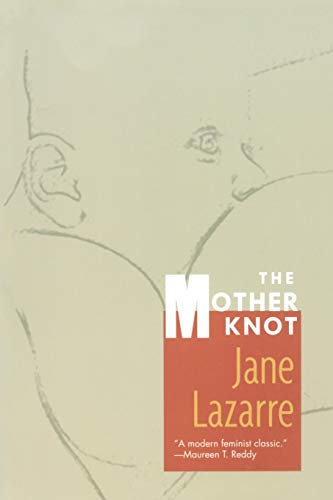
In this compelling memoir by a writer, mother, and feminist, Jane Lazarre confronts the myth of the "good mother" with her fiercely honest and intimate portrait of early motherhood as a time of profound ambivalence and upheaval, filled with desperation as well as joy, the struggle to reclaim a sense of self, and sheer physical exhaustion. Originally published in 1976, The Mother Knot is a feminist classic, as relevant today as it was twenty years ago.
Die Inhaltsangabe kann sich auf eine andere Ausgabe dieses Titels beziehen.
Über die Autorin bzw. den Autor
Jane Lazarre is on the Faculty of Eugene Lang College at the New School for Social Research. She is the author of numerous works of fiction and non-fiction, including Beyond the Whiteness of Whiteness and Wet Earth and Dreams, both published by Duke University Press.
Von der hinteren Coverseite
""The Mother Knot" deserves a permanent place in the stirring body of testimonial literature American feminism has given rise to."--Vivian Gornick
Auszug. © Genehmigter Nachdruck. Alle Rechte vorbehalten.
The Mother Knot
By Jane LazarreDuke University Press
Copyright © 1976 Jane Lazarre
All rights reserved.
ISBN: 978-0-8223-2039-5All rights reserved.
Contents
Introduction,
Preface to the Duke Edition,
Acknowledgments,
Preface,
Part One: Birth,
Part Two: Mothers and Fathers,
Part Three: Children,
Part Four: The Dark Lady,
CHAPTER 1
I was terrified. Had been for two months. During my first labor, four years before, I had been innocent, allaying my fears with the knowledge that birth is a natural process. This time I was wiser. Euphemisms, whether medical or mystical, no longer held any weight with me. My only hope was that, instead of the twenty-four-hour labor I had suffered with my first child, this one would be short.
The nurse wouldn't let James come in with me and the minute he left me my fear increased. The pains were still mild, a real contraction coming only every twenty minutes or so. But in between, anxiety would cramp my stomach, convincing me I was two minutes away from the delivery table. "Relax and it will hurt less," people had told me, suggesting that there was really nothing to be frightened of, as if the source of the pain were my imagination instead of my uterus. But I had determined that it was best to face this night with an uncompromising realism. So until my husband walked through the door again, I paced and wept, not yet in pain, only in fear.
At the beginning of our love affair, seven years before, he had told me how he hated conflict. Coming from a loud-talking, deep-feeling family, most of whom were constantly involved in trying to figure themselves and each other out, he had been the one to withdraw from childhood on. He would run up to his room to escape the suffocating flow of human feeling. Or he would go to the field behind his house and lie down in the grass to clear his head and think of nothing but the reed he chewed in his teeth. Intensity was a burden. If he ever expressed his own, he did it on the football field or in early, passionate sex, but not in talk, not even in remembered dreams. It was as if there had been some agreement made at an uncertain moment in the past, an agreement which designated James as the child who would express the silent controls lacked by everyone else, who would run in a straight line toward the goal while everyone else spilled all over the field.
The family would be listening to the radio, the television and the record player simultaneously in three different rooms, an animated discussion would be taking place in the kitchen, and they all would wait for James's predictable plea for something, anything, to be turned off. While everyone else in the large family found solace and strength in sharing all the details, each and every nuance, of the problems of their individual lives, James developed the need for strict privacy; he kept his business to himself, he would say. And he would inevitably decide to read a magazine during the frequent emotional confrontations.
James loved his family; so much so that when he married he chose someone much more like them than like himself. Perhaps he needed the familiar, open, relentlessly shared feeling to keep him in touch with his own boundaries. Maybe he had grown comfortable playing the quiet role to someone else's intensity. In any case, he did not marry a controlled sort of woman who could be counted on to keep her deepest feelings tucked neatly out of sight; he married me.
Finally the nurse allowed him into the dingy room, paint peeling from the walls, the air conditioner making the sound of several hundred horses galloping down a road full of sloshing water. Just the right atmosphere for concentrated breathing, panting and blowing. I was only up to the first stage of the breathing and already I was losing control. The Lamaze Method. I had sworn never to believe their insidious promises again. James grinned at me when he saw me sitting down seriously on the hospital bed, trying to pant in rhythm to "Mary Had a Little Lamb." I grinned, too, and said, Shit. That had been our attitude throughout the last six weeks. When we could bring ourselves to practice, alone and with our friends who were also expecting their second child, we always ended up laughing after ten minutes and abandoned the effort. We had learned with our first child, we thought, that the entire sect of natural childbirth was a big fat defense mechanism against pain. In one Pacific Island culture, the women beat themselves with sharp sticks during labor, perhaps a more diverting physical exercise than breathing like a dog in heat. But in both cases, the assumption is the same: the more you can manage to think of something else, the more you will be able to endure the horror going on in your uterus.
But I am not the type to endure. Falling short of the revolutionary image passed on to me through my father's dreams, I can only in fantasy withstand the fascist torture while refusing to divulge the names of my comrades. In truth, I am afraid that the moment they even threaten to hurt me, I will tell all.
Movies, so popular in my generation, which depict people suffering all sorts of physical pain upset me for days, creep into my nights and make my insomnia worse. Not that I want to be this way. I want to be brave—an amazon. And when it comes to tolerating mental pain, I am definitely in the race. But my body is weak. Just its ability to go on living is a miracle to me.
When James grinned, I lost the grasp I had on the tail end of the Lamaze illusion. "Might just as well wait for the pain," I said. "Chances are I will still be alive by morning." Remembering the short, fifteen minutes of transition (that terror-filled time of labor when you feel a steel rod pushing apart your insides) which I had experienced with my first child, I felt I could take it.
So for the next three hours I simply lay there and suffered, a little more with each contraction, and pretended to breathe correctly so I wouldn't have an argument with the obstetrician. At least I wasn't spitting forth green vomit into James's arms like the last time. I submitted to the shaving of my perineum, nearly coming in the nurse's palm, tried to drive away the fears of pain and death, and concentrated on my son and my sister whose dependency on me always succeeded in increasing my evident strength and self-restraint. I was convinced I would deliver by 5 A.M. One nurse even bet her tuna-fish sandwich on it. And that it would be a typical second birth—tolerable if not easy.
Therefore, I was totally unprepared for the two hours and fifty-nine minutes of transition during which I screamed continually, begging for them to cut me open or end my life. I must have squeezed the blood out of James's hand as the nurses held my legs apart while I tried to push the baby's head into position. They gave me Pitocin to speed up contractions which, my feminist sisters had warned me, made the pains more intense and less controllable. But who cared. At least they would be over faster. I wanted it to be over. I wanted to be alive. I wanted James to get home to our little boy, Benjamin, who, I was convinced, was suffering a trauma of separation. Then I let them give me Demerol, knowing that any last hope of controlling the contractions would be gone as I drifted in and out of foggy and nauseous slumber, wakened only by the pain in my anus—("Very common to feel the pressure in your anus with the second child, young lady")—or shrieks coming from very far away. In the two or three minutes of consciousness during the contraction I would know those shrieks were my own,...
„Über diesen Titel“ kann sich auf eine andere Ausgabe dieses Titels beziehen.
Suchergebnisse für The Mother Knot

Beispielbild für diese ISBN
The Mother Knot
Anbieter: Better World Books: West, Reno, NV, USA
Verkäuferbewertung 5 von 5 Sternen

Zustand: Good. Pages intact with minimal writing/highlighting. The binding may be loose and creased. Dust jackets/supplements are not included. Stock photo provided. Product includes identifying sticker. Better World Books: Buy Books. Do Good. Artikel-Nr. 9129779-6
Gebraucht kaufen
EUR 9,11
Versand gratis
Versand innerhalb von USA
Versand innerhalb von USA
Anzahl: 1 verfügbar
Foto des Verkäufers
The Mother Knot
Anbieter: Rarewaves USA, HEBRON, KY, USA
Verkäuferbewertung 5 von 5 Sternen
Paperback. Zustand: New. In this compelling memoir by a writer, mother, and feminist, Jane Lazarre confronts the myth of the "good mother" with her fiercely honest and intimate portrait of early motherhood as a time of profound ambivalence and upheaval, filled with desperation as well as joy, the struggle to reclaim a sense of self, and sheer physical exhaustion. Originally published in 1976, The Mother Knot is a feminist classic, as relevant today as it was twenty years ago. Artikel-Nr. LU-9780822320395
Neu kaufen
EUR 24,12
Versand gratis
Versand innerhalb von USA
Versand innerhalb von USA
Anzahl: Mehr als 20 verfügbar
Foto des Verkäufers
The Mother Knot
Anbieter: Rarewaves.com USA, London, LONDO, Vereinigtes Königreich
Verkäuferbewertung 5 von 5 Sternen
Paperback. Zustand: New. In this compelling memoir by a writer, mother, and feminist, Jane Lazarre confronts the myth of the "good mother" with her fiercely honest and intimate portrait of early motherhood as a time of profound ambivalence and upheaval, filled with desperation as well as joy, the struggle to reclaim a sense of self, and sheer physical exhaustion. Originally published in 1976, The Mother Knot is a feminist classic, as relevant today as it was twenty years ago. Artikel-Nr. LU-9780822320395
Neu kaufen
EUR 28,45
Versand gratis
Versand von Vereinigtes Königreich nach USA
Versand von Vereinigtes Königreich nach USA
Anzahl: Mehr als 20 verfügbar
Beispielbild für diese ISBN
The Mother Knot
Anbieter: California Books, Miami, FL, USA
Verkäuferbewertung 5 von 5 Sternen
Zustand: New. Artikel-Nr. I-9780822320395
Neu kaufen
EUR 25,89
EUR 2,69 Versand
Versand innerhalb von USA
Versand innerhalb von USA
Anzahl: Mehr als 20 verfügbar
Beispielbild für diese ISBN
The Mother Knot
Anbieter: PBShop.store UK, Fairford, GLOS, Vereinigtes Königreich
Verkäuferbewertung 5 von 5 Sternen
PAP. Zustand: New. New Book. Shipped from UK. Established seller since 2000. Artikel-Nr. FW-9780822320395
Neu kaufen
EUR 26,73
EUR 4,99 Versand
Versand von Vereinigtes Königreich nach USA
Versand von Vereinigtes Königreich nach USA
Anzahl: 1 verfügbar
Beispielbild für diese ISBN
The Mother Knot
Anbieter: WorldofBooks, Goring-By-Sea, WS, Vereinigtes Königreich
Verkäuferbewertung 5 von 5 Sternen
Paperback. Zustand: Very Good. The book has been read, but is in excellent condition. Pages are intact and not marred by notes or highlighting. The spine remains undamaged. Artikel-Nr. GOR012267746
Gebraucht kaufen
EUR 28,09
EUR 6,71 Versand
Versand von Vereinigtes Königreich nach USA
Versand von Vereinigtes Königreich nach USA
Anzahl: 1 verfügbar
Beispielbild für diese ISBN
The Mother Knot
Anbieter: Kennys Bookshop and Art Galleries Ltd., Galway, GY, Irland
Verkäuferbewertung 5 von 5 Sternen
Zustand: New. Chronicling the early years of the author's eldest son's life, this book presents a portrait of early motherhood as a time of profound crisis, both physical and emotional. It deals about the shock and pain of giving birth, the total exhaustion of caring for a demanding newborn, the struggle to reclaim a sense of self, and her chaotic feelings. Num Pages: 176 pages. BIC Classification: JFFK; JHBK. Category: (P) Professional & Vocational. Dimension: 152 x 229 x 13. Weight in Grams: 290. . 1997. Reprint. paperback. . . . . Artikel-Nr. V9780822320395
Neu kaufen
EUR 32,74
EUR 9,50 Versand
Versand von Irland nach USA
Versand von Irland nach USA
Anzahl: 1 verfügbar
Beispielbild für diese ISBN
The Mother Knot
Anbieter: Revaluation Books, Exeter, Vereinigtes Königreich
Verkäuferbewertung 5 von 5 Sternen
Paperback. Zustand: Brand New. reprint edition. 150 pages. 9.25x5.75x0.50 inches. In Stock. Artikel-Nr. x-0822320398
Neu kaufen
EUR 31,13
EUR 11,99 Versand
Versand von Vereinigtes Königreich nach USA
Versand von Vereinigtes Königreich nach USA
Anzahl: 2 verfügbar
Foto des Verkäufers
Mother Knot
Anbieter: GreatBookPricesUK, Woodford Green, Vereinigtes Königreich
Verkäuferbewertung 5 von 5 Sternen
Zustand: New. Artikel-Nr. 202267-n
Neu kaufen
EUR 25,36
EUR 17,98 Versand
Versand von Vereinigtes Königreich nach USA
Versand von Vereinigtes Königreich nach USA
Anzahl: Mehr als 20 verfügbar
Beispielbild für diese ISBN
The Mother Knot
Anbieter: Ria Christie Collections, Uxbridge, Vereinigtes Königreich
Verkäuferbewertung 5 von 5 Sternen
Zustand: New. In English. Artikel-Nr. ria9780822320395_new
Neu kaufen
EUR 32,58
EUR 11,23 Versand
Versand von Vereinigtes Königreich nach USA
Versand von Vereinigtes Königreich nach USA
Anzahl: 2 verfügbar