
Verwandte Artikel zu The Spectacle of History: Speech, Text, and Memory...
The Spectacle of History: Speech, Text, and Memory at the Iran-Contra Hearings (Post-Contemporary Interventions) - Softcover
Buch 31 von 94: Post-contemporary interventions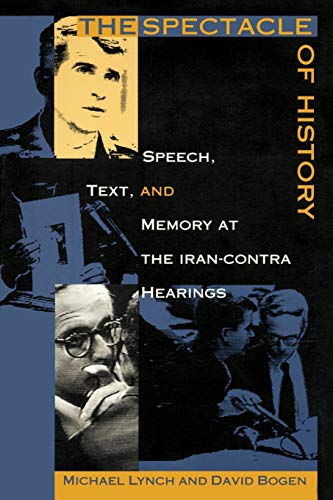
Inhaltsangabe
How is history produced? How do individuals write-or rewrite-their parts while engaged in the production of history? Michael Lynch and David Bogen take the example of the Iran-contra hearings to explore these questions. These hearings, held in 1987 by the Joint House-Senate Select Committee on Secret Military Assistance to Iran and the Nicaragua Opposition, provided the nation with a media spectacle and a rare chance to see a struggle over the writing of history. There was Oliver North, prime suspect and designated scapegoat, turning into a hero of the American Right before the very eyes of the nation. How this transformation occurred, with the complicity of the press and the public, becomes disturbingly clear in The Spectacle of History.
Lynch and Bogen detail the practices through which the historical agents at the center of the hearings composed, confirmed, used, erased, and denied the historical record. They show how partisan skirmishes over the disclosure of records and testimony led to a divided and irresolute outcome, an outcome further facilitated by the "applied deconstruction" deployed by North and his allies. The Spectacle of History immerses the reader in a crowded field of texts, utterances, visual displays, and media commentaries, but, more than a case study, it develops unique insight into problems at the heart of society and social theory-lying and credibility, the production of civic spectacle, the relationship between testimony and history, the uses of memory, and the interplay between speech and writing.
Drawing on themes from sociology, literary theory, and ethnomethodology and challenging prevailing concepts held by contemporary communication and cultural studies, Lynch and Bogen extract valuable theoretical lessons from this specific and troubling historical episode.
Die Inhaltsangabe kann sich auf eine andere Ausgabe dieses Titels beziehen.
Über die Autorin bzw. den Autor
Michael Lynch is Professor in the Department of Human Sciences at Brunel University, Middlesex.
David Bogen is Assistant Professor of Sociology at Emerson College.
Von der hinteren Coverseite
It is a well-known feature of historical inquiries that an event can be reconstructed in countless ways. Chronologies can begin earlier or later and can be fleshed out with variable amounts of detail; characters can be added or elided; agency and blame can be assigned to different parties.
Auszug. © Genehmigter Nachdruck. Alle Rechte vorbehalten.
The Spectacle of History
Speech, Text, and Memory at the Iran-contra Hearings
By Michael Lynch, David BogenDuke University Press
Copyright © 1996 Duke University Press
All rights reserved.
ISBN: 978-0-8223-1738-8All rights reserved.
Contents
Preface,
Transcription Conventions,
Introduction,
1. The Sincere Liar,
2. The Production of History,
3. The Ceremonial of Truth,
4. The Truth-Finding Engine,
5. Stories and Master Narratives,
6. Memory in Testimony,
7. The Documentary Method of Interrogation,
Conclusion: A Civics Lesson in the Logic of Sleaze,
Methodological Appendix: Postanalytic Ethnomethodology,
Notes,
Index,
CHAPTER 1
THE SINCERE LIAR
In the seventeenth century it was accepted that honesty and sincerity could not be communicated. Anyone claiming to be honest would at the same time give off the impression that there might be doubts about it. —Niklas Luhmann
"I'm not trying to dissemble at all with you."—Oliver North
The Iran-contra story is largely about lies, secrecy, and deception. Oliver North and the other principal characters in the story admitted to withholding evidence, writing false chronologies, and shredding documents. They described elaborate methods for securing and hiding caches of funds and conducting covert operations under pretext. Most interestingly for our purposes, they admitted that these activities were designed to enable "plausible deniability." In other words, according to North's testimony, rather than simply hiding their activities from scrutiny, he and his White House and CIA colleagues prospectively constructed a field of evidence to mislead future inquiries. They anticipated the possibility of an official investigation or other threat of exposure, and they set up their pretexts, alibis, and paper trails accordingly. The testimony about these practices, together with a set of problems associated with the interpretation of such testimony, provide a striking exhibit of how actions in history reflexively become entangled with the investigation of history.
Naturally enough, the investigating committee, the journalists who covered the hearings, and many members of the audience remained curious as to whether North and his fellow operatives were coming clean in their testimony or continuing to dissemble, dissimulate, and withhold significant evidence. This issue came to a head early during the first day of North's testimony on July 7, 1987, when House majority counsel John Nields directly challenged North for having difficulty recalling any details about the records from his office he destroyed shortly after the scandal became public.
Nields: Well that's the whole reason for shredding documents, isn't it, Colonel North, so that you can later say you don't remember, (0.4) whether you had 'em, and you don't remember what's in 'em.
North: No, Mister Nields, the reason for shredding documents, and the reason the Government of the United States gave me a shredder, I mean I didn't buy it myself, was to destroy documents that were no longer relevant, that did not apply or that should not be divulged. And again I want to go back to the whole intent of the covert operation. Part of (in- eh) a covert operation is to offer plausible deniability of the association of the government of the United States with the activity, part of it is to deceive our adversaries. Part of it is to insure that those people who are at great peril, carrying out those activities are not further endangered. All of those are good and sufficient reasons to destroy documents. And that's why the government buys shredders by the tens and dozens. And gives them to people running covert operations. Not so that they can have convenient memories. I came here to tell you the truth. To tell you:: and this committee, and the American people the truth, and I'm trying to do that Mister Nields, °hh and I don't like the insinuation that I'm up here having a convenient memory lapse, like perhaps some others have had.
Nields: Colonel North, you shredded these documents on the Twenty-first of November, Nineteen-eighty-six, isn't that true? (1.2)
North: Try me again on the date. (1.0)
Nields: Friday, the Twenty-first of November, Nineteen-eighty-six. (1.8)
Nields: I started shredding documents as early as:: uh my return from Europe in October (0.4)
North: I have absolutely no recollection (0.2) when those documents were deswere shredded. None whatsoever.=
Nields: =There's been testimony before the committee that you engaged in shredding of documents on November the Twenty-first, Nineteen-eighty-six.
North: [(as-) [
Nields: [Do you deny that?
North: I do not deny that I engaged in shredding on November Twenty-first. (1.2) I will also tell this committee that I engaged in shredding (.) almost every day that I had a shredder. And that I put things in burn bags when I didn't. (0.8) So, every single day that I was at the National Security Counsel Staff, some documents were destroyed. (0.6) And I don't want you to- to have the impression (0.2) that (.) those documents that I referred to (0.2) seeking approval, disappeared on the Twenty-first, 'cause I can't say that.
This exchange is rich with pragmatic moves that recurred throughout North's testimony: failures to recall significant details, temporal refram-ings of acknowledged actions and events, and self-righteous proclamations in response to questions and challenges. We shall revisit these moves at length, but for the present we shall observe only how North denies what Nields suggests is the "whole reason" for his apparent inability to remember significant details of the matter in question. Nields's initial challenge suggests that history was being fabricated from both ends: from a retrospective vantage point in the present, and from an anticipatory one in the past. North's present testimony fails to recall certain details from his past, and as an actor in the past he may have shredded documentary evidence of those same details. North counteracts this scenario by giving an alternative rationale for his shredding-as-usual on the date in question. Not only that, he expresses strong indignation at the very suggestion that he could be dissimulating, and, in a memorable evocation of truthfulness and patriotism, he reaffirms his will to tell the truth.
Sequences of testimony like this one create a number of analytic temptations, two of which immediately come to mind. First, it is tempting to declare that North certainly is lying, and then to give an account of how his lies can be made visible through an inspection of his words and body behavior, together with a reconstruction of what he must have known. Second, there is the temptation to politicize the question of lying by subordinating truth to a clash of ideologies. These analytic paths are temptations not because they are likely to lead to error, but because they would be all too easy to pursue with the materials at hand. The problem with yielding to such temptations is that one settles presumptively what often remains contentious and unresolved at the surface of the testimony. In contrast, we want to investigate how the parties to the testimony employed the distinction between truth and lying, and how they articulated the opposition between politics and value neutrality.
LIES, TRUTH-TELLING, AND TESTIMONY
During North's unsuccessful run for a U.S. Senate seat in Virginia in 1994, virtually every journalist, writer, and commentator...
„Über diesen Titel“ kann sich auf eine andere Ausgabe dieses Titels beziehen.
Suchergebnisse für The Spectacle of History: Speech, Text, and Memory...

Beispielbild für diese ISBN
The Spectacle of History: Speech, Text, and Memory at the Iran-Contra Hearings
Anbieter: ThriftBooks-Atlanta, AUSTELL, GA, USA
Verkäuferbewertung 5 von 5 Sternen

Paperback. Zustand: Very Good. No Jacket. May have limited writing in cover pages. Pages are unmarked. ~ ThriftBooks: Read More, Spend Less. Artikel-Nr. G0822317389I4N00
Gebraucht kaufen
EUR 15,67
Versand gratis
Versand innerhalb von USA
Versand innerhalb von USA
Anzahl: 1 verfügbar
Beispielbild für diese ISBN
The Spectacle of History: Speech, Text, and Memory at the Iran-Contra Hearings
Anbieter: ThriftBooks-Dallas, Dallas, TX, USA
Verkäuferbewertung 5 von 5 Sternen
Paperback. Zustand: Very Good. No Jacket. May have limited writing in cover pages. Pages are unmarked. ~ ThriftBooks: Read More, Spend Less. Artikel-Nr. G0822317389I4N00
Gebraucht kaufen
EUR 15,67
Versand gratis
Versand innerhalb von USA
Versand innerhalb von USA
Anzahl: 1 verfügbar
Beispielbild für diese ISBN
The Spectacle of History: Speech, Text, and Memory at the Iran-Contra Hearings
Anbieter: Anybook.com, Lincoln, Vereinigtes Königreich
Verkäuferbewertung 5 von 5 Sternen
Zustand: Good. This is an ex-library book and may have the usual library/used-book markings inside.This book has soft covers. In good all round condition. Please note the Image in this listing is a stock photo and may not match the covers of the actual item,650grams, ISBN:9780822317388. Artikel-Nr. 5594426
Gebraucht kaufen
EUR 23,91
EUR 15,34 Versand
Versand von Vereinigtes Königreich nach USA
Versand von Vereinigtes Königreich nach USA
Anzahl: 1 verfügbar
Beispielbild für diese ISBN
The Spectacle of History: Speech, Text, and Memory at the Iran-Contra Hearings (Post-Contemporary Interventions)
Anbieter: Wonder Book, Frederick, MD, USA
Verkäuferbewertung 5 von 5 Sternen
Zustand: As New. Like New condition. A near perfect copy that may have very minor cosmetic defects. Artikel-Nr. P14U-00966
Gebraucht kaufen
EUR 41,32
Versand gratis
Versand innerhalb von USA
Versand innerhalb von USA
Anzahl: 1 verfügbar
Beispielbild für diese ISBN
The Spectacle of History: Speech, Text, and Memory at the Iran-Contra Hearings (Post-Contemporary Interventions)
Anbieter: WorldofBooks, Goring-By-Sea, WS, Vereinigtes Königreich
Verkäuferbewertung 5 von 5 Sternen
Paperback. Zustand: Very Good. The book has been read, but is in excellent condition. Pages are intact and not marred by notes or highlighting. The spine remains undamaged. Artikel-Nr. GOR009362781
Gebraucht kaufen
EUR 37,04
EUR 6,59 Versand
Versand von Vereinigtes Königreich nach USA
Versand von Vereinigtes Königreich nach USA
Anzahl: 1 verfügbar
Beispielbild für diese ISBN
The Spectacle of History
Anbieter: PBShop.store UK, Fairford, GLOS, Vereinigtes Königreich
Verkäuferbewertung 5 von 5 Sternen
PAP. Zustand: New. New Book. Shipped from UK. Established seller since 2000. Artikel-Nr. FW-9780822317388
Neu kaufen
EUR 37,83
EUR 5,91 Versand
Versand von Vereinigtes Königreich nach USA
Versand von Vereinigtes Königreich nach USA
Anzahl: 3 verfügbar
Beispielbild für diese ISBN
The Spectacle of History
Anbieter: Majestic Books, Hounslow, Vereinigtes Königreich
Verkäuferbewertung 4 von 5 Sternen

Zustand: New. pp. 368. Artikel-Nr. 7955845
Neu kaufen
EUR 46,30
EUR 7,65 Versand
Versand von Vereinigtes Königreich nach USA
Versand von Vereinigtes Königreich nach USA
Anzahl: 3 verfügbar
Beispielbild für diese ISBN
The Spectacle of History: Speech, Text, and Memory at the Iran-Contra Hearings (Post-Contemporary Interventions)
Anbieter: Ria Christie Collections, Uxbridge, Vereinigtes Königreich
Verkäuferbewertung 5 von 5 Sternen
Zustand: New. In English. Artikel-Nr. ria9780822317388_new
Neu kaufen
EUR 43,38
EUR 13,28 Versand
Versand von Vereinigtes Königreich nach USA
Versand von Vereinigtes Königreich nach USA
Anzahl: 3 verfügbar
Beispielbild für diese ISBN
The Spectacle of History: Speech, Text, and Memory at the Iran-Contra Hearings
Anbieter: Kennys Bookstore, Olney, MD, USA
Verkäuferbewertung 5 von 5 Sternen
Zustand: New. 1996. Paperback. . . . . . Books ship from the US and Ireland. Artikel-Nr. V9780822317388
Neu kaufen
EUR 54,59
EUR 9,33 Versand
Versand innerhalb von USA
Versand innerhalb von USA
Anzahl: 1 verfügbar
Beispielbild für diese ISBN
The Spectacle of History Speech, Text, and Memory at the IranContra Hearings
Anbieter: Revaluation Books, Exeter, Vereinigtes Königreich
Verkäuferbewertung 5 von 5 Sternen
Paperback. Zustand: Brand New. 368 pages. 9.25x6.25x1.00 inches. In Stock. Artikel-Nr. x-0822317389
Neu kaufen
EUR 62,72
EUR 14,71 Versand
Versand von Vereinigtes Königreich nach USA
Versand von Vereinigtes Königreich nach USA
Anzahl: 2 verfügbar