
Verwandte Artikel zu Skin Shows: Gothic Horror and the Technology of Monsters
Inhaltsangabe
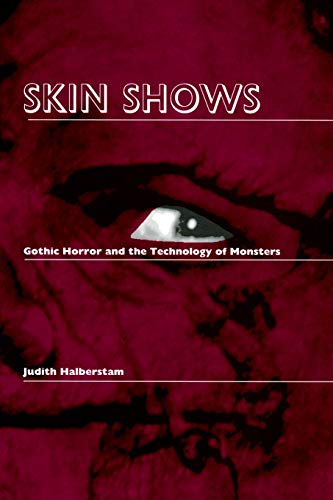
In this examination of the monster as cultural object, Judith Halberstam offers a rereading of the monstrous that revises our view of the Gothic. Moving from the nineteenth century and the works of Shelley, Stevenson, Stoker, and Wilde to contemporary horror film exemplified by such movies as Silence of the Lambs, Texas Chainsaw Massacre, and Candyman, Skin Shows understands the Gothic as a versatile technology, a means of producing monsters that is constantly being rewritten by historically and culturally conditioned fears generated by a shared sense of otherness and difference.
Deploying feminist and queer approaches to the monstrous body, Halberstam views the Gothic as a broad-based cultural phenomenon that supports and sustains the economic, social, and sexual hierarchies of the time. She resists familiar psychoanalytic critiques and cautions against any interpretive attempt to reduce the affective power of the monstrous to a single factor. The nineteenth-century monster is shown, for example, as configuring otherness as an amalgam of race, class, gender, and sexuality. Invoking Foucault, Halberstam describes the history of monsters in terms of its shifting relation to the body and its representations. As a result, her readings of familiar texts are radically new. She locates psychoanalysis itself within the gothic tradition and sees sexuality as a beast created in nineteenth century literature. Excessive interpretability, Halberstam argues, whether in film, literature, or in the culture at large, is the actual hallmark of monstrosity.
Die Inhaltsangabe kann sich auf eine andere Ausgabe dieses Titels beziehen.
Über die Autorin bzw. den Autor
Judith Halberstam is Professor of Literature at the University of California, San Diego.
Von der hinteren Coverseite
"Halberstam's argument is elegant in its simplicity, but far-reaching in its implications. Providing a strikingly original account of the Gothic, she proposes through her work a cultural history of fear and prejudice and, thus, paves the way for a new scholarly enterprise."--Ann Cvetkovich, University of Texas, Austin
Auszug. © Genehmigter Nachdruck. Alle Rechte vorbehalten.
Skin Shows
Gothic Horror and the Technology of Monsters
By Judith HalberstamDuke University Press
Copyright © 1995 Duke University Press
All rights reserved.
ISBN: 978-0-8223-1663-3All rights reserved.
Contents
Acknowledgments,
1 Parasites and Perverts: An Introduction to Gothic Monstrosity,
2 Making Monsters: Mary Shelley's Frankenstein,
3 Gothic Surface, Gothic Depth: The Subject of Secrecy in Stevenson and Wilde,
4 Technologies of Monstrosity: Bram Stoker's Dracula,
5 Reading Counterclockwise: Paranoid Gothic or Gothic Paranoia?,
6 Bodies that Splatter: Queers and Chain Saws,
7 Skinflick: Posthuman Gender in Jonathan Demme's the Silence of the Lambs,
8 Conclusion: Serial Killing,
Notes,
Bibliography,
Index,
CHAPTER 1
Parasites and Perverts: An Introduction to Gothic Monstrosity
So many monsters; so little time. — promotional slogan for HELLRAISER
Skin Shows
In The Silence of the Lambs (1991) by Jonathan Demme, one of many modern adaptations of Frankenstein, a serial killer known as Buffalo Bill collects women in order to flay them and use their skins to construct a "woman suit." Sitting in his basement sewing hides, Buffalo Bill makes his monster a sutured beast, a patchwork of gender, sex, and sexuality. Skin, in this morbid scene, represents the monstrosity of surfaces and as Buffalo Bill dresses up in his suit and prances in front of the mirror, he becomes a layered body, a body of many surfaces laid one upon the other. Depth and essence dissolve in this mirror dance and identity and humanity become skin deep.
My subject is monsters and I begin in Buffalo Bill's basement, his "filthy workshop of creation," because it dramatizes precisely the distance traveled between current representations of monstrosity and their genesis in nineteenth-century Gothic fiction. Where the monsters of the nineteenth century metaphorized modern subjectivity as a balancing act between inside/outside, female/male, body/mind, native/foreign, proletarian/aristocrat, monstrosity in postmodern horror films finds its place in what Baudrillard has called the obscenity of "immediate visibility" and what Linda Williams has dubbed "the frenzy of the visible." The immediate visibility of a Buffalo Bill, the way in which he makes the surface itself monstrous transforms the cavernous monstrosity of Jekyll/Hyde, Dorian Gray, or Dracula into a beast who is all body and no soul.
Victorian monsters produced and were produced by an emergent conception of the self as a body which enveloped a soul, as a body, indeed, enthralled to its soul. Michel Foucault writes in Discipline and Punish that "the soul is the prison of the body" and he proposes a genealogy of the soul that will show it to be born out of "methods of punishment, supervision and constraint." Foucault also claims that, as modern forms of discipline shifted their gaze from the body to the soul, crime literature moved from confession or gallows speeches or the cataloguing of famous criminals to the detective fiction obsessed with identifying criminality and investigating crime. The hero of such literature was now the middle- or upper-class schemer whose crime became a virtuoso performance of skill and enterprise.
There are many congruities between Gothic fiction and detective fiction but in the Gothic, crime is embodied within a specifically deviant form — the monster — that announces itself (de-monstrates) as the place of corruption. Furthermore, just as the detective character appears across genres in many different kinds of fiction (in the sensation novel, in Dickens), so Gothic infiltrates the Victorian novel as a symptomatic moment in which boundaries between good and evil, health and perversity, crime and punishment, truth and deception, inside and outside dissolve and threaten the integrity of the narrative itself. While many literary histories, therefore, have relegated Gothic to a subordinate status in relation to realism, I will be arguing that nineteenth-century literary tradition is a Gothic tradition and that this has everything to do with the changing technologies of subjectivity that Foucault describes.
Gothic fiction is a technology of subjectivity, one which produces the deviant subjectivities opposite which the normal, the healthy, and the pure can be known. Gothic, within my analysis, may be loosely defined as the rhetorical style and narrative structure designed to produce fear and desire within the reader. The production of fear in a literary text (as opposed to a cinematic text) emanates from a vertiginous excess of meaning. Gothic, in a way, refers to an ornamental excess (think of Gothic architecture — gargoyles and crazy loops and spirals), a rhetorical extravagance that produces, quite simply, too much. Within Gothic novels, I argue, multiple interpretations are embedded in the text and part of the experience of horror comes from the realization that meaning itself runs riot. Gothic novels produce a symbol for this interpretive mayhem in the body of the monster. The monster always becomes a primary focus of interpretation and its monstrosity seems available for any number of meanings. While I will examine closely the implications of embodied horror (monstrosity) in nineteenth-century Gothic, I will also be paying careful attention to the rhetorical system which produces it (Gothic).
Many histories of the Gothic novel begin with the Gothic Romances of the later eighteenth century by Mrs. Radcliffe, Horace Walpole, and Matthew Lewis. While, obviously, there are connections to be made between these stories of mad monks, haunted castles, and wicked foreigners and the nineteenth-century Gothic tales of monsters and vampires, we should not take the connections too far. I will argue in this book that the emergence of the monster within Gothic fiction marks a peculiarly modern emphasis upon the horror of particular kinds of bodies. Furthermore, the ability of the Gothic story to take the imprint of any number of interpretations makes it a hideous offspring of capitalism itself. The Gothic novel of the nineteenth century and the Gothic horror film of the late twentieth century are both obsessed with multiple modes of consumption and production, with dangerous consumptions and excessive productivity, and with economies of meaning. The monster itself is an economic form in that it condenses various racial and sexual threats to nation, capitalism, and the bourgeoisie in one body. If the Gothic novel produces an easy answer to the question of what threatens national security and prosperity (the monster), the Gothic monster represents many answers to the question of who must be removed from the community at large. I will be considering, therefore, nineteenth- and twentieth-century Gothic as separate from eighteenth-century Gothic, but I will also be tracing Gothic textuality across many modes of discourse.
Within the nineteenth-century Gothic, authors mixed and matched a wide variety of signifiers of difference to fabricate the deviant body — Dracula, Jekyll/Hyde, and even Frankenstein's monster before them are lumpen bodies, bodies pieced together out of the fabric of race, class, gender, and sexuality. In the modern period and with the advent of cinematic body horror, the shift from the literary Gothic to the visual Gothic was accompanied by a narrowing rather than a broadening of the scope of horror. One might expect to find that cinema multiplies the possibilities for monstrosity but in fact, the visual...
„Über diesen Titel“ kann sich auf eine andere Ausgabe dieses Titels beziehen.
Suchergebnisse für Skin Shows: Gothic Horror and the Technology of Monsters

Beispielbild für diese ISBN
Skin Shows: Gothic Horror and the Technology of Monsters
Anbieter: World of Books (was SecondSale), Montgomery, IL, USA
Verkäuferbewertung 5 von 5 Sternen

Paperback. Zustand: Fair. In this examination of the monster as cultural object, Judith Halberstam offers a rereading of the monstrous that revises our view of the Gothic. Moving from the nineteenth century and the works of Shelley, Stevenson, Stoker, and Wilde to contemporary horror film exemplified by such movies as Silence of the Lambs, Texas Chainsaw Massacre, and Candyman, Skin Shows understands the Gothic as a versatile technology, a means of producing monsters that is constantly being rewritten by historically and culturally conditioned fears generated by a shared sense of otherness and difference.Deploying feminist and queer approaches to the monstrous body, Halberstam views the Gothic as a broad-based cultural phenomenon that supports and sustains the economic, social, and sexual hierarchies of the time. She resists familiar psychoanalytic critiques and cautions against any interpretive attempt to reduce the affective power of the monstrous to a single factor. The nineteenth-century monster is shown, for example, as configuring otherness as an amalgam of race, class, gender, and sexuality. Invoking Foucault, Halberstam describes the history of monsters in terms of its shifting relation to the body and its representations. As a result, her readings of familiar texts are radically new. She locates psychoanalysis itself within the gothic tradition and sees sexuality as a beast created in nineteenth century literature. Excessive interpretability, Halberstam argues, whether in film, literature, or in the culture at large, is the actual hallmark of monstrosity. Artikel-Nr. 00110126823
Gebraucht kaufen
EUR 21,39
Versand gratis
Versand innerhalb von USA
Versand innerhalb von USA
Anzahl: 1 verfügbar
Beispielbild für diese ISBN
Skin Shows: Gothic Horror and the Technology of Monsters
Anbieter: World of Books (was SecondSale), Montgomery, IL, USA
Verkäuferbewertung 5 von 5 Sternen
Paperback. Zustand: Good. In this examination of the monster as cultural object, Judith Halberstam offers a rereading of the monstrous that revises our view of the Gothic. Moving from the nineteenth century and the works of Shelley, Stevenson, Stoker, and Wilde to contemporary horror film exemplified by such movies as Silence of the Lambs, Texas Chainsaw Massacre, and Candyman, Skin Shows understands the Gothic as a versatile technology, a means of producing monsters that is constantly being rewritten by historically and culturally conditioned fears generated by a shared sense of otherness and difference.Deploying feminist and queer approaches to the monstrous body, Halberstam views the Gothic as a broad-based cultural phenomenon that supports and sustains the economic, social, and sexual hierarchies of the time. She resists familiar psychoanalytic critiques and cautions against any interpretive attempt to reduce the affective power of the monstrous to a single factor. The nineteenth-century monster is shown, for example, as configuring otherness as an amalgam of race, class, gender, and sexuality. Invoking Foucault, Halberstam describes the history of monsters in terms of its shifting relation to the body and its representations. As a result, her readings of familiar texts are radically new. She locates psychoanalysis itself within the gothic tradition and sees sexuality as a beast created in nineteenth century literature. Excessive interpretability, Halberstam argues, whether in film, literature, or in the culture at large, is the actual hallmark of monstrosity. Artikel-Nr. 00107410923
Gebraucht kaufen
EUR 21,39
Versand gratis
Versand innerhalb von USA
Versand innerhalb von USA
Anzahl: 2 verfügbar
Beispielbild für diese ISBN
Skin Shows: Gothic Horror and the Technology of Monsters
Anbieter: ThriftBooks-Atlanta, AUSTELL, GA, USA
Verkäuferbewertung 5 von 5 Sternen
Paperback. Zustand: Very Good. No Jacket. May have limited writing in cover pages. Pages are unmarked. ~ ThriftBooks: Read More, Spend Less. Artikel-Nr. G0822316633I4N00
Gebraucht kaufen
EUR 21,40
Versand gratis
Versand innerhalb von USA
Versand innerhalb von USA
Anzahl: 1 verfügbar
Beispielbild für diese ISBN
Skin Shows: Gothic Horror and the Technology of Monsters
Anbieter: WorldofBooks, Goring-By-Sea, WS, Vereinigtes Königreich
Verkäuferbewertung 5 von 5 Sternen
Paperback. Zustand: Fine. Artikel-Nr. GOR012158936
Gebraucht kaufen
EUR 19,40
EUR 6,61 Versand
Versand von Vereinigtes Königreich nach USA
Versand von Vereinigtes Königreich nach USA
Anzahl: 1 verfügbar
Beispielbild für diese ISBN
Skin Shows
Anbieter: PBShop.store UK, Fairford, GLOS, Vereinigtes Königreich
Verkäuferbewertung 5 von 5 Sternen
PAP. Zustand: New. New Book. Shipped from UK. Established seller since 2000. Artikel-Nr. FW-9780822316633
Neu kaufen
EUR 25,02
EUR 4,91 Versand
Versand von Vereinigtes Königreich nach USA
Versand von Vereinigtes Königreich nach USA
Anzahl: 14 verfügbar
Beispielbild für diese ISBN
Skin Shows: Gothic Horror and the Technology of Monsters
Anbieter: Phatpocket Limited, Waltham Abbey, HERTS, Vereinigtes Königreich
Verkäuferbewertung 5 von 5 Sternen
Zustand: Good. Your purchase helps support Sri Lankan Children's Charity 'The Rainbow Centre'. Ex-library, so some stamps and wear, but in good overall condition. Our donations to The Rainbow Centre have helped provide an education and a safe haven to hundreds of children who live in appalling conditions. Artikel-Nr. Z1-W-011-02180
Gebraucht kaufen
EUR 17,94
EUR 12,55 Versand
Versand von Vereinigtes Königreich nach USA
Versand von Vereinigtes Königreich nach USA
Anzahl: 1 verfügbar
Beispielbild für diese ISBN
Skin Shows Gothic Horror and the Technology of Monsters
Anbieter: Revaluation Books, Exeter, Vereinigtes Königreich
Verkäuferbewertung 5 von 5 Sternen
Paperback. Zustand: Brand New. 1st edition. 232 pages. 9.50x6.25x1.00 inches. In Stock. Artikel-Nr. __0822316633
Neu kaufen
EUR 26,00
EUR 11,80 Versand
Versand von Vereinigtes Königreich nach USA
Versand von Vereinigtes Königreich nach USA
Anzahl: 2 verfügbar
Beispielbild für diese ISBN
Skin Shows
Anbieter: Majestic Books, Hounslow, Vereinigtes Königreich
Verkäuferbewertung 4 von 5 Sternen

Zustand: New. pp. 232. Artikel-Nr. 7955863
Neu kaufen
EUR 32,48
EUR 7,67 Versand
Versand von Vereinigtes Königreich nach USA
Versand von Vereinigtes Königreich nach USA
Anzahl: 3 verfügbar
Beispielbild für diese ISBN
Skin Shows: Gothic Horror and the Technology of Monsters
Anbieter: Kennys Bookstore, Olney, MD, USA
Verkäuferbewertung 5 von 5 Sternen
Zustand: New. Num Pages: 232 pages, 6 black and white photographs. BIC Classification: APF; JFC. Category: (G) General (US: Trade); (UU) Undergraduate. Dimension: 164 x 231 x 17. Weight in Grams: 378. . 1995. 1st Edition. Paperback. . . . . Books ship from the US and Ireland. Artikel-Nr. V9780822316633
Neu kaufen
EUR 35,44
EUR 9,36 Versand
Versand innerhalb von USA
Versand innerhalb von USA
Anzahl: 1 verfügbar
Beispielbild für diese ISBN
Skin Shows Gothic Horror and the Technology of Monsters
Anbieter: Revaluation Books, Exeter, Vereinigtes Königreich
Verkäuferbewertung 5 von 5 Sternen
Paperback. Zustand: Brand New. 1st edition. 232 pages. 9.50x6.25x1.00 inches. In Stock. Artikel-Nr. x-0822316633
Neu kaufen
EUR 42,25
EUR 11,80 Versand
Versand von Vereinigtes Königreich nach USA
Versand von Vereinigtes Königreich nach USA
Anzahl: 2 verfügbar