
Verwandte Artikel zu Representing Jazz
Inhaltsangabe
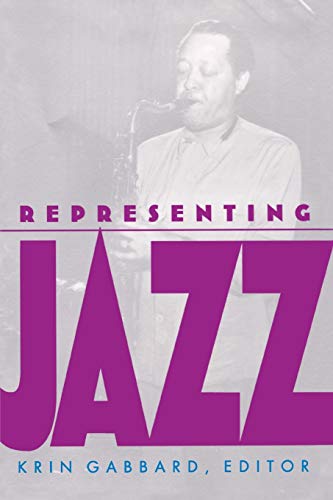
Traditional jazz studies have tended to see jazz in purely musical terms, as a series of changes in rhythm, tonality, and harmony, or as a parade of great players. But jazz has also entered the cultural mix through its significant impact on novelists, filmmakers, dancers, painters, biographers, and photographers. Representing Jazz explores the "other" history of jazz created by these artists, a history that tells us as much about the meaning of the music as do the many books that narrate the lives of musicians or describe their recordings. Krin Gabbard has gathered essays by distinguished writers from a variety of fields. They provide engaging analyses of films such as Round Midnight, Bird, Mo' Better Blues, Cabin in the Sky, and Jammin' the Blues; the writings of Eudora Welty and Dorothy Baker; the careers of the great lindy hoppers of the 1930s and 1940s; Mura Dehn's extraordinary documentary on jazz dance; the jazz photography of William Claxton; painters of the New York School; the traditions of jazz autobiography; and the art of "vocalese." The contributors to this volume assess the influence of extramusical sources on our knowledge of jazz and suggest that the living contexts of the music must be considered if a more sophisticated jazz scholarship is ever to evolve. Transcending the familiar patterns of jazz history and criticism, Representing Jazz looks at how the music actually has been heard and felt at different levels of American culture. With its companion anthology, Jazz Among the Discourses, this volume will enrich and transform the literature of jazz studies. Its provocative essays will interest both aficionados and potential jazz fans. Contributors. Karen Backstein, Leland H. Chambers, Robert P. Crease, Krin Gabbard, Frederick Garber, Barry K. Grant, Mona Hadler, Christopher Harlos, Michael Jarrett, Adam Knee, Arthur Knight, James Naremore
Die Inhaltsangabe kann sich auf eine andere Ausgabe dieses Titels beziehen.
Über die Autorin bzw. den Autor
Krin Gabbard is Associate Professor of Comparative Literature at the State University of New York, Stony Brook.
Von der hinteren Coverseite
"One of the strongest jazz anthologies I have seen. Its focus is original. Jazz in literature has been treated before to some extent, but not in the same fashion, and there is little elsewhere on jazz in dance or jazz and the visual arts."--Lewis Porter, author, with Michael Ullman, of "Jazz: From Its Origins to the Present "
Auszug. © Genehmigter Nachdruck. Alle Rechte vorbehalten.
Representing Jazz
By Krin GabbardDuke University Press
Copyright © 1995 Duke University Press
All rights reserved.
ISBN: 978-0-8223-1594-0All rights reserved.
Contents
Acknowledgments,
Introduction: Writing the Other History,
Notes,
Works Cited,
Jazz in Literature and Film,
Jammin' the Blues, or the Sight of Jazz, 1944,
Improvising and Mythmaking in Eudora Welty's "Powerhouse",
Fabulating Jazz,
Signifyin(g) the Phallus: Mo' Better Blues and Representations of the Jazz Trumpet,
Jazz Autobiography: Theory, Practice, Politics,
Excursus: Cabin in the Sky,
Uptown Folk: Blackness and Entertainment in Cabin in the Sky,
Doubling, Music, and Race in Cabin in the Sky,
Jazz and Dance,
Divine Frivolity: Hollywood Representations of the Lindy Hop, 1937–1942,
Keeping the Spirit Alive: The Jazz Dance Testament of Mura Dehn,
Picturing Jazz,
Jazz and the New York School,
The Tenor's Vehicle: Reading Way Out West,
Vocalese: Representing Jazz with Jazz,
Purple Passages or Fiestas in Blue? Notes Toward an Aesthetic of Vocalese,
Contributors,
Index,
CHAPTER 1
Jammin' the Blues, or the Sight of Jazz, 1944
ARTHUR KNIGHT
... music is heard and seldom seen.... –Ralph Ellison (1952)
W. H. Auden says of music ... that it "can be made anywhere, is invisible, and does not smell." But music is made by men who are insistently visible, especially, as in jazz, when the players are their music–Nat Hentoff (1961)
Last year some twit in a British jazz rag proclaimed the music has never been a particularly visual medium.... What music has this motherfucker been looking at?–Greg Tate (1992)
In his "Jazz Symposium" column in the July 1944 issue of Esquire, Leonard Feather, critic, impresario, and sometime composer of "modernist" jazz, asked an eclectic group of jazz musicians and aficionados, "If you had a million dollars to spend on jazz, how would you use it?" Sam Donahue, "Musician Third Class, U.S. Navy; tenor saxman, trumpeter and leader of the Navy band," answered this way:
Well, I'd like to make an educational film, debunking the average movie musical. I'd tear down the studios' haphazard method of sloughing off good music. Instead of having some chick bursting into song somewhere in the middle of a forest, accompanied by an invisible fifty piece band from out of space, I'd work the music in logically and give the musicians a break. If I could get Duke Ellington or any great colored band, I'd fix it so you could really see the band and get to know it, instead of covering it up with a lot of jitterbug dancing and stuff.... I'd have all the recording done simultaneously with the shooting of the pictures, instead of having it dubbed in separately the way they do now. That would help make the music real and spontaneous. Listen, after I got that movie on the market, all the musicals after that would just have to be legitimate! ("Jazz Symposium" 95)
Clearly, Donahue was aware of the conventions for representing musical performance in Hollywood musicals. He was also aware that those conventions depended on and played with the audiovisual split made possible by sound film's dual recording technologies. Further, he understood that these conventions and the technologies they drew on had racial-political implications. Hearing jazz, Donahue's comments suggest, was only part of the experience of jazz; "really see[ing] the band and get[ting] to know it" was another. But, especially if the band was "colored," really seeing and getting to know it was an experience that Hollywood conventionally denied its customers. Donahue felt confident that altering these conventions and letting audiences see as well as hear the music, no matter what color, would be "educational."
In August and September 1944 the recording and photographing were done at Warner Bros, studios for Jammin' the Blues, a ten-minute musical short that seems nearly, if imperfectly, built on Donahue's debunking model. Produced and distributed by Warners, Jammin' the Blues was created by a group of people whose relationships with Hollywood were either unusual or nonexistent. It was directed by Gjon Mili, a Life photographer, coordinated by Norman Granz, an apprentice film editor who was also a jazz fan just starting a career as an activist entrepreneur, and featured performances by jazz musicians of varying degrees of fame: Lester Young, Red Callender, Harry Edison, Marlowe Morris, Sid Catlett, Barney Kessel, Jo Jones, John Simmons, Illinois Jacquet, and Marie Bryant. Jammin' the Blues was what would later be labeled a consummate "crossover" product. It combined small group "hot jazz" and "art" photography, inserted them into the mechanisms and forms of Hollywood, and distributed the results to theaters everywhere.
Most shorts came and went without much notice, but after it was released late in December 1944, Jammin' the Blues attracted positive reviews from Time, Life, Esquire, Theatre Arts, Down Beat, the Chicago Defender, and Ebony. Walter Winchell acclaimed it on his radio show, and James Agee gave it an equivocal, though finally negative, review in the Nation. It was also nominated for an Academy Award in the one-reel short subject category. In other words, the Hollywood industry establishment, the mainstream press, and a variety of specialty presses all found Jammin' the Blues worthy of special note.
If he was paying attention, Sam Donahue must have been pleased; a version of his proposed education and legitimation project seemed to be working. But very quickly his satisfaction would have turned to disappointment. Jammin' the Blues may have crossed over, but it did not start any trends. Hollywood musicals, whether feature-length or short, did not become any more "legitimate" from the jazz fan or player's perspective after Jammin' the Blues than they had been before it. Instead, Jammin' the Blues passed into jazz lore as an anomaly: "one of the few honest motion pictures about jazz" (Balliet 6), "a landmark" (Smith 382), "probably the most famous jazz movie of all" (Meeker entry 1637), and "the greatest film to depict jazz musicians in their natural habitat" (Driggs and Lewine 268).
Why was Jammin' the Blues so successful as an individual film and so unsuccessful in inspiring similar films? This essay will analyze Jammin' the Blues within the multiple, overlapping contexts of its production and reception in the mid-forties: the jazz scene, Hollywood, and the audiovisual politics of the representation of race in the arena of American culture. Jammin' the Blues provides a unique, densely encoded site for exploring the connections that music–and particularly jazz–was thought to provide between hearing, seeing, and "getting to know" other Americans. It provides an opportunity to explore the relations of peripheral and central, repressed and ascendent discourses, discourses about Hollywood film, jazz, entertainment, art, race, and American culture–discourses which standard Hollywood practice worked to control and hold separate but which, as Jammin' the Blues shows, sometimes overlapped, sometimes competed, and often were contradictory. Finally, Jammin' the Blues, when considered in this context, reveals the possibilities and limits of "education" and "legitimation" through crossover products, products in which the sight of music becomes the object of industrial...
„Über diesen Titel“ kann sich auf eine andere Ausgabe dieses Titels beziehen.
Suchergebnisse für Representing Jazz

Beispielbild für diese ISBN
Representing Jazz
Anbieter: ThriftBooks-Atlanta, AUSTELL, GA, USA
Verkäuferbewertung 5 von 5 Sternen

Paperback. Zustand: Very Good. No Jacket. May have limited writing in cover pages. Pages are unmarked. ~ ThriftBooks: Read More, Spend Less. Artikel-Nr. G0822315947I4N00
Gebraucht kaufen
EUR 10,07
Versand gratis
Versand innerhalb von USA
Versand innerhalb von USA
Anzahl: 1 verfügbar
Beispielbild für diese ISBN
Representing Jazz
Anbieter: PBShop.store UK, Fairford, GLOS, Vereinigtes Königreich
Verkäuferbewertung 5 von 5 Sternen
PAP. Zustand: New. New Book. Shipped from UK. Established seller since 2000. Artikel-Nr. FW-9780822315940
Neu kaufen
EUR 33,28
EUR 5,85 Versand
Versand von Vereinigtes Königreich nach USA
Versand von Vereinigtes Königreich nach USA
Anzahl: 1 verfügbar
Beispielbild für diese ISBN
Representing Jazz
Anbieter: Ria Christie Collections, Uxbridge, Vereinigtes Königreich
Verkäuferbewertung 5 von 5 Sternen
Zustand: New. In English. Artikel-Nr. ria9780822315940_new
Neu kaufen
EUR 34,73
EUR 13,17 Versand
Versand von Vereinigtes Königreich nach USA
Versand von Vereinigtes Königreich nach USA
Anzahl: 1 verfügbar
Beispielbild für diese ISBN
Representing Jazz
Anbieter: Kennys Bookstore, Olney, MD, USA
Verkäuferbewertung 5 von 5 Sternen
Zustand: New. Looks at how jazz music has actually been heard and felt at different levels of American culture. Editor(s): Gabbard, Krin. Num Pages: 328 pages, 39 b&w photographs. BIC Classification: 1KBB; AVGJ; AVGK. Category: (P) Professional & Vocational. Dimension: 234 x 158 x 24. Weight in Grams: 576. . 1995. Illustrated. Paperback. . . . . Books ship from the US and Ireland. Artikel-Nr. V9780822315940
Neu kaufen
EUR 47,42
EUR 9,14 Versand
Versand innerhalb von USA
Versand innerhalb von USA
Anzahl: 1 verfügbar
Beispielbild für diese ISBN
Representing Jazz
Anbieter: Majestic Books, Hounslow, Vereinigtes Königreich
Verkäuferbewertung 4 von 5 Sternen

Zustand: New. pp. 328. Artikel-Nr. 7955869
Neu kaufen
EUR 53,12
EUR 7,58 Versand
Versand von Vereinigtes Königreich nach USA
Versand von Vereinigtes Königreich nach USA
Anzahl: 1 verfügbar
Beispielbild für diese ISBN
Representing Jazz
Anbieter: Revaluation Books, Exeter, Vereinigtes Königreich
Verkäuferbewertung 5 von 5 Sternen
Paperback. Zustand: Brand New. 328 pages. 9.50x6.50x1.00 inches. In Stock. Artikel-Nr. x-0822315947
Neu kaufen
EUR 54,29
EUR 14,58 Versand
Versand von Vereinigtes Königreich nach USA
Versand von Vereinigtes Königreich nach USA
Anzahl: 2 verfügbar