
Verwandte Artikel zu Time and the Erotic in Horace's Odes
Inhaltsangabe
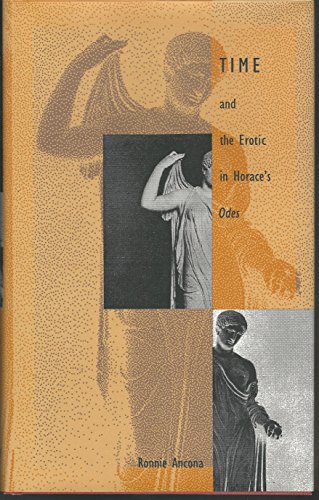
In Horace's Odes love cannot last. Is the poet unromantic, as some critics claim? Is he merely realistic? Or is he, as Ronnie Ancona contends, relating the erotic to time in a more complex and interesting way than either of these positions allows? Rejecting both the notion that Horace fails as a love poet because he undermines the romantic ideal that love conquers time and the notion that he succeeds becauses he eschews illusions about love's ability to endure, this book challenges the assumption that temporality must inevitably pose a threat to the erotic. The author argues that temporality, understood as the contingency the male poet/lover wants to but cannot control, explains why love "fails" in Horace's Odes.
Drawing on contemporary theory, including recent work in feminist criticism, Ancona provides close readings of fourteen odes, which are presented in English translation as well as in Latin. Through a discussion of the poet's use of various temporal devices--the temporal adverb, seasonal imagery, and the lover or beloved's own temporality--she shows how Horace makes time dominate the erotic context and, further, how the version of love that appears in his poems is characterized by the lover's desire to control the beloved. The romantic ideal of a timeless love, apparently rejected by the poet, emerges here instead as an underlying element of the poet's portrayal of the erotic. In a critique of the predominant modes of recent Horatian scholarship on the love odes, Ancona offers an alternative view that takes into account the male gender of the lover and its effect on the structure of desire in the poems. By doing so, she advances a broader project in recent classical studies that aims to include discussion of features of classical literature, such as sexuality and gender, which have previously escaped critical attention.
Addressing aspects of Horace as a love poet--especially the dynamics of gender relations--that critics have tended to ignore, this book articulates his version of love as something not to be championed or condemned but rather to be seen as challengingly problematic. Of primary interest to classicists, it will also engage the attention of scholars and teachers in the humanities with specializations in gender, sexuality, lyric poetry, or feminist theory.
Die Inhaltsangabe kann sich auf eine andere Ausgabe dieses Titels beziehen.
Über die Autorin bzw. den Autor
Ronnie Ancona is Assistant Professor of Classics and Director, Master of Arts in the Teaching of Latin, at Hunter College.
Von der hinteren Coverseite
"This study has much to offer specialists in the field of Horatian poetry in particular and of Augustan literature generally: its nuanced, insightful and provocative close readings of various poems; its successful efforts at problematizing both the poet/lover's perspective and the tendency of Horace's leading modern interpreters to adopt this perspective uncritically; its recognition that certain innovative, feminist perspectives pioneered in theoretically grounded studies of modern literature can prove helpful both in dealing with Horace's texts and in comprehending the limitations of traditional Horatian criticism."--Judith P. Hallett, University of Maryland
Auszug. © Genehmigter Nachdruck. Alle Rechte vorbehalten.
Time and the Erotic in Horace's Odes
By Ronnie AnconaDuke University Press
Copyright © 1994 Duke University Press
All rights reserved.
ISBN: 978-0-8223-1476-9All rights reserved.
Contents
Preface,
Acknowledgments,
Introduction,
One: Time, Gender, and the Erotic: Critical Orthodoxy and the Prospects for a Feminist Critique,
Two: The Temporal Adverb,
Three: Seasonal Imagery,
Four: Age and Experience,
Five: The Romantic Ideal and the Domination of the Beloved,
Conclusion,
Notes,
Bibliography,
General Index,
Index of Passages Cited,
CHAPTER 1
Time, Gender, and the Erotic: Critical Orthodoxy and the Prospects for a Feminist Critique
The vast majority of recent commentary on Horace as a love poet falls into one of two categories: criticism informed by the privileging of a romantic version of love, or criticism informed by what might be called a notion of the poet as universal spokesman. In the first kind of criticism, what occurs is a deprecation of Horace's love poems for not according with the model of a Catullus, many of whose love poems seem to be a direct outpouring of emotion toward an idealized beloved with whom he wants a lasting relationship. In the second kind of criticism, Horace is hailed as a sober and wise man, with whom we should all identify, who "correctly observes" that love does not last. Thus in the first kind of criticism Horace is condemned for having the wrong approach to love—at least the wrong approach to be chosen for expression in love poetry—and in the second, he is endorsed for bringing a necessary realism to the area of love.
While these approaches at first glance appear to be radically different, they in fact share a common assumption, namely, that the proper focus of criticism is the reproduction of the poet's own conceptions of love. In the first case the result is a devaluation of Horace as a love poet for not producing a version of love characterized by the romantic ideal of timelessness. In the second, the result is a lauding of Horace for "correctly" perceiving romantic love as an impossibility. The problem with both positions, however, is that their effort to provide an accurate reproduction of Horace's view of love precludes any genuine critique of that view. The critics who devalue Horace because of his failure to accord with a romantic version of love assume that Horace's own views are self-evident, and thus do little to set the internal dynamics of the poems they discuss in relation to the romantic model of love that they privilege. While the critics who seek to defend Horace's view of love offer a needed corrective to such devaluation and also provide insightful explications of many of the love poems, their approach is limited, in turn, by an unconscious identification with the poet/lover, which produces a blindness to the problems that his male desire produces both for the beloved and for himself.
The critical approach to Horace as a love poet that privileges a romantic version of love is perhaps best exemplified by the statement of R. G. M. Nisbet: "None of Horace's love-poems (if that is the right name for them) reaches the first rank." Implicit in this remark is a judgment about Horace's love poetry that is based on an unstated assumption of what a love poem should be, yet Nisbet offers no clear and consistent notion of what would constitute a love poem, or more specifically, a good love poem. Nevertheless, the faults that he attributes to Horace as a love poet (lack of seriousness and involvement, artificiality, and unbelievability), and the poets with whom he compares Horace unfavorably (Catullus and Propertius), would suggest that the model that Horace fails to live up to is that of the romantic love poet. What Nisbet finds disturbing about Horace's love poetry is its remoteness from a romanticism that exhibits desire with the kind of directness and immediacy of, for example, a Propertius, whose poems (according to Nisbet) "are written with an earnestness and intensity that seem to be derived at least partly from real life." Thus, because Horace deals with desire in less overt ways than do romantic poets, he is unable to meet Nisbet's standards for good love poetry.
While somewhat less negative, the perspective of R. G. M. Nisbet and Margaret Hubbard on the love poems, as expressed in the introduction to their commentary on Book 1 of the Odes, retains the general sense of Nisbet's earlier criticisms. Their perspective is worth discussing at some length, both for the notions it contains, and for the influence that those notions have by appearing in the current standard commentary in English on the Odes. For them, the problem with Horace as a love poet seems to be his failure to produce the kind of love poetry with which they can be comfortable, that is, love poetry in the Catullan tradition. They assume that other present-day readers will have a similar response: "[t]he modern reader is apt to draw unfavorable comparisons with Catullus and Propertius, but they were intending something very different." What that "something ... different" is remains unstated, but one imagines that it has something to do with how Horace is perceived to handle the emotions of love: "Horace is not concerned with his own emotions; exceptions are embarrassing, however explicable in the context."
As far as the first part of this remark is concerned, what Nisbet and Hubbard do not seem to recognize is that "concern with one's emotions" need not be directly expressed. By the 1920s, literary critics outside of classics had already seen the problem with this reductive notion of what it means to deal with emotion, and it is worth recalling how fully New Criticism succeeded in exposing the inadequacy of reducing poetry to what is assumed to be the emotional life of the author. Thus, T. S. Eliot, in his essay "Tradition and the Individual Talent" (1919), written in response to Romantic assumptions about poetry—most notably expressed in Wordsworth's description of poetry as "emotion recollected in tranquility"—attacks the notion that a poet in any straightforward fashion expresses his personality or his emotions through his poetry. Eliot argues that the poet works not in isolation but in relation to a literary tradition and that poetry is, in fact, in some sense "an escape from emotion" and "an escape from personality" although "only those who have personality and emotions know what it means to want to escape from these things."
Still further, I. A. Richards, in Practical Criticism (1929), had eloquently challenged the notion that emotion mediated by reflection is somehow "insincere." Thus irony, "where the feeling really present is often the exact contrary to that overtly professed," should not be viewed "as insincere as simple readers often suppose it must be." The classicist Archibald Allen, writing more than three decades later, addresses some of these same issues in "Sunt qui Propertium malint," published, interestingly enough, in the same book of essays on elegy and lyric in which Nisbet's negative comment upon Horace's love odes appears. Allen persuasively argues that the seemingly spontaneous expression of emotion commonly identified with Propertius, for example, and not with Ovid, is in fact not always present in Propertius. More importantly, he discusses the fact that an ancient audience would have identified sincerity as a function of style, not of personality, and that as a consequence, sincerity has more to do with the persuasiveness of the poet's style than with the relationship between the poet's style...
„Über diesen Titel“ kann sich auf eine andere Ausgabe dieses Titels beziehen.
Suchergebnisse für Time and the Erotic in Horace's Odes

Beispielbild für diese ISBN
Time and the Erotic in Horace's Odes
Anbieter: Powell's Bookstores Chicago, ABAA, Chicago, IL, USA
Verkäuferbewertung 5 von 5 Sternen

hardcover. Zustand: Used-Very Good. Cloth, d.j. Some shelf-wear. Else clean copy. Artikel-Nr. 1781678
Gebraucht kaufen
EUR 11,53
EUR 4,47 Versand
Versand innerhalb von USA
Versand innerhalb von USA
Anzahl: 1 verfügbar
Beispielbild für diese ISBN
Time and the Erotic in Horace's Odes
Anbieter: Powell's Bookstores Chicago, ABAA, Chicago, IL, USA
Verkäuferbewertung 5 von 5 Sternen
Hardcover. Zustand: Very Good. Minimal shelf wear, clean internals. Remainder mark. Artikel-Nr. 2047030
Gebraucht kaufen
EUR 11,53
EUR 4,47 Versand
Versand innerhalb von USA
Versand innerhalb von USA
Anzahl: 13 verfügbar
Beispielbild für diese ISBN
Time and the Erotic in Horace's Odes (First Edition)
Verlag:
Duke University Press, 1994
ISBN 10: 0822314762
ISBN 13: 9780822314769
Gebraucht
Hardcover
Erstausgabe
Anbieter: Dan Pope Books, West Hartford, CT, USA
Verkäuferbewertung 5 von 5 Sternen
Hardcover. Zustand: As New. Zustand des Schutzumschlags: As New. 1st Edition. Duke University Press [1994]. First edition. First printing. Hardbound. Very fine/very fine. A nice new copy. Smoke free shop, comes with Mylar dust jacket protector. Pristine, unread copy. F800. Artikel-Nr. jean0406-10
Gebraucht kaufen
EUR 13,83
EUR 4,03 Versand
Versand innerhalb von USA
Versand innerhalb von USA
Anzahl: 1 verfügbar
Beispielbild für diese ISBN
Time and the Erotic in Horace's Odes
Verlag:
Durham/London, Duke University Press 1994, 1994
ISBN 10: 0822314762
ISBN 13: 9780822314769
Gebraucht
Hardcover
Anbieter: Antiquariaat Schot, Hendrik-Ido-Ambacht, Niederlande
Verkäuferbewertung 5 von 5 Sternen
(X) 186 p. Bound in the publisher's red/brown cloth with pictorial dustjacket (In very good condition.). Artikel-Nr. 028449
Gebraucht kaufen
EUR 9,20
EUR 25,00 Versand
Versand von Niederlande nach USA
Versand von Niederlande nach USA
Anzahl: 1 verfügbar
Foto des Verkäufers
Time and the Erotic in Horace's Odes.
Verlag:
Durham, London: Duke University Press, 1994
ISBN 10: 0822314762
ISBN 13: 9780822314769
Gebraucht
Hardcover
Anbieter: Borkert, Schwarz und Zerfaß GbR, Berlin, Deutschland
Verkäuferbewertung 5 von 5 Sternen
Hardcover with dustjacket. Zustand: Gut. X, 186 p. Schutzumschlag mit Klarsichtfolie eingeschlagen, leicht berieben, Bleistifteintrag auf Schmutztitel, sonst sehr gut und sauber / dust jacket wrapped in clear film, slightly rubbed, pencil entry on half title, otherwise very good and clean. - In Horaces Odes love cannot last. Is the poet unromantic, as some critics claim? Is he merely realistic? Or is he, as Ronnie Ancona contends, relating the erotic to time in a more complex and interesting way than either of these positions allows? Rejecting both the notion that Horace fails as a love poet because he undermines the romantic ideal that love conquers time and the notion that he succeeds becauses he eschews illusions about loves ability to endure, this book challenges the assumption that temporality must inevitably pose a threat to the erotic. The author argues that temporality, understood as the contingency the male poet/lover wants to but cannot control, explains why love fails in Horaces Odes. Drawing on contemporary theory, including recent work in feminist criticism, Ancona provides close readings of fourteen odes, which are presented in English translation as well as in Latin. Through a discussion of the poets use of various temporal devicesthe temporal adverb, seasonal imagery, and the lover or beloveds own temporalityshe shows how Horace makes time dominate the erotic context and, further, how the version of love that appears in his poems is characterized by the lovers desire to control the beloved. The romantic ideal of a timeless love, apparently rejected by the poet, emerges here instead as an underlying element of the poets portrayal of the erotic. In a critique of the predominant modes of recent Horatian scholarship on the love odes, Ancona offers an alternative view that takes into account the male gender of the lover and its effect on the structure of desire in the poems. By doing so, she advances a broader project in recent classical studies that aims to include discussion of features of classical literature, such as sexuality and gender, which have previously escaped critical attention. Addressing aspects of Horace as a love poet especially the dynamics of gender relationsthat critics have tended to ignore, this book articulates his version of love as something not to be championed or condemned but rather to be seen as challengingly problematic. Of primary interest to classicists, it will also engage the attention of scholars and teachers in the humanities with specializations in gender, sexuality, lyric poetry, or feminist theory. / CONTENTS Preface Acknowledgments Introduction ONE Time, Gender, and the Erotic: Critical Orthodoxy and the Prospects for a Feminist Critique TWO The Temporal Adverb (Odes 1.25, 2.5, 3.7) THREE Seasonal Imagery (Odes 1.4, 4.7, 1.9, 1.23) FOUR Age and Experience (Odes 2.8, 4.1, 4.13) FIVE The Romantic Ideal and the Domination of the Beloved (Odes 2.9, 1.22, 1.13, 3.9)Conclusion Notes Bibliography General Index Index of Passages Cited. ISBN 9780822314769 Sprache: Englisch Gewicht in Gramm: 711. Artikel-Nr. 1200708
Gebraucht kaufen
EUR 37,00
EUR 40,00 Versand
Versand von Deutschland nach USA
Versand von Deutschland nach USA
Anzahl: 1 verfügbar
Beispielbild für diese ISBN
Time and the Erotic in Horace's Odes
Anbieter: Ria Christie Collections, Uxbridge, Vereinigtes Königreich
Verkäuferbewertung 5 von 5 Sternen
Zustand: New. In English. Artikel-Nr. ria9780822314769_new
Neu kaufen
EUR 139,60
EUR 13,48 Versand
Versand von Vereinigtes Königreich nach USA
Versand von Vereinigtes Königreich nach USA
Anzahl: 1 verfügbar
Foto des Verkäufers
Time and the Erotic in Horace\ s Odes
Anbieter: moluna, Greven, Deutschland
Verkäuferbewertung 5 von 5 Sternen
Gebunden. Zustand: New. Über den AutorRonnie AnconaKlappentextrnrn This study has much to offer specialists in the field of Horatian poetry in particular and of Augustan literature generally: its nuanced, insightful and provocative clos. Artikel-Nr. 595068425
Neu kaufen
EUR 104,80
EUR 48,99 Versand
Versand von Deutschland nach USA
Versand von Deutschland nach USA
Anzahl: 1 verfügbar
Beispielbild für diese ISBN
Time and the Erotic in Horace's Odes
Anbieter: Revaluation Books, Exeter, Vereinigtes Königreich
Verkäuferbewertung 5 von 5 Sternen
Hardcover. Zustand: Brand New. 200 pages. 9.25x6.25x0.75 inches. In Stock. Artikel-Nr. __0822314762
Neu kaufen
EUR 147,52
EUR 11,94 Versand
Versand von Vereinigtes Königreich nach USA
Versand von Vereinigtes Königreich nach USA
Anzahl: 1 verfügbar
Beispielbild für diese ISBN
Time and the Erotic in Horace's Odes
Anbieter: Kennys Bookstore, Olney, MD, USA
Verkäuferbewertung 5 von 5 Sternen
Zustand: New. 1994. hardcover. . . . . . Books ship from the US and Ireland. Artikel-Nr. V9780822314769
Neu kaufen
EUR 182,82
EUR 9,40 Versand
Versand innerhalb von USA
Versand innerhalb von USA
Anzahl: 1 verfügbar