
Verwandte Artikel zu Queering the Renaissance (Series Q)
Inhaltsangabe
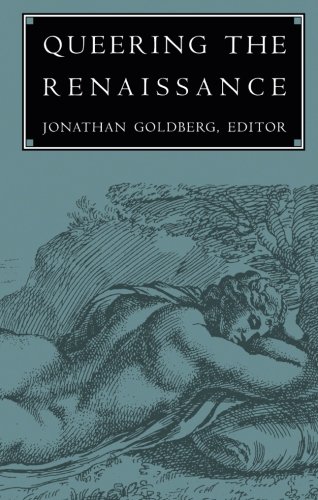
Queering the Renaissance offers a major reassessment of the field of Renaissance studies. Gathering essays by sixteen critics working within the perspective of gay and lesbian studies, this collection redraws the map of sexuality and gender studies in the Renaissance. Taken together, these essays move beyond limiting notions of identity politics by locating historically forms of same-sex desire that are not organized in terms of modern definitions of homosexual and heterosexual.
The presence of contemporary history can be felt throughout the volume, beginning with an investigation of the uses of Renaissance precedents in the 1986 U.S. Supreme Court decision Bowers v. Hardwick, to a piece on the foundations of 'our' national imaginary, and an afterword that addresses how identity politics has shaped the work of early modern historians. The volume examines canonical and noncanonical texts, including highly coded poems of the fifteenth-century Italian poet Burchiello, a tale from Marguerite de Navarre's Heptameron, and Erasmus's letters to a young male acolyte. English texts provide a central focus, including works by Spenser, Shakespeare, Bacon, Donne, Beaumont and Fletcher, Crashaw, and Dryden. Broad suveys of the complex terrains of friendship and sodomy are explored in one essay, while another offers a cross-cultural reading of the discursive sites of lesbian desire.
Contributors. Alan Bray, Marcie Frank, Carla Freccero, Jonathan Goldberg, Janet Halley, Graham Hammill, Margaret Hunt, Donald N. Mager, Jeff Masten, Elizabeth Pittenger, Richard Rambuss, Alan K. Smith, Dorothy Stephens, Forrest Tyler Stevens, Valerie Traub, Michael Warner
Die Inhaltsangabe kann sich auf eine andere Ausgabe dieses Titels beziehen.
Über die Autorin bzw. den Autor
Jonathan Goldberg is the Sir William Osler Professor of English Literature at the Johns Hopkins University. He is the author of Sodometries: Renaissance Texts, Modern Sexualities.
Von der hinteren Coverseite
"An outstanding collection . . . Not only does it contribute importantly to emerging areas of gay/lesbian studies and the history of sexuality by historicizing what has been for the most part a relentlessly presentist field; it makes significant scholarly contributions to traditional fields in Renaissance studies."--Karen Newman, Brown University
Auszug. © Genehmigter Nachdruck. Alle Rechte vorbehalten.
Queering the Renaissance
By Jonathan GoldbergDuke University Press
Copyright © 1994 Duke University Press
All rights reserved.
ISBN: 978-0-8223-1385-4All rights reserved.
Contents
Introduction,
Bowers v. Hardwick: in the Renaissance,
Homosexuality and the Signs of Male Friendship in Elizabethan England,
The (In)Significance of "Lesbian" Desire in Early Modern England,
Fraudomy: Reading Sexuality and Politics in Burchiello,
Practicing Queer Philology with Marguerite de Navarre: Nationalism and the Castigation of Desire,
Erasmus's "Tigress": The Language of Friendship, Pleasure, and the Renaissance Letter,
John Bale and Early Tudor Sodomy Discourse,
"To Serve the Queere": Nicholas Udall, Master of Revels,
Into Other Arms: Amoret's Evasion,
Romeo and Juliet's Open Rs,
The Epistemology of Expurgation: Bacon and The Masculine Birth of Time,
Pleasure and Devotion: The Body of Jesus and Seventeenth–Century Religious Lyric,
My Two Dads: Collaboration and the Reproduction of Beaumont and Fletcher,
Fighting Women and Loving Men: Dryden's Representation of Shakespeare in All for Love,
New English Sodom,
Afterword,
Notes on Contributors,
CHAPTER 1
BOWERS V. HARDWICK: in the Renaissance
JANET E. HALLEY
HISTORIANS queering the Renaissance occupy a particularly auspicious vantage point for probing the social fictions spun by the United States Supreme Court's notorious decision in Bowers v. Hardwick. After all, both Justice White writing for the majority and Justice Burger concurring in his own opinion trace Georgia's statute to the state's reception of English law, positing an unmediated codification of Henry VIII's statute prohibiting buggery and Elizabeth I's reinstatement of it in the criminal law of the United States. The historiography of sodomy proposed by the Supreme Court in Hardwick—one in which sodomy is always and everywhere the same, always and everywhere opprobriated, always and everywhere joined in a purportedly stable equation with homosexual identity—provides an important contemporary context for the essays collected here. It is the purpose of this essay to examine that historiography, and to make some suggestions about how cultural history can contribute to the dis-authorization of the Hardwick opinion and its cultural meanings.
In Bowers v. Hardwick the United States Supreme Court held that.constitutional privacy and substantive due process rights are not violated when a state criminalizes what the Court was pleased to call "homosexual sodomy." Courts, legislators, and executive officials have repeatedly cited this baneful decision to justify the official denomination of a class of homosexuals and its equation with criminalizable sodomy. Several federal courts have held that Hardwick forecloses meaningful equal protection for gay men, lesbians, and bisexuals because sodomy is the "behavior that defines the class" of homosexuals. Others have refused to acknowledge that a gay public employee who comes out of the closet has engaged in First Amendment protected speech, or indeed any speech at all, because to acknowledge gay identity is to admit membership in a criminal class. The Alabama legislature has banned public funding of any student group "that fosters or promotes a lifestyle or actions prohibited by the [state's] sodomy and sexual misconduct laws," relying on the state attorney general's opinion that, under Hardwick, Alabama's sodomy statute—a prohibition of oral/genital and genital/ anal contacts between any unmarried persons—constitutionally prohibits "homosexuality."
In the face of these category implosions equating sodomy with the personhood of individuals identified as gay or lesbian, it is well to recall Jonathan Goldberg's conclusion that "sodomy, 'that utterly confused category,' as Foucault memorably put it, identifies neither persons nor acts with any coherence or specificity. This is one reason why the term can be mobilized—precisely because it is incapable of exact definition; but this is also how the bankruptcy of the term, and what has been done in its name, can be uncovered." Presiding over this regime of incoherence, the Hardwick decision exploits confusion about what sodomy is in ways that create opportunities for the Court's exercise of homophobic power. And yet Hardwick represents sodomy as a self-evident unit of thought, an act rather than many. Indeed, the very logic of the decision depends on a representation of sodomy as immutable, as a historical monolith, the unitary object of an uninterrupted continuity of historical condemnation running forward, according to Justice White's majority opinion, from the date of the Bill of Rights to the date of Hardwick's arrest, running back, according to Justice Burger's concurring opinion, through the "millennia" to the very origins of "Western civilization:'
Two questions, both important for the shared project of the essays collected here, arise from this conjuncture of history making with definitional politics: how did the Hardwick majority manage the definitional relationship between sodomy and gay identity, and how did it deploy history in doing so? The Hardwick Court's historical/definitional practices suggest that the most useful questions for cultural historians to explore may not be precisely the same as the ones that have energized historical examinations of gay, lesbian, and bisexual practices and identities in recent years. I would argue that Hardwick's invocation of legal and cultural tradition can best be critiqued by queer historiography that asks not whether and when gay and lesbian identities and subjectivities became historically available to people who did (or did not) engage in same-sex erotic contacts, but how contests to control the meaning of sodomy have involved shifting, opportunistic, sometimes ontologically coherent and sometimes inchoate deployments of the relationship between act and identity.
As courts of limited jurisdiction, federal courts are constitutionally empowered (they themselves have held) to answer only the specific legal questions that litigants present to them. But what are those questions? The process of framing the question is a second-order constitutive activity, in which the court defines its own power and the context in which (the court hopes) that power will operate. By the time the Hardwick majority framed the question it then proceeded to answer, most of its work of deciding, and much of its work of situating itself in relation to the question it would answer, was done. It's important, then, to describe quite carefully the definitional implications of the question the Supreme Court purported to answer:
The issue presented is whether the Federal Constitution confers a fundamental right upon homosexuals to engage in sodomy and hence invalidates the laws of the many States that still make such conduct illegal and have done so for a very long time.
This question has struck many readers as odd, because the Georgia sodomy statute provides that "a person commits the offense of sodomy when he performs or submits to any sexual act involving the sex organs of one person and the mouth or anus of the other"—that is, it is a facially neutral prohibition of the specified bodily contacts notwithstanding the gender of the actors. Not only is it not limited to "homosexuals": it does not even mention them. To be sure, Michael Hardwick was charged with sodomy after a Georgia police...
„Über diesen Titel“ kann sich auf eine andere Ausgabe dieses Titels beziehen.
Suchergebnisse für Queering the Renaissance (Series Q)

Beispielbild für diese ISBN
Queering the Renaissance
Anbieter: World of Books (was SecondSale), Montgomery, IL, USA
Verkäuferbewertung 5 von 5 Sternen

Paperback. Zustand: Good. Queering the Renaissance offers a major reassessment of the field of Renaissance studies. Gathering essays by sixteen critics working within the perspective of gay and lesbian studies, this collection redraws the map of sexuality and gender studies in the Renaissance. Taken together, these essays move beyond limiting notions of identity politics by locating historically forms of same-sex desire that are not organized in terms of modern definitions of homosexual and heterosexual.The presence of contemporary history can be felt throughout the volume, beginning with an investigation of the uses of Renaissance precedents in the 1986 U.S. Supreme Court decision Bowers v. Hardwick, to a piece on the foundations of 'our' national imaginary, and an afterword that addresses how identity politics has shaped the work of early modern historians. The volume examines canonical and noncanonical texts, including highly coded poems of the fifteenth-century Italian poet Burchiello, a tale from Marguerite de Navarre's Heptameron, and Erasmus's letters to a young male acolyte. English texts provide a central focus, including works by Spenser, Shakespeare, Bacon, Donne, Beaumont and Fletcher, Crashaw, and Dryden. Broad suveys of the complex terrains of friendship and sodomy are explored in one essay, while another offers a cross-cultural reading of the discursive sites of lesbian desire.Contributors. Alan Bray, Marcie Frank, Carla Freccero, Jonathan Goldberg, Janet Halley, Graham Hammill, Margaret Hunt, Donald N. Mager, Jeff Masten, Elizabeth Pittenger, Richard Rambuss, Alan K. Smith, Dorothy Stephens, Forrest Tyler Stevens, Valerie Traub, Michael Warner. Artikel-Nr. 00102587909
Gebraucht kaufen
EUR 5,59
Versand gratis
Versand innerhalb von USA
Versand innerhalb von USA
Anzahl: 1 verfügbar
Beispielbild für diese ISBN
Queering the Renaissance (Series Q)
Verlag:
Duke University Press (edition Edition Not Stated), 1993
ISBN 10: 0822313855
ISBN 13: 9780822313854
Gebraucht
Paperback
Anbieter: BooksRun, Philadelphia, PA, USA
Verkäuferbewertung 5 von 5 Sternen
Paperback. Zustand: Very Good. Edition Not Stated. It's a well-cared-for item that has seen limited use. The item may show minor signs of wear. All the text is legible, with all pages included. It may have slight markings and/or highlighting. Artikel-Nr. 0822313855-11-1
Gebraucht kaufen
EUR 5,60
Versand gratis
Versand innerhalb von USA
Versand innerhalb von USA
Anzahl: 1 verfügbar
Beispielbild für diese ISBN
Queering the Renaissance
Anbieter: Better World Books Ltd, Dunfermline, Vereinigtes Königreich
Verkäuferbewertung 5 von 5 Sternen
Zustand: Good. 1st ptg. Former library copy. Pages intact with minimal writing/highlighting. The binding may be loose and creased. Dust jackets/supplements are not included. Includes library markings. Stock photo provided. Product includes identifying sticker. Better World Books: Buy Books. Do Good. Artikel-Nr. GRP59356104
Gebraucht kaufen
EUR 9,87
EUR 5,88 Versand
Versand von Vereinigtes Königreich nach USA
Versand von Vereinigtes Königreich nach USA
Anzahl: 1 verfügbar
Beispielbild für diese ISBN
Queering the Renaissance
Anbieter: PBShop.store UK, Fairford, GLOS, Vereinigtes Königreich
Verkäuferbewertung 5 von 5 Sternen
PAP. Zustand: New. New Book. Shipped from UK. Established seller since 2000. Artikel-Nr. FW-9780822313854
Neu kaufen
EUR 34,25
EUR 5,91 Versand
Versand von Vereinigtes Königreich nach USA
Versand von Vereinigtes Königreich nach USA
Anzahl: 1 verfügbar
Foto des Verkäufers
Queering the Renaissance
Anbieter: The Private Library, London, Vereinigtes Königreich
Verkäuferbewertung 5 von 5 Sternen
Zustand: Very Good. From the Library of John Russell Taylor. Artikel-Nr. PL-16142-S16
Gebraucht kaufen
EUR 32,72
EUR 17,59 Versand
Versand von Vereinigtes Königreich nach USA
Versand von Vereinigtes Königreich nach USA
Anzahl: 1 verfügbar
Beispielbild für diese ISBN
Queering the Renaissance (Series Q)
Anbieter: Kennys Bookstore, Olney, MD, USA
Verkäuferbewertung 5 von 5 Sternen
Zustand: New. Editor(s): Goldberg, Jonathan. Series: Series Q. Num Pages: 424 pages. BIC Classification: HBG; JFSK. Category: (P) Professional & Vocational; (UP) Postgraduate, Research & Scholarly; (UU) Undergraduate. Dimension: 230 x 153 x 29. Weight in Grams: 658. . 1993. 0th Edition. Paperback. . . . . Books ship from the US and Ireland. Artikel-Nr. V9780822313854
Neu kaufen
EUR 53,86
EUR 9,33 Versand
Versand innerhalb von USA
Versand innerhalb von USA
Anzahl: 1 verfügbar
Beispielbild für diese ISBN
Queering the Renaissance (Series Q)
Anbieter: Ria Christie Collections, Uxbridge, Vereinigtes Königreich
Verkäuferbewertung 5 von 5 Sternen
Zustand: New. In English. Artikel-Nr. ria9780822313854_new
Neu kaufen
EUR 60,86
EUR 13,28 Versand
Versand von Vereinigtes Königreich nach USA
Versand von Vereinigtes Königreich nach USA
Anzahl: Mehr als 20 verfügbar
Beispielbild für diese ISBN
Queering the Renaissance
Anbieter: Mooney's bookstore, Den Helder, Niederlande
Verkäuferbewertung 4 von 5 Sternen

Zustand: Very Good. Artikel-Nr. D81881A11F6A5BC
Gebraucht kaufen
EUR 59,33
EUR 14,95 Versand
Versand von Niederlande nach USA
Versand von Niederlande nach USA
Anzahl: 1 verfügbar
Beispielbild für diese ISBN
Queering the Renaissance (Series Q)
Anbieter: Revaluation Books, Exeter, Vereinigtes Königreich
Verkäuferbewertung 5 von 5 Sternen
Paperback. Zustand: Brand New. 424 pages. 9.25x5.75x1.25 inches. In Stock. Artikel-Nr. x-0822313855
Neu kaufen
EUR 63,00
EUR 14,71 Versand
Versand von Vereinigtes Königreich nach USA
Versand von Vereinigtes Königreich nach USA
Anzahl: 2 verfügbar
Beispielbild für diese ISBN
Queering the Renaissance
Anbieter: Majestic Books, Hounslow, Vereinigtes Königreich
Verkäuferbewertung 4 von 5 Sternen
Zustand: New. pp. 424. Artikel-Nr. 5326261
Neu kaufen
EUR 72,66
EUR 7,65 Versand
Versand von Vereinigtes Königreich nach USA
Versand von Vereinigtes Königreich nach USA
Anzahl: 1 verfügbar