
Verwandte Artikel zu The Worlds of Petrarch (Duke Monographs in Medieval...
Inhaltsangabe
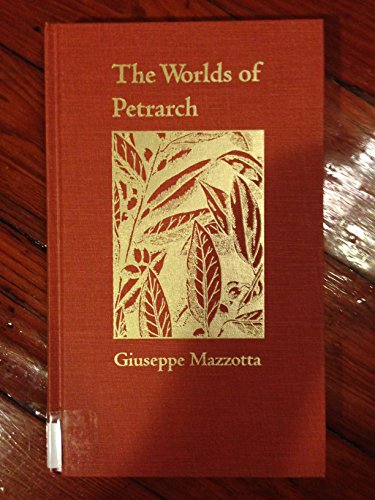
At the center of Petrarch's vision, announcing a new way of seeing the world, was the individual, a sense of the self that would one day become the center of modernity as well. This self, however, seemed to be fragmented in Petrarch's work, divided among the worlds of philosophy, faith, and love of the classics, politics, art, and religion, of Italy, France, Greece, and Rome. In recent decades scholars have explored each of these worlds in depth. In this work, Giuseppe Mazzotta shows for the first time how all these fragmentary explorations relate to each other, how these separate worlds are part of a common vision.
Written in a clear and passionate style, The Worlds of Petrarch takes us into the politics of culture, the poetic imagination, into history and ethics, art and music, rhetoric and theology. With this encyclopedic strategy, Mazzotta is able to demonstrate that the self for Petrarch is not a unified whole but a unity of parts, and, at the same time, that culture emerges not from a consensus but from a conflict of ideas produced by opposition and dark passion. These conflicts, intrinsic to Petrarch's style of thought, lead Mazzotta to a powerful rethinking of the concepts of "fragments" and "unity" and, finally, to a new understanding of the relationship between them.
Die Inhaltsangabe kann sich auf eine andere Ausgabe dieses Titels beziehen.
Über die Autorin bzw. den Autor
Giuseppe Mazzotta is Professor and Chair, Italian Language and Literature Department, Yale University. His is the author of Dante, Poet of the Desert, The World at Play, and Dante's Vision and the Circle of Knowledge.
Von der hinteren Coverseite
"A richly textured, deeply learned, and broadly inclusive study of Petrarch's writing, his historical situation, and his contribution to our own cultural formation."--William Kennedy, Cornell University
Auszug. © Genehmigter Nachdruck. Alle Rechte vorbehalten.
The Worlds of Petrarch
By Giuseppe MazzottaDuke University Press
Copyright © 1993 Duke University Press
All rights reserved.
ISBN: 978-0-8223-1363-2All rights reserved.
Contents
Acknowledgments,
Note on Petrarch's Texts,
Petrarch's Works,
Translations,
Introduction,
Chapter I: Antiquity and the New Arts,
Chapter II: The Thought of Love,
Chapter III: The Canzoniere and the Language of the Self,
Chapter IV: Ethics of Self,
Chapter V: The World of History,
Chapter VI: Orpheus: Rhetoric and Music,
Chapter VII: Humanism and Monastic Spirituality,
Appendix 1: Petrarch's Song 126,
Appendix 2: Ambivalences of Power,
Notes,
About the Author,
CHAPTER 1
Antiquity and the New Arts
* * *
The convention of partitioning history according to distinguishable and discrete intellectual periods has not gone unchallenged in recent times. Historiographic categories such as "Renaissance," "modernity," and "Middle Ages" continue to retain at least a nominal validity as terms of chronological demarcation (certainly useful for primers of literary history), but the historical specificity of each epoch, which in the nineteenth century could be defined with ease, is now hard to pinpoint. In 1870 Francesco De Sanctis published his Storia della letteratura italiana, which is shaped by the Hegelian belief in the organic, teleological process of history. The security of the Hegelian historiographic model, wherein contradictory individual phenomena can be manipulated into an overarching totality or significant unity, is in question from a variety of perspectives. Paradoxically, two radically contrasting premises about history usually end up agreeing in their dismissal of historical boundaries. These boundaries are arbitrary, it is said, because "human nature tends to remain much the same in all times." The judgment is underwritten by those who believe in the irreducible individuality of each spiritual and artistic experience. But the major doubts about the legitimacy of traditional historical periodizations occur to scholars who, engaged as they are in interpretive practices, inevitably come to discover that data cannot be rigidly classified or epistemological breaks identified and to recognize the crudeness of the notion of originality and foundation in literary history. They discover, in short, that textual details do not always fit the generality of formulas established a priori and that canons of a culture repress or exclude what may contradict the myths of that culture.
These doubts have been recently reinforced by deconstructive modes of analysis, but they need not be thought of merely as the domain of deconstruction theory. Renaissance scholars, for instance, have long been aware of how blurred the dividing line between "medieval" and "Renaissance" culture is. They have wondered whether the concept "Renaissance" is, in the words of Erwin Panofsky, an accurate "self-definition" or a mere "self-deception," and they have probed the degree to which the uniqueness of the Italian Renaissance extends the Carolingian revival and the Ottonian resurgence of the tenth century.
The notion of "modernity" is certainly no less problematical. In an important study written in the 1970s, The Legitimacy of the Modern Age, Hans Blumenberg argues that modernity, a period that stretches broadly from the 1600s to the present, is a legitimate category of history in that it inaugurates a new configuration in the field of knowledge. The "epochal threshold" or reversal of direction from the core of theological dogmatics, which characterizes the historical process until the 1600s, is not embodied by Nicholas Cusanus, as Hans-Georg Gadamer maintains, but by Giordano Bruno's "heretical" casting of the plurality of worlds in an infinite cosmology. Blumenberg never stops to consider "modernity" as a theoretical, persistently present question of positing a break from tradition if only to discover that modernity is forever inscribed in the archives of the past. Nor does he probe the self-evident aporia of any historicist philosophy that affirms the ceaseless mobility of the historical process and yet must arrest history's flow in order to impart a new direction to it. His aim, rather, is to counter Karl Lowith's assertion that the discourse of modernity is a secular retrieval of medieval themes. The legitimacy of the modern age, stated simply, resides in the scientific subversion of the authority of the canon as well as of the paradigms of knowledge rampant in the theological, medieval models of the economy of creation.
Medieval and Renaissance scholars could easily take to task Blumenberg's concept of a prolonged, unified Middle Ages as well as his version of an unscientific Middle Ages as the last in an endless series of myths that modernity keeps forging about the past in order to justify itself. If one were to look at the 1979 issue of New Literary History devoted to the "Alterity of the Middle Ages," one could perceive the fallacy of, say, Henry O. Taylor's The Mediaeval Mind, with its overt claim that the Middle Ages was a time of spiritual homogeneity. One could also see the gulf yawning between the present state of medieval studies and that of the nineteenth century, when Gaston Paris at the Collège de France, Francisque Michel at Bordeaux, Léon Gautier, and, eventually, Joseph Bédier made the knowledge of the Middle Ages (in the double value of the genitive case) central to the curriculum. These savants could even object to the distortions as to what the Middle Ages were (and the list of perpetrators goes from Rabelais to Voltaire to Chateaubriand to Hugo) without themselves escaping other distortions they inevitably committed in the name of paleography, philology, and archaeology.
The old myths about the Middle Ages linger tenaciously in new guises. Because the encyclopedia of Vincent of Beauvais, written toward the middle of the thirteenth century, in many ways derives from Isidore of Seville's Etymologies, written some seven centuries earlier, it is still assumed by medievalists that the inventory of knowledge remains unchanged. That Vincent makes available to the general public the new Aristotle, Arabic writings on the sciences, and the Chartrians is not deemed sufficient to dispel the notion that knowledge in the Middle Ages is a perpetual anachronism, an immutable, closed-off space of superstitious beliefs. The impression of an immobile universe of knowledge is reinforced by the practice of biblical exegesis (notoriously conservative), which, in its quasi-mechanical repetitiveness, seeks to shelter the sovereignty of the Biblical Text from subversive encroachments. The infinitely selfsame message of biblical exegesis, of the Neoplatonic structures, and of forever-fixed scholastic arrangements of the totality of creation unavoidably project the Middle Ages as the parable of an untroubled Utopia of the soul, of an otherness no longer accessible to us, of an "alterity," in short (the word, of course, is the matrix of allegory), that is both an alibi and a scandal to current intellectual concerns.
This powerful and alluring vision of an ordered world is a repression of history, of the contradictory voices punctuating the philosophical debates, the spiritual lacerations, or the political struggles of the thirteenth and fourteenth centuries. One would only have to mention the impact of Aristotle's De anima and its commentary by Averroës at the universities of Oxford and Paris in the thirteenth century; Marsilius's doctrine of law as coercive...
„Über diesen Titel“ kann sich auf eine andere Ausgabe dieses Titels beziehen.
Weitere beliebte Ausgaben desselben Titels

Suchergebnisse für The Worlds of Petrarch (Duke Monographs in Medieval...

Beispielbild für diese ISBN
The Worlds of Petrarch (Duke Monographs in Medieval and Renaissance Studies)
Anbieter: Ammareal, Morangis, Frankreich
Verkäuferbewertung 5 von 5 Sternen

Hardcover. Zustand: Bon. Ancien livre de bibliothèque avec équipements. Ammareal reverse jusqu'à 15% du prix net de cet article à des organisations caritatives. ENGLISH DESCRIPTION Book Condition: Used, Good. Former library book. Ammareal gives back up to 15% of this item's net price to charity organizations. Artikel-Nr. G-659-312
Gebraucht kaufen
EUR 6,99
EUR 16,50 Versand
Versand von Frankreich nach USA
Versand von Frankreich nach USA
Anzahl: 1 verfügbar
Beispielbild für diese ISBN
Duke Monographs in Medieval & Renaissance Studies: The Worlds of Petrarch (Volume 14)
Anbieter: Anybook.com, Lincoln, Vereinigtes Königreich
Verkäuferbewertung 5 von 5 Sternen
Zustand: Good. Volume 14. This is an ex-library book and may have the usual library/used-book markings inside.This book has soft covers. Clean from markings. In good all round condition. Please note the Image in this listing is a stock photo and may not match the covers of the actual item,450grams, ISBN:0822313634. Artikel-Nr. 9878728
Gebraucht kaufen
EUR 31,18
EUR 15,85 Versand
Versand von Vereinigtes Königreich nach USA
Versand von Vereinigtes Königreich nach USA
Anzahl: 1 verfügbar
Beispielbild für diese ISBN
The Worlds of Petrarch (Duke Monographs in Medieval and Renaissance Studies) Giuseppe Mazzotta
Anbieter: BUCHSERVICE / ANTIQUARIAT Lars Lutzer, Wahlstedt, Deutschland
Verkäuferbewertung 5 von 5 Sternen
Hardcover. Zustand: gut. The Worlds of Petrarch (Duke Monographs in Medieval and Renaissance Studies) In englischer Sprache. pages. Artikel-Nr. BN329111
Gebraucht kaufen
EUR 179,90
EUR 39,95 Versand
Versand von Deutschland nach USA
Versand von Deutschland nach USA
Anzahl: 1 verfügbar