
Verwandte Artikel zu Terminal Identity: The Virtual Subject in Postmodern...
Inhaltsangabe
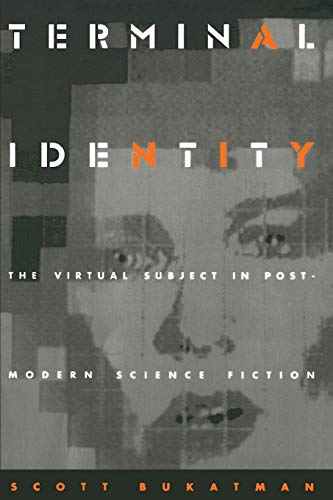
Scott Bukatman's Terminal Identity-referring to both the site of the termination of the conventional "subject" and the birth of a new subjectivity constructed at the computer terminal or television screen--puts to rest any lingering doubts of the significance of science fiction in contemporary cultural studies. Demonstrating a comprehensive knowledge, both of the history of science fiction narrative from its earliest origins, and of cultural theory and philosophy, Bukatman redefines the nature of human identity in the Information Age.
Drawing on a wide range of contemporary theories of the postmodern-including Fredric Jameson, Donna Haraway, and Jean Baudrillard-Bukatman begins with the proposition that Western culture is suffering a crisis brought on by advanced electronic technologies. Then in a series of chapters richly supported by analyses of literary texts, visual arts, film, video, television, comics, computer games, and graphics, Bukatman takes the reader on an odyssey that traces the postmodern subject from its current crisis, through its close encounters with technology, and finally to new self-recognition. This new "virtual subject," as Bukatman defines it, situates the human and the technological as coexistent, codependent, and mutally defining.
Synthesizing the most provocative theories of postmodern culture with a truly encyclopedic treatment of the relevant media, this volume sets a new standard in the study of science fiction-a category that itself may be redefined in light of this work. Bukatman not only offers the most detailed map to date of the intellectual terrain of postmodern technology studies-he arrives at new frontiers, providing a propitious launching point for further inquiries into the relationship of electronic technology and culture.
Die Inhaltsangabe kann sich auf eine andere Ausgabe dieses Titels beziehen.
Über die Autorin bzw. den Autor
Scott Bukatman is Associate Professor of Art and Art History at Stanford University. He is the author of Terminal Identity: The Virtual Subject in Postmodern Science Fiction, published by Duke University Press.
Von der hinteren Coverseite
"This book should appeal to . . . anyone in the humanities disciplines working within the discourses of postmodernism. The scholarship is absolutely superior."--Vivian Sobchack, author of "Screening Space: The American Science Fiction Film"
Auszug. © Genehmigter Nachdruck. Alle Rechte vorbehalten.
Terminal Identity
The Virtual Subject in Postmodern Science Fiction
By Scott BukatmanDuke University Press
Copyright © 1993 Duke University Press
All rights reserved.
ISBN: 978-0-8223-1340-3All rights reserved.
Contents
Acknowledgments,
Introduction,
1 Terminal Image,
2 Terminal Space,
3 Terminal Penetration,
4 Terminal Flesh,
5 Terminal Resistance/Cyborg Acceptance,
Conclusion,
Notes,
Filmography,
Bibliography,
Index,
CHAPTER 1
TERMINAL IMAGE
INTRODUCTION
In the real world of television, technology is perfectly interiorized: it comes within the self.–Kroker and Cook ¶ Television is the sincerest form of imitation.–Fred Allen
Several sections of Chris Marker's 1982 film, Sans Soleil, present contemporary Tokyo as a science fiction metropolis. Marker does not understand the Japanese language, and the resultant disorientation, when coupled with the high-technology compactness of this urban environment, creates the effect of a futuristic alienation. Like the protagonist/narrator of Edward Bellamy's 1888 novel Looking Backward (the significantly surnamed Julian West), Marker has awakened to find himself dislocated, both spatially and temporally. Unlike West, Marker has few guides to his brave new world, and those that do exist serve to distort more than to clarify. Cinematically, his alienation is conveyed through montage, sound/image disunion, and an evocation of the surfeit of signifiers, signs for which Marker can only guess at possible referents. Passengers doze on a commuter train as the electronic soundtrack drones, punctuated by a series of beeps and bleeps reminiscent of old Astroboy cartoons. The commuter train is intercut with shots of the space-borne locomotive from the popular animated film Galaxy Express, further implicating the film in a web of intertextual and intergalactic reference. These associations also have the effect of infantilizing the narrator, as alienation engenders a retreat to the images of childhood–or children's media.
Marker does not simply map Tokyo onto the field of science fiction, but onto the field of the media-spectacle as well. What characterizes Tokyo is the domination of the image: not simply the static, over-sized posters with their staring eyes ("voyeurizing the voyeurs," as the narrator says), but the endless flow of images across the television screen and the endless televisions which multiply across Marker's solitary cinematic frame. Tokyo constitutes the "world of appearances" for Marker–how could it be otherwise, given his selective and seemingly deliberate cultural illiteracy–but it is also a realm devoted to the surface, to the external. Tokyo exists as pure spectacle; that is, as a proliferation of semiotic systems and simulations which increasingly serve to replace physical human experience and interaction. Television brings the signs of a peculiar sexuality into Marker's hotel room, videogames serve as furniture in numberless arcades, sumo-wrestling fans gather to watch their favorites do combat along walls of TV monitors; a serial multiplication of the same image-flow extended onto a grid formation like Warhol's Marilyn or Elvis panels. Video monitors are so prevalent that the narrator finally concludes that in Tokyo, "Television is watching you."
Ultimately, the narrator finds a kind of solace with a companion who has designed a video-synthesizer as a means of resisting the onslaught of images, the bombardment of signals. Their electronically reprocessed world is dubbed the Zone (in homage to Tarkovsky's Stalker [1979]). In the Zone the image is regrounded as image rather than functioning as a surrogate reality. The passivity engendered by the spectacle has ostensibly been shattered; the filmmaker has reappropriated control of the image.
Sans Soleil presents, in compact form, a remarkable number of the tropes which recur in both contemporary science fiction and the critical discourse regarding the media. The pervasive domination by, and addiction to, the image might be regarded as a primary symptom of terminal identity. The "image addict" is a metaphor which exists in and through the media, subject to forces which might at first seem to be controlled by the instrumental forces of government and/or big business, but that ultimately seems to signify the passage into a new reality. The spectacular world of television dominates and defines existence, becoming more "real" (more familiar, more authoritative, more satisfying) than physical reality itself. Much science fiction recognizes that we now inhabit what techno-prophet Alvin Toffler has called "blip culture," a rhetorical (and perhaps "real") construct within which citizens are becoming blips: electronic pulses which exist only as transitory bits or bytes of information in a culture inundated with information. The science fiction of the 1950s resisted the advent of the spectacular society (in works by Ray Bradbury, Frederik Pohl and C. M. Kornbluth, and Robert Sheckley, for example), while more recent texts acknowledge, analyze, and sometimes apparently embrace this new state of things. A spectacular ambivalence pervades science fiction cinema, television, and comics. Television and computer cultures have repeatedly been posited as formations of spectacular control, but it is important to note that the new modes of challenge and resistance have themselves become spectacular in form.
In its discursive play, including its images, music, and narration, this section of Sans Soleil aspires to the condition of science fiction. The narrator's Tokyo journey takes him from an initial state of radical alienation in the face of the constant flow of images, through periods of an almost palpable terror of assault and invasion by the forces of blip culture. Finally, the journey into the Zone represents an adaptation to, and appropriation of, the society of the spectacle. Marker utilizes the rhetorical strategies of the genre of science fiction to evoke the experience of disorientation before the media eruption of Tokyo. Similarly, the film The Man Who Fell to Earth (1976), in its depiction of an alien abroad in a distant world, bombarded by the images and sounds of the media culture which is America, might be regarded as the fictional analogue to Marker's avant-garde documentary.
This conflation of science fiction and media criticism is neither unique nor even unusual in recent years. It is already evident in the writings of Marshall McLuhan, replete with their metaphors of neurology and bodily transformation. It is evident in Alvin Toffler's paeans to technological development and cybernetic adaptation. But it is equally apparent in the more negative postures of the Situationists, in their concern with urban redefinition and individual existence; and it exists, perhaps most clearly, in the profound ambivalence of Jean Baudrillard's cyborg rants, which loudly declaim the new state of things while maintaining an ironic distance.
In all these cases, and others less notorious, the cyberneticized orientation of the respected critic aligns him or her with society's debased prophet of the technological: the science fiction writer. But the conflation of SF and critical discourse doesn't only exist on the referential level, it extends to the deployment of signifiers. If it is true, as Samuel R. Delany and Teresa deLauretis contend, that the use of language in science fiction is sufficiently idiosyncratic as to demand new strategies of...
„Über diesen Titel“ kann sich auf eine andere Ausgabe dieses Titels beziehen.
Suchergebnisse für Terminal Identity: The Virtual Subject in Postmodern...

Beispielbild für diese ISBN
Terminal Identity: The Virtual Subject in Postmodern Science Fiction
Anbieter: WorldofBooks, Goring-By-Sea, WS, Vereinigtes Königreich
Verkäuferbewertung 5 von 5 Sternen

Paperback. Zustand: Fair. A readable copy of the book which may include some defects such as highlighting and notes. Cover and pages may be creased and show discolouration. Artikel-Nr. GOR015119362
Gebraucht kaufen
EUR 5,38
EUR 6,53 Versand
Versand von Vereinigtes Königreich nach USA
Versand von Vereinigtes Königreich nach USA
Anzahl: 1 verfügbar
Beispielbild für diese ISBN
Terminal Identity : The Virtual Subject in Postmodern Science Fiction
Anbieter: Better World Books, Mishawaka, IN, USA
Verkäuferbewertung 5 von 5 Sternen
Zustand: Good. Former library copy. Pages intact with minimal writing/highlighting. The binding may be loose and creased. Dust jackets/supplements are not included. Includes library markings. Stock photo provided. Product includes identifying sticker. Better World Books: Buy Books. Do Good. Artikel-Nr. GRP70138937
Gebraucht kaufen
EUR 12,42
Versand gratis
Versand innerhalb von USA
Versand innerhalb von USA
Anzahl: 1 verfügbar
Beispielbild für diese ISBN
Terminal Identity : The Virtual Subject in Postmodern Science Fiction
Anbieter: Better World Books Ltd, Dunfermline, Vereinigtes Königreich
Verkäuferbewertung 5 von 5 Sternen
Zustand: Very Good. Former library copy. Pages intact with possible writing/highlighting. Binding strong with minor wear. Dust jackets/supplements may not be included. Includes library markings. Stock photo provided. Product includes identifying sticker. Better World Books: Buy Books. Do Good. Artikel-Nr. 11167925-20
Gebraucht kaufen
EUR 7,42
EUR 5,83 Versand
Versand von Vereinigtes Königreich nach USA
Versand von Vereinigtes Königreich nach USA
Anzahl: 1 verfügbar
Beispielbild für diese ISBN
Terminal Identity : The Virtual Subject in Postmodern Science Fiction
Anbieter: Better World Books Ltd, Dunfermline, Vereinigtes Königreich
Verkäuferbewertung 5 von 5 Sternen
Zustand: Good. Former library copy. Pages intact with minimal writing/highlighting. The binding may be loose and creased. Dust jackets/supplements are not included. Includes library markings. Stock photo provided. Product includes identifying sticker. Better World Books: Buy Books. Do Good. Artikel-Nr. GRP70138937
Gebraucht kaufen
EUR 7,42
EUR 5,83 Versand
Versand von Vereinigtes Königreich nach USA
Versand von Vereinigtes Königreich nach USA
Anzahl: 2 verfügbar
Foto des Verkäufers
Terminal Identity The Virtual Subject in Postmodern Science Fiction
Verlag:
Duke University Press, Durham, NC, 1993
ISBN 10: 0822313405
ISBN 13: 9780822313403
Gebraucht
Paperback
Anbieter: True Oak Books, Highland, NY, USA
Verkäuferbewertung 5 von 5 Sternen
Paperback. Zustand: Fair. No Edition Stated. 6.13 X 1.06 X 9.25 inches; 404 pages; B&W illustrations. Moderate foxing on the exterior edges of textblock. Some on front and rear endpages. Good condition otherwise. No other noteworthy defects. No markings. ; - Your satisfaction is our priority. We offer free returns and respond promptly to all inquiries. Your item will be packaged with care and ship on the same or next business day. Buy with confidence. Artikel-Nr. HVD-69627-A-0
Gebraucht kaufen
EUR 18,16
Versand gratis
Versand innerhalb von USA
Versand innerhalb von USA
Anzahl: 1 verfügbar
Beispielbild für diese ISBN
Terminal Identity: The Virtual Subject in Postmodern Science Fiction
Anbieter: Anybook.com, Lincoln, Vereinigtes Königreich
Verkäuferbewertung 5 von 5 Sternen
Zustand: Fair. This is an ex-library book and may have the usual library/used-book markings inside.This book has soft covers. Book contains pencil markings. In fair condition, suitable as a study copy. Library sticker on front cover. Please note the Image in this listing is a stock photo and may not match the covers of the actual item,750grams, ISBN:9780822313403. Artikel-Nr. 5975490
Gebraucht kaufen
EUR 3,01
EUR 15,21 Versand
Versand von Vereinigtes Königreich nach USA
Versand von Vereinigtes Königreich nach USA
Anzahl: 1 verfügbar
Beispielbild für diese ISBN
Terminal Identity: The Virtual Subject in Postmodern Science Fiction
Anbieter: Anybook.com, Lincoln, Vereinigtes Königreich
Verkäuferbewertung 5 von 5 Sternen
Zustand: Fair. This is an ex-library book and may have the usual library/used-book markings inside.This book has soft covers. In fair condition, suitable as a study copy. Library sticker on front cover. Please note the Image in this listing is a stock photo and may not match the covers of the actual item,750grams, ISBN:9780822313403. Artikel-Nr. 5975491
Gebraucht kaufen
EUR 3,01
EUR 15,21 Versand
Versand von Vereinigtes Königreich nach USA
Versand von Vereinigtes Königreich nach USA
Anzahl: 1 verfügbar
Beispielbild für diese ISBN
Terminal Identity: The Virtual Subject in Postmodern Science Fiction
Anbieter: Anybook.com, Lincoln, Vereinigtes Königreich
Verkäuferbewertung 5 von 5 Sternen
Zustand: Poor. This is an ex-library book and may have the usual library/used-book markings inside.This book has soft covers. Book contains pencil markings. In poor condition, suitable as a reading copy. Library sticker on front cover. Please note the Image in this listing is a stock photo and may not match the covers of the actual item,700grams, ISBN:0822313405. Artikel-Nr. 5975492
Gebraucht kaufen
EUR 3,01
EUR 15,21 Versand
Versand von Vereinigtes Königreich nach USA
Versand von Vereinigtes Königreich nach USA
Anzahl: 1 verfügbar
Beispielbild für diese ISBN
Terminal Identity: The Virtual Subject in Postmodern Science Fiction
Anbieter: Anybook.com, Lincoln, Vereinigtes Königreich
Verkäuferbewertung 5 von 5 Sternen
Zustand: Good. This is an ex-library book and may have the usual library/used-book markings inside.This book has soft covers. In good all round condition. Please note the Image in this listing is a stock photo and may not match the covers of the actual item,800grams, ISBN:9780822313403. Artikel-Nr. 4146718
Gebraucht kaufen
EUR 3,35
EUR 15,21 Versand
Versand von Vereinigtes Königreich nach USA
Versand von Vereinigtes Königreich nach USA
Anzahl: 1 verfügbar
Beispielbild für diese ISBN
Terminal Identity: The Virtual Subject in Postmodern Science Fiction
Anbieter: Anybook.com, Lincoln, Vereinigtes Königreich
Verkäuferbewertung 5 von 5 Sternen
Zustand: Good. This is an ex-library book and may have the usual library/used-book markings inside.This book has soft covers. In good all round condition. Please note the Image in this listing is a stock photo and may not match the covers of the actual item,800grams, ISBN:9780822313403. Artikel-Nr. 4146719
Gebraucht kaufen
EUR 3,35
EUR 15,21 Versand
Versand von Vereinigtes Königreich nach USA
Versand von Vereinigtes Königreich nach USA
Anzahl: 1 verfügbar