
Verwandte Artikel zu Secretaries of the Moon: The Letters of Wallace Stevens...
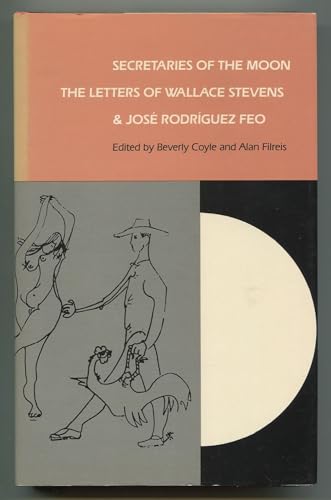
Secretaries of the Moon: The Letters of Wallace Stevens and Jose Rodriguez Feo: The Letters of Wallace Stevens and José Rodriguez Feo - Hardcover
Inhaltsangabe
The letter from Jose Rodriguez Feo that prompted Stevens's poem was the third in a ten-year correspondence (1944-54) between the poet and the young Cuban, who quickly became Stevens's "most exciting correspondent." The two shared a Harvard education, both were anxious to see Stevens translated for a Cuban audience, and each had an enduring admiration for Santayana, whose awareness of the cultural tensions between the Northern and Southern hemispheres formed a basis for the protracted argument between Stevens as the practical, Protestant father and the passionate Rodriguez Feo. The Cuban's descriptions of his life at the Villa Olga, of his black-and-white cow Lucera and his mule Pompilio, delighted Stevens, as did his wide-ranging questions and pronouncements of literary matters. Unaware of the well-known Stevens reticence, Rodriguz Feo elicited a more informal, playful response than Stevens's other correspondents. Formal salutations soon gave way to "Dear Antillean," "Dear Wallachio."
Coyle and Filreis present the entire extant correspondence between the two men. The fifty-one Rodriguez Feo letters and ten of the numerous Stevens letters are printed here for the first time, and the exchange between the two is unusually complete. The work includes a critical introduction and complete annotation of the letters.
Die Inhaltsangabe kann sich auf eine andere Ausgabe dieses Titels beziehen.
Von der hinteren Coverseite
"This superbly edited text brings to the foreground Stevens' cultural and social interests, often with specific references to the Third World. . . . It is a very important tool for the study of Stevens and modernism which will help us to forge ahead n what may be the decisive scholarly project for literary critics and historians over the next decade: the discovery and definition of the supremely worldly, densely historical and political character of literary modernism."--Frank Lentricchia
Auszug. © Genehmigter Nachdruck. Alle Rechte vorbehalten.
Secretaries of the Moon
The Letters of Wallace Stevens & José Rodríguez Feo
By Beverly Coyle, Alan FilreisDuke University Press
Copyright © 1986 Duke University Press
All rights reserved.
ISBN: 978-0-8223-0670-2All rights reserved.
Contents
Acknowledgments,
A Note on the Text,
Introduction,
Origins: 1944-1945,
Putting Together a World: 1945-1947,
Dear Old Princeton: 1948-1949,
The Planet Pancreas: 1949-1951,
Vies Imaginaires: 1951-1955,
Index,
CHAPTER 1
ORIGINS 1944-1945
B entre 12 y 14
Rpto. Almendares
Havana
Nov. 30,1944
My dear Mr. Stevens,
With such ardor one must be allowed the pecadillo of forgetting that after all there is a due respect to the author. Being almost satisfied with the translations of "Esthétique du Mai," I could have published it in our magazine. But then I recollected Marianne Moore's words–why don't you translate Stevens? Yes, I had already translated some poems from Harmonium [and] Notes Toward a Supreme Fiction. That was at Harvard and they were too "anglicized." They had the Spanish polish, the perfect poetic recognition of similar images, combinations, and the affinities which make it so difficult to keep the poem from turning into something quite foreign.
I like very much to send you Orígenes, our review. And W. C. Williams could tell you of my virtuosity, I mean my ability as translator. For you must justly fear. I hope you will write and tell me you're willing. Orígenes would publish "Esthétique" this winter or spring. Of course, you could select something else or send us a new poem.
Allow me this opportunity, now, to wish you the happy greetings for Christmas. And pardon such naive familiarity. Indeed, I feel I know you quite well already. And if I have hesitated so long to address you, it is because "this is a part of the sublime from which we shrink."
Yours ever, a most enthusiastic Cuban reader, José Rodríguez Feo
[Hartford, Connecticut]
December 8,1944
Dear Mr. Fes [sic]:
Your letter of November 30th gives me more pleasure than I can tell you. I shall be most interested to have you translate the "Esthétique." Unfortunately, my knowledge of Spanish is too limited to make it possible for me to be of the slightest help to you.
Do send me a copy of Orígenes. At the present time I subscribe to Sur of Buenos Aires, and enjoy reading a few pages of it now and then. I don't know why I should not enjoy reading a page of Orígenes just as much.
I am grateful to you for your letter and shall look forward to seeing your translation.
Yours very truly, Wallace Stevens
[Hartford, Connecticut]
January 4, 1945
Dear Mr. Feo:
Thank you for your very agreeable letter.
If the "Esthétique" is too long, I shall be very glad to have you use something else, as you like.
The copies of Orígenes came yesterday, and I spent last evening reading them. They remind me of Sventail, which was published at Geneva about the time of the last war. The fastidious make-up and Mariano's happy little drawings touch me (Mariano is in fact exquisite). Nothing quite so unconcerned has come my way for a long time. Man's fever is not present here.
Of course, for the reader of the exterior, what is of particular interest is the Cubans themselves. I very much wish I could read more exactly the essay of Anfbal Rodríguez on the bases of alegria. His subject is a footnote to felicidad, which, after all, is the great subject. And just as Eric Bentley, in the current Kenyon Review says that, today, treatises absorb the attention that novels absorbed twenty years ago, so I think that the philosophical and critical work in Orígenes is better than anything else, so far as I am able to judge it. I am quite unable to judge the poetry because of my unfamiliar-ity with the language, and because in poetry the language is everything.
I doubt if Santayana was any more isolated at Cambridge than he wished to be. While I did not take any of his courses and never heard him lecture, he invited me to come to see him a number of times and, in that way, I came to know him a little. I read several poems to him and he expressed his own view of the subject of them in a sonnet which he sent me, and which is in one of his books. This was forty years ago, when I was a boy and he was not yet in mid-life. Obviously, his mind was full of the great projects of his future and, while some of these have been realized, it is possible to think that many have not. It would be easy to speak of his interest and sympathy; it might amuse you more to know that Sparklets were then something new and that Santayana liked to toy with them as he charged the water which he used to make a highball or two. They seemed to excite him. I always came away from my visits to him feeling that he made up in the most genuine way for many things that I needed. He was then still definitely a poet.
I should like to continue to receive Origems, and enclose a check for $5.00. Since you have been kind enough to send me the first three numbers, please apply this as a subscription beginning with Number One. I shall be looking forward to your next number: the Winter number.
Very truly yours, Wallace Stevens
Habana, Cuba
January 13, [1945]
Dear Mr. Stevens:
I cannot express my delight at being so intimately taken into your recollection of Señor Santayana. It amused me indeed to read about his interest in Sparklets. It comes as a sort of ironic commentary on the pompous, delicious and traditional Cambridge existence; I regard his excitement as a strange and lovely thing. I think you share with him that rediscovery of the supreme beauty that small, every-day objects have for the poetic eye. Another reason for my feeling quite astonished when reading American criticism. I distinctly remember Yvor Winters' essay on your poetry: there he goes around the subject, in a morbid, cowboy-like manner and calls you all sorts of unpleasant things and never sees the target. I mean he misses completely the point: that your poetry, just as Marianne Moore's, is a delicate, elegant, and very human annotation of the small things of life which at bottom makes this our "imperfect paradise" so worthwhile and of course unique. His rendition of "Sunday Morning" is absurd and if a critic as loudly proclaimed as Mr. Winters cannot sum up intelligently the simplest passages, what are we to think, I mean us poor latinos who must some time look here and there for guidance into the more difficult realms of the poetic expression? To whom can I go now? To Mr. [R. P.] Blackmur? Can you suggest some intelligent creature or some good, solid book on modern American poetry? Or hasn't that book arrived yet?
Your praise of Orígenes has pleased me immensely, and you don't know how it has encouraged me—to go on. Thank you for the money. I felt tempted to send it back in return for the following: Ideas of Order or The Man With The Blue Guitar which I haven't been able to get yet. But I won't be so mercenary or abuse your kindness. Perhaps, I can get these books in New York next summer when I return to the States. By the way, you do not mention the place where your "Academic Discourse in Habana" appeared? Some Cuban poet spoke to me of it a while ago. Is there such a poem? Moreover you didn't tell me when you were here last....
„Über diesen Titel“ kann sich auf eine andere Ausgabe dieses Titels beziehen.
Suchergebnisse für Secretaries of the Moon: The Letters of Wallace Stevens...

Beispielbild für diese ISBN
Secretaries of the Moon: The Letters of Wallace Stevens and Josà Rodriguez Feo
Anbieter: ThriftBooks-Dallas, Dallas, TX, USA
Verkäuferbewertung 5 von 5 Sternen

Hardcover. Zustand: Good. No Jacket. Missing dust jacket; Pages can have notes/highlighting. Spine may show signs of wear. ~ ThriftBooks: Read More, Spend Less. Artikel-Nr. G0822306700I3N01
Gebraucht kaufen
EUR 20,72
Versand gratis
Versand innerhalb von USA
Versand innerhalb von USA
Anzahl: 1 verfügbar