
Verwandte Artikel zu Blue-Eyed Child of Fortune: The Civil War Letters of...
Inhaltsangabe
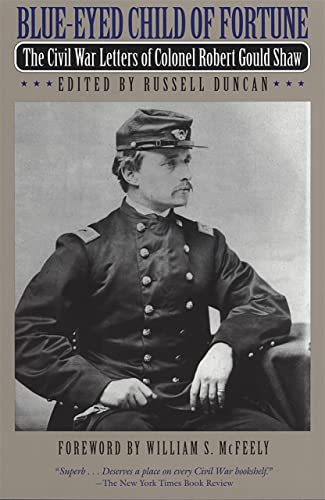
On the Boston Common stands one of the great Civil War memorials, a magnificent bronze sculpture by Augustus Saint-Gaudens. It depicts the black soldiers of the Fifty-fourth Massachusetts Infantry marching alongside their young white commander, Colonel Robert Gould Shaw. When the philosopher William James dedicated the memorial in May 1897, he stirred the assembled crowd with these words: "There they march, warm-blooded champions of a better day for man. There on horseback among them, in the very habit as he lived, sits the blue-eyed child of fortune."
In this book Shaw speaks for himself with equal eloquence through nearly two hundred letters he wrote to his family and friends during the Civil War. The portrait that emerges is of a man more divided and complex--though no less heroic--than the Shaw depicted in the celebrated film Glory. The pampered son of wealthy Boston abolitionists, Shaw was no abolitionist himself, but he was among the first patriots to respond to Lincoln's call for troops after the attack on Fort Sumter. After Cedar Mountain and Antietam, Shaw knew the carnage of war firsthand. Describing nightfall on the Antietam battlefield, he wrote, "the crickets chirped, and the frogs croaked, just as if nothing unusual had happened all day long, and presently the stars came out bright, and we lay down among the dead, and slept soundly until daylight. There were twenty dead bodies within a rod of me." When Federal war aims shifted from an emphasis on restoring the Union to the higher goal of emancipation for four million slaves, Shaw's mother pressured her son into accepting the command of the North's vanguard black regiment, the Fifty-fourth Massachusetts. A paternalist who never fully reconciled his own prejudices about black inferiority, Shaw assumed the command with great reluctance. Yet, as he trained his recruits in Readville, Massachusetts, during the early months of 1963, he came to respect their pluck and dedication. "There is not the least doubt," he wrote his mother, "that we shall leave the state, with as good a regiment, as any that has marched." Despite such expressions of confidence, Shaw in fact continued to worry about how well his troops would perform under fire. The ultimate test came in South Carolina in July 1863, when the Fifty-fourth led a brave but ill-fated charge on Fort Wagner, at the approach to Charleston Harbor. As Shaw waved his sword and urged his men forward, an enemy bullet felled him on the fort's parapet. A few hours later the Confederates dumped his body into a mass grave with the bodies of twenty of his men. Although the assault was a failure from a military standpoint, it proved the proposition to which Shaw had reluctantly dedicated himself when he took command of the Fifty-fourth: that black soldiers could indeed be fighting men. By year's end, sixty new black regiments were being organized. A previous selection of Shaw's correspondence was privately published by his family in 1864. For this volume, Russell Duncan has restored many passages omitted from the earlier edition and has provided detailed explanatory notes to the letters. In addition he has written a lengthy biographical essay that places the young colonel and his regiment in historical context.Die Inhaltsangabe kann sich auf eine andere Ausgabe dieses Titels beziehen.
Über die Autorin bzw. den Autor
ROBERT GOULD SHAW (1837-1863) commanded the first all-black regiment (54th Massachusetts) in the Northeast during the Civil War. He was killed at the Second Battle of Fort Wagner, near Charleston, South Carolina.
„Über diesen Titel“ kann sich auf eine andere Ausgabe dieses Titels beziehen.
Suchergebnisse für Blue-Eyed Child of Fortune: The Civil War Letters of...

Beispielbild für diese ISBN
Blue-Eyed Child of Fortune : The Civil War Letters of Colonel Robert Gould Shaw
Verlag:
University of Georgia Press, 1999
ISBN 10: 0820321745
ISBN 13: 9780820321745
Gebraucht
Softcover
Anbieter: Better World Books, Mishawaka, IN, USA
Verkäuferbewertung 5 von 5 Sternen

Zustand: Good. New Ed. Pages intact with minimal writing/highlighting. The binding may be loose and creased. Dust jackets/supplements are not included. Stock photo provided. Product includes identifying sticker. Better World Books: Buy Books. Do Good. Artikel-Nr. 9919198-6
Gebraucht kaufen
EUR 21,63
Versand gratis
Versand innerhalb von USA
Versand innerhalb von USA
Anzahl: 1 verfügbar
Beispielbild für diese ISBN
Blueeyed Child of Fortune Civi
Verlag:
University of Georgia Press, 1999
ISBN 10: 0820321745
ISBN 13: 9780820321745
Gebraucht
Softcover
Anbieter: World of Books (was SecondSale), Montgomery, IL, USA
Verkäuferbewertung 5 von 5 Sternen
Zustand: Very Good. Item in very good condition! Textbooks may not include supplemental items i.e. CDs, access codes etc. Artikel-Nr. 00108319467
Gebraucht kaufen
EUR 23,44
Versand gratis
Versand innerhalb von USA
Versand innerhalb von USA
Anzahl: 1 verfügbar
Beispielbild für diese ISBN
Blue-Eyed Child of Fortune: The Civil War Letters of Colonel Robert Gould Shaw
Verlag:
University of Georgia Press, 1999
ISBN 10: 0820321745
ISBN 13: 9780820321745
Gebraucht
Paperback
Anbieter: WorldofBooks, Goring-By-Sea, WS, Vereinigtes Königreich
Verkäuferbewertung 5 von 5 Sternen
Paperback. Zustand: Very Good. The book has been read, but is in excellent condition. Pages are intact and not marred by notes or highlighting. The spine remains undamaged. Artikel-Nr. GOR008144074
Gebraucht kaufen
EUR 26,89
EUR 6,52 Versand
Versand von Vereinigtes Königreich nach USA
Versand von Vereinigtes Königreich nach USA
Anzahl: 2 verfügbar
Beispielbild für diese ISBN
Blue-Eyed Child of Fortune: The Civil War Letters of Colonel Robert Gould Shaw
Anbieter: Ria Christie Collections, Uxbridge, Vereinigtes Königreich
Verkäuferbewertung 5 von 5 Sternen
Zustand: New. In English. Artikel-Nr. ria9780820321745_new
Neu kaufen
EUR 44,37
EUR 13,15 Versand
Versand von Vereinigtes Königreich nach USA
Versand von Vereinigtes Königreich nach USA
Anzahl: Mehr als 20 verfügbar
Beispielbild für diese ISBN
BlueEyed Child of Fortune The Civil War Letters of Colonel Robert Gould Shaw
Anbieter: Revaluation Books, Exeter, Vereinigtes Königreich
Verkäuferbewertung 5 von 5 Sternen
Paperback. Zustand: Brand New. 480 pages. 9.25x6.25x1.25 inches. In Stock. Artikel-Nr. x-0820321745
Neu kaufen
EUR 59,96
EUR 14,56 Versand
Versand von Vereinigtes Königreich nach USA
Versand von Vereinigtes Königreich nach USA
Anzahl: 2 verfügbar
Foto des Verkäufers
Blue-Eyed Child of Fortune : The Civil War Letters of Colonel Robert Gould Shaw
Verlag:
University Of Georgia Press Nov 1999, 1999
ISBN 10: 0820321745
ISBN 13: 9780820321745
Neu
Taschenbuch
Anbieter: AHA-BUCH GmbH, Einbeck, Deutschland
Verkäuferbewertung 5 von 5 Sternen
Taschenbuch. Zustand: Neu. Neuware - Only two months after his marriage, twenty-six-year-old Robert Gould Shaw, the commander of the Union Army's vanguard black regiment, gave his life to the cause of freedom. These letters portray the celebrated abolitionist hero in his own words, revealing a man sometimes very different from the Shaw lauded in art, poetry, and film. Shaw's frank and eloquent descriptions of his coming of age in upper-class Boston circles and in two years of battle vividly detail the transformation of a cosmopolitan son into a disciplined and devoted soldier. Artikel-Nr. 9780820321745
Neu kaufen
EUR 62,74
EUR 30,50 Versand
Versand von Deutschland nach USA
Versand von Deutschland nach USA
Anzahl: 1 verfügbar
Foto des Verkäufers
Blue-Eyed Child of Fortune: The Civil War Letters of Colonel Robert Gould Shaw
Anbieter: moluna, Greven, Deutschland
Verkäuferbewertung 5 von 5 Sternen
Zustand: New. Über den AutorROBERT GOULD SHAW (1837-1863) commanded the first all-black regiment (54th Massachusetts) in the Northeast during the Civil War. He was killed at the Second Battle of Fort Wagner, near Charleston, South Carolina. Artikel-Nr. 898828905
Neu kaufen
EUR 51,05
EUR 48,99 Versand
Versand von Deutschland nach USA
Versand von Deutschland nach USA
Anzahl: Mehr als 20 verfügbar