
Verwandte Artikel zu Embodied Spirits: Stories of Spiritual Directors of...
Inhaltsangabe
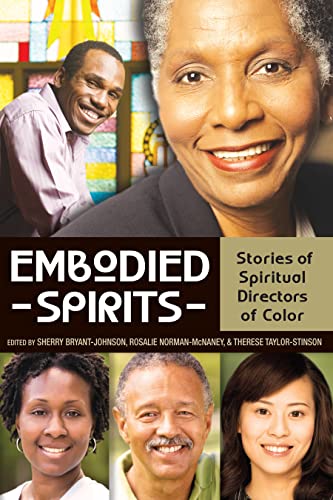
First book addressing the concerns and issues of people of color in spiritual direction
“These essays speak of how we have incorporated our contemplative practices into our family life; our urban, non-religious background; how we have been nurtured in struggles for health and life through our contemplative prayer practices and our courage to survive and even thrive in the midst of dire circumstances. We speak of the unfolding bridge between faith and culture; our conflicts with an Interspiritual journey with a Christian foundation; our sexuality; our journey to healing and authenticity; and how we are taking this practice that began in the first centuries of the church with the desert mothers and fathers to the present and into the future with spiritual direction through the Internet across the world.” ―from the Introduction
Die Inhaltsangabe kann sich auf eine andere Ausgabe dieses Titels beziehen.
Über die Autorinnen und Autoren
Sherry Bryant-Johnson, an ordained deacon in the United Methodist Church, is associate director of the Center for Ministry, a Christian leadership development organization in Jackson, Mississippi. She holds professional certification in spiritual formation through the General Board of Higher Education and Ministry of the United Methodist Church and is a member of Spiritual Directors International and the Fellowship of United Methodist Retreat Leaders and Spiritual Directors.
Therese Taylor-Stinson is a native of Washington, DC, and an ordained Deacon and Ruling Elder in the Presbyterian Church (USA), who recently served as Moderator of the National Capital Presbytery. Taylor-Stinson is a founder and incorporator of the Spiritual Directors of Color Network, Ltd., and serves as the Managing Member. A graduate of the Shalem Institute for Spiritual Formation, she has served on the board of directors, is a member of the Shalem Society for Contemplative Leadership, and was commissioned associate faculty to offer Shalem's Personal Spiritual Deepening Program in her local community.
Rosalie E. Norman-McNaney, MDiv, M.Ed., is an ordained American Baptist minister and graduate of the Shalem Institute for Spiritual Formation. She offers individual and group spiritual direction as well as serving as a conference, workshop, and retreat leader.
Auszug. © Genehmigter Nachdruck. Alle Rechte vorbehalten.
EMBODIED SPIRITS
Stories of Spiritual Directors of Color
By SHERRY BRYANT-JOHNSON, ROSALIE NORMAN-MCNANEY, THERESE TAYLOR-STINSONChurch Publishing Incorporated
Copyright © 2014 Sherry Bryant-Johnson, Rosalie Norman-McNaney, and Therese Taylor-Stinson
All rights reserved.
ISBN: 978-0-8192-2893-2All rights reserved.
Contents
Foreword,
Acknowledgments,
Introduction,
Chapter 1 Cross-Cultural Spiritual Direction: To Construct a Borderland Jung Eun Sophia Park,
Chapter 2 Trouble Don't Last Always: Toward a Spirituality of Hope Maurice J. Nutt,
Chapter 3 Living My Legacy Sherry Bryant-Johnson,
Chapter 4 I Am Spirit Lakesha S. Bradshaw,
Chapter 5 Praying without Ceasing: Basking in the Loving Presence of God Lerita Coleman Brown,
Chapter 6 Claimed: A Transformational Journey of Holiness, Wholeness, and Ministry Cynthia Bailey Manns,
Chapter 7 Becoming a Contemplative Sistah: Finding Weird Joy in Spiritual Freedom Ineda P. Adesanya,
Chapter 8 Spiritual Journey for the Birthing of My Soul Rosalie Norman-McNaney,
Chapter 9 Spiraling Into Trust Gigi Ross,
Chapter 10 Rest Works: Quiet Times Fuel Grateful Activity Maisie Sparks,
Chapter 11 Ethnic Identity and the Call to Faith Rev. Gibbon Bogatsu,
Chapter 12 Spiritual Journey to Spiritual Direction Ruqaiyah Nabe,
Chapter 13 The Journey Home Therese Taylor-Stinson,
About the Authors,
CHAPTER 1
Cross-Cultural Spiritual Direction: To Construct a Borderland
Jung Eun Sophia Park, SNJM, Ph.D.
Once
By mistake
She tore a map
in half.
She taped it back,
but crookedly.
Now all the roads
ended in water.
There were mountains
right next to her hometown.
Wouldn't that be nice
If it were true?
I'd tear a map
And be right next
to you.
As the well-known Palestinian American poet Naomi Shihab Nye describes, a woman happened to tear a map and then taped it back together; now the line is crooked, so an unanticipated stranger can be a companion. Of course, in today's world, this event is not just one individual person's imagination. Rather, it is a common experience: to encounter the "other" in this way. In today's global world, one of the most remarkable phenomena is multiculturalism, and it designates cultural diversity in a society. Although the meaning and implication of multiculturalism are very ambiguous, people are already beginning to live in this multicultural way. That being the case, the consequential question regarding multiculturalism is how to deal with differences within the same culture. In a culture that includes different cultures, the cross-cultural aspect should be considered seriously unless multiculturalism means just separated cultural groupings. In this article, I want to apply the topic of cross-cultural encounter to spiritual direction, utilizing the concept of borderland. First, I will characterize spiritual direction as a borderland in which a spiritual director and a directee experience mutual transformation, without losing their own identities. Second, I will give an example of creating a borderland in a spiritual directors training program. In so doing, finally, I will delineate necessary elements for creating a borderland in spiritual direction.
Spiritual Direction: To Create a Borderland
There are many metaphors for spiritual direction. My preference is dance. Each dance can be different according to the rhythm and the partner. Thus, a good dancer needs to have the sensitivity to be aware of the rhythm of the dance itself as well as the unique rhythm that the other carries. Cross-cultural spiritual direction is a dance with a stranger who does not seem to have a rhythm familiar to me. It means that a spiritual director and directee who come from different cultures in terms of denomination or even religion itself, as well as any one or all of the following subcultures: ethnicity, gender, age, and class, sit together in front of the Holy Spirit and appreciate, understand, and examine how the Spirit guides the directee's life.
Very often, cross-cultural spiritual direction is considered simply as the case when the spiritual director meets a directee from another country. In this case, the director may see this as the sole difference, but in reality the range of foreignness can be much more diverse and complex. First of all, the spiritual director should examine what stage the directee is in: alignment with his or her home country; negating the home country; or in between the home country and the hosting country. Also, the directee's relationship with the mainline culture and/or with the diaspora community in the hosting country can determine the directee's spiritual life.
Furthermore, cross-cultural encounter is never limited only in terms of ethnicity and race. Cross-cultural encounter happens at almost every spiritual direction, considering the subcultures to which people can belong. Then, any spiritual direction, in a sense, is cross-cultural, and this element should be counted as an essential part, not as an addendum.
The concept of borderland is useful to enhance understanding of the crosscultural aspect of spiritual direction. The borderland itself is a place in between the two different national borders. Very often in this area, the border becomes porous, the division blurred, and in this way, the two cultures interact and create an alternative, a third culture. This "third space" is never dominated by one culture, nor simply a sum of the two cultures.
In cross-cultural spiritual direction, the space that a spiritual director and directee create is the third space, where two different cultures encounter one another. As a matter of fact, in studying borders, we can see how violent the border area can be. In general, border towns are dangerous and highly violent. For example, the Texas-Mexico border is notorious for its high rates of shooting by drug cartels and of human trafficking.
However, the same area creates a new culture, which can be transformative and life-giving. This transforming borderland is a heterotopia, which praises difference, rejecting any universal notion and embracing multiple and opposing messages. Hispanic, immigrant poet and feminist Gloria Anzaldua, in her Borderlands/La Fronterra, explains how her own inner conflicts prompted her to be an agent of transformation. The various disagreeing inner voices function as an agent of her own transformation, as well as that of the others. It is likely that a subculture that itself includes conflicting and dissonant elements has the energy to transform the whole culture.
In this borderland, mutual transformation happens, and it is of great merit to cross-cultural spiritual direction. In other words, cross-cultural spiritual direction assumes bi-directional, mutual transformation rather than a spiritual director's service to the directee. On the one hand, as Homi Bhabha contends, the residents who live in the borderland or the third space can experience empowerment and transformation when they can articulate their situation. Then, it is very clear that spiritual direction can be an agent to help a directee to articulate experiences, which include personal and internal conflicts as well as social and structural conflicts. In this way, the directee experiences empowerment.
On the other hand, for the director in a cross-cultural spiritual direction session, one of the most common experiences is to hold all the disagreement and oppositions created through the encounter in silence...
„Über diesen Titel“ kann sich auf eine andere Ausgabe dieses Titels beziehen.
Suchergebnisse für Embodied Spirits: Stories of Spiritual Directors of...

Beispielbild für diese ISBN
Embodied Spirits: Stories of Spiritual Directors of Color
Anbieter: World of Books (was SecondSale), Montgomery, IL, USA
Verkäuferbewertung 5 von 5 Sternen

Paperback. Zustand: Good. First book addressing the concerns and issues of people of color in spiritual direction ?These essays speak of how we have incorporated our contemplative practices into our family life; our urban, non-religious background; how we have been nurtured in struggles for health and life through our contemplative prayer practices and our courage to survive and even thrive in the midst of dire circumstances. We speak of the unfolding bridge between faith and culture; our conflicts with an Interspiritual journey with a Christian foundation; our sexuality; our journey to healing and authenticity; and how we are taking this practice that began in the first centuries of the church with the desert mothers and fathers to the present and into the future with spiritual direction through the Internet across the world.? ?from the Introduction. Artikel-Nr. 00104486844
Gebraucht kaufen
EUR 7,08
Versand gratis
Versand innerhalb von USA
Versand innerhalb von USA
Anzahl: 4 verfügbar
Beispielbild für diese ISBN
Embodied Spirits : Stories of Spiritual Directors of Color
Verlag:
Church Publishing Incorporated, 2013
ISBN 10: 0819228931
ISBN 13: 9780819228932
Gebraucht
Softcover
Anbieter: Better World Books: West, Reno, NV, USA
Verkäuferbewertung 5 von 5 Sternen
Zustand: Good. Former library copy. Pages intact with minimal writing/highlighting. The binding may be loose and creased. Dust jackets/supplements are not included. Includes library markings. Stock photo provided. Product includes identifying sticker. Better World Books: Buy Books. Do Good. Artikel-Nr. 16492995-6
Gebraucht kaufen
EUR 7,09
Versand gratis
Versand innerhalb von USA
Versand innerhalb von USA
Anzahl: 1 verfügbar
Beispielbild für diese ISBN
Embodied Spirits: Stories of Spiritual Directors of Color
Anbieter: ThriftBooks-Phoenix, Phoenix, AZ, USA
Verkäuferbewertung 5 von 5 Sternen
Paperback. Zustand: Good. No Jacket. Pages can have notes/highlighting. Spine may show signs of wear. ~ ThriftBooks: Read More, Spend Less. Artikel-Nr. G0819228931I3N00
Gebraucht kaufen
EUR 7,79
Versand gratis
Versand innerhalb von USA
Versand innerhalb von USA
Anzahl: 1 verfügbar
Beispielbild für diese ISBN
Embodied Spirits: Stories of Spiritual Directors of Color
Anbieter: ThriftBooks-Atlanta, AUSTELL, GA, USA
Verkäuferbewertung 5 von 5 Sternen
Paperback. Zustand: Fair. No Jacket. Readable copy. Pages may have considerable notes/highlighting. ~ ThriftBooks: Read More, Spend Less. Artikel-Nr. G0819228931I5N00
Gebraucht kaufen
EUR 7,81
Versand gratis
Versand innerhalb von USA
Versand innerhalb von USA
Anzahl: 1 verfügbar
Beispielbild für diese ISBN
Embodied Spirits: Stories of Spiritual Directors of Color
Anbieter: ThriftBooks-Dallas, Dallas, TX, USA
Verkäuferbewertung 5 von 5 Sternen
Paperback. Zustand: Good. No Jacket. Pages can have notes/highlighting. Spine may show signs of wear. ~ ThriftBooks: Read More, Spend Less. Artikel-Nr. G0819228931I3N00
Gebraucht kaufen
EUR 7,81
Versand gratis
Versand innerhalb von USA
Versand innerhalb von USA
Anzahl: 1 verfügbar
Beispielbild für diese ISBN
Embodied Spirits
Anbieter: PBShop.store US, Wood Dale, IL, USA
Verkäuferbewertung 5 von 5 Sternen
PAP. Zustand: New. New Book. Shipped from UK. Established seller since 2000. Artikel-Nr. CX-9780819228932
Beispielbild für diese ISBN
Embodied Spirits
Anbieter: PBShop.store UK, Fairford, GLOS, Vereinigtes Königreich
Verkäuferbewertung 5 von 5 Sternen
PAP. Zustand: New. New Book. Shipped from UK. Established seller since 2000. Artikel-Nr. CX-9780819228932
Neu kaufen
EUR 17,65
EUR 4,84 Versand
Versand von Vereinigtes Königreich nach USA
Versand von Vereinigtes Königreich nach USA
Anzahl: 15 verfügbar
Beispielbild für diese ISBN
Embodied Spirits
Verlag:
Church Publishing, Incorporated, 2013
ISBN 10: 0819228931
ISBN 13: 9780819228932
Neu
Softcover
Anbieter: Majestic Books, Hounslow, Vereinigtes Königreich
Verkäuferbewertung 4 von 5 Sternen

Zustand: New. pp. 176. Artikel-Nr. 95976407
Neu kaufen
EUR 24,73
EUR 7,56 Versand
Versand von Vereinigtes Königreich nach USA
Versand von Vereinigtes Königreich nach USA
Anzahl: 1 verfügbar
Beispielbild für diese ISBN
Embodied Spirits: Stories of Spiritual Directors of Color
Anbieter: Ria Christie Collections, Uxbridge, Vereinigtes Königreich
Verkäuferbewertung 5 von 5 Sternen
Zustand: New. In English. Artikel-Nr. ria9780819228932_new
Neu kaufen
EUR 21,42
EUR 10,90 Versand
Versand von Vereinigtes Königreich nach USA
Versand von Vereinigtes Königreich nach USA
Anzahl: Mehr als 20 verfügbar
Beispielbild für diese ISBN
Embodied Spirits: Stories of Spiritual Directors of Color
Anbieter: Revaluation Books, Exeter, Vereinigtes Königreich
Verkäuferbewertung 5 von 5 Sternen
Paperback. Zustand: Brand New. 176 pages. 8.75x6.00x0.50 inches. In Stock. Artikel-Nr. x-0819228931
Neu kaufen
EUR 22,44
EUR 11,63 Versand
Versand von Vereinigtes Königreich nach USA
Versand von Vereinigtes Königreich nach USA
Anzahl: 2 verfügbar