
Verwandte Artikel zu A User's Guide to the Book of Common Prayer: Morning...
Inhaltsangabe
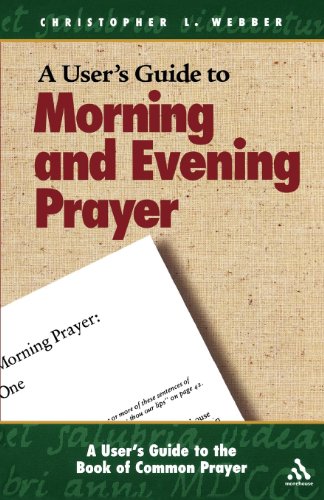
The only way you can really get to know God is through prayer, says author Christopher L. Webber, and the Prayer Book sets out a pattern that has been used by saints and sinners for centuries. This guide will help readers, newcomers, and longtime Episcopalians alike get started on the ancient way of praying found in the Daily Office of the Book of Common Prayer. A User's Guide illuminates the theology, history, and practical concerns of worshipping God in Morning and Evening Prayer. With the complete text of these prayer services, in both Rite I and Rite II, along with running commentary, this book takes Episcopalians by the hand as they explore and pray the Daily Office.
Die Inhaltsangabe kann sich auf eine andere Ausgabe dieses Titels beziehen.
Über die Autorin bzw. den Autor
Christopher L. Webber, a graduate of Princeton University and the General Theological Seminary in New York, is an Episcopal priest who has led urban, rural, and overseas parishes. He is the author of several books, including Welcome to Christian Faith,Beyond Beowulf, and A Year with American Saints, co-authored with Lutheran Pastor G. Scott Cady. Webber grew up in Cuba, New York, and lives in San Francisco.
Auszug. © Genehmigter Nachdruck. Alle Rechte vorbehalten.
A User's Guide to the Book of Common Prayer
Morning and Evening Prayer
By Christopher L. WebberChurch Publishing Incorporated
Copyright © 2005 Christopher L. Webber
All rights reserved.
ISBN: 978-0-8192-2197-1All rights reserved.
Contents
| Part I: Daily Morning Prayer | |
| Introduction | |
| Commentary | |
| Part II: Daily Evening Prayer | |
| Commentary | |
| Glossary | |
| Suggestions for Further Reading | |
| Index |
Excerpt
CHAPTER 1
Daily Morning Prayer
Introduction
Apart from the Holy Eucharist, Morning and Evening Prayer are the most familiarservices of the Book of Common Prayer. But they are very different in characterfrom the Holy Eucharist. The Eucharist is primarily an action in which we areinvolved, and, to a degree, an end in itself. Morning and EveningPrayer—also known as the Daily Offices, from the Latin word for"duty"—are more contemplative than active and are primarily a means fordoing something else. They are intended to provide, first, a pattern for readingthe Bible, and, second, a framework for our day.
In the 1979 Book of Common Prayer, the basic structure of Morning and EveningPrayer remains essentially unchanged from the pattern of the very first PrayerBook, compiled by Archbishop Thomas Cranmer in 1549. The 1979 Prayer Bookprovides two versions: one in traditional Elizabethan English (Rite I) and onein contemporary English (Rite II). No matter which version we use, no matterwhere we take part in the services—in a cathedral or parish church, athome, in an office, or on a commuter train—we are sanctifying time byframing each day with prayer. No matter the setting, the goal of the DailyOffice remains the same: to provide opportunity for every Christian to offereach day to God.
A Pattern for Reading the Bible
In monastic communities, one of the reasons the monks prayed the Daily Officeswas to read the Bible through in some systematic way. In the Middle Ages thegrowing number of saints' days interrupted the regular pattern of readings, andone of Archbishop Cranmer's objectives was to enable lay people to hear thewhole Bible read.
Central to both Morning and Evening Prayer are the readings from the Bible. InCranmer's plan there was to be one reading from the Old Testament and one fromthe New at each service. Most of the Old Testament and the Apocrypha would beread through each year, and the New Testament (except for the Book ofRevelation) was to be read through three times each year. The psalms weredivided into sixty segments so that by reading one at each service, morning andevening, the whole psalter could be read each month.
The 1979 Book of Common Prayer allows for the use of the thirty-day cycle ofpsalm readings but also provides a schedule that distributes the psalms overseven weeks through most of the year. Three Lessons, one each from the OldTestament, the Epistles, and the Gospels, are provided for each day with thesuggestion that two be read in the morning and one in the evening. Followingthis pattern, most of the Old Testament would be read through in two years andmost of the New Testament every year. Alternative plans include reading threeLessons at one service daily or two Lessons at both daily services. (See page934 of the Book of Common Prayer for more information.)
The readings from the Bible are preceded by the psalms and separated andfollowed by Canticles. The Canticles provide opportunity to reflect on thereadings while they are said or sung and to respond to the readings with praise.The readings and Canticles are followed by the Apostles' Creed, so that thereadings lead to a statement of faith. The service then concludes with prayer.Morning and Evening Prayer are, then, biblical services: a way to read the Biblein a careful and systematic way as part of an offering of praise and prayer bythe Christian community.
Just as the monastic offices were usually sung, so Morning and Evening Prayerhave developed a rich heritage of music. Music adds to the beauty of theservice, but there is also a very practical advantage to singing. Chanting thepsalms and Canticles makes it easier to recite them in unison, and chanting theprayers makes it easier to hear the words, especially in a large church orcathedral. Evening Prayer, especially, is so often sung that it is commonlyreferred to as "Evensong." But while the Daily Offices may be elaborately sung,they may also be recited very simply by a few people in a small chapel or saidprivately by an individual with a Bible and a prayer book and ten or fifteenquiet minutes. Doing so frames our time in a Bible-centered pattern of prayer,shared in by countless Christians throughout the world.
A Framework for the Day
Time is God's most elusive gift: there is no way to hold it or change it. But wecan measure it and, indeed, one of the psalms (104:20) suggests that God madethe moon specifically to mark the seasons for us. If we can measure time, thenwe can also set aside a part of it to give back to God, just as we set asideparts of all our other gifts to offer them to the God who gives them to us. Withtime, as with money, we can find ways to set aside part as a way of showing thatall of it belongs to God. The Sabbath was set aside as a way of making the wholeweek holy, and, in the same way, we set aside times of daily prayer to mark eachday as God's. This marking and offering of time to God is an act of bothstewardship and praise.
Christians inherited a pattern of daily prayer from the Jews, who set asidethree times of prayer daily. But Christians found the psalm verse (119:164) thatsays, "Seven times a day do I praise you" and by the Middle Ages monks haddeveloped a tradition of seven daily times of prayer:
Matins before dawn and Lauds at daybreak, combined into one service;Prime, at the beginning of the work day;Terce, Sext, and None at midmorning, noon, and midafternoon;Vespers at sundown;and Compline at bedtime.
Obviously, such a schedule could be kept only by monks and nuns, though laypeople were encouraged to attend when they could.
In the first English Book of Common Prayer, Archbishop Cranmer set out tocombine and revise the Daily Offices so that ordinary people could take part inthem. The two new services of Morning Prayer and Evening Prayer would replacethe sevenfold pattern and provide a way for everyone to praise God at thebeginning and end of each day. These services, required for the clergy, becameso popular that for centuries they pushed aside the Eucharist and even becamethe principal Sunday services, for both morning and evening. With the revisionsof the 1979 Prayer Book restoring the Eucharist to its central place, however,Morning and Evening Prayer, in their turn, have often been pushed aside. As aremedy, the 1979 Prayer Book offers brief "Daily Devotions" for morning, noon,early evening, and close of day (BCP pages 136–140) and also restores theservice of Compline to assist Christians who want a fuller structure of prayerfor their daily lives.
How to Use Morning (and Evening) Prayer
For most Christians daily attendance at church morning and evening will beimpractical, but the Daily Offices can be used at home (before breakfast orafter dinner, for example) or in the office, or even while traveling. Longer andshorter versions can be used, as follows.
1 - Full Morning Prayer (Rite II)
Opening sentences...
„Über diesen Titel“ kann sich auf eine andere Ausgabe dieses Titels beziehen.
Suchergebnisse für A User's Guide to the Book of Common Prayer: Morning...

Beispielbild für diese ISBN
A User's Guide to the Book of Common Prayer: Morning and Evening Prayer
Verlag:
Morehouse Publishing (edition First Edition), 2006
ISBN 10: 081922197X
ISBN 13: 9780819221971
Gebraucht
Paperback
Erstausgabe
Anbieter: BooksRun, Philadelphia, PA, USA
Verkäuferbewertung 5 von 5 Sternen

Paperback. Zustand: Very Good. First Edition. It's a well-cared-for item that has seen limited use. The item may show minor signs of wear. All the text is legible, with all pages included. It may have slight markings and/or highlighting. Artikel-Nr. 081922197X-11-1
Gebraucht kaufen
EUR 4,80
Versand gratis
Versand innerhalb von USA
Versand innerhalb von USA
Anzahl: 1 verfügbar
Beispielbild für diese ISBN
A User's Guide to the Book of Common Prayer : Morning and Evening Prayer
Verlag:
Church Publishing Incorporated, 2006
ISBN 10: 081922197X
ISBN 13: 9780819221971
Gebraucht
Softcover
Anbieter: Better World Books, Mishawaka, IN, USA
Verkäuferbewertung 5 von 5 Sternen
Zustand: Very Good. Pages intact with possible writing/highlighting. Binding strong with minor wear. Dust jackets/supplements may not be included. Stock photo provided. Product includes identifying sticker. Better World Books: Buy Books. Do Good. Artikel-Nr. 19216998-6
Gebraucht kaufen
EUR 6,56
Versand gratis
Versand innerhalb von USA
Versand innerhalb von USA
Anzahl: 1 verfügbar
Beispielbild für diese ISBN
A User's Guide to the Book of Common Prayer : Morning and Evening Prayer
Verlag:
Church Publishing Incorporated, 2006
ISBN 10: 081922197X
ISBN 13: 9780819221971
Gebraucht
Softcover
Anbieter: Better World Books, Mishawaka, IN, USA
Verkäuferbewertung 5 von 5 Sternen
Zustand: Good. Pages intact with minimal writing/highlighting. The binding may be loose and creased. Dust jackets/supplements are not included. Stock photo provided. Product includes identifying sticker. Better World Books: Buy Books. Do Good. Artikel-Nr. 6147277-6
Gebraucht kaufen
EUR 6,56
Versand gratis
Versand innerhalb von USA
Versand innerhalb von USA
Anzahl: 1 verfügbar
Beispielbild für diese ISBN
A User's Guide to the Book of Common Prayer: Morning and Evening Prayer
Anbieter: ThriftBooks-Dallas, Dallas, TX, USA
Verkäuferbewertung 5 von 5 Sternen
Paperback. Zustand: Good. No Jacket. Pages can have notes/highlighting. Spine may show signs of wear. ~ ThriftBooks: Read More, Spend Less. Artikel-Nr. G081922197XI3N00
Gebraucht kaufen
EUR 6,62
Versand gratis
Versand innerhalb von USA
Versand innerhalb von USA
Anzahl: 1 verfügbar
Beispielbild für diese ISBN
A User's Guide to the Book of Common Prayer: Morning and Evening Prayer
Anbieter: ThriftBooks-Dallas, Dallas, TX, USA
Verkäuferbewertung 5 von 5 Sternen
Paperback. Zustand: Very Good. No Jacket. May have limited writing in cover pages. Pages are unmarked. ~ ThriftBooks: Read More, Spend Less. Artikel-Nr. G081922197XI4N00
Gebraucht kaufen
EUR 6,62
Versand gratis
Versand innerhalb von USA
Versand innerhalb von USA
Anzahl: 1 verfügbar
Beispielbild für diese ISBN
A User's Guide to the Book of Common Prayer: Morning and Evening Prayer
Anbieter: ThriftBooks-Atlanta, AUSTELL, GA, USA
Verkäuferbewertung 5 von 5 Sternen
Paperback. Zustand: Very Good. No Jacket. May have limited writing in cover pages. Pages are unmarked. ~ ThriftBooks: Read More, Spend Less. Artikel-Nr. G081922197XI4N00
Gebraucht kaufen
EUR 6,62
Versand gratis
Versand innerhalb von USA
Versand innerhalb von USA
Anzahl: 1 verfügbar
Beispielbild für diese ISBN
A User's Guide to the Book of Common Prayer: Morning and Evening Prayer
Anbieter: ThriftBooks-Dallas, Dallas, TX, USA
Verkäuferbewertung 5 von 5 Sternen
Paperback. Zustand: As New. No Jacket. Pages are clean and are not marred by notes or folds of any kind. ~ ThriftBooks: Read More, Spend Less. Artikel-Nr. G081922197XI2N00
Gebraucht kaufen
EUR 6,62
Versand gratis
Versand innerhalb von USA
Versand innerhalb von USA
Anzahl: 1 verfügbar
Beispielbild für diese ISBN
A User's Guide to the Book of Common Prayer: Morning and Evening Prayer
Anbieter: ThriftBooks-Reno, Reno, NV, USA
Verkäuferbewertung 5 von 5 Sternen
Paperback. Zustand: Very Good. No Jacket. May have limited writing in cover pages. Pages are unmarked. ~ ThriftBooks: Read More, Spend Less. Artikel-Nr. G081922197XI4N00
Gebraucht kaufen
EUR 6,62
Versand gratis
Versand innerhalb von USA
Versand innerhalb von USA
Anzahl: 1 verfügbar
Beispielbild für diese ISBN
A User's Guide to the Book of Common Prayer
Verlag:
Church Publishing, Incorporated, 2006
ISBN 10: 081922197X
ISBN 13: 9780819221971
Neu
Softcover
Anbieter: Majestic Books, Hounslow, Vereinigtes Königreich
Verkäuferbewertung 4 von 5 Sternen

Zustand: New. pp. 98 1:B&W 5.5 x 8.5 in or 216 x 140 mm (Demy 8vo) Perfect Bound on Creme w/Gloss Lam. Artikel-Nr. 7959471
Neu kaufen
EUR 18,21
EUR 7,69 Versand
Versand von Vereinigtes Königreich nach USA
Versand von Vereinigtes Königreich nach USA
Anzahl: 1 verfügbar
Beispielbild für diese ISBN
A User's Guide to Morning and Evening Prayer (User's Guide to the Book of Common Prayer: Morning and Eveni)
Anbieter: Revaluation Books, Exeter, Vereinigtes Königreich
Verkäuferbewertung 5 von 5 Sternen
Paperback. Zustand: Brand New. 52 pages. 8.50x5.50x0.25 inches. In Stock. Artikel-Nr. x-081922197X
Neu kaufen
EUR 16,26
EUR 11,84 Versand
Versand von Vereinigtes Königreich nach USA
Versand von Vereinigtes Königreich nach USA
Anzahl: 2 verfügbar