
Verwandte Artikel zu Welcome to the Church Year: An Introduction to the...
Inhaltsangabe
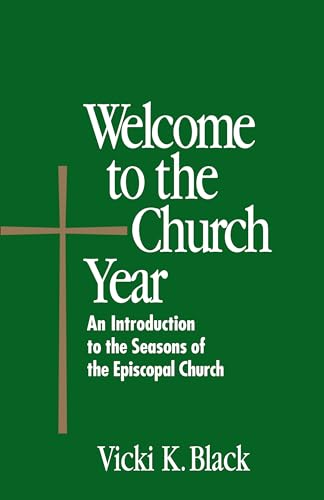
From birthday cakes and anniversary dinners to summer vacations at the beach, each family has its own ways of marking the days and seasons of its life. For the Christian family―especially Episcopalians―it’s no different. With an array of colors and an assortment of rich traditions, Episcopalians move through the Church year, marking the days and seasons that tell the story of Christ in our lives―in history and today.
This book―written for newcomers to the Episcopal Church as well as lifelong members―takes readers by the hand and leads them through the Church year, from the first Sunday of Advent through the last Sunday of Pentecost, answering questions like “Why do we use purple in Lent?” and “What does Maundy Thursday mean?” In an easy-to-read conversational style, Welcome to the Church Year introduces readers to the traditions of the Church seasons and explains why we do what we do. But it does more than offer interesting trivia about church vestments and pageantry. Its insights can help readers participate in the liturgies of the Church year in a deeper, more meaningful way.
Die Inhaltsangabe kann sich auf eine andere Ausgabe dieses Titels beziehen.
Über die Autorin bzw. den Autor
Vicki K. Black is a writer, editor, and book designer. She is the author of Welcome to the Bible, Welcome to the Book of Common Prayer, and Welcome to the Church Year, three popular church titles all published by Morehouse. She and her family live in Maine.
Auszug. © Genehmigter Nachdruck. Alle Rechte vorbehalten.
Welcome to the Church Year
An Introduction to the Seasons of the Episcopal ChurchBy Vicki K. BlackChurch Publishing Incorporated
Copyright © 2004 Vicki BlackAll right reserved.
ISBN: 978-0-8192-1966-4
Contents
Chapter One
Welcome to the Church Year
When our son Benjamin was about four years old, he was given a Spirograph set at a birthday party. I was delighted to know they still made Spirographs after all these years. I still remember the hours I spent as a child, pen clutched tightly in hand, tracing the swirls and ellipses and spirals made with the various sets of plastic wheels turning around and around inside other wheels. Now Benjamin, too, is watching the amazing patterns that emerge as he circles the wheels over and over on the paper. The key is the number of repetitions: the more times he goes round the wheel, the more intricate and three-dimensional the picture he creates.
The same is true of the church year. Every year we cycle through the seasons from Advent through the Season after Pentecost, and with every repetition their meaning becomes more textured—richer, deeper, more subtle and complex. Sometimes a particular season will stand out for us in a given year and its message will take on fresh significance, while we will speed through another almost without noticing its passing. The repetition is the key to their gift of grace in our lives. Like the Spirograph's layers of single ellipses combining to form intricate spirals, the cycle of the repeating and overlapping cycles of the feasts and fasts of the church year create patterns of meaning in our lives, giving shape and direction to the events that mark our days.
Repeating the cycle of the seasons makes us aware of the passing of time. Most of us have had this experience with family holidays, or occasions such as high school or college reunions. As we decorate the Christmas tree or open gifts, we notice how our children have grown; as we gather around the Thanksgiving table, we are aware that our aging parents or grandparents—and we ourselves—have changed during the previous year.
We are also reminded of who we are, as we gather with family and friends and mark traditions that are part of our identity within the larger community. If the year has had difficult moments, we are perhaps a bit wiser and more sober than the year before, and also more aware of our dependence on God's merciful grace. If the year has been filled with joyful occasions and gifts of new life, we may find gratitude welling up as we sing familiar songs or tell a family story. For Christians, keeping the church year likewise becomes a means of grace in our lives: the repetition of the cycle of feasts and fasts teaches us who we are as followers of Christ and beloved children of God.
What Is the Church Year?
While I was writing this book, whenever I told someone it was about the church year, the most common response would be a polite look of confusion and the embarrassed question, "Now, umm, what exactly is the church year?" The church year goes by any number of names—the Christian calendar, the liturgical year, the church's feasts and fasts, the seasons of the church—but it is essentially the cycle of days and seasons that mark occasions of special devotion in the Christian faith. The Book of Common Prayer officially calls this cycle of feasts and fasts "The Calendar of the Church Year." You can find a brief description and a list of the days in that section of the prayer book.
Every culture, every religious tradition has its cycle of seasons, holy days (or holidays), and occasions of special commemoration. We know the earth's seasons of winter, spring, summer, and fall. In the United States, for example, people celebrate national holidays such as Independence Day and Memorial Day. The calendar of the Christian year marks the occasions that have to do with the life of Jesus: his conception, birth, baptism, teaching, ministry, suffering, death, resurrection, and ascension. Someone has said that the church year "is the life of Christ lived out again in liturgical time—in the time and in the memory of his Church." Other days in the church year focus on the church community, such as the coming of the Holy Spirit at Pentecost or the communion of believers throughout all time at All Saints' Day.
There are significant variations in the liturgical calendars of different traditions within the wider church, especially the Orthodox, Roman Catholic, Anglican, and Lutheran, though the broad outline of seasons is quite similar because all the calendars share common roots in the early church. The Orthodox dates for Christmas and Easter differ from those in the western churches, for example, because we have long followed different calendars. In this book, however, we will be focusing on the liturgical year as practiced in the Episcopal Church.
Time in the Church Year
Fundamental to the Christian year is the concept of time. Time can be measured in any number of ways: we order our days by using a common standard for minutes, hours, days, months, and years. Historians speak of time in terms of eras, geologists in terms of epochs or ages. We speak of meeting someone at noon or four P.M., and we also speak more generally of "a time" in our lives when we were students or newlyweds or first-time parents or recently retired. In the church year we likewise have two different approaches to time, and as we move through the seasons, we tend to blend them in our worship, prayer, and reflection.
The most straightforward approach to time in the church year is the historical approach, which the liturgical professor Marianne Micks once called a "tourist's view of time." It became more prevalent during the fourth century, as churches in the Holy Land developed liturgies to mark the days of Holy Week and Easter at the various sites at which Jesus suffered, died, and rose again. Pilgrims began to travel to Jerusalem to participate in these liturgies, and they brought them back to other countries as they returned. We have the diary of one such pilgrim, Egeria, who visited Jerusalem in the year 385. She describes in great detail how the Jerusalem church marked the days of Lent, Holy Week, and Easter with a series of liturgies that recalled the historical events at the end of Jesus' ministry.
In the historical approach to the church year we, too, like the pilgrims in Jerusalem, follow the life of Jesus step by step, from his conception and birth through his baptism and years of ministry and teaching to his suffering, death, resurrection, and ascension. As Micks puts it, "The historical approach offers a chance to relive in microcosm every twelve months what Jesus himself experienced in his thirty-some years. By walking in his footsteps one imitates his rhythms."
The second approach to time in the church year is one that actually predates the historical perspective, and might be described with words like mystical, theological, or eschatological (meaning the end of all time, or outside time as we know it). It is a way to understand and participate in the eternal and mysterious meaning of the holy days of the calendar, beyond all time and human history. In Micks's words, what she calls the "mystery" approach
offers Christians a chance instead to experience the full mystery of God's plan for mankind, not only in each Eucharist but also in each full cycle of Christian holidays. The stress in this interpretation is on times and seasons wherein Christian worshipers encounter the power of the Holy Spirit to make...
„Über diesen Titel“ kann sich auf eine andere Ausgabe dieses Titels beziehen.
Suchergebnisse für Welcome to the Church Year: An Introduction to the...

Beispielbild für diese ISBN
Welcome to the Church Year: An Introduction to the Seasons of the Episcopal Church
Verlag:
Morehouse Publishing (edition Standard Edition), 2004
ISBN 10: 0819219665
ISBN 13: 9780819219664
Gebraucht
Paperback
Anbieter: BooksRun, Philadelphia, PA, USA
Verkäuferbewertung 5 von 5 Sternen

Paperback. Zustand: Very Good. Standard Edition. It's a well-cared-for item that has seen limited use. The item may show minor signs of wear. All the text is legible, with all pages included. It may have slight markings and/or highlighting. Artikel-Nr. 0819219665-11-1
Gebraucht kaufen
EUR 4,43
Versand gratis
Versand innerhalb von USA
Versand innerhalb von USA
Anzahl: 1 verfügbar
Beispielbild für diese ISBN
Welcome to the Church Year: An Introduction to the Seasons of the Episcopal Church
Anbieter: World of Books (was SecondSale), Montgomery, IL, USA
Verkäuferbewertung 5 von 5 Sternen
Zustand: Good. Item in good condition. Textbooks may not include supplemental items i.e. CDs, access codes etc. Artikel-Nr. 00108316228
Gebraucht kaufen
EUR 5,31
Versand gratis
Versand innerhalb von USA
Versand innerhalb von USA
Anzahl: 1 verfügbar
Beispielbild für diese ISBN
Welcome to the Church Year: An Introduction to the Seasons of the Episcopal Church (Welcome to the Episcopal Church)
Anbieter: Wonder Book, Frederick, MD, USA
Verkäuferbewertung 5 von 5 Sternen
Zustand: Good. Good condition. A copy that has been read but remains intact. May contain markings such as bookplates, stamps, limited notes and highlighting, or a few light stains. Artikel-Nr. E14K-00464
Gebraucht kaufen
EUR 6,19
Versand gratis
Versand innerhalb von USA
Versand innerhalb von USA
Anzahl: 1 verfügbar
Beispielbild für diese ISBN
Welcome to the Church Year : An Introduction to the Seasons of the Episcopal Church
Verlag:
Church Publishing Incorporated, 2004
ISBN 10: 0819219665
ISBN 13: 9780819219664
Gebraucht
Softcover
Anbieter: Better World Books, Mishawaka, IN, USA
Verkäuferbewertung 5 von 5 Sternen
Zustand: Good. Pages intact with minimal writing/highlighting. The binding may be loose and creased. Dust jackets/supplements are not included. Stock photo provided. Product includes identifying sticker. Better World Books: Buy Books. Do Good. Artikel-Nr. 40623245-6
Gebraucht kaufen
EUR 8,04
Versand gratis
Versand innerhalb von USA
Versand innerhalb von USA
Anzahl: 1 verfügbar
Beispielbild für diese ISBN
Welcome to the Church Year : An Introduction to the Seasons of the Episcopal Church
Verlag:
Church Publishing Incorporated, 2004
ISBN 10: 0819219665
ISBN 13: 9780819219664
Gebraucht
Softcover
Anbieter: Better World Books, Mishawaka, IN, USA
Verkäuferbewertung 5 von 5 Sternen
Zustand: Fine. Used book that is in almost brand-new condition. May contain a remainder mark. Better World Books: Buy Books. Do Good. Artikel-Nr. 56954311-6
Gebraucht kaufen
EUR 8,04
Versand gratis
Versand innerhalb von USA
Versand innerhalb von USA
Anzahl: 1 verfügbar
Beispielbild für diese ISBN
Welcome to the Church Year : An Introduction to the Seasons of the Episcopal Church
Verlag:
Church Publishing Incorporated, 2004
ISBN 10: 0819219665
ISBN 13: 9780819219664
Gebraucht
Softcover
Anbieter: Better World Books: West, Reno, NV, USA
Verkäuferbewertung 5 von 5 Sternen
Zustand: Good. Former library copy. Pages intact with minimal writing/highlighting. The binding may be loose and creased. Dust jackets/supplements are not included. Includes library markings. Stock photo provided. Product includes identifying sticker. Better World Books: Buy Books. Do Good. Artikel-Nr. 18572621-6
Gebraucht kaufen
EUR 8,04
Versand gratis
Versand innerhalb von USA
Versand innerhalb von USA
Anzahl: 1 verfügbar
Beispielbild für diese ISBN
Welcome to the Church Year: An Introduction to the Seasons of the Episcopal Church
Anbieter: WorldofBooks, Goring-By-Sea, WS, Vereinigtes Königreich
Verkäuferbewertung 5 von 5 Sternen
Paperback. Zustand: Very Good. The book has been read, but is in excellent condition. Pages are intact and not marred by notes or highlighting. The spine remains undamaged. Artikel-Nr. GOR014044718
Gebraucht kaufen
EUR 6,98
EUR 6,52 Versand
Versand von Vereinigtes Königreich nach USA
Versand von Vereinigtes Königreich nach USA
Anzahl: 1 verfügbar
Beispielbild für diese ISBN
Welcome to the Church Year
Anbieter: PBShop.store US, Wood Dale, IL, USA
Verkäuferbewertung 5 von 5 Sternen
PAP. Zustand: New. New Book. Shipped from UK. Established seller since 2000. Artikel-Nr. CX-9780819219664
Beispielbild für diese ISBN
Welcome to the Church Year
Anbieter: PBShop.store UK, Fairford, GLOS, Vereinigtes Königreich
Verkäuferbewertung 5 von 5 Sternen
PAP. Zustand: New. New Book. Shipped from UK. Established seller since 2000. Artikel-Nr. CX-9780819219664
Neu kaufen
EUR 17,68
EUR 3,83 Versand
Versand von Vereinigtes Königreich nach USA
Versand von Vereinigtes Königreich nach USA
Anzahl: 15 verfügbar
Beispielbild für diese ISBN
Welcome to the Church Year
Verlag:
Church Publishing, Incorporated, 2004
ISBN 10: 0819219665
ISBN 13: 9780819219664
Neu
Softcover
Anbieter: Majestic Books, Hounslow, Vereinigtes Königreich
Verkäuferbewertung 4 von 5 Sternen

Zustand: New. pp. 160. Artikel-Nr. 96371191
Neu kaufen
EUR 22,17
EUR 7,57 Versand
Versand von Vereinigtes Königreich nach USA
Versand von Vereinigtes Königreich nach USA
Anzahl: 1 verfügbar