
Verwandte Artikel zu Fractional Analysis: Methods of Motion Decomposition
Inhaltsangabe
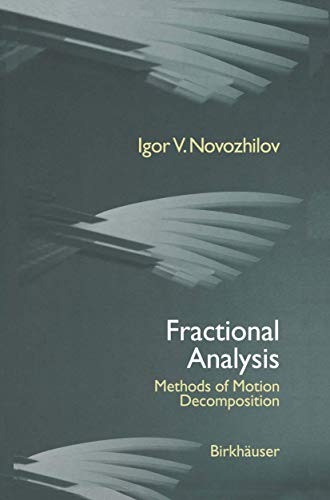
This book considers methods of approximate analysis of mechanical, elec tromechanical, and other systems described by ordinary differential equa tions. Modern mathematical modeling of sophisticated mechanical systems consists of several stages: first, construction of a mechanical model, and then writing appropriate equations and their analytical or numerical ex amination. Usually, this procedure is repeated several times. Even if an initial model correctly reflects the main properties of a phenomenon, it de scribes, as a rule, many unnecessary details that make equations of motion too complicated. As experience and experimental data are accumulated, the researcher considers simpler models and simplifies the equations. Thus some terms are discarded, the order of the equations is lowered, and so on. This process requires time, experimentation, and the researcher's intu ition. A good example of such a semi-experimental way of simplifying is a gyroscopic precession equation. Formal mathematical proofs of its admis sibility appeared some several decades after its successful introduction in engineering calculations. Applied mathematics now has at its disposal many methods of approxi mate analysis of differential equations. Application of these methods could shorten and formalize the procedure of simplifying the equations and, thus, of constructing approximate motion models. Wide application of the methods into practice is hindered by the fol lowing. 1. Descriptions of various approximate methods are scattered over the mathematical literature. The researcher, as a rule, does not know what method is most suitable for a specific case. 2.
Die Inhaltsangabe kann sich auf eine andere Ausgabe dieses Titels beziehen.
Von der hinteren Coverseite
The book deals with a method of formalized construction of approximate mathematical models of dynamic systems, which combines methods of similitude and perturbation theory and algorithms of asymptotic expansions in small parameter. This method was termed by Kline 'fractional analysis'.
„Über diesen Titel“ kann sich auf eine andere Ausgabe dieses Titels beziehen.
Suchergebnisse für Fractional Analysis: Methods of Motion Decomposition

Beispielbild für diese ISBN
Fractional Analysis: Methods of Motion Decomposition
Anbieter: Ria Christie Collections, Uxbridge, Vereinigtes Königreich
Verkäuferbewertung 5 von 5 Sternen

Zustand: New. In English. Artikel-Nr. ria9780817638894_new
Neu kaufen
EUR 67,17
EUR 13,16 Versand
Versand von Vereinigtes Königreich nach USA
Versand von Vereinigtes Königreich nach USA
Anzahl: Mehr als 20 verfügbar
Beispielbild für diese ISBN
Fractional Analysis - Methods of Motion Decomposition
Anbieter: Romtrade Corp., STERLING HEIGHTS, MI, USA
Verkäuferbewertung 5 von 5 Sternen
Zustand: New. This is a Brand-new US Edition. This Item may be shipped from US or any other country as we have multiple locations worldwide. Artikel-Nr. ABBB-165826
Foto des Verkäufers
Fractional Analysis
Anbieter: moluna, Greven, Deutschland
Verkäuferbewertung 5 von 5 Sternen
Gebunden. Zustand: New. Artikel-Nr. 5975546
Neu kaufen
EUR 48,37
EUR 48,99 Versand
Versand von Deutschland nach USA
Versand von Deutschland nach USA
Anzahl: Mehr als 20 verfügbar
Beispielbild für diese ISBN
Fractional Analysis: Methods of Motion Decomposition
Anbieter: Kennys Bookstore, Olney, MD, USA
Verkäuferbewertung 5 von 5 Sternen
Zustand: New. 1997. Hardcover. . . . . . Books ship from the US and Ireland. Artikel-Nr. V9780817638894
Neu kaufen
EUR 91,57
EUR 9,17 Versand
Versand innerhalb von USA
Versand innerhalb von USA
Anzahl: 15 verfügbar
Foto des Verkäufers
Fractional Analysis : Methods of Motion Decomposition
Anbieter: AHA-BUCH GmbH, Einbeck, Deutschland
Verkäuferbewertung 5 von 5 Sternen
Buch. Zustand: Neu. Druck auf Anfrage Neuware - Printed after ordering - This book considers methods of approximate analysis of mechanical, elec tromechanical, and other systems described by ordinary differential equa tions. Modern mathematical modeling of sophisticated mechanical systems consists of several stages: first, construction of a mechanical model, and then writing appropriate equations and their analytical or numerical ex amination. Usually, this procedure is repeated several times. Even if an initial model correctly reflects the main properties of a phenomenon, it de scribes, as a rule, many unnecessary details that make equations of motion too complicated. As experience and experimental data are accumulated, the researcher considers simpler models and simplifies the equations. Thus some terms are discarded, the order of the equations is lowered, and so on. This process requires time, experimentation, and the researcher's intu ition. A good example of such a semi-experimental way of simplifying is a gyroscopic precession equation. Formal mathematical proofs of its admis sibility appeared some several decades after its successful introduction in engineering calculations. Applied mathematics now has at its disposal many methods of approxi mate analysis of differential equations. Application of these methods could shorten and formalize the procedure of simplifying the equations and, thus, of constructing approximate motion models. Wide application of the methods into practice is hindered by the fol lowing. 1. Descriptions of various approximate methods are scattered over the mathematical literature. The researcher, as a rule, does not know what method is most suitable for a specific case. 2. Artikel-Nr. 9780817638894
Neu kaufen
EUR 78,76
EUR 35,00 Versand
Versand von Deutschland nach USA
Versand von Deutschland nach USA
Anzahl: 1 verfügbar
Foto des Verkäufers
Fractional Analysis : Methods of Motion Decomposition
Anbieter: Buchpark, Trebbin, Deutschland
Verkäuferbewertung 5 von 5 Sternen
Zustand: Gut. Zustand: Gut | Sprache: Englisch | Produktart: Bücher | This book considers methods of approximate analysis of mechanical, elec tromechanical, and other systems described by ordinary differential equa tions. Modern mathematical modeling of sophisticated mechanical systems consists of several stages: first, construction of a mechanical model, and then writing appropriate equations and their analytical or numerical ex amination. Usually, this procedure is repeated several times. Even if an initial model correctly reflects the main properties of a phenomenon, it de scribes, as a rule, many unnecessary details that make equations of motion too complicated. As experience and experimental data are accumulated, the researcher considers simpler models and simplifies the equations. Thus some terms are discarded, the order of the equations is lowered, and so on. This process requires time, experimentation, and the researcher's intu ition. A good example of such a semi-experimental way of simplifying is a gyroscopic precession equation. Formal mathematical proofs of its admis sibility appeared some several decades after its successful introduction in engineering calculations. Applied mathematics now has at its disposal many methods of approxi mate analysis of differential equations. Application of these methods could shorten and formalize the procedure of simplifying the equations and, thus, of constructing approximate motion models. Wide application of the methods into practice is hindered by the fol lowing. 1. Descriptions of various approximate methods are scattered over the mathematical literature. The researcher, as a rule, does not know what method is most suitable for a specific case. 2. Artikel-Nr. 638739/3
Gebraucht kaufen
EUR 37,07
EUR 105,00 Versand
Versand von Deutschland nach USA
Versand von Deutschland nach USA
Anzahl: 1 verfügbar
Foto des Verkäufers
Fractional Analysis : Methods of Motion Decomposition
Anbieter: Buchpark, Trebbin, Deutschland
Verkäuferbewertung 5 von 5 Sternen
Zustand: Sehr gut. Zustand: Sehr gut | Sprache: Englisch | Produktart: Bücher | This book considers methods of approximate analysis of mechanical, elec tromechanical, and other systems described by ordinary differential equa tions. Modern mathematical modeling of sophisticated mechanical systems consists of several stages: first, construction of a mechanical model, and then writing appropriate equations and their analytical or numerical ex amination. Usually, this procedure is repeated several times. Even if an initial model correctly reflects the main properties of a phenomenon, it de scribes, as a rule, many unnecessary details that make equations of motion too complicated. As experience and experimental data are accumulated, the researcher considers simpler models and simplifies the equations. Thus some terms are discarded, the order of the equations is lowered, and so on. This process requires time, experimentation, and the researcher's intu ition. A good example of such a semi-experimental way of simplifying is a gyroscopic precession equation. Formal mathematical proofs of its admis sibility appeared some several decades after its successful introduction in engineering calculations. Applied mathematics now has at its disposal many methods of approxi mate analysis of differential equations. Application of these methods could shorten and formalize the procedure of simplifying the equations and, thus, of constructing approximate motion models. Wide application of the methods into practice is hindered by the fol lowing. 1. Descriptions of various approximate methods are scattered over the mathematical literature. The researcher, as a rule, does not know what method is most suitable for a specific case. 2. Artikel-Nr. 638739/2
Gebraucht kaufen
EUR 38,18
EUR 105,00 Versand
Versand von Deutschland nach USA
Versand von Deutschland nach USA
Anzahl: 1 verfügbar