
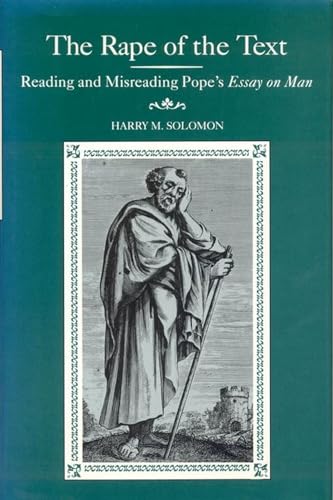
Inhaltsangabe
First published in 1733-1734, An Essay on Man, Alexander Pope's best-known philosophical poem was highly praised by many of Pope's European contemporaries, including Voltaire, Rousseau and Hume. The poem, divided into four Epistles, deals with the nature of man and his place in the universe, man as an individual, man in society, and man in pursuit of happiness.
Voltaire called An Essay on Man "the most beautiful, most useful, most sublime didactic poem" in the English language, but what was formerly regarded as the pinnacle of 18th-century poetry now languishes largely unread or misread as a quaint period piece. Harold Bloom recently described the Essay as a "poetic disaster" of "absurd theodicy." The Rape of the Text deconstructs the history of criticism of An Essay on Man to account for and to reverse over two hundred years of deformation and trivialization of Pope's text by literary critics, philosophers, and historians of ideas.
After showing why the commonplaces about the Essay inscribed in Pope scholarship are suspect because of the mutual and abiding hostility of logocentric and aesthetic traditions of misreading, Solomon rebuts the objections made to Pope's "philosophy" in a series of chapters demonstrating more appropriate strategies for interpreting Pope's persona, tone, methodology, argument, and figurality. Cumulatively, the chapters characterize a discourse world of "middle-state" Academic Skepticism that Pope shared with his admirers.
While the characterization of Pope's discourse world in The Rape of the Text has implications for Pope and for 18th-century scholarship beyond the Essay on Man, it also has implications for reading all philosophical poetry. Solomon contends that criticism of the Essay on Man is only an extreme example of the deformation that occurs routinely when literary critics or philosophers interpret philosophical poetry, and in the final chapter he calls for a "naturalization" of philosophical poetry as a genre as the necessary remedy to our present willful blindness.
Die Inhaltsangabe kann sich auf eine andere Ausgabe dieses Titels beziehen.
Über die Autorinnen und Autoren
Harry M. Solomon is Hollifield Professor of English and Director of Great Books at Auburn University.
Normal0falsefalsefalseMicrosoftInternetExplorer4
Harry M. Solomon is Hollifield Professor of English and Director of Great Books at Auburn University.
Von der hinteren Coverseite
First published in 1733-1734, An Essay on Man, Alexander Pope's best-known philosophical poem was highly praised by many of Pope's European contemporaries, including Voltaire, Rousseau and Hume. The poem, divided into four Epistles, deals with the nature of man and his place in the universe, man as an individual, man in society, and man in pursuit of happiness. Voltaire called An Essay on Man "the most beautiful, most useful, most sublime didactic poem" in the English language, but what was formerly regarded as the pinnacle of 18th-century poetry now languishes largely unread or misread as a quaint period piece. Harold Bloom recently described the Essay as a "poetic disaster" of "absurd theodicy". The Rape of the Text deconstructs the history of criticism of An Essay on Man to account for and to reverse over two hundred years of deformation and trivialization of Pope's text by literary critics, philosophers, and historians of ideas. After showing why the commonplaces about the Essay inscribed in Pope scholarship are suspect because of the mutual and abiding hostility of logocentric and aesthetic traditions of misreading, Solomon rebuts the objections made to Pope's "philosophy" in a series of chapters demonstrating more appropriate strategies for interpreting Pope's persona, tone, methodology, argument, and figurality. Cumulatively, the chapters characterize a discourse world of "middle-state" Academic Skepticism that Pope shared with his admirers. While the characterization of Pope's discourse world in The Rape of the Text has implications for Pope and for 18th-century scholarship beyond the Essay on Man, it also has implications for reading all philosophical poetry. Solomon contendsthat criticism of the Essay on Man is only an extreme example of the deformation that occurs routinely when literary critics or philosophers interpret philosophical poetry, and in the final chapter he calls for a "naturalization" of philosophical poetry as a genre as the necessary remedy to our present willful blindness.
„Über diesen Titel“ kann sich auf eine andere Ausgabe dieses Titels beziehen.
Suchergebnisse für The Rape of the Text: Reading and Misreading Pope's...

Beispielbild für diese ISBN
The Rape of the Text: Reading and Misreading Pope's Essay on Man
Verlag:
University of Alabama Press, 1993
ISBN 10: 081730696X
ISBN 13: 9780817306960
Neu
Hardcover
Erstausgabe
Anbieter: Dan Pope Books, West Hartford, CT, USA
Verkäuferbewertung 5 von 5 Sternen

Hardcover. Zustand: New. Zustand des Schutzumschlags: New. 1st Edition. First printing. New/New. Still in original shrink-wrap! Perfect, unread copy. Deconstructs the history and criticism of Alexander Pope's best-known philosophical poem to account for and to reverse over 200 years of deformation and trivialization of Pope's text by literary critics, philosophers and historians. 245 pages. SALE. Artikel-Nr. 6332
Neu kaufen
EUR 16,27
EUR 3,84 Versand
Versand innerhalb von USA
Versand innerhalb von USA
Anzahl: 1 verfügbar
Beispielbild für diese ISBN
The Rape of the Text: Reading and Misreading Pope's Essay on Man
Verlag:
The University Of Alabama Press, 1993
ISBN 10: 081730696X
ISBN 13: 9780817306960
Gebraucht
Hardcover
Anbieter: Anybook.com, Lincoln, Vereinigtes Königreich
Verkäuferbewertung 5 von 5 Sternen
Zustand: Poor. This is an ex-library book and may have the usual library/used-book markings inside.This book has hardback covers. Book contains pen markings. In poor condition, suitable as a reading copy. No dust jacket. Please note the Image in this listing is a stock photo and may not match the covers of the actual item,600grams, ISBN:081730696X. Artikel-Nr. 9893582
Gebraucht kaufen
EUR 14,25
EUR 15,70 Versand
Versand von Vereinigtes Königreich nach USA
Versand von Vereinigtes Königreich nach USA
Anzahl: 1 verfügbar
Foto des Verkäufers
The rape of the text. Reading and misreading Pope's 'Essay on man'.
Verlag:
University Alabama Press, 1993
ISBN 10: 081730696X
ISBN 13: 9780817306960
Gebraucht
Hardcover
Anbieter: Grimbergen Booksellers, Lisse, Niederlande
Verkäuferbewertung 4 von 5 Sternen

University of Alabama Press. 1993. Hard Cover with dustjacket. Very Good. l 245 p. Index. Artikel-Nr. 92092
Gebraucht kaufen
EUR 24,00
EUR 23,00 Versand
Versand von Niederlande nach USA
Versand von Niederlande nach USA
Anzahl: 1 verfügbar
Foto des Verkäufers
The Rape of the Text: Reading and Misreading Pope's Essay on Man.
Verlag:
Tuscaloosa, London: The University of Alabame Press, 1993
ISBN 10: 081730696X
ISBN 13: 9780817306960
Gebraucht
Hardcover
Anbieter: Borkert, Schwarz und Zerfaß GbR, Berlin, Deutschland
Verkäuferbewertung 5 von 5 Sternen
Hardcover with dust jacket. Zustand: Sehr gut. 245 p. Sehr gutes Exemplar ohne Anstreichungen / a good copy without markings. - First published in 1733-1734, An Essay on Man, Alexander Popes best-known philosophical poem, was highly praised by many of Popes European contemporaries, including Voltaire, Rousseau, Kant, and Hume. Voltaire called An Essay on Man the most beautiful, most useful, most sublime didactic poem in the English language, but what was formerly regarded as the pinnacle of 18th- century poetry now languishes largely unread or misread as a quaint period piece. Harold Bloom recently described the Essay as a poetic disaster of absurd theodicy. The Rape of the Text deconstructs the history of criticism of An Essay on Man to account for and to reverse over two hundred years of deformation and trivialization of Popes text by literary critics, philosophers, and historians of ideas. / CONTENTS Acknowledgments Introduction: A Poetic Disaster 1. Trivializing An Essay on Man 2. Disseminating Theodicy 3. The Self as Aporia 4. Optimism and Pessimism 5. Academic Discourse 6. Paradox Against the Orthodox Conclusion: Naturalizing Philosophical Poetry Notes Bibliography Index. ISBN 9780817306960 Sprache: Englisch Gewicht in Gramm: 563. Artikel-Nr. 1208088
Gebraucht kaufen
EUR 23,20
EUR 40,00 Versand
Versand von Deutschland nach USA
Versand von Deutschland nach USA
Anzahl: 1 verfügbar
Beispielbild für diese ISBN
The Rape of the Text: Reading and Misreading Pope's Essay on Man
Anbieter: Kennys Bookstore, Olney, MD, USA
Verkäuferbewertung 5 von 5 Sternen
Zustand: New. 1993. Hardcover. . . . . . Books ship from the US and Ireland. Artikel-Nr. V9780817306960
Neu kaufen
EUR 72,18
EUR 8,96 Versand
Versand innerhalb von USA
Versand innerhalb von USA
Anzahl: 15 verfügbar
Foto des Verkäufers
The Rape of the Text: Reading and Misreading Pope\ s Essay on Man
Anbieter: moluna, Greven, Deutschland
Verkäuferbewertung 5 von 5 Sternen
Zustand: New. Über den AutorNormal 0 false false false MicrosoftInternetExplorer4 Harry M. Solomon is Hollifield Professor of English and Director of Great Books at Auburn University.Klappentext The Rape of the Tex. Artikel-Nr. 898820287
Neu kaufen
EUR 56,59
EUR 48,99 Versand
Versand von Deutschland nach USA
Versand von Deutschland nach USA
Anzahl: Mehr als 20 verfügbar