
Verwandte Artikel zu Changing Life: Genomes, Ecologies, Bodies, Commodities:...
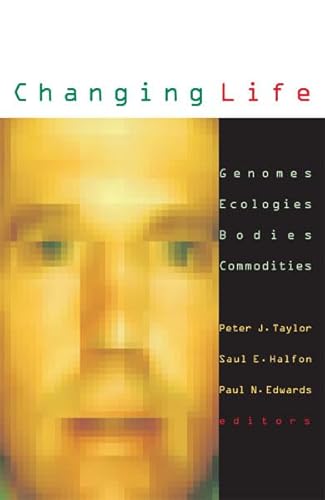
Changing Life: Genomes, Ecologies, Bodies, Commodities: Genomes, Ecologies, Bodies, Commodities Volume 13 (Cultural Politics, Band 13) - Softcover
Inhaltsangabe
A fascinating look at how the culture of today's life sciences affects our culture.
In laboratories all over the world, life--even the idea of life--is changing. And with these changes, whether they result in square tomatoes or cyborgs, come transformations in our social order-sometimes welcome, sometimes troubling, depending on where we stand. Changing Life offers a close look at how the mutable forms and concepts of life link the processes of science to those of information, finance, and commodities.
The contributors, drawn from disciplines within science and technology studies and from geography, ecology, and developmental biology, provide a range of interpretive angles on the metaphors, narratives, models, and practices of the life sciences. Their essays--about planetary management and genome sequencing, ecologies and cyborgs--address actual and imagined transformations at the center and at the margins of transnational relations, during the post-Cold War era and in times to come. They consider such topics as the declining regulatory state, ascendant transnational networks, and capital's legal reign over intellectual property, life-form patents, and marketable pollution licenses.Changing Life argues that we cannot understand the power of the life sciences in modern society without exploring the intersections of science and technology with other cultural realms. To that end, this book represents a collective attempt to join the insights of science and technology studies and cultural studies. As a work of cultural politics, it makes a contribution to changing life in a context of changing social order. Contributors: Simon Cole, Cornell U; Scott Gilbert, Swarthmore College; Herbert Gottweis, U of Salzburg; Yrjö Haila, U of Tampere, Finland; Rosaleen Love, Victoria U of Technology, Melbourne, Australia; and Richard A. Schroeder, Rutgers.Die Inhaltsangabe kann sich auf eine andere Ausgabe dieses Titels beziehen.
Über die Autorin bzw. den Autor
Peter J. Taylor is Eugene Lang Professor of Social Change at Swarthmore College. Saul E. Halfon is a doctoral candidate in the Department of Science and Technology Studies at Cornell University. Paul N. Edwards is acting assistant professor in the Program in Science, Technology, and Society at Stanford University.
„Über diesen Titel“ kann sich auf eine andere Ausgabe dieses Titels beziehen.
Suchergebnisse für Changing Life: Genomes, Ecologies, Bodies, Commodities:...

Beispielbild für diese ISBN
Changing Life: Genomes, Ecologies, Bodies, Commodities (Volume 13) (Studies in Classical Philology)
Verlag:
Univ Of Minnesota Press (edition First Edition), 1997
ISBN 10: 0816630135
ISBN 13: 9780816630134
Gebraucht
Paperback
Erstausgabe
Anbieter: BooksRun, Philadelphia, PA, USA
Verkäuferbewertung 5 von 5 Sternen

Paperback. Zustand: Very Good. First Edition. It's a well-cared-for item that has seen limited use. The item may show minor signs of wear. All the text is legible, with all pages included. It may have slight markings and/or highlighting. Artikel-Nr. 0816630135-11-1
Gebraucht kaufen
EUR 13,58
Versand gratis
Versand innerhalb von USA
Versand innerhalb von USA
Anzahl: 1 verfügbar
Beispielbild für diese ISBN
Changing Life: Genomes, Ecologies, Bodies, Commodities Volume 13
Verlag:
University of Minnesota Press, 1997
ISBN 10: 0816630135
ISBN 13: 9780816630134
Gebraucht
Paperback
Anbieter: ThriftBooks-Atlanta, AUSTELL, GA, USA
Verkäuferbewertung 5 von 5 Sternen
Paperback. Zustand: Good. No Jacket. Pages can have notes/highlighting. Spine may show signs of wear. ~ ThriftBooks: Read More, Spend Less. Artikel-Nr. G0816630135I3N00
Gebraucht kaufen
EUR 14,55
Versand gratis
Versand innerhalb von USA
Versand innerhalb von USA
Anzahl: 1 verfügbar
Beispielbild für diese ISBN
Changing Life - Genomes, Ecologies, Bodies, Commodities -
Anbieter: Martin Preuß / Akademische Buchhandlung Woetzel, Kerzenheim, Deutschland
Verkäuferbewertung 5 von 5 Sternen
03. Zustand: Wie neu. 1997. 230 S., flex. kart. The book offers a close look at how the mutable forms and concepts of life link the processes of science to those of information, finance, and commodities. These essays about planetary management and genome sequencing, ecologies and cyborgs address actua Sprache: Deutsch. Artikel-Nr. 18638
Gebraucht kaufen
EUR 24,70
EUR 15,90 Versand
Versand von Deutschland nach USA
Versand von Deutschland nach USA
Anzahl: 2 verfügbar
Beispielbild für diese ISBN
Changing Life: Genomes, Ecologies, Bodies, Commodities
Anbieter: Kennys Bookstore, Olney, MD, USA
Verkäuferbewertung 5 von 5 Sternen
Zustand: New. Editor(s): Taylor, Peter J.; Halfon, Saul E.; Edwards, Paul N. Series: Cultural Politics S. Num Pages: 240 pages. BIC Classification: JFC; JHM; PDR; PS; TCB. Category: (P) Professional & Vocational; (UP) Postgraduate, Research & Scholarly; (UU) Undergraduate. Dimension: 230 x 151 x 13. Weight in Grams: 320. . 1997. First Edition. paperback. . . . . Books ship from the US and Ireland. Artikel-Nr. V9780816630134
Neu kaufen
EUR 48,47
EUR 9,23 Versand
Versand innerhalb von USA
Versand innerhalb von USA
Anzahl: 15 verfügbar