
Verwandte Artikel zu Developing Nations and the Politics of Global Integration...
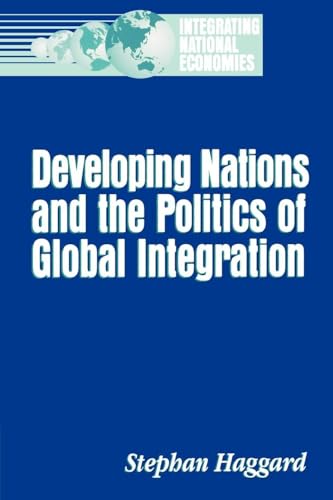
Developing Nations and the Politics of Global Integration (Integrating National Economies Series) - Softcover
Inhaltsangabe
" Developing countries are becoming important players in the world economy. Although they were slow to liberalize trade, they are now joining the more economically advanced nations in implementing trade reforms and in taking steps to deepen global integration. The lowering of trade barriers and the growth of foreign investment have benefited the developing countries but have also created vulnerabilities, including risks of dependence and political interference. Is deeper integration in the best interest of developing countries? In this book, part of the Integrating National Economies series, Stephen Haggard examines the position of the developing countries in the international trade regime. Focusing on the nations of East and Southeast Asia and Latin American, Haggard explores the cause of economic liberalization policies in the developing nations. He argues that various international constraints, such as economic shocks and political pressures from the economically advanced nations, pushed developing countries to open up to internatioal competition and to pursue economic relations with advanced industrial states. Haggard addresses such central questions as: Will developing countries benefit from the deep integration agenda? Will they instead join closed regional blocs that fragment the international economy? Will the developing nations orient themselves toward the multilateral institutions, particularly the World Trade Organization, or will they gravitate toward regional arrangements. Haggard argues that the advanced developing countries have become strong supporters of the multilateral system and that the extent of regionalism has been over stated. He contends that a more serious threat is the lure of biliteralism and the effort of the advanced industrial states to impose standards on developing countries that are inappropriate or politically counterproductive. A volume of Brookings' Integrating National Economies Series"
Die Inhaltsangabe kann sich auf eine andere Ausgabe dieses Titels beziehen.
Über die Autorin bzw. den Autor
Stephan Haggard
Von der hinteren Coverseite
Haggard examines developing-country responses to growing global economic integration. He pays close attention to the impact on developing-country policy of international events and pressures, on one hand, and domestic conditions, on the other.
„Über diesen Titel“ kann sich auf eine andere Ausgabe dieses Titels beziehen.
Suchergebnisse für Developing Nations and the Politics of Global Integration...

Beispielbild für diese ISBN
Developing Nations and the Politics of Global Integration
Verlag:
Brookings Institution Press, 1995
ISBN 10: 0815733895
ISBN 13: 9780815733898
Gebraucht
Softcover
Anbieter: Better World Books: West, Reno, NV, USA
Verkäuferbewertung 5 von 5 Sternen

Zustand: Good. Former library copy. Pages intact with minimal writing/highlighting. The binding may be loose and creased. Dust jackets/supplements are not included. Includes library markings. Stock photo provided. Product includes identifying sticker. Better World Books: Buy Books. Do Good. Artikel-Nr. 45700896-6
Gebraucht kaufen
EUR 12,96
Versand gratis
Versand innerhalb von USA
Versand innerhalb von USA
Anzahl: 1 verfügbar
Beispielbild für diese ISBN
Developing Nations and the Politics of Global Integration
Verlag:
Brookings Institution Press, 1995
ISBN 10: 0815733895
ISBN 13: 9780815733898
Gebraucht
Softcover
Anbieter: Better World Books, Mishawaka, IN, USA
Verkäuferbewertung 5 von 5 Sternen
Zustand: Good. Former library copy. Pages intact with minimal writing/highlighting. The binding may be loose and creased. Dust jackets/supplements are not included. Includes library markings. Stock photo provided. Product includes identifying sticker. Better World Books: Buy Books. Do Good. Artikel-Nr. 45700896-6
Gebraucht kaufen
EUR 12,96
Versand gratis
Versand innerhalb von USA
Versand innerhalb von USA
Anzahl: 1 verfügbar
Beispielbild für diese ISBN
Developing Nations and the Politics of Global Integration (Integrating National Economies: Promise & Pitfalls)
Verlag:
The Brookings Institution, 1995
ISBN 10: 0815733895
ISBN 13: 9780815733898
Gebraucht
Softcover
Anbieter: Anybook.com, Lincoln, Vereinigtes Königreich
Verkäuferbewertung 5 von 5 Sternen
Zustand: Poor. This is an ex-library book and may have the usual library/used-book markings inside.This book has soft covers. Book contains pencil markings. In poor condition, suitable as a reading copy. Please note the Image in this listing is a stock photo and may not match the covers of the actual item,350grams, ISBN:9780815733898. Artikel-Nr. 9913214
Gebraucht kaufen
EUR 6,33
EUR 15,48 Versand
Versand von Vereinigtes Königreich nach USA
Versand von Vereinigtes Königreich nach USA
Anzahl: 1 verfügbar
Beispielbild für diese ISBN
Developing Nations and the Politics of Global Integration (Integrating National Economies: Promise & Pitfalls)
Verlag:
Brookings Institution Press, 1995
ISBN 10: 0815733895
ISBN 13: 9780815733898
Gebraucht
Softcover
Anbieter: Phatpocket Limited, Waltham Abbey, HERTS, Vereinigtes Königreich
Verkäuferbewertung 5 von 5 Sternen
Zustand: Good. Your purchase helps support Sri Lankan Children's Charity 'The Rainbow Centre'. Ex-library, so some stamps and wear, but in good overall condition. Our donations to The Rainbow Centre have helped provide an education and a safe haven to hundreds of children who live in appalling conditions. Artikel-Nr. Z1-R-016-01366
Gebraucht kaufen
EUR 18,84
EUR 12,63 Versand
Versand von Vereinigtes Königreich nach USA
Versand von Vereinigtes Königreich nach USA
Anzahl: 1 verfügbar
Beispielbild für diese ISBN
Developing Nations and the Politics of Global Integration (Integrating National Economies: Promise & Pitfalls)
Anbieter: Ria Christie Collections, Uxbridge, Vereinigtes Königreich
Verkäuferbewertung 5 von 5 Sternen
Zustand: New. In English. Artikel-Nr. ria9780815733898_new
Neu kaufen
EUR 32,54
EUR 11,12 Versand
Versand von Vereinigtes Königreich nach USA
Versand von Vereinigtes Königreich nach USA
Anzahl: Mehr als 20 verfügbar
Beispielbild für diese ISBN
Developing Nations and the Politics of Global Integration
Anbieter: Majestic Books, Hounslow, Vereinigtes Königreich
Verkäuferbewertung 4 von 5 Sternen

Zustand: New. pp. 178. Artikel-Nr. 5475346
Neu kaufen
EUR 51,31
EUR 7,71 Versand
Versand von Vereinigtes Königreich nach USA
Versand von Vereinigtes Königreich nach USA
Anzahl: 1 verfügbar
Beispielbild für diese ISBN
Developing Nations and the Politics of Global Integration
Verlag:
Brookings Institution Press, 1995
ISBN 10: 0815733895
ISBN 13: 9780815733898
Gebraucht
Softcover
Anbieter: Buchpark, Trebbin, Deutschland
Verkäuferbewertung 5 von 5 Sternen
Zustand: Sehr gut. Zustand: Sehr gut | Sprache: Englisch | Produktart: Bücher | "Developing countries are becoming important players in the world economy. Although they were slow to liberalize trade, they are now joining the more economically advanced nations in implementing trade reforms and in taking steps to deepen global integration. The lowering of trade barriers and the growth of foreign investment have benefited the developing countries but have also created vulnerabilities, including risks of dependence and political interference. Is deeper integration in the best interest of developing countries?In this book, part of the Integrating National Economies series, Stephen Haggard examines the position of the developing countries in the international trade regime. Focusing on the nations of East and Southeast Asia and Latin American, Haggard explores the cause of economic liberalization policies in the developing nations. He argues that various international constraints, such as economic shocks and political pressures from the economically advanced nations, pushed developing countries to open up to internatioal competition and to pursue economic relations with advanced industrial states.Haggard addresses such central questions as: Will developing countries benefit from the deep integration agenda? Will they instead join closed regional blocs that fragment the international economy? Will the developing nations orient themselves toward the multilateral institutions, particularly the World Trade Organization, or will they gravitate toward regional arrangements. Haggard argues that the advanced developing countries have become strong supporters of the multilateral system and that the extent of regionalism has been over stated. He contends that a more serious threat is the lure of biliteralism and the effort of the advanced industrial states to impose standards on developing countries that are inappropriate or politically counterproductive.A volume of Brookings' Integrating National Economies Series". Artikel-Nr. 1296632/122
Gebraucht kaufen
EUR 17,06
EUR 105,00 Versand
Versand von Deutschland nach USA
Versand von Deutschland nach USA
Anzahl: 1 verfügbar